Is Traveling a Hobby? (Yes — and Here Is Exactly Why It Qualifies)
Quick Answer: Is Traveling a Hobby?
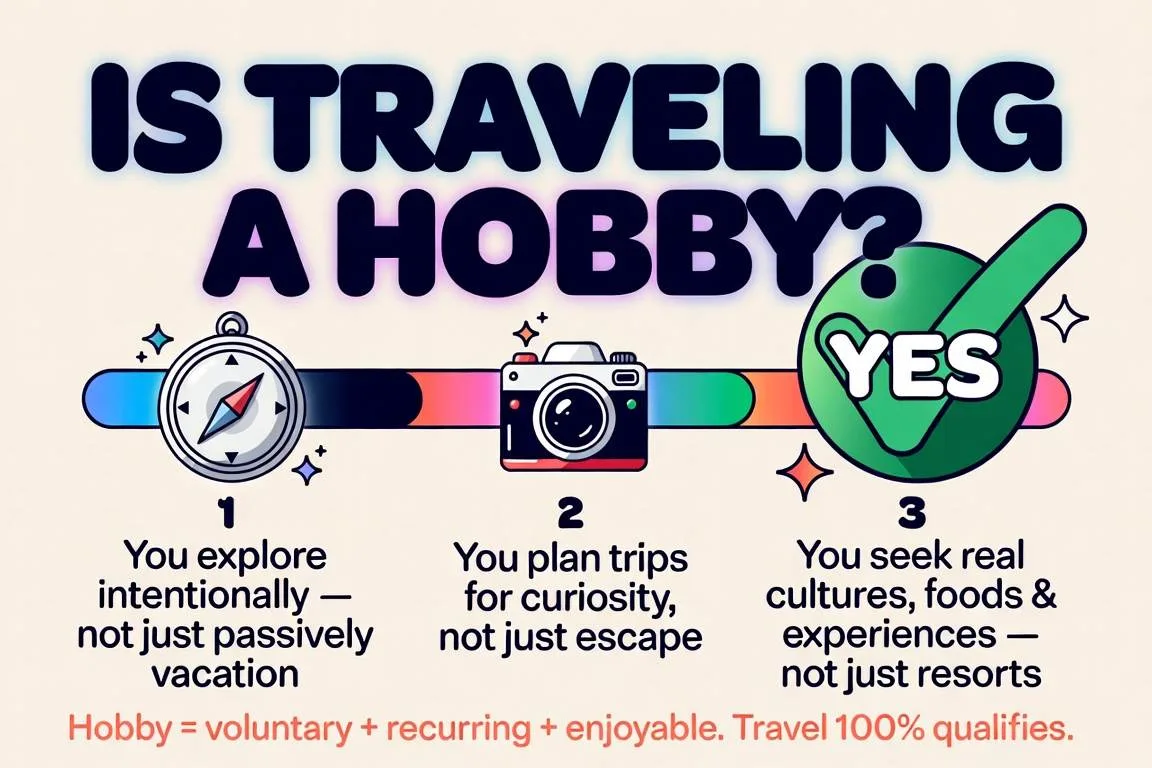
Traveling is a hobby when you explore new places intentionally and regularly because you enjoy the experience — not because someone else planned it for you or because you need a vacation from exhaustion. A hobby is any activity you choose to do during free time because it brings you enjoyment, satisfaction, or personal growth. Traveling meets every part of that definition: it is voluntary, recurring for those who pursue it, and produces genuine satisfaction that goes far beyond the trip itself. Nausheen Farishta from Globe Gazers — a solo traveler and travel blogger — describes the moment she realized travel could be a hobby: “It wasn’t until I was in my 20s that I had the epiphany that you could travel simply because you wanted to. Because you felt like it. For fun.”
The debate about whether traveling “counts” as a hobby comes from the same place as the debate about whether working out is a hobby or whether cooking is a hobby — people confuse practical activities with non-hobby activities. But photography is a hobby even though it is also a profession. Cooking is a hobby even though it also feeds you. Traveling is a hobby even though it also happens during vacations. The function does not cancel the enjoyment. Both exist at the same time.
If you are wondering whether traveling is a hobby, a lifestyle, a passion, or just an interest — this article answers every version of that question with frameworks, tables, and specific criteria you can apply to your own travel behavior.
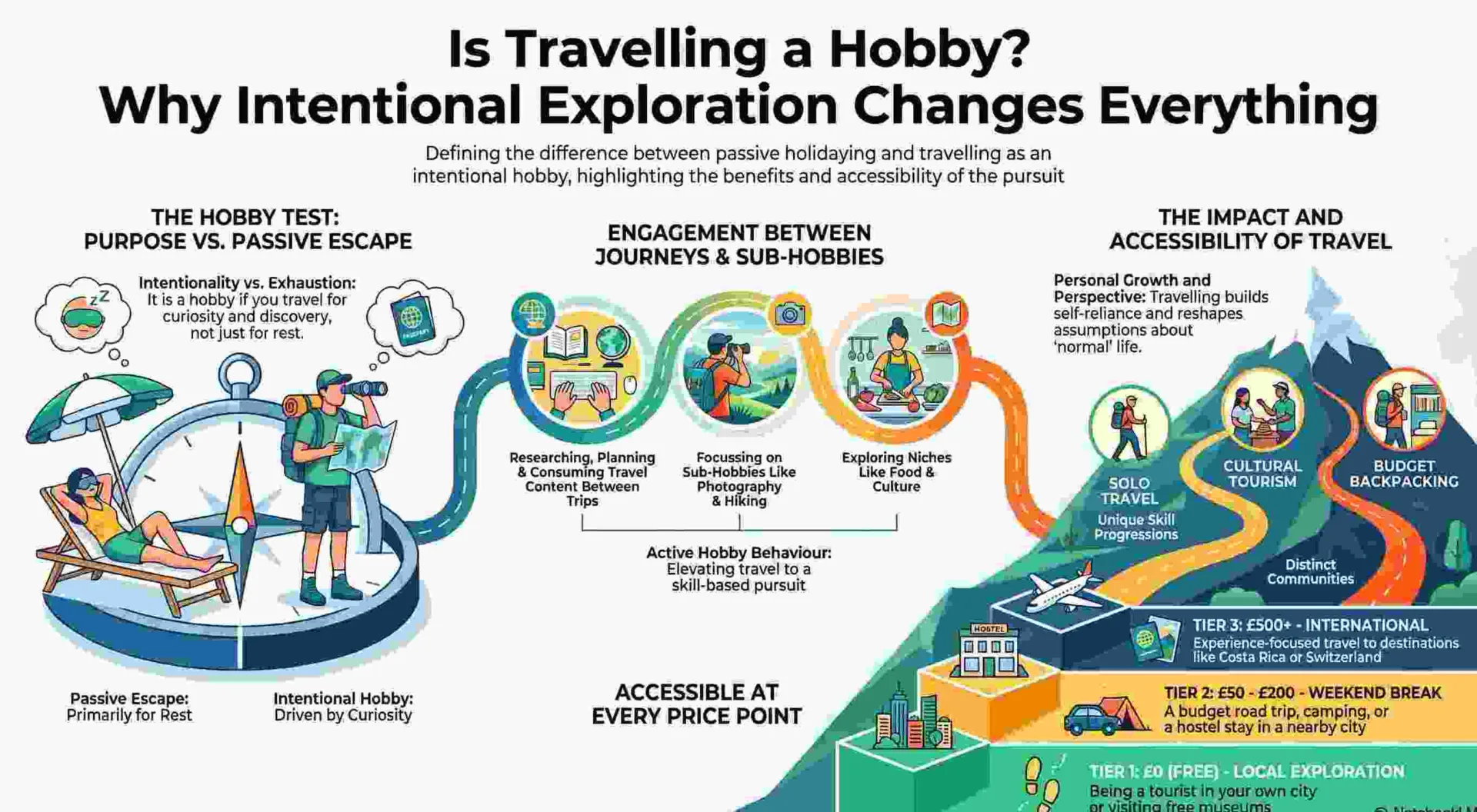
The 3-Part Test: Is Your Travel a Hobby, a Habit, or Just a Vacation?
Not all travel is a hobby. Here is how to tell whether your specific travel behavior qualifies.
| Question | If Yes → Hobby | If No → Vacation/Obligation |
| Do you plan trips because you are genuinely curious about a place — its culture, food, history, or landscape? | You travel for discovery. That is hobby behavior. | You travel to escape work or routine. That is a vacation. |
| Do you travel regularly — at least 2+ times per year — because you want to, not because of work or family obligations? | You pursue travel as a recurring leisure activity. Hobby. | You travel only when required or when others plan it. Not a hobby. |
| Do you spend time between trips researching, planning, or consuming travel content (books, shows, blogs, maps)? | You are engaged with travel even when not traveling. Classic hobby behavior. | You forget about travel between trips. Interest, not hobby. |
| Do you have a wish list of specific destinations, types of travel, or experiences you want to pursue? | You have travel goals. Hobbies have goals. | You have no travel direction. Travel is incidental, not intentional. |
| Do you combine travel with other interests — food, photography, hiking, history, architecture? | You use travel as a vehicle for deeper engagement. That is an advanced hobby. | You visit resorts and stay inside. That is recreation, not a hobby. |
If you answered yes to 3 or more of these, traveling is a hobby for you. If you answered yes to all 5, traveling is not just a hobby — it may be a lifestyle. If you want to explore how different activities fit these categories, our guide on how to find a hobby walks you through a 5-question framework.
Is Traveling a Hobby, an Interest, or a Lifestyle?
The distinction matters because each label describes a different level of engagement.
| Label | Definition | Travel Example |
| Interest | Something you enjoy thinking about or consuming content about, but do not actively pursue | You love watching travel documentaries and reading travel blogs but rarely take trips yourself |
| Hobby | Something you actively pursue during free time because it brings enjoyment and personal growth | You plan and take 2 to 5 trips per year because you genuinely enjoy the experience of exploring new places |
| Passion | A hobby with deep emotional investment — it shapes your identity and your decisions | You structure your career, savings, and lifestyle around maximizing travel opportunities |
| Lifestyle | A way of living that integrates the activity into daily life, not just free time | You are a digital nomad, a travel blogger, or someone who lives abroad intentionally and permanently |
Most people who search “is traveling a hobby” fall between interest and hobby. The shift from interest to hobby happens when you move from consuming travel content to actually traveling. The shift from hobby to lifestyle happens when travel stops being something you do during vacations and starts being something you organize your life around.
Nausheen Farishta from Globe Gazers describes this progression in her own life: she went from someone who thought you needed a “reason” to travel (visiting family, work trips) to someone who travels purely for enjoyment, and eventually to someone who built a career around it. The label changed, but the core motivation — curiosity and enjoyment — stayed the same.
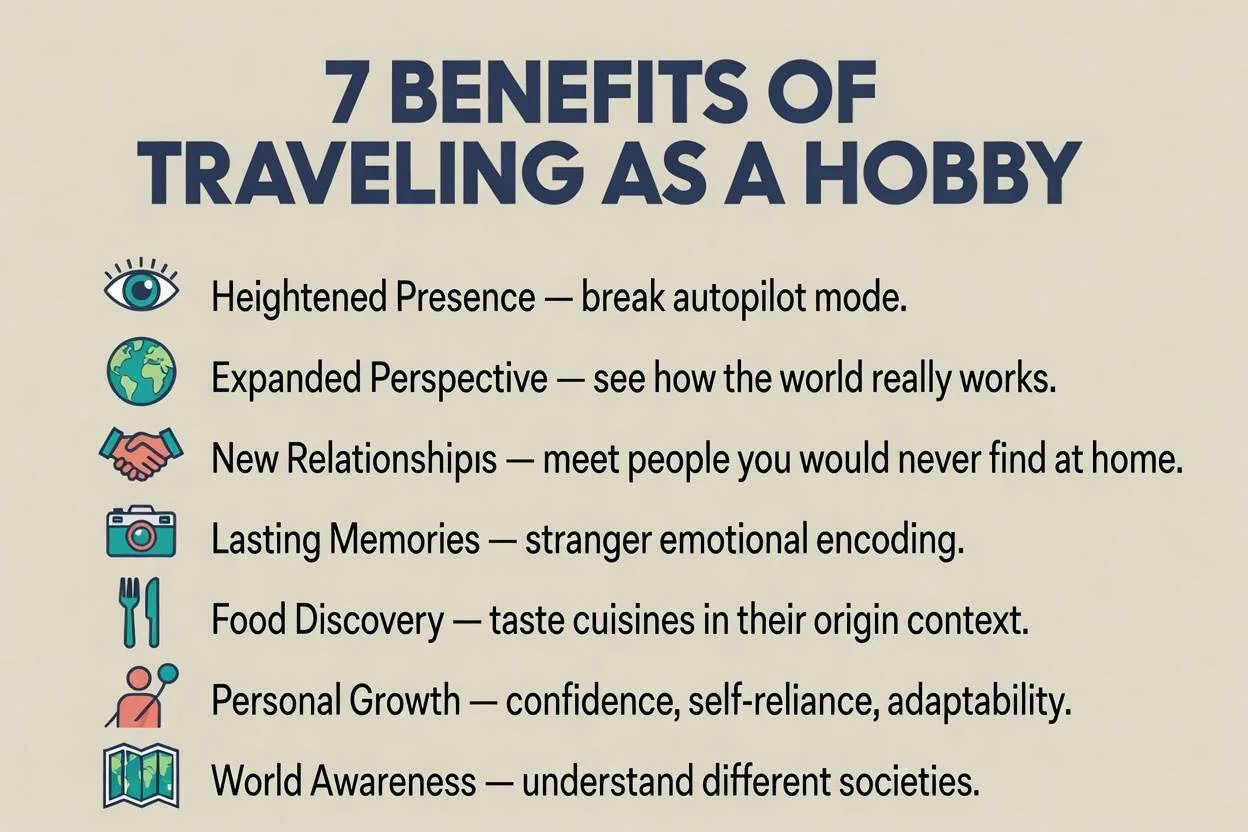
7 Benefits of Traveling as a Hobby (With Evidence)
Here is what traveling as a hobby does for you that vacationing does not.
| Benefit | What It Means | Why Hobby Travel Delivers It |
| Heightened presence | You become hyper-aware of your surroundings — sights, sounds, smells, textures | New environments break autopilot mode. Even grocery shopping abroad becomes interesting. |
| Expanded perspective | Exposure to different customs, traditions, cultures, beliefs, and lifestyles | You learn that breakfast can be soup and vegetables, not just eggs and pancakes. |
| New relationships | Meeting people you would never cross paths with at home | A solo traveler cooking a Pakistani recipe with an Airbnb host in Costa Rica becomes a core memory. |
| Lasting memories | Experiences that stay vivid for years, unlike routine days that blur together | Travel memories are stored differently — with stronger emotional encoding — than daily routine memories. |
| Food discovery | Tasting cuisines in their origin context, not adapted restaurant versions | Somebody Feed Phil exists because food travel is its own hobby category. Oaxaca, Mexico is a food destination worth planning around. |
| Personal growth | Increased confidence, self-reliance, problem-solving, and adaptability | Solo travelers report the highest personal growth gains because they navigate everything alone. |
| World awareness | Understanding how different societies work — family-oriented vs. individualistic, different careers, different socializing patterns | Seeing how people live in Lucerne, Switzerland vs. La Fortuna, Costa Rica vs. Madrid, Spain reshapes your assumptions about what a “normal” life looks like. |
If you enjoy traveling for these benefits, it is a hobby. If you travel only for relaxation and do not actively seek these experiences, it is a vacation. Both are valid. The distinction is in the intention. If food is your primary travel motivator, our guide on things to cook when bored has kitchen experiments that bring travel flavors home.
“Traveling Is Not a Hobby” — Addressing the Debate
The internet has 2 recurring arguments against traveling as a hobby. Both fail.
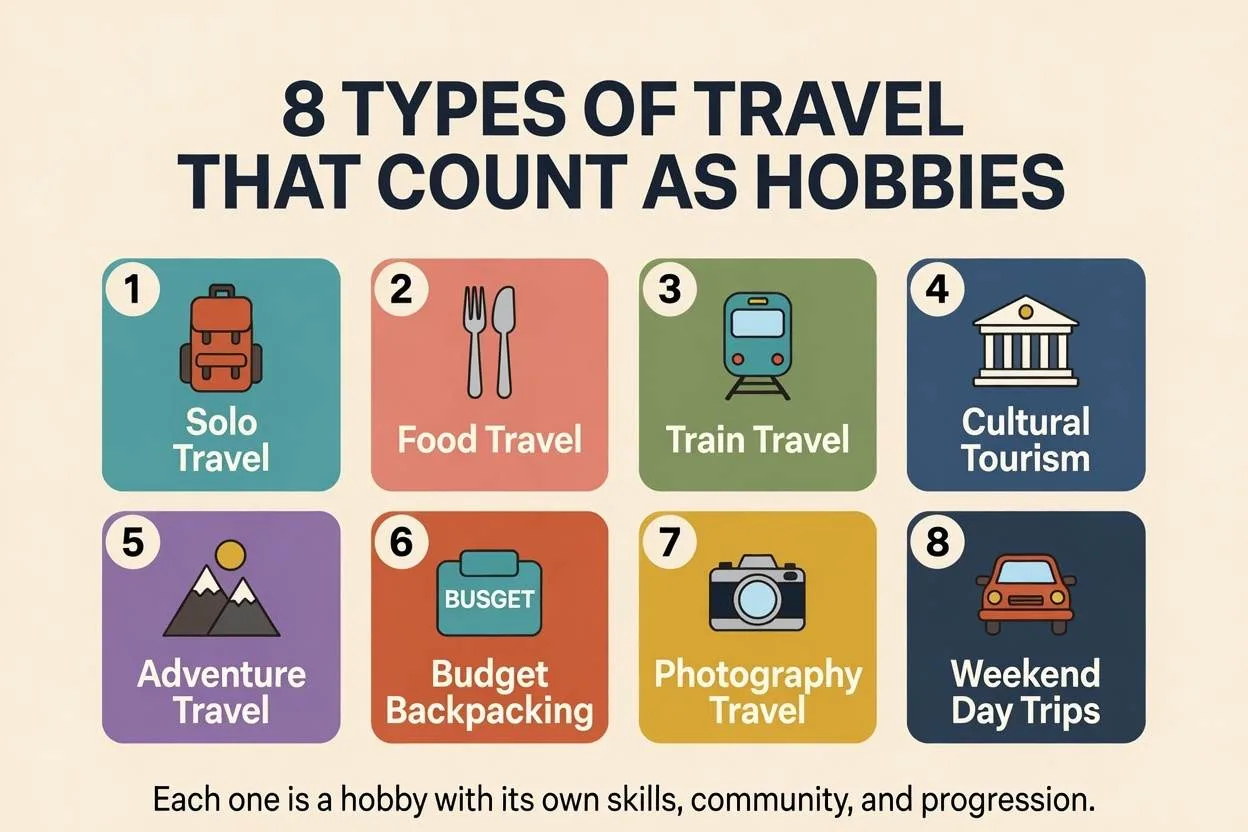
Argument 1: “Traveling is too vague to be a hobby.” This argument says that “travel” is a category, not an activity — like saying “being outside” is a hobby. The counterpoint: photography is also a category (portrait, landscape, street, wildlife, macro) and nobody argues it is not a hobby. Cooking is a category (baking, grilling, fermenting, pastry) and it is universally a hobby. Travel contains specific sub-hobbies — solo travel, train travel, food travel, adventure travel, cultural tourism, backpacking, road tripping — each with its own community, skills, and progression. The category width does not disqualify it.
Argument 2: “You cannot do it regularly enough for it to count.” This argument says hobbies require weekly or daily practice, and most people only travel a few times per year. The counterpoint: hobby engagement between trips counts. Researching destinations, planning itineraries, reading travel books, watching Somebody Feed Phil, learning a language on Duolingo for your next trip, saving money in a travel fund — all of these are active hobby behaviors that happen between physical trips. A photographer who shoots 4 times a year but edits, studies, and plans shots year-round is still a photographer. A traveler who trips 3 times a year but plans, researches, and dreams year-round is still a travel hobbyist.
Damocles Journal published a provocative piece titled “Travelling is Your Hobby? Shush, You’re Boring.” The argument boils down to: if everyone says travel is their hobby, nobody is interesting. The counterpoint is simple: popularity does not disqualify an activity from being a hobby. Reading is popular. Cooking is popular. Photography is popular. All are hobbies. The number of people who share your hobby does not change whether it is one. If you want to explore whether other popular activities qualify as hobbies, our article on Is Working Out a Hobby? addresses the same debate for fitness.
8 Types of Travel That Qualify as Hobbies
Not all travel looks the same. Here are 8 specific forms that each qualify as a standalone hobby.
| Travel Type | What It Involves | Who It Is For | Example |
| Solo Travel | Traveling alone, navigating independently, making all decisions yourself | Introverts, independence seekers, personal growth oriented | A solo trip to La Fortuna, Costa Rica with no itinerary |
| Food Travel | Choosing destinations based on cuisine, taking cooking classes, eating local | Foodies, adventurous eaters, home cooks | Flying to Oaxaca specifically for mole and mezcal |
| Train Travel | Using rail networks as both transportation and experience | Slow travelers, scenic seekers, romantic travelers | Riding Swiss rail from Lucerne to Interlaken for the views |
| Cultural Tourism | Seeking museums, historical sites, local customs, and traditions | History buffs, curious minds, learners | Walking the Chapel Bridge in Lucerne and learning its fire history |
| Adventure Travel | Hiking, climbing, diving, rafting, or other physical exploration | Active travelers, thrill seekers | Hiking near Arenal Volcano in Costa Rica |
| Budget Backpacking | Traveling with minimal money, staying in hostels, maximizing experience over comfort | Young travelers, minimalists, community seekers | Backpacking Southeast Asia on $30/day |
| Photography Travel | Traveling specifically to photograph landscapes, architecture, people, and culture | Photographers, visual thinkers, artists | Visiting Morocco for the light, the color, and the architecture |
| Weekend/Day Trip Travel | Exploring nearby towns, parks, and attractions within 1 to 3 hours of home | Budget-conscious travelers, time-limited explorers, families | Driving 2 hours to a town you have never visited on a Saturday |
Each of these is a distinct hobby with its own skills, community, equipment, and progression. Calling them all “traveling” is like calling running, weightlifting, yoga, and basketball all “exercising.” Technically true. Practically reductive. If you want to explore travel as part of a broader hobby search, our guide on 50 hobbies to try in 2026 has travel in the Explorer category.
How to Turn Casual Travel Into a Genuine Hobby
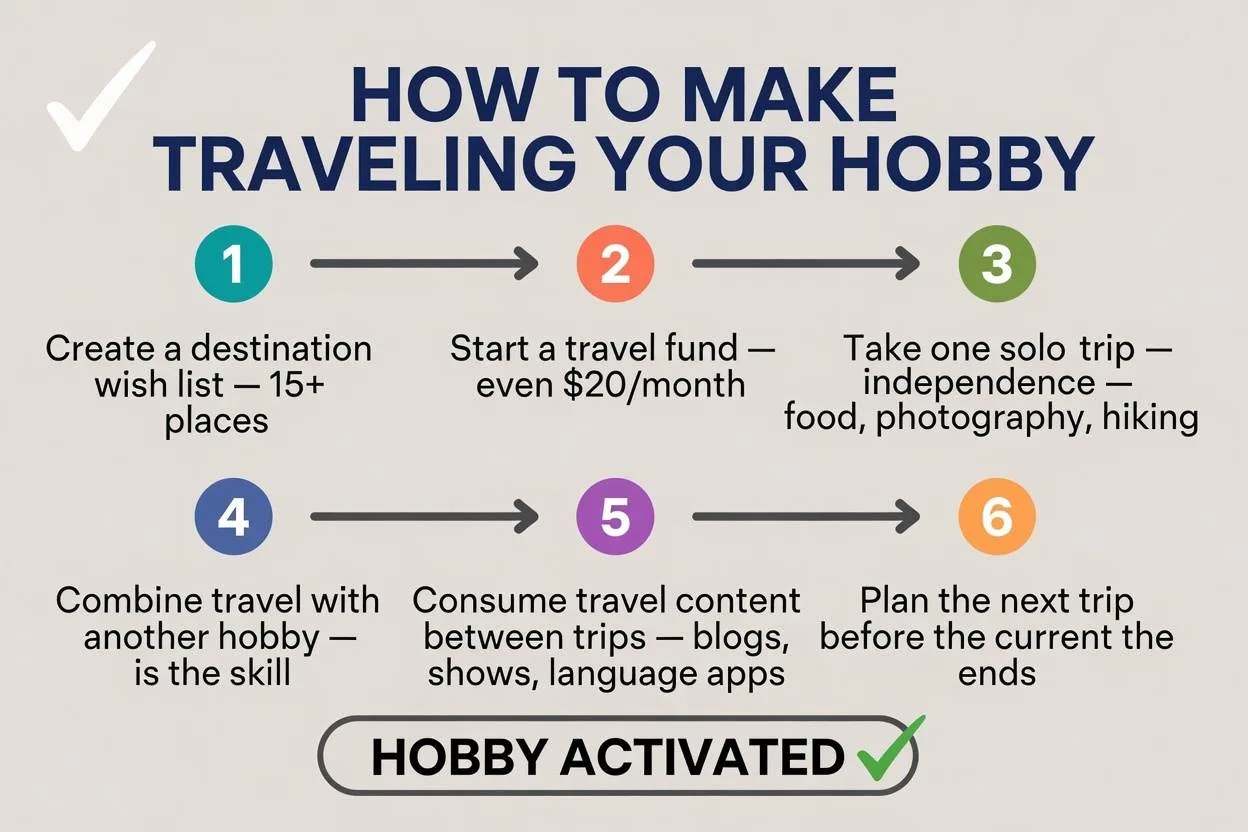
If you currently travel only when forced by vacation schedules and want to make it a real hobby, these 6 steps create the shift.
1. Create a destination wish list. Write 15 to 20 places you want to visit. Not places other people recommend. Places you are genuinely curious about. Pin the list to your fridge or set it as a note on your phone. The wish list gives travel a direction, which is what separates a hobby from a random activity.
2. Start a travel fund — even $20 per month. Nausheen Farishta from Globe Gazers recommends starting a dedicated savings account for travel. Even small monthly contributions compound into real trip budgets over 6 to 12 months. The fund makes travel feel planned and intentional instead of impulsive and guilt-laden.
3. Take one solo trip. You do not need a travel partner. You need curiosity and a train ticket. Solo travel is the purest form of travel as a hobby because every decision is yours. Our guide on things to do when bored by yourself has 30 solo activities that build the independence muscle.
4. Combine travel with another hobby. Love food? Plan a trip around restaurants. Love photography? Plan a trip around light and landscapes. Love hiking? Plan a trip around trails. The intersection of two hobbies creates experiences that neither hobby produces alone. Our guide on things to do when bored during holiday has more vacation-activity combinations.
5. Consume travel content between trips. Read travel blogs, watch Somebody Feed Phil, subscribe to Lonely Planet or Travel + Leisure, browse Expedia deals, learn a language on Duolingo for your next destination, build Pinterest boards of places you want to visit. The engagement between trips is what makes travel a hobby instead of an occasional vacation.
6. Plan your next trip before the current one ends. The anticipation of future travel is itself a form of hobby engagement. Plan the next destination on the flight home. The cycle of planning-traveling-planning eliminates the dead zone between trips where the hobby goes dormant.
Is Traveling an Expensive Hobby?
Traveling can be any price — from free (exploring your own city) to unlimited (first-class international travel). The cost is not fixed. You set it.
| Travel Budget | What It Looks Like | Examples |
| $0 — Free | Be a tourist in your own city, day hike to a nearby trail, visit a free museum | Walking a neighborhood you have never explored, visiting a local historical site |
| Under $50 | Day trip within 2 hours, picnic at a state park, train ride to a nearby town | Saturday day trip to a small town, packing lunch, exploring on foot |
| $50 to $200 | Weekend trip, Airbnb stay, budget road trip with camping | Overnight camping trip, weekend city visit with hostel |
| $200 to $500 | Budget flight + 2 to 3 night stay, domestic travel | Flying to a new city for a long weekend |
| $500+ | International travel, extended trips, experience-focused travel | A week in Costa Rica, a train trip through Switzerland |
The expensive-hobby argument fails because it ignores the lower end of the spectrum. You can practice travel as a hobby for $0 by exploring your own city as a tourist. You can practice it for $50 with a day trip. The cost scales to your budget, just like photography (phone camera = free, DSLR = $1,000+) or cooking (pantry staples = free, specialty ingredients = expensive). If budget is a constraint, our guide on things to do when bored with no money has 47 free activities including free travel ideas.
Traveling as a Hobby — FAQs
Is traveling considered a hobby on a resume or application? Yes. Listing travel as a hobby signals cultural awareness, adaptability, and independence. If you can be specific — “solo travel across Southeast Asia” or “food travel across Mexico” — it is even stronger.
Is solo traveling a hobby? Yes. Solo travel is a distinct sub-hobby of travel with its own skills (navigation, self-reliance, safety awareness), its own community (solo travel forums, Globe Gazers, Reddit r/solotravel), and its own progression (local day trip → domestic solo trip → international solo trip).
Is travel planning a hobby? Yes. Many people spend more time planning trips than taking them — and they enjoy it. Researching destinations, building itineraries, finding deals on TripAdvisor and Expedia, creating Pinterest boards — all hobby-grade engagement.
Why is traveling not a hobby (according to some)? The argument that traveling is not a hobby usually comes from people who define hobbies narrowly as skill-based activities (playing piano, painting, woodworking). By that narrow definition, travel does not fit. By the broader and more accurate definition — an activity pursued during free time for enjoyment and personal growth — travel absolutely fits. Our article on Is Sleeping a Hobby? addresses a similar definitional argument.
Is traveling a hobby or passion? It can be both. A hobby becomes a passion when the emotional investment deepens. You do not just enjoy traveling — you organize your life around it. Both labels are valid simultaneously.
What Traveling as a Hobby Is Actually Telling You
Searching “is traveling a hobby” reveals something about what you want from your free time: you want novelty, presence, growth, and the feeling that your time produced a memory worth keeping. You want to break the autopilot mode that routine creates. You want to see how other people live and feel your own life expand in response.
Traveling as a hobby answers all of those wants. It gives you novelty (new places), presence (heightened awareness in unfamiliar environments), growth (self-reliance, cultural understanding), and lasting memories (experiences that stay vivid for decades). If those are the things your brain is craving, travel is not just a hobby. It is your hobby.
If the curiosity extends beyond travel into a broader search for what to do with your free time, our guide on how to find a hobby has a 5-question framework. And if travel-adjacent hobbies interest you, our guide on modern hobbies to beat boredom in 2026 covers 20 hobbies that combine exploration with creativity.
Final Thoughts
Traveling is a hobby when you pursue it intentionally, regularly, and for enjoyment. It is a hobby when you plan trips out of curiosity, not obligation. It is a hobby when you engage with it between trips through research, learning, and anticipation. It is a hobby when the experience produces personal growth, lasting memories, and a broader understanding of how the world works.
The debate is settled. Travel is a hobby for the people who treat it like one. If you treat it like one, it is one. No further validation required. Pick a destination. Plan a trip. Go.
MORE FROM BOREDOMWIZARD.COM
Hobbies: How to Find a Hobby · 50 Hobbies to Try · Is Working Out a Hobby? .