How to Draw a Dinosaur: 20 Species with Free Printable Pack
Every dinosaur drawing guide online shows you one species — usually a T-Rex — and calls it done. This one covers 20 dinosaurs from cute cartoon to museum-quality skeleton, with a free printable PDF you can download available at the bottom, print and use as colouring pages or tracing references. Each drawing includes a quick species fact and what makes it different to draw.
The easiest answer of how to draw a dinosaur is a T-Rex: a large oval body, a big circle head with open jaw, two tiny arms, two powerful legs, and a thick tail. Start with basic shapes, refine the outline, add teeth and claws. The printable pack at the bottom of this page includes all 20 dinosaurs as individual colouring pages.
Easy dinosaur drawings for beginners
Start here if you are drawing dinosaurs for the first time or drawing with kids. These use bold outlines, simplified shapes and friendly expressions.
1. T-Rex — simple side view
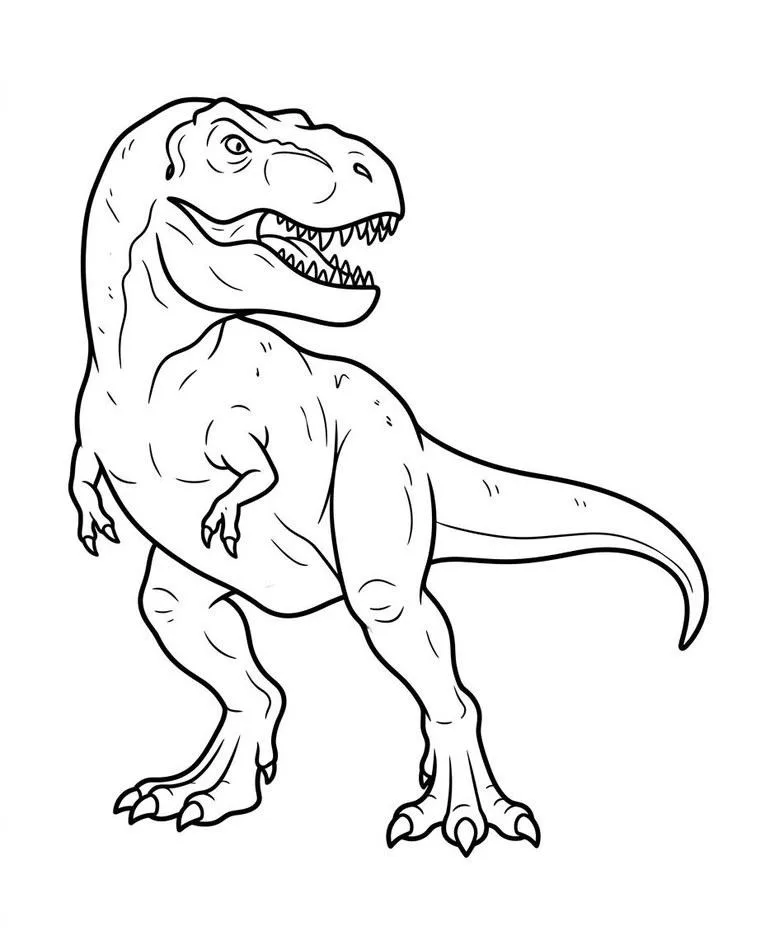
The king of dinosaur drawings and the easiest to start with. A massive head takes up nearly a third of the body length, which means proportional mistakes are hidden by the sheer size of the skull. Start with a large tilted oval for the body, a big circle for the head, connect them with a thick neck, add two powerful hind legs, two tiny forearms, and a long horizontal tail. Open the jaw, add triangular teeth, and it reads as a T-Rex immediately.
Species fact: T-Rex had the most powerful bite force of any land animal that ever lived — roughly 12,800 pounds, enough to crush bone.
2. Cute cartoon baby T-Rex
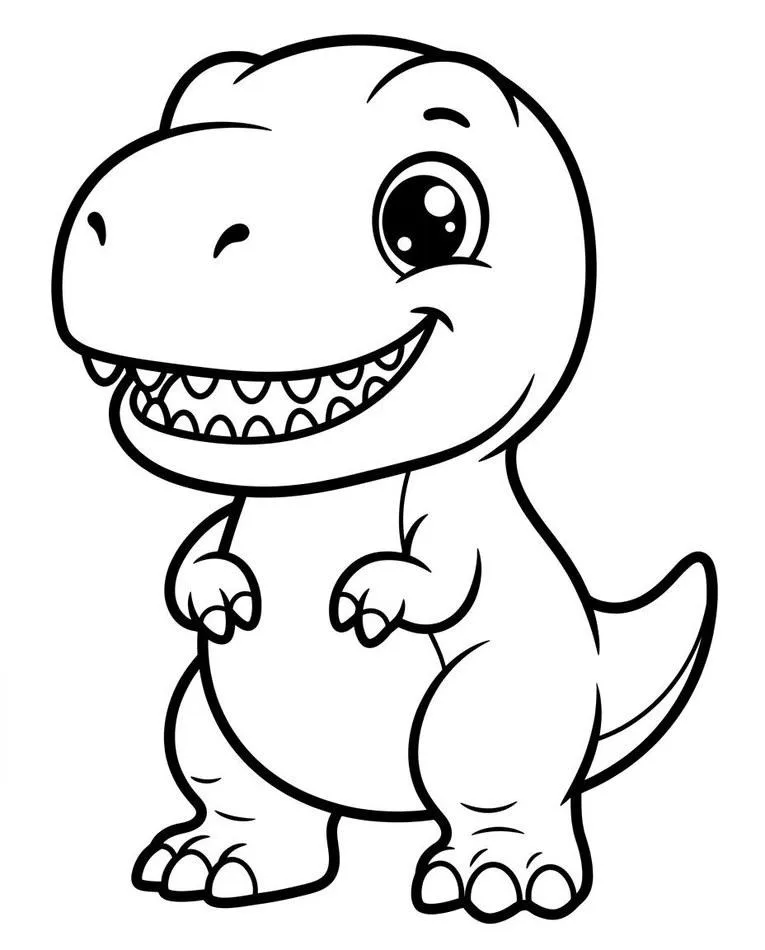
An oversized head, huge round eyes, a big toothy grin and a chubby body. The chibi proportions make this the most forgiving dinosaur to draw — the head is nearly as large as the body, so any anatomy mistake is absorbed by the cartoon style. This is the drawing that works best for younger kids and the one that performs best as a colouring page.
3. Triceratops
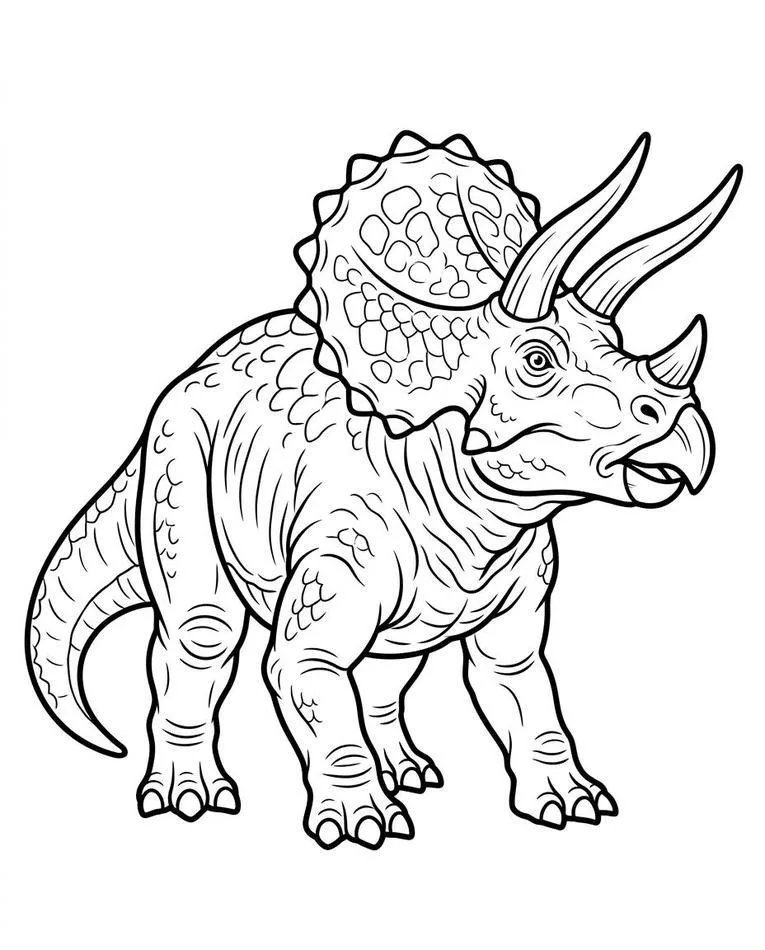
Three horns and a massive neck frill make this the second most recognisable dinosaur silhouette after T-Rex. The frill is the drawing challenge — it fans out behind the head with scalloped edges and internal texture. Start with a large barrel body, add a rectangular head tilted slightly downward, place the nose horn and two brow horns, then extend the frill backward from the top of the skull.
Species fact: Triceratops’ frill was solid bone, unlike many relatives whose frills had large openings. It may have been used for species recognition and temperature regulation.
4. Brachiosaurus — long neck
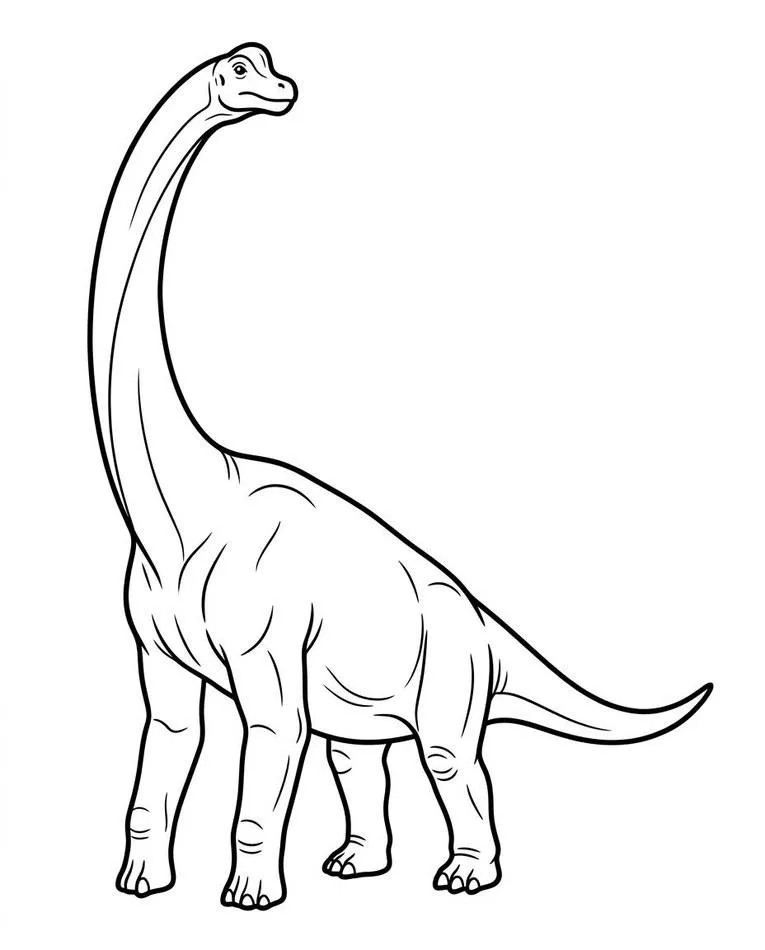
The neck is the drawing. Brachiosaurus had front legs longer than its rear legs, giving it a distinctive upward slope from hip to shoulder and a nearly vertical neck. The neck should take up roughly half the height of your drawing. The head is tiny relative to the body — a common beginner mistake is making the head too large. Keep it small and simple.
Species fact: Brachiosaurus stood about 40 feet tall and weighed around 80 tons — roughly the weight of 11 elephants.
5. Stegosaurus
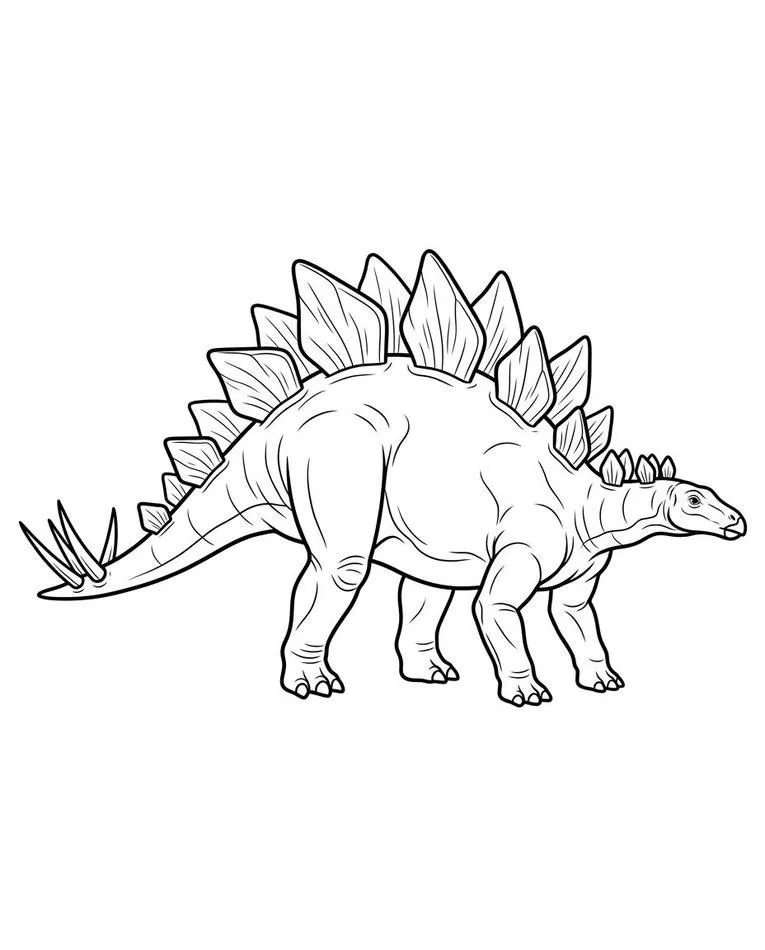
Two rows of alternating diamond-shaped plates along the back and four tail spikes (the thagomizer) are the defining features. The head is held low and is disproportionately small compared to the body. The rear legs are noticeably longer than the front legs, creating an arched back. Draw the plates as kite shapes standing upright, alternating left and right along the spine.
Species fact: Stegosaurus had a brain roughly the size of a walnut — one of the smallest brain-to-body ratios of any dinosaur.
Intermediate dinosaur drawings
These species have more complex anatomy — feathers, armour plates, sail structures, and crests that require more careful line work.
6. Velociraptor — running pose
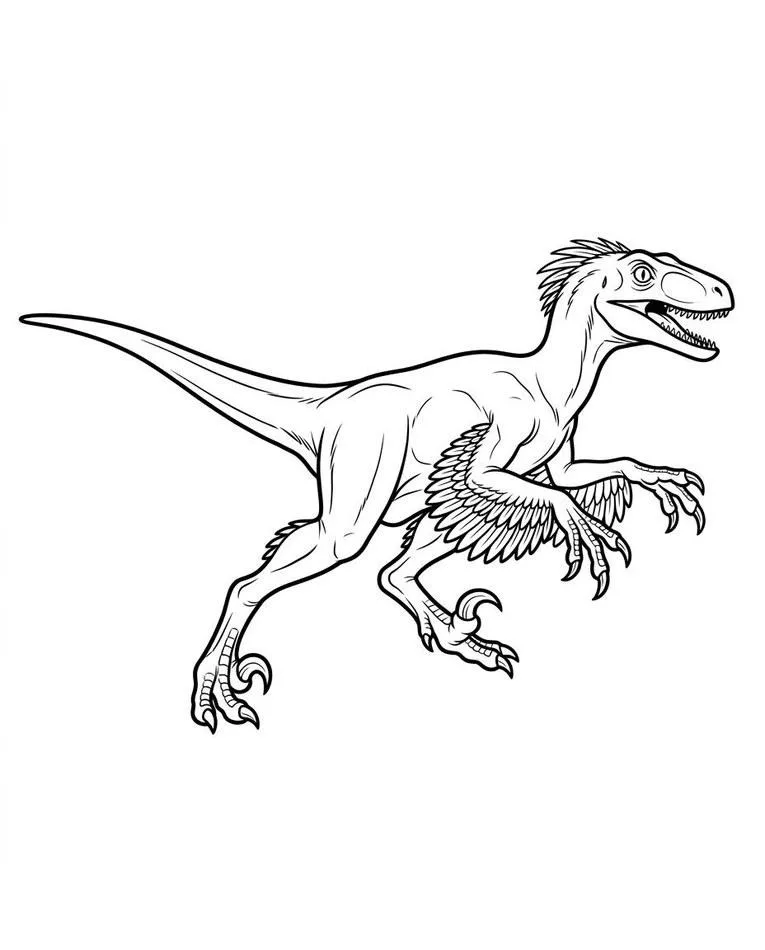
Lean, agile, and feathered. Modern palaeontology has confirmed Velociraptor had feathered forearms and possibly a feathered crest, so drawing it with feathers is scientifically accurate. The characteristic large curved sickle claw on each foot is the identifying feature. The body leans forward in a running pose with the stiff tail held straight behind for balance.
Species fact: Real Velociraptors were roughly the size of a turkey — about 2 feet tall and 6 feet long including the tail. The movie versions are closer in size to Deinonychus.
7. Pteranodon — in flight
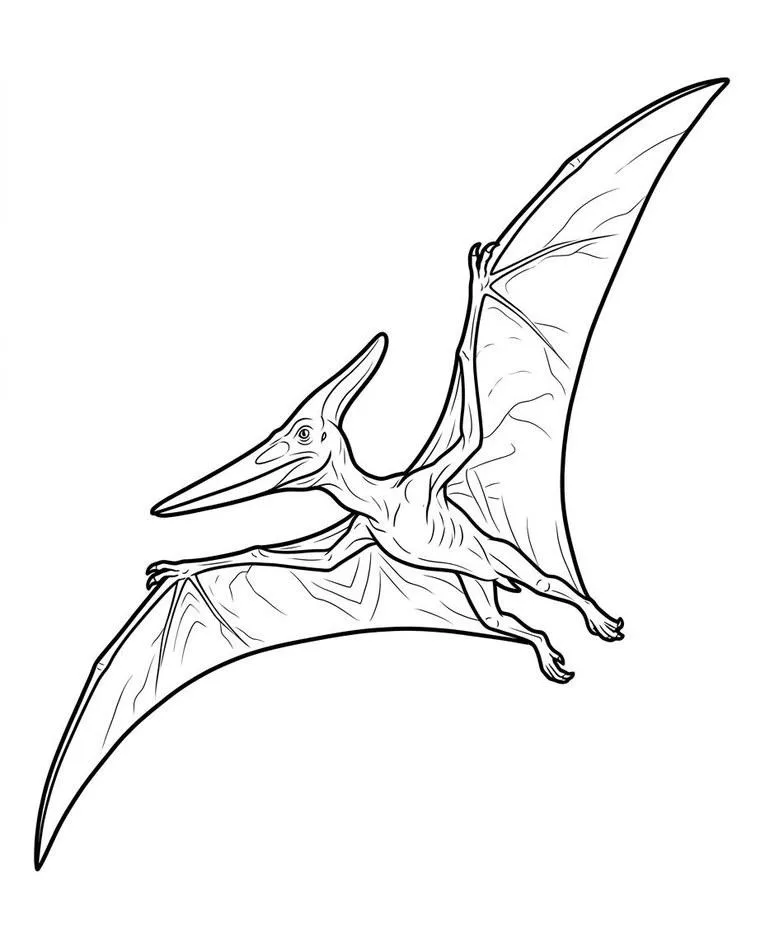
Not technically a dinosaur but always included in dinosaur drawing sets. The challenge is the wing membrane — it stretches between an enormously elongated fourth finger and the body. The long backward-pointing head crest and the toothless beak are the identifying features. Draw the wings as two large triangles stretched out from the body, then add the membrane texture with subtle vein-like lines.
Species fact: Pteranodon had a wingspan of up to 23 feet but weighed only about 55 pounds — lighter than a Labrador.
8. Spinosaurus — the sail-backed predator
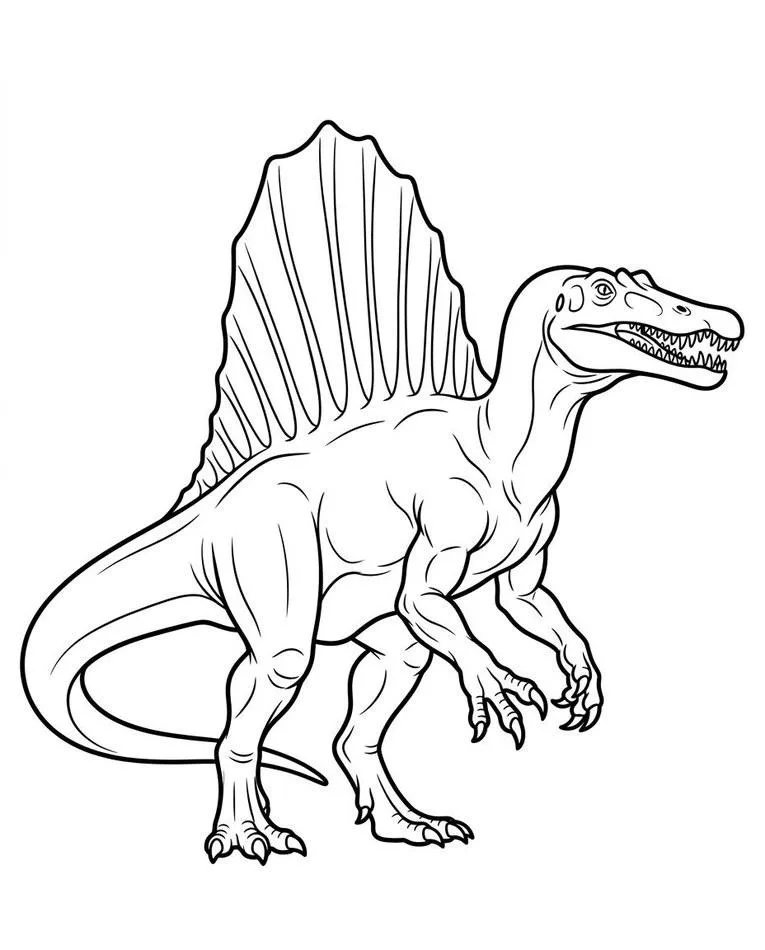
The tall sail on the back is the dominant feature — formed by elongated neural spines, it could reach over 5 feet tall at the peak. Unlike T-Rex, Spinosaurus had a long crocodile-like snout with conical teeth designed for catching fish, and large powerful forearms with big claws. The sail should be dramatically tall, roughly half the height of the animal.
Species fact: Spinosaurus is the largest known carnivorous dinosaur — longer than T-Rex at up to 50 feet. Recent evidence suggests it was semi-aquatic and hunted in rivers.
9. Ankylosaurus — the living tank
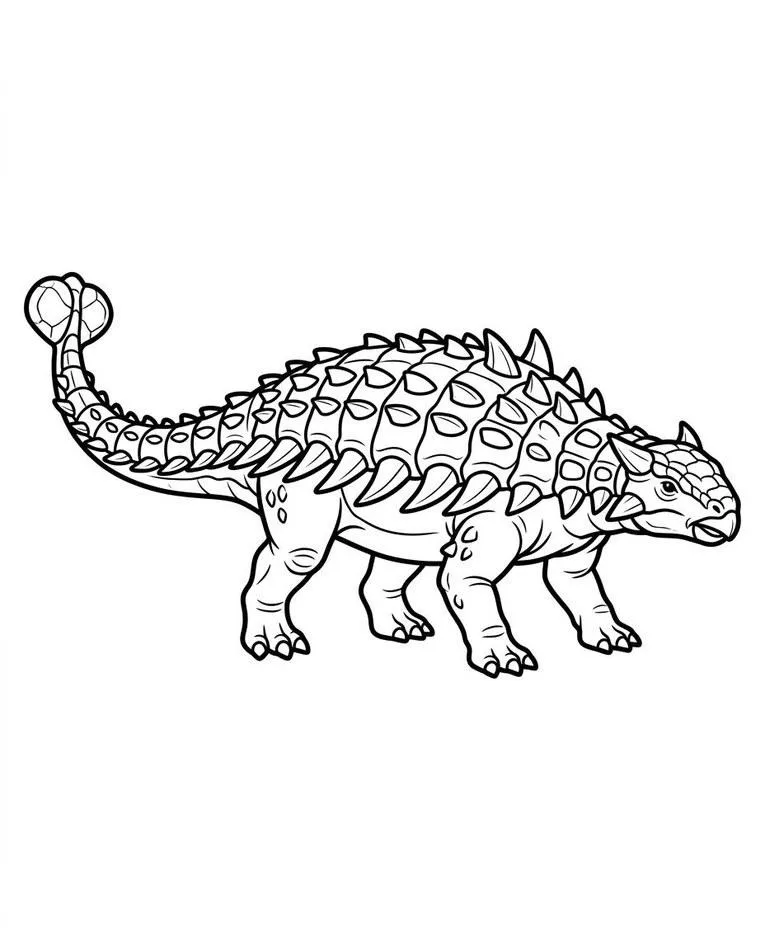
Heavily armoured from head to tail with bony plates, spikes and osteoderms, ending in a massive bony tail club. The body is wide, low and tank-like — draw it as a flattened oval with four short sturdy legs. The armour pattern is the drawing challenge: overlapping rows of bony plates across the back, larger spikes along the sides, and the club at the tail tip.
Species fact: Ankylosaurus could swing its tail club with enough force to break the leg bones of a full-grown T-Rex. It was essentially a biological wrecking ball.
10. Parasaurolophus — the crested duck-bill
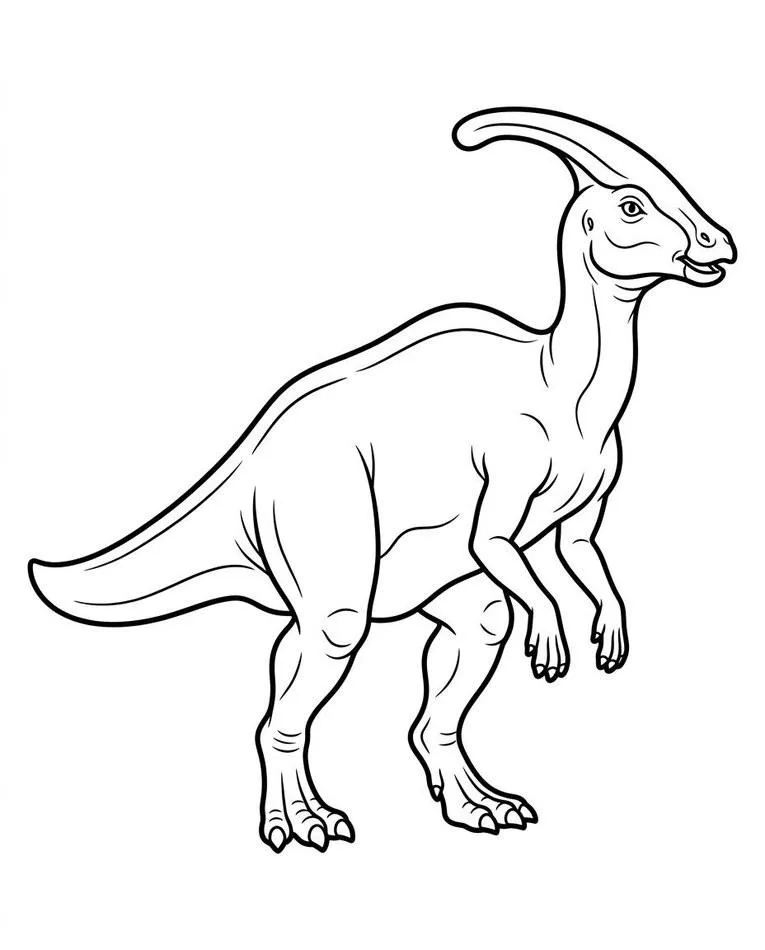
The long curved tubular crest extending backward from the skull is the defining feature and the reason this dinosaur is so satisfying to draw — the crest gives the profile a dramatic, elegant curve that no other species has. The body is a standard hadrosaur build: duck-billed mouth, relatively slender, capable of walking on two or four legs.
Species fact: The hollow crest may have been used as a resonating chamber to produce loud, low-frequency calls that could travel for miles through Cretaceous forests.
11. Diplodocus
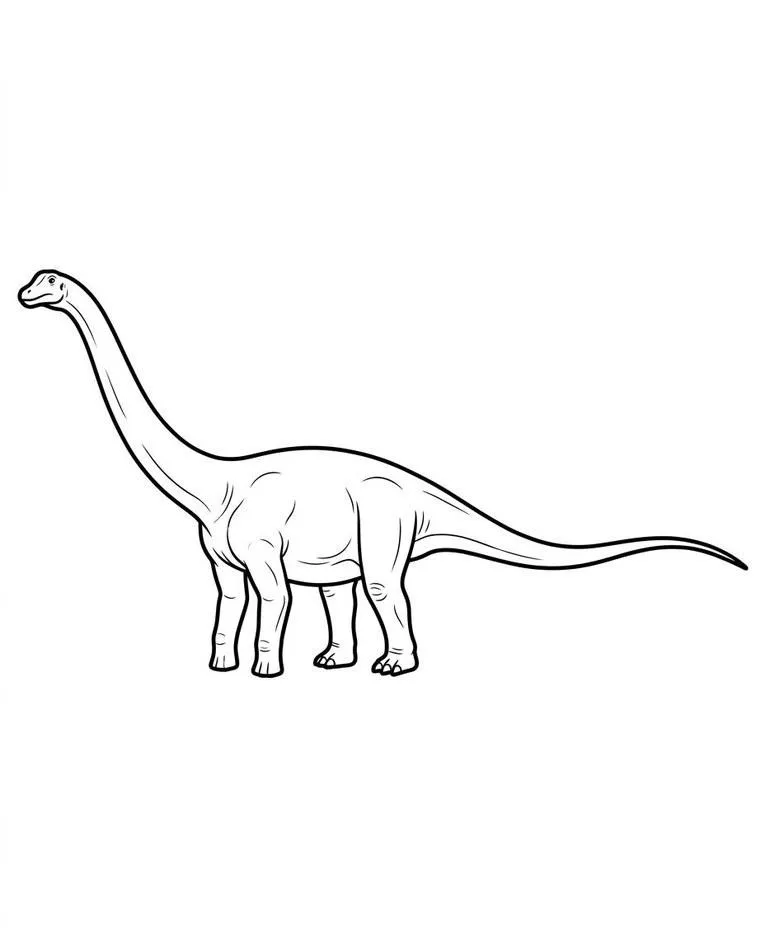
The longest dinosaur commonly drawn. Diplodocus differs from Brachiosaurus in two key ways: its front and rear legs are roughly the same height (giving a level back rather than a sloped one), and its tail is extremely long and whip-like. The neck is held more horizontally than vertically. The body looks proportionally tiny between the enormous neck and the even longer tail.
Species fact: Diplodocus could reach over 85 feet in length, making it one of the longest animals ever to walk the Earth. Its tail may have been used as a whip for defence.
Advanced dinosaur drawings
These drawings demand more detail, anatomical precision and confidence with line weight variation.
12. T-Rex skeleton — museum-style
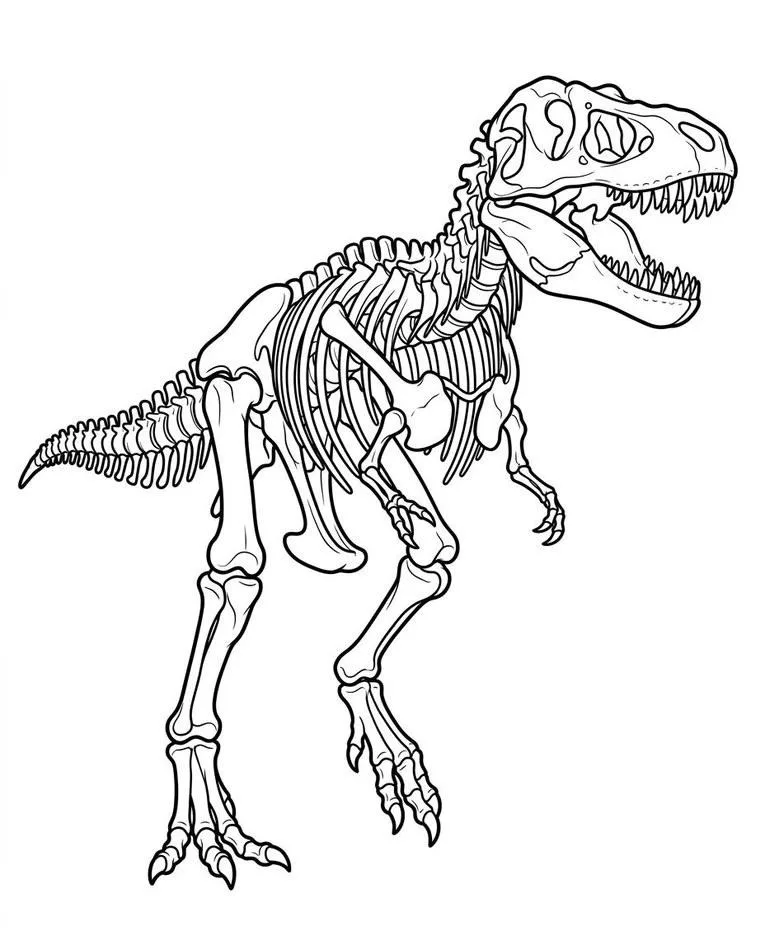
A complete Tyrannosaurus Rex skeleton as it would appear mounted in a natural history museum. Every major bone is visible and clearly outlined — the skull with teeth, the ribcage, the spine, the tiny forearm bones, the massive femur, and the tail vertebrae. This is the hardest drawing in the set because every bone must be recognisable and correctly connected. Use an actual museum skeleton photo as reference and work bone by bone.
13. T-Rex skull — detailed close-up
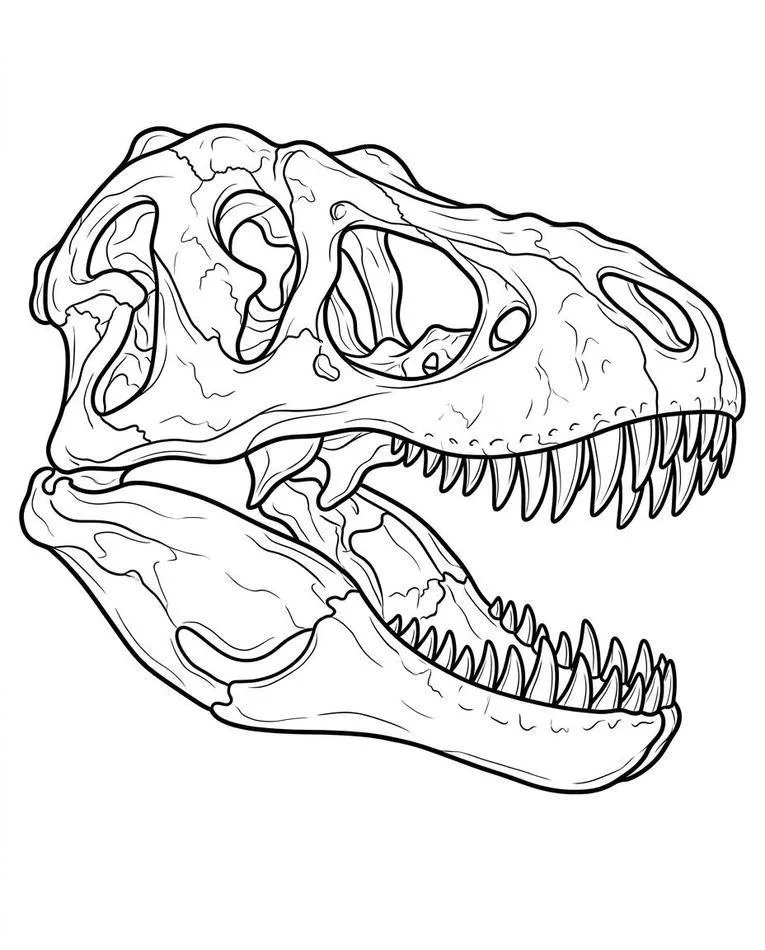
A T-Rex skull in side profile filling the entire frame. The eye socket, nasal opening, jaw hinge, teeth of varying sizes, the fenestrae (skull openings), and the heavy brow ridge are all delineated. The teeth are individually drawn with accurate root placement. This is the drawing that captures the “dinosaur skull drawing” search cluster at 250 searches per month and the “dinosaur bones drawing” cluster at 200.
14. Baby dinosaur hatching from egg
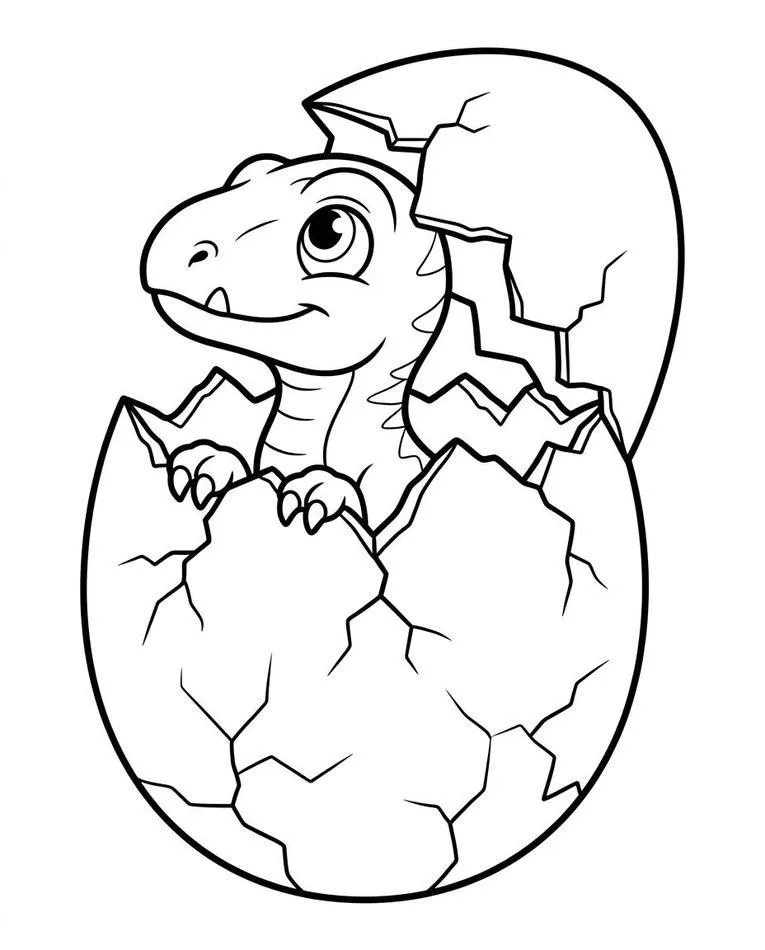
A baby theropod emerging from a cracked egg — the top half of the shell broken open, the hatchling peeking out with big round eyes and tiny claws gripping the shell edge. The egg tooth on the tip of the snout is a detail most dinosaur drawings miss. This drawing bridges the cute/cartoon audience and the scientifically interested audience, making it one of the most versatile pages in the printable pack.
15. Chibi kawaii dinosaur set — four species
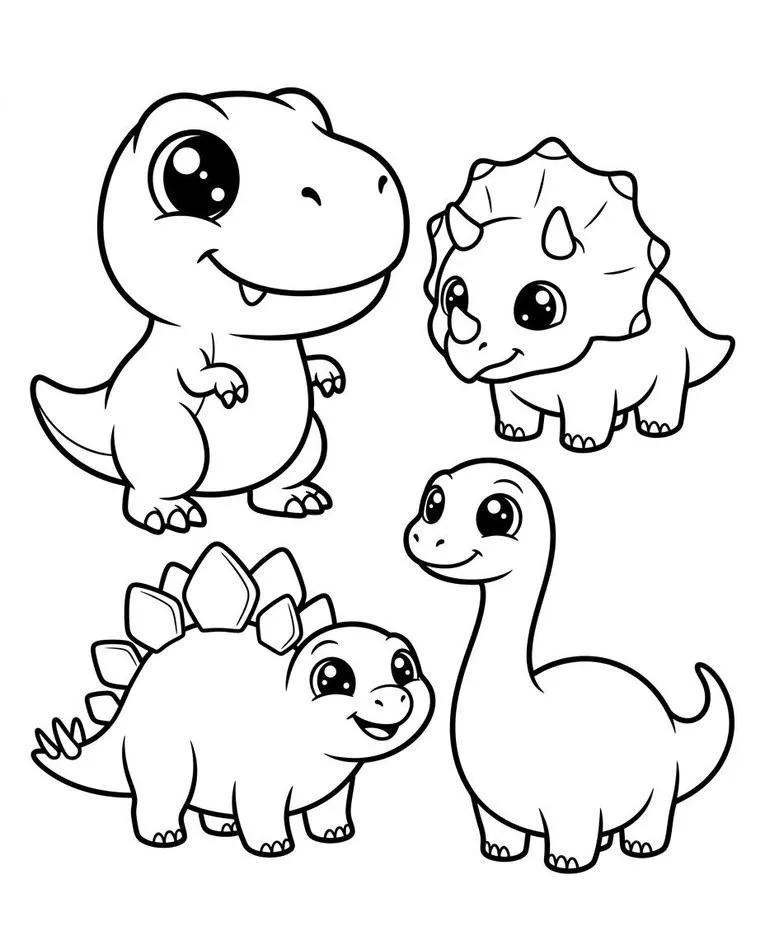
Four tiny chibi dinosaurs on one page: a round T-Rex, a stubby Triceratops, a smiling Stegosaurus, and a little Brontosaurus. All have oversized heads, huge sparkly eyes, and rounded bodies. This is the page designed for the youngest artists — simple enough for a four-year-old to colour and cute enough for a teenager to redraw in their own style. It captures the “cute dinosaur drawing” cluster at 5,000 searches per month.
16. Mosasaurus — sea predator
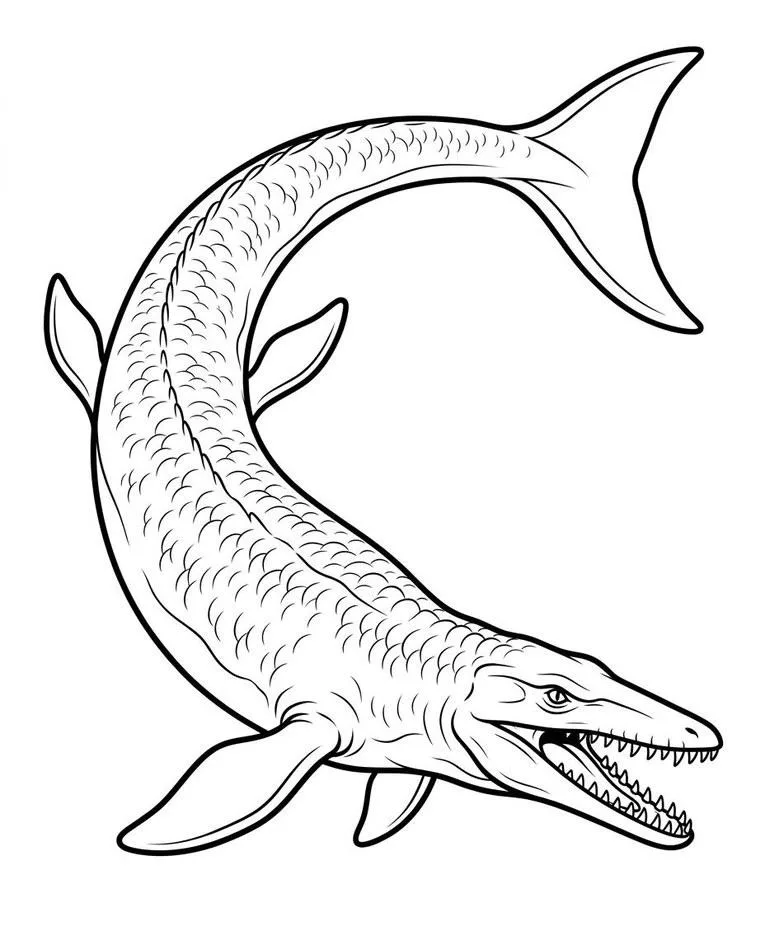
A marine reptile with a streamlined body, powerful vertical tail fin, four paddle-like flippers, and an elongated snout filled with conical teeth. The body curves slightly as if turning in the water. Not technically a dinosaur but massively popular since its appearance in the Jurassic World films. The scales along the body are drawn as subtle overlapping lines that suggest texture without overwhelming the outline.
17. T-Rex roaring — three-quarter front view
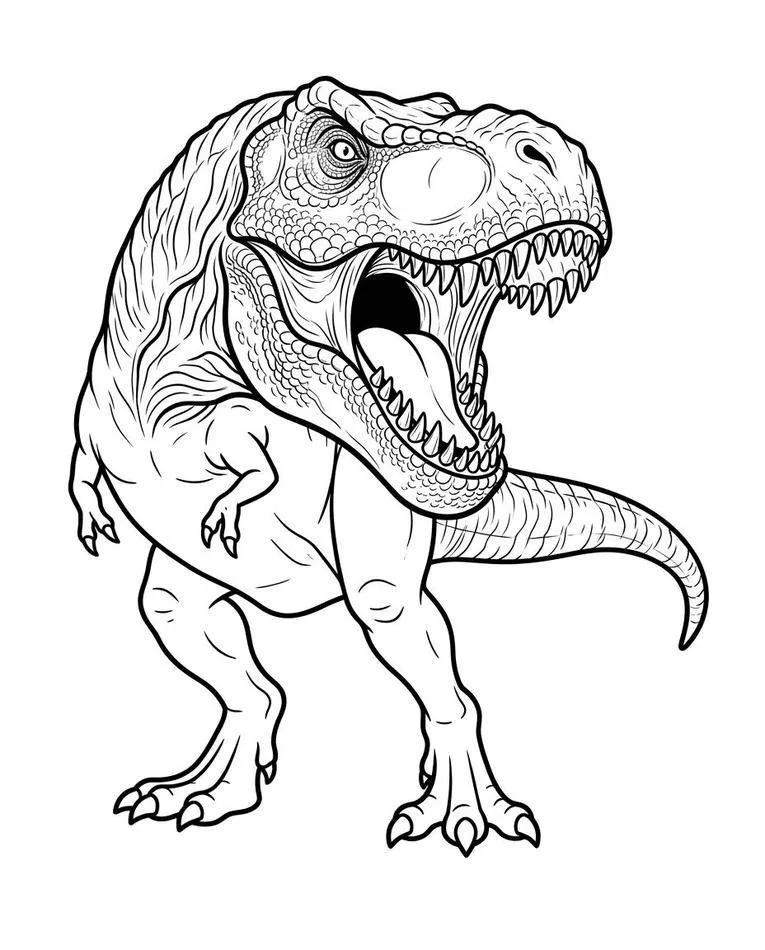
The most dramatic pose in the set. A T-Rex faces slightly toward the viewer with mouth wide open, showing teeth, tongue and the textured scaly skin around the jaw. The foreshortening makes the head massive and the body recede behind it. This is the advanced version of drawing 1 — the same animal rendered with full anatomical detail, muscle contours and skin texture instead of simplified outlines.
Special dinosaur drawings
18. Prehistoric landscape with volcano
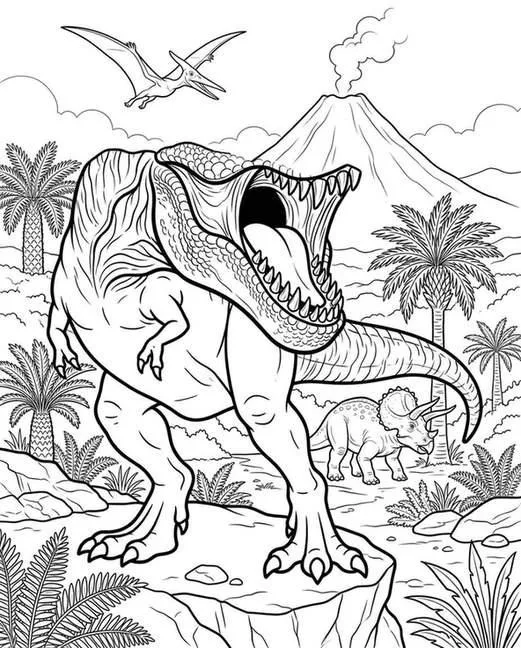
A complete scene designed as a colouring page. A T-Rex dominates the foreground on a rocky outcrop. A Triceratops walks in the middle ground near palm trees. A Pteranodon flies overhead, and a volcano smokes in the background. Each element is drawn with enough detail to colour individually but simple enough that the scene does not overwhelm. This is the printable page people frame after colouring.
19. Dinosaur footprint and ammonite fossil
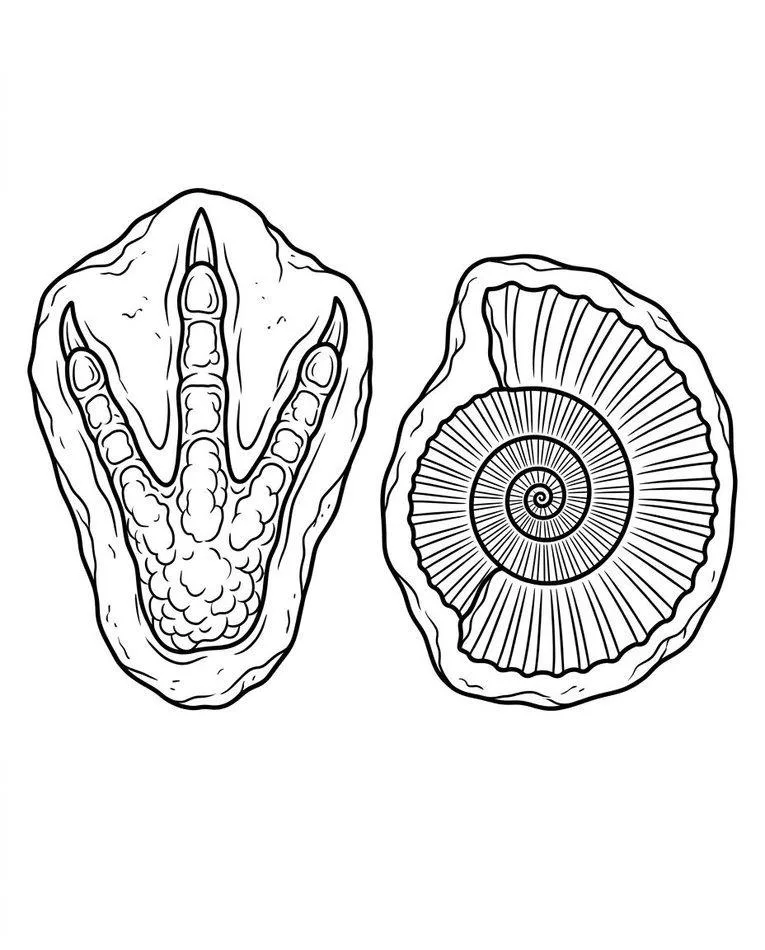
Two fossil impressions side by side: a large three-toed theropod footprint with clear claw marks and pad texture on the left, and an ammonite spiral shell with ribbed chamber divisions on the right. Both are shown as they would appear pressed into rock. This captures the “dinosaur fossil drawing” cluster at 200/mo and adds palaeontological variety to a set that would otherwise be all living animals.
20. Cartoon dinosaur parade
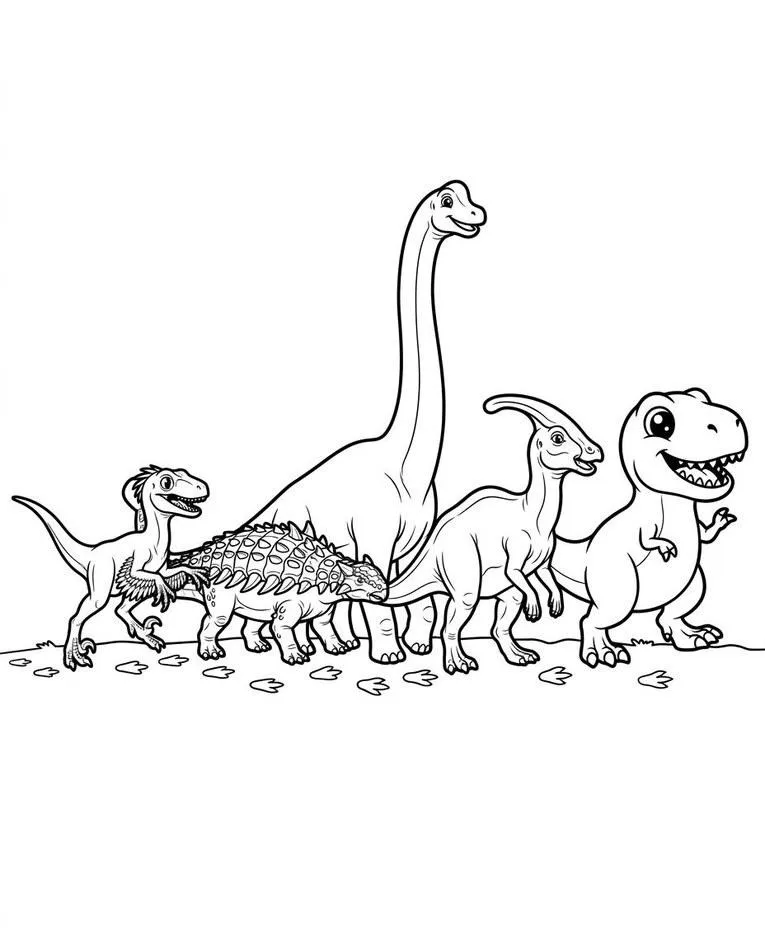
Five cartoon dinosaurs walking together in a group: a feathered Velociraptor, an armoured Ankylosaurus, a towering Brachiosaurus with its neck reaching to the top of the frame, a crested Parasaurolophus, and a cheerful T-Rex. Each has friendly cartoon proportions and its own personality. This is the widest and most detailed colouring page in the pack — designed for older kids and adults who want a longer colouring session.
Free printable dinosaur drawing pack — PDF download
Download all 20 dinosaur drawings as a single PDF — one drawing per page, ready to print on standard letter or A4 paper. Use them as colouring pages, tracing references or drawing practice. Print as many copies as you want.
Dinosaur drawing tips that actually help
- Start with the body oval, not the head. The body sets the scale. Add the head, neck and tail to the body, not the other way around.
- Most dinosaurs are horizontal, not vertical. Beginners instinctively draw dinosaurs standing upright like humans. Theropods held their bodies roughly horizontal with the tail counterbalancing the head. The spine is a see-saw, not a flagpole.
- The tail is longer than you think. A T-Rex’s tail was roughly half its total body length and was held stiff and straight for balance, not dragging on the ground.
- Legs go straight down under the body. Unlike lizards whose legs splay to the sides, dinosaur legs were held directly beneath the body like columns. This upright posture is what made them so successful.
- Add skin texture last. Get the outline and proportions right first. Scales, wrinkles and plates are detail work that goes on top of a correct silhouette, not a substitute for one.
- Use real skeletons as reference. Museum skeleton photos are the best drawing reference because they show you the actual bone structure underneath the skin. Drawing 12 in this set is a skeleton reference for exactly this purpose.
How to draw a dinosaur: FAQ
What is the easiest dinosaur to draw?
A cartoon T-Rex (drawing 2 in this guide). The oversized head and tiny arms mean proportional mistakes are invisible in the cartoon style. A simple Brachiosaurus (drawing 4) is also very easy — it is essentially a long neck attached to a large oval body with four pillar legs.
How do you draw a T-Rex step by step?
Start with a large tilted oval for the body. Add a big circle at one end for the head, connected by a thick short neck. Draw two powerful hind legs with three-toed feet directly beneath the body. Add two tiny forearms with two clawed fingers near the chest. Extend a long thick tail from the opposite end, held horizontally. Open the jaw by splitting the head circle, add triangular teeth, a small eye, and nostril. Refine the outline and erase the construction shapes.
What is the hardest dinosaur to draw?
A museum-quality T-Rex skeleton (drawing 12) is the most technically demanding because every bone must be anatomically correct and correctly connected. Among living dinosaurs, Ankylosaurus (drawing 9) is the hardest due to the complex armour plate pattern across the entire body.
How do you draw dinosaur scales?
Draw the full outline first, then add scales as small overlapping U-shapes or crescent marks following the contour of the body. Scales should be smaller on the head and legs and larger on the body and tail. Do not draw every individual scale — suggest the texture with clusters of marks in key areas and let the viewer’s eye fill in the rest.
How do you draw a dinosaur for kids?
Use the cartoon style: oversized heads, big round eyes, rounded bodies, short legs, and friendly expressions. Drawings 2 and 15 in this guide are designed specifically for young children. The chibi kawaii set (drawing 15) works for kids as young as four because the shapes are simple enough to trace and colour.
Were dinosaurs feathered?
Many theropod dinosaurs had feathers, including close relatives of T-Rex and all raptors. Velociraptor (drawing 6) is drawn with feathered forearms and a head crest, which reflects current scientific evidence. Drawing feathered dinosaurs is more scientifically accurate than drawing them with bare reptile skin.
Pick a species and start drawing
The best way to draw dinosaurs is the same way palaeontologists study them — one species at a time. Start with the easy T-Rex, move to a Triceratops, try a Stegosaurus, and by the time you reach the skeleton drawing you will have drawn enough dinosaur bodies to understand how the bones fit inside them.
For more drawing subjects beyond dinosaurs, our how to draw a horse guide uses the same species-by-species approach with a free printable pack. Easy things to draw has dozens more starting points, doodle ideas covers quick five-minute sketches, and things to draw when bored is the full list.