Is Working Out a Hobby? (Yes — and Here Is Exactly Why It Counts)
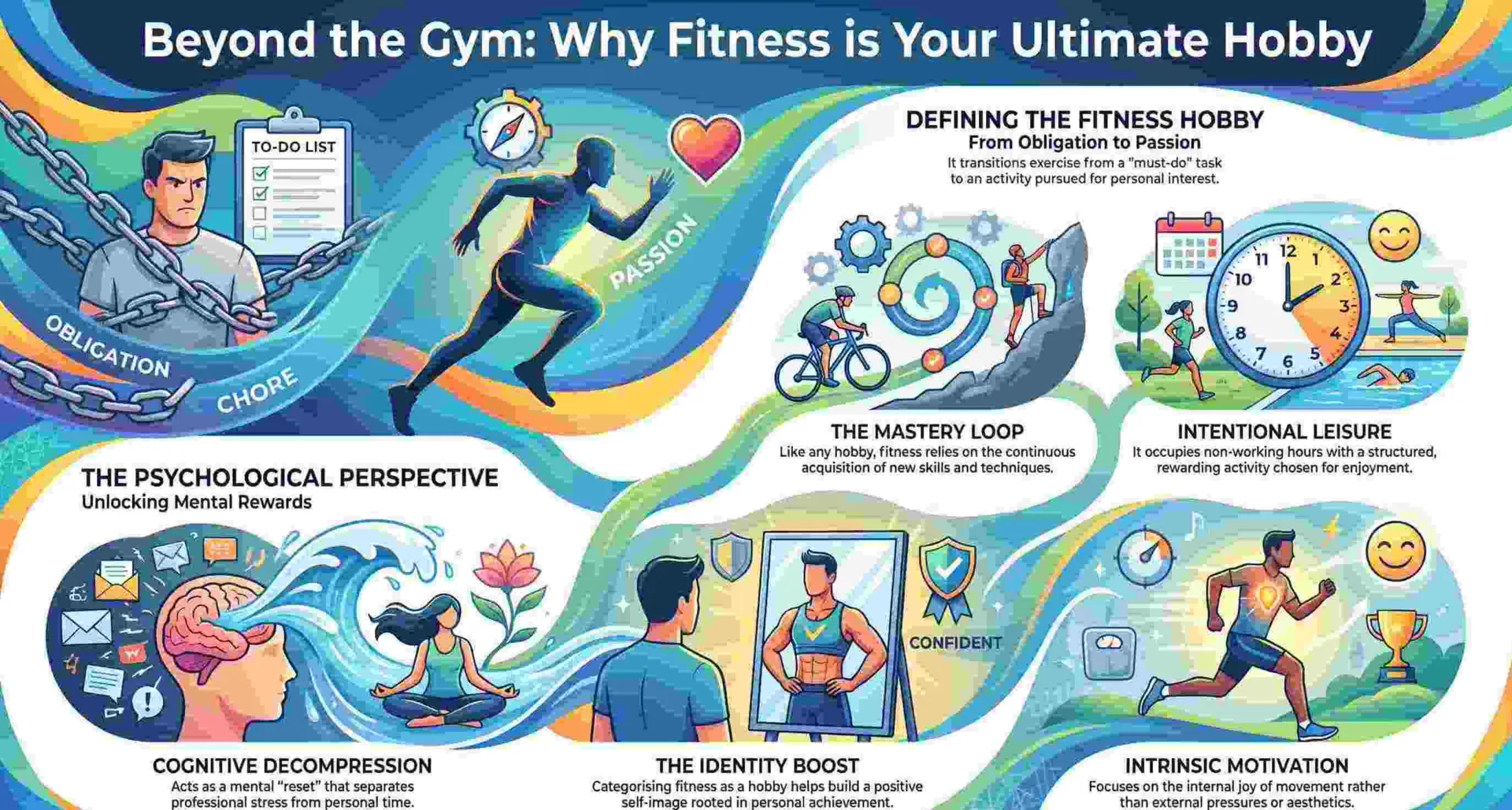
Is working out a hobby ? A hobby is any activity you choose to do during free time because it brings you enjoyment, satisfaction, or personal growth. If you go to the gym, run, do yoga, lift weights, or follow a home workout routine because you genuinely look forward to it — not because a doctor told you to or because you hate how you look — then working out is a hobby in the fullest sense of the word. Peloton, CrossFit, Planet Fitness, Gold’s Gym, Nike Training Club, and every boutique studio in the world exist because millions of people treat fitness as a hobby, not just a health requirement.
The debate about whether working out “counts” as a hobby comes from an outdated definition of hobbies that excludes anything practical. Nobody questions whether cooking is a hobby because cooking also keeps you alive. Nobody questions whether gardening is a hobby because gardening also produces food. Working out is the same: it serves a practical purpose (health) and it can simultaneously be a genuine hobby (enjoyment). Both are true. They are not in conflict.
What Makes Working Out a Hobby vs. Just a Habit?
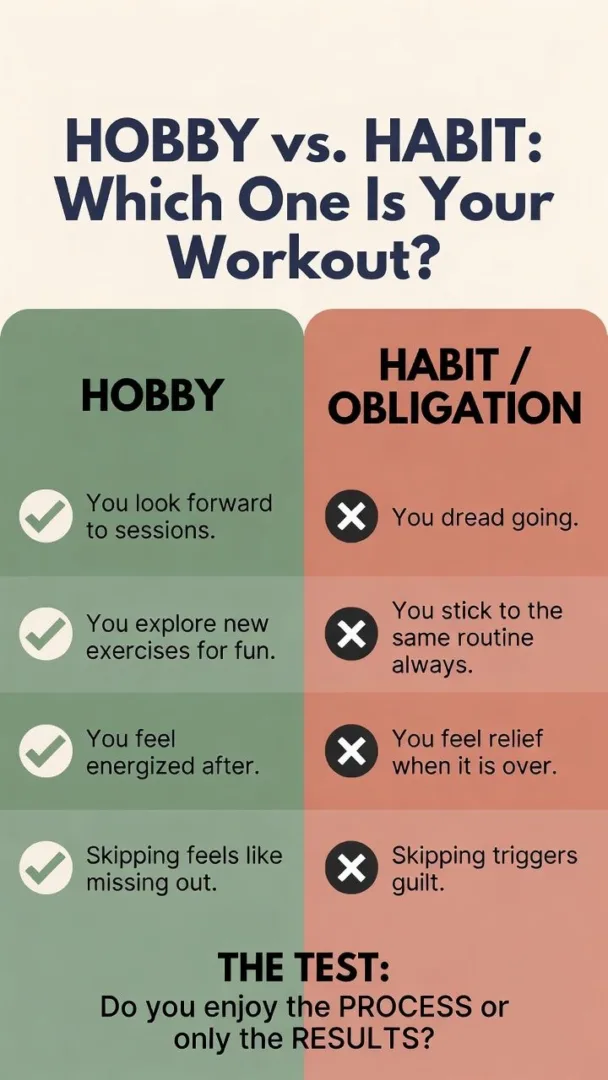
The difference between working out as a hobby and working out as a habit is the reason you do it. Kelly Barbera from Temple Fitness in Franklin puts it clearly: fitness becomes a hobby when you find joy in movement and activity. When you look forward to the session, not just the results.
Here is the test. Answer honestly:
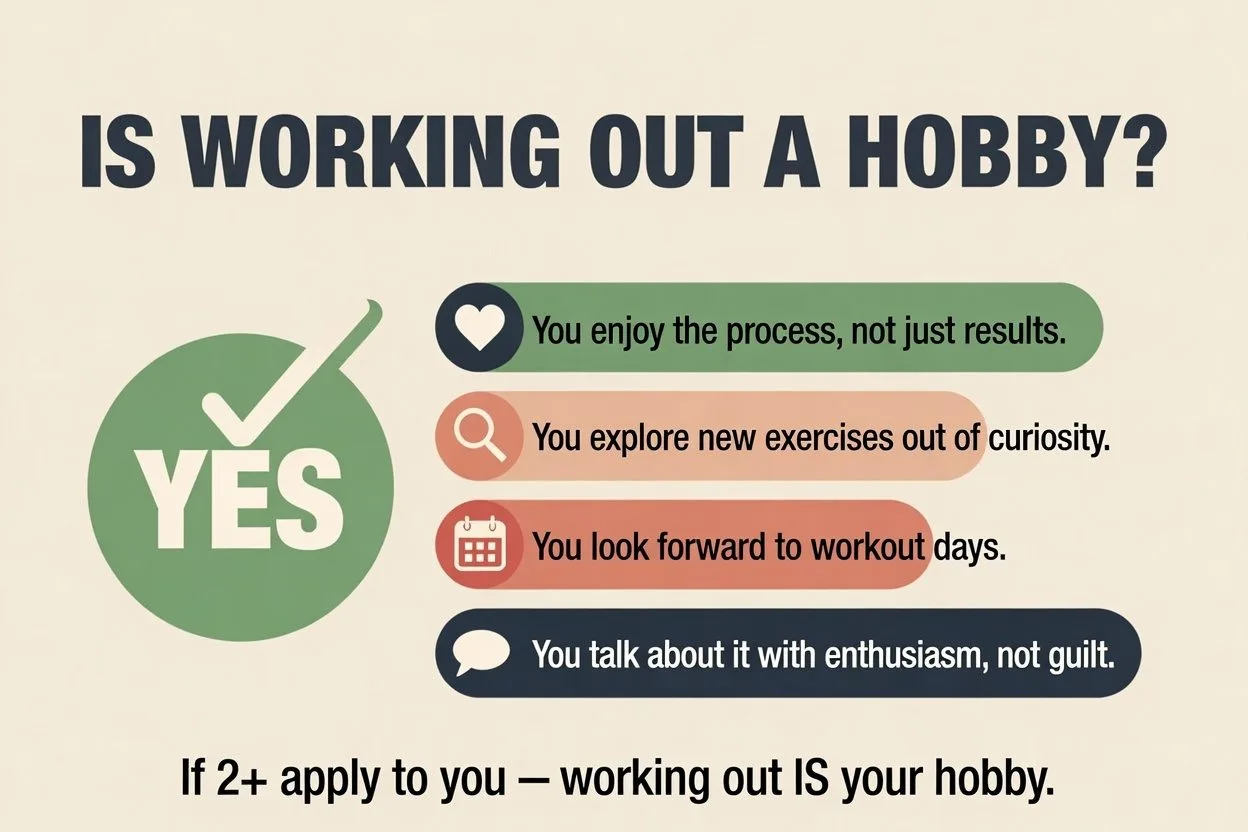
Do you exercise because you enjoy the process? If yes, working out is a hobby. You look forward to the session itself — the movement, the challenge, the feeling during the workout — not just the body changes afterward.
Do you exercise because you feel guilty when you skip? If this is your primary driver, working out is a habit or an obligation, not a hobby. Hobbies do not produce guilt when skipped. They produce longing.
Do you try new exercises, routines, or classes because you are curious? If yes, working out is a hobby. Curiosity is the hallmark of hobby behavior. You explore variations not because a trainer told you to, but because you want to see what this new thing feels like.
Do you talk about working out with enthusiasm, not just discipline? Hobby language sounds like “I tried this new HIIT class and it was intense in the best way.” Obligation language sounds like “I need to go to the gym today.” The vocabulary reveals the motivation.
If you answered yes to 2 or more of these, working out is a hobby for you — regardless of what anyone on Reddit says.
Is Working Out a Hobby? — What the Science Says
The National Institutes of Health confirms that regular physical activity improves cardiovascular health, immune response, and reduces the risk of chronic conditions like diabetes and heart disease — but the psychological benefits are what make it a hobby.
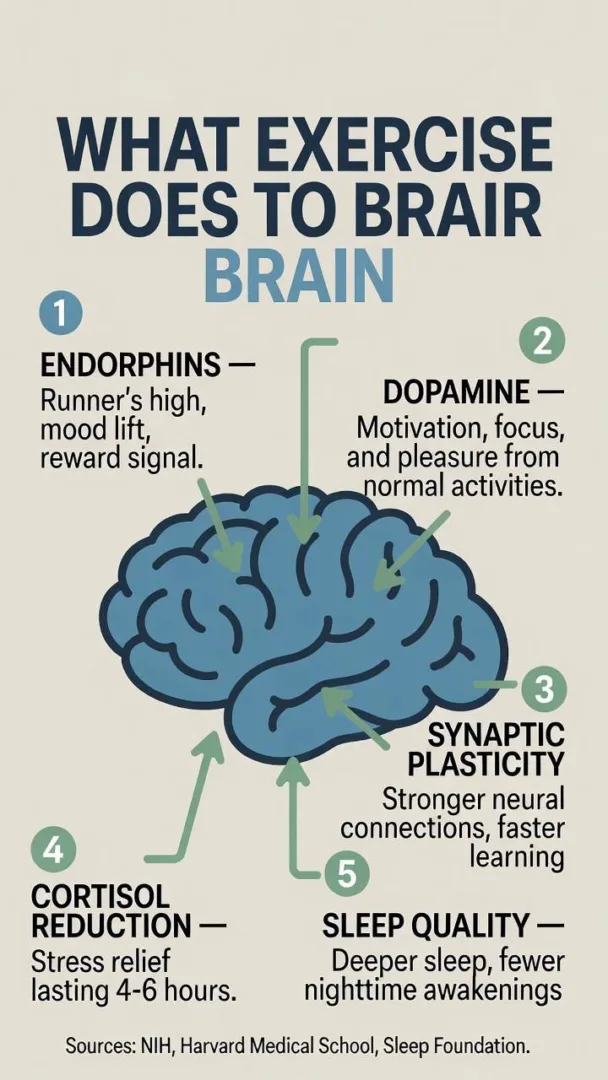
Here is what happens in your brain when you exercise:
Endorphin release. Exercise triggers the release of endorphins — the neurotransmitter responsible for the “runner’s high” and the post-workout mood lift. This is the same reward mechanism that makes any hobby satisfying. Your brain rewards the activity with a chemical that says “do this again.”
Dopamine production. Working out increases dopamine levels, which improves motivation, focus, and the ability to experience pleasure from normal activities. If you want to understand how dopamine drives hobby selection, our guide on how to build a dopamine menu when bored covers the neuroscience in detail.
Stress and anxiety reduction. Harvard Medical School research shows that even moderate exercise — walking, using a treadmill or elliptical machine, basic stretching — reduces cortisol and produces a calming effect that lasts 4 to 6 hours after the session.
Improved sleep quality. The Sleep Foundation states that light resistance exercise or aerobic exercise in the evening helps reduce nighttime awakenings. High-intensity exercise like running or cycling promotes deeper sleep by reducing wakefulness. Better sleep improves everything else.
Synaptic plasticity. Exercise enhances synaptic plasticity — your brain’s ability to form new connections and strengthen existing ones. This means working out literally makes your brain more adaptable. That cognitive benefit is a hobby-grade reward, not just a health byproduct.
The science is clear: working out produces the same neurological reward pattern as any recognized hobby. The brain does not distinguish between the satisfaction of finishing a painting and the satisfaction of finishing a hard workout. Both produce dopamine. Both produce endorphins. Both produce the “I did something meaningful” feeling that defines a hobby.
Is Working Out a Hobby, a Lifestyle, or a Sport?
Working out can be all three — the labels are not mutually exclusive. Here is how to tell which one applies to you:
It is a hobby when you do it during free time, for personal enjoyment, with no competitive goal. You go to the gym because you enjoy the process. You try new classes because you are curious. You look forward to workout days.
It is a lifestyle when fitness shapes your daily decisions beyond the gym: what you eat, when you sleep, how you socialize, what you prioritize. A lifestyle is broader than a hobby. It is an identity.
It is a sport when you train for competition: a race, a match, a meet, a ranked event. The goal shifts from personal enjoyment to competitive performance.
Most people who work out regularly exist somewhere on the spectrum between hobby and lifestyle. Both are valid. The label matters less than the enjoyment. If you want to explore how different activities fit these categories, our guide on how to find a hobby walks you through a 5-question framework that helps you determine which activities match your personality.
10 Types of Working Out That Count as Hobbies
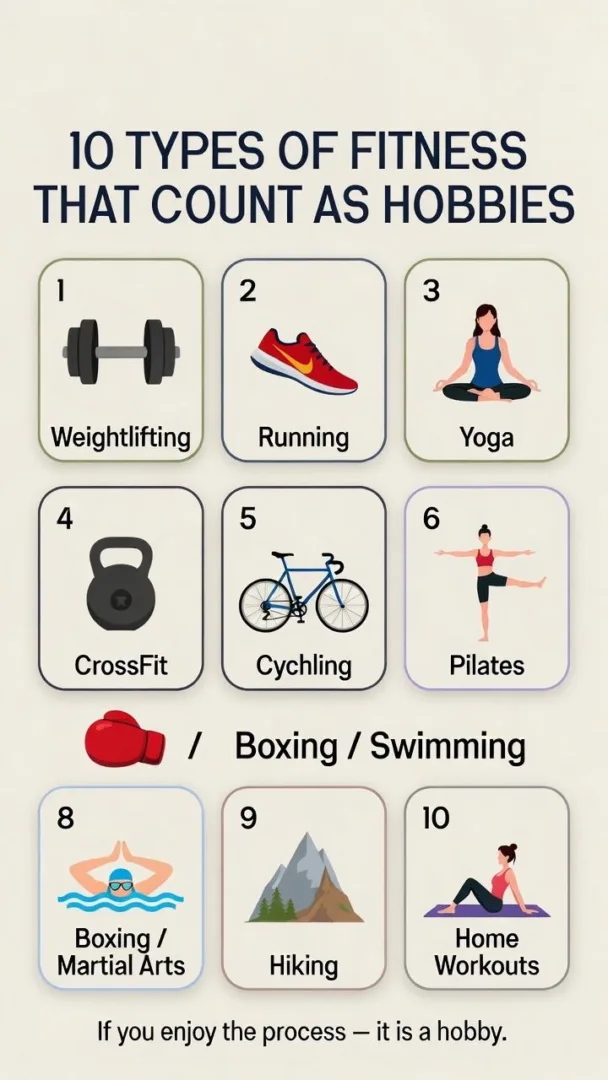
If you are unsure whether your specific type of exercise qualifies as a hobby, this table settles it.
1. Weightlifting and Strength Training. Lifting weights, bodyweight exercises like pushups, squats, lunges, and dips, and muscle building programs are hobbies when pursued for enjoyment and personal challenge. The progression — lifting more, building visible strength — provides the same satisfaction as leveling up in any skill-based hobby.
2. Running and Jogging. Running is a hobby when you run for the experience, not just the exercise. The meditative quality of a solo run, the exploration of new routes, the community of running groups — all hobby-grade characteristics.
3. Yoga. Yoga is a physical, mental, and spiritual practice that is unambiguously a hobby for the millions who practice it. The progression from beginner poses to advanced flows provides the same skill-development satisfaction as any creative hobby. If you enjoy yoga, our guide on things to do when bored alone has more mindful movement options.
4. CrossFit and Functional Fitness. CrossFit built an entire culture around treating fitness as a community hobby. The box (gym), the WOD (workout of the day), the leaderboard, the competitions — all hobby infrastructure.
5. Cycling. Cycling is transportation, exercise, and hobby simultaneously. The community, the gear, the routes, the challenges — all hobby signals.
6. Pilates. Pilates is a controlled-movement practice that demands precision and concentration. The discipline of form is what makes it feel like a skill-based hobby rather than generic exercise.
7. Boxing and Martial Arts. Boxing is a hobby when you train for the craft, not for a fight. The technique, the footwork, the bag work, the discipline — all hobby-grade engagement. If you want a deeper dive on physical hobbies, our article on 50 Hobbies to Try has martial arts in the Mover category.
8. Swimming. Swimming is one of the few exercises that works every muscle group simultaneously. Lap swimming has a meditative, rhythmic quality that makes it feel more like a practice than a workout.
9. Hiking. Hiking is walking with scenery, challenge, and discovery. It is universally recognized as a hobby and is one of the most searched hobby-related terms online. Our guide on things to do when bored in spring has seasonal hiking ideas.
10. Home Workouts and Bodyweight Training. Following YouTube workouts, Nike Training Club routines, or Peloton sessions from your living room is a hobby when you enjoy the process. The equipment does not define the hobby. The enjoyment does.
Is Working Out an Attractive Hobby?
Yes — and research supports why. Studies show that people who exercise regularly are perceived as more disciplined, more energetic, and more confident. But the attraction is not about the body changes. It is about what fitness signals: that a person has the discipline to pursue something consistently and the self-awareness to invest in their own wellbeing. Those qualities are attractive in every context — professional, social, and personal.
On dating profiles and in social settings, fitness as a hobby signals that you value health, have a consistent routine, and have interests beyond passive consumption. That combination is more attractive than the six-pack itself. If you want to explore other hobbies that develop these qualities, our guide on modern hobbies to beat boredom in 2026 covers 20 hobby options that build discipline and creativity.
“Working Out Is Not a Hobby” — Addressing the Reddit Argument
The most common argument against working out as a hobby is: “It is not a hobby because everyone should do it.” This argument appears frequently on Reddit and in casual conversations. Here is why it does not hold up:
The obligation argument fails. Everyone should eat well too, but cooking is universally recognized as a hobby. Everyone should read, but reading is a hobby. Everyone should sleep, but even sleeping has a dedicated community that treats sleep optimization as a hobby. The fact that something is also necessary does not disqualify it from being a hobby.
The simplicity argument fails. “Working out is just moving your body” is the same as saying “cooking is just heating food” or “photography is just pressing a button.” The reductive framing ignores the skill development, the community, the gear, the variety, the progression, and the genuine enjoyment that fitness provides. Our article on Is Sleeping a Hobby? addresses a similar reductive argument.
The identity argument reveals the real issue. Most people who say “working out is not a hobby” are really saying “I do not find it enjoyable, so it should not count.” That is a personal preference, not a definitional argument. Working out is a hobby for the people who enjoy it. It is not a hobby for the people who do not. Both experiences are valid.
How to Turn Working Out Into a Hobby (If It Feels Like a Chore)
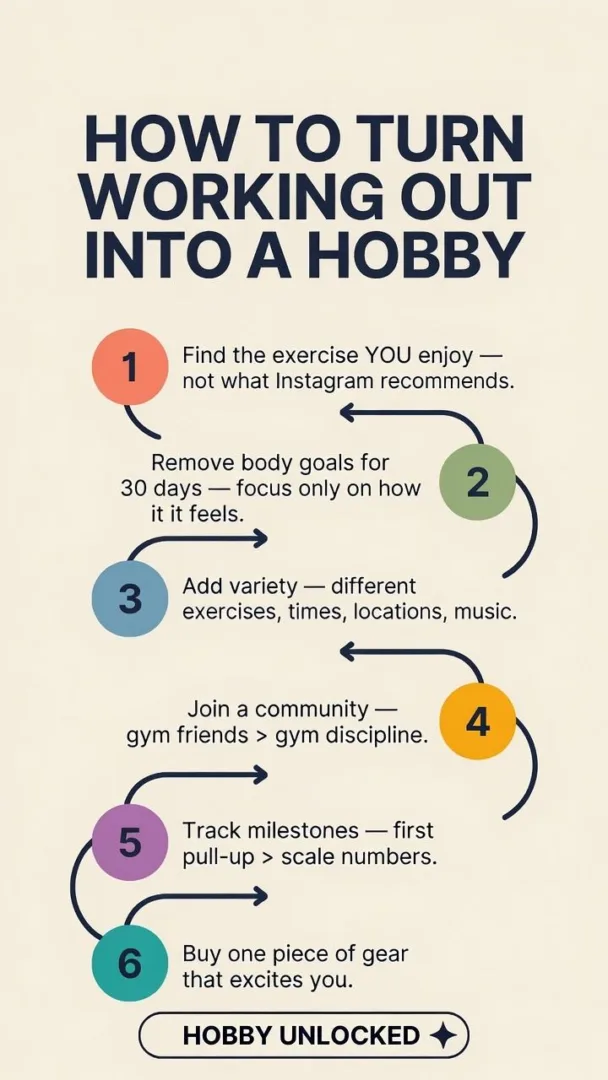
If you currently work out from obligation and want it to feel like a hobby, these 6 shifts change the experience.
1. Find the type of exercise you actually enjoy. Not the type your trainer recommends. Not the type Instagram promotes. The type that makes you lose track of time. If running bores you, try climbing. If the gym feels sterile, try outdoor cycling. If solo workouts feel lonely, try a group fitness class. The enjoyment is in the match, not the effort.
2. Remove the body-change goal temporarily. For 30 days, exercise with no weight goal, no body composition target, no before-and-after photos. Exercise purely for how it makes you feel during and after. This resets your motivation from extrinsic (body changes) to intrinsic (enjoyment). Peloton instructor Tunde Oyeneyin calls this “returning to your why.”
3. Add variety to prevent fitness boredom. Kelly Barbera at Temple Fitness says boredom is the biggest reason people stop exercising. Variety prevents it: different exercises, different times of day, different locations, different music. Rotate your routine monthly. If you want a framework for building variety into your activity choices, our guide on how to build a dopamine menu when bored covers the system.
4. Join a fitness community for social support. CrossFit, running clubs, cycling groups, climbing gyms, yoga studios — all provide social infrastructure that makes fitness feel like belonging, not obligation. The community transforms “I have to go to the gym” into “I want to see my gym friends.”
5. Track milestones, not just metrics. Instead of tracking weight and body fat, track milestones: first unassisted pull-up, first 5K without stopping, first yoga headstand, first time lifting your body weight. Milestones produce hobby-grade satisfaction because they represent skill, not just effort.
6. Buy one piece of workout gear that excites you. New running shoes, a gym bag you love, wireless earbuds that stay in during burpees, a yoga mat in your favorite color. The gear ritual is part of what makes hobbies feel special. Apply it to fitness.
Is Working Out a Hobby for Specific Groups?
Is exercising a hobby for busy adults? Yes. A 20-minute home workout on YouTube or Nike Training Club counts. The time does not define the hobby. The enjoyment does.
Is going to the gym a hobby? Yes. The gym is the venue. The hobby is the training. Going to the gym 3 to 5 times per week because you enjoy being there is textbook hobby behavior.
Is running considered a hobby? Absolutely. Running has one of the largest hobby communities in the world: running clubs, races, gear culture, route tracking apps, marathon culture. It is both exercise and hobby simultaneously. If you want more physical hobbies, our guide on exercises to do when bored has 20 movement-based options.
Is working out a hobby for people with ADHD? Yes — and it may be particularly valuable. Exercise increases dopamine production, which ADHD brains are chronically low on. The novelty of varying workouts satisfies the ADHD craving for new stimulation. Our guide on things to do when bored with ADHD covers the neurodivergent approach to activity selection.
Is Pilates a hobby? Yes. Pilates is a skill-based movement practice with progression, community, and personal growth — all hobby criteria.
Is yoga a hobby? Yes. Yoga has been practiced as a personal hobby for thousands of years. The 2026 version — YouTube classes, studio memberships, retreat culture — is hobby infrastructure at scale.
Final Thoughts
Working out is a hobby when you enjoy the process, look forward to sessions, explore new exercises out of curiosity, and feel satisfied after training — not guilty when you skip. The science confirms it: exercise produces the same dopamine, endorphins, and reward-system activation as any recognized hobby. The community confirms it: millions of people worldwide treat fitness as their primary leisure activity.
The debate about whether working out “counts” is a debate about definitions, not about reality. In reality, the person who looks forward to their morning run is experiencing the same hobby-grade enjoyment as the person who looks forward to their evening painting session. The brain does not care about the label. The brain cares about the reward.
If you currently work out from obligation and want it to feel like a hobby, the shift is not about doing more. It is about finding the type of movement you genuinely enjoy, removing the pressure to achieve a body goal, and letting yourself experience exercise the way a hobbyist experiences any passion: with curiosity, variety, community, and the freedom to enjoy the process without justifying the outcome.
Pick the exercise that makes you lose track of time. That one is your hobby. If you do not know which type of exercise matches your personality, our guide on how to find a hobby has a 5-question framework that works for fitness and every other hobby category. And if you are looking for more hobby ideas beyond fitness, our guide on 50 hobbies to try in 2026 covers 10 personality types with 5 matched hobbies each.