30 Outdoor Hobbies You Can Actually Start (18 Need No Car at All)
Most “outdoor hobbies” lists read like a gear catalog written for someone who already lives next to a mountain. You scroll past sea kayaking, alpine climbing, and whitewater rafting, and you quietly close the tab — because you live in an apartment, you don’t own a roof rack, and the nearest “wilderness” is the landscaping outside a retail park.
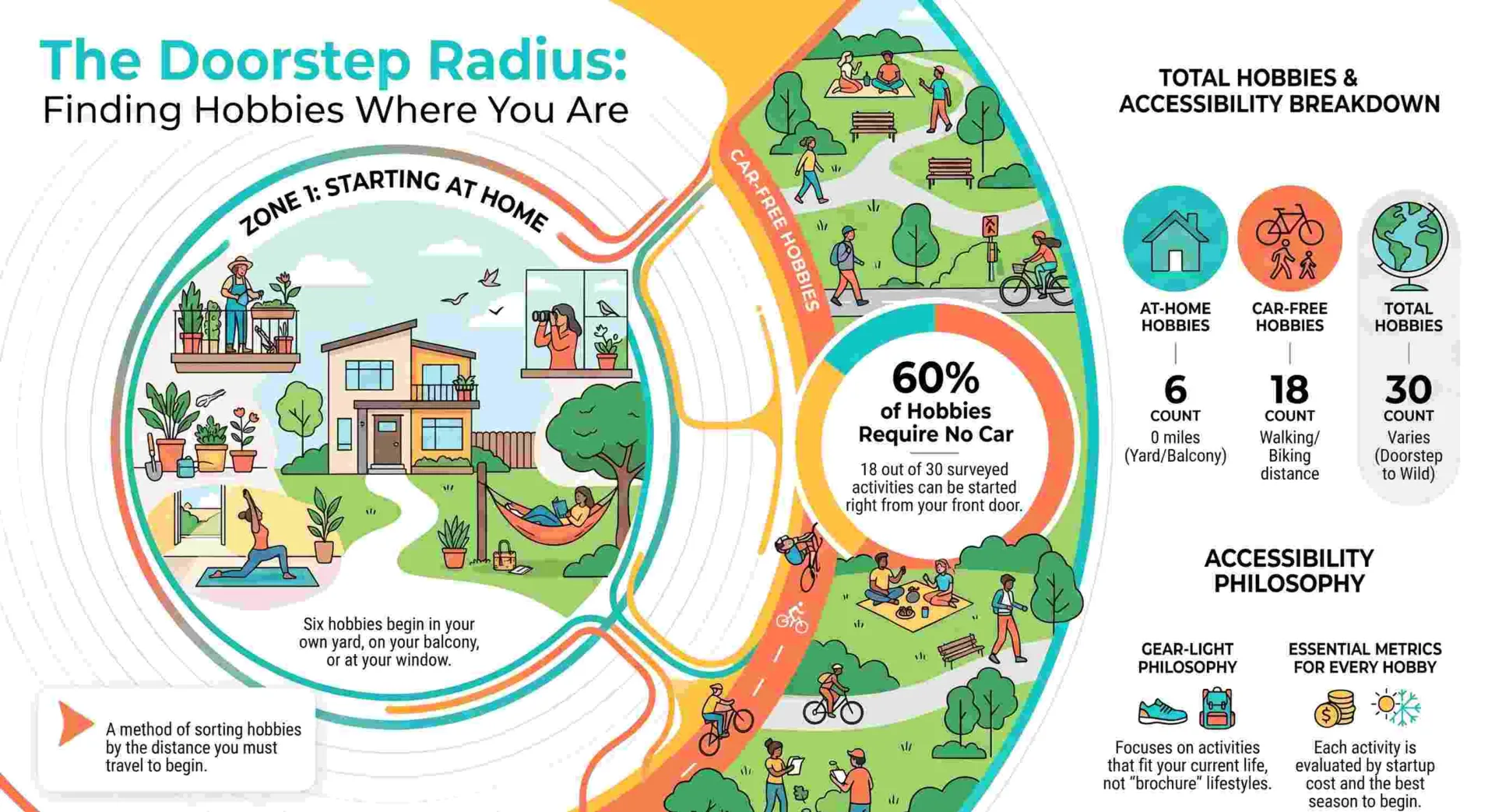
So I built this list differently. I took 30 outdoor hobbies and sorted every single one by one honest question: how far from your front door do you actually have to travel before you can start? I call it the Doorstep Radius, and it flips the whole conversation. When you sort by distance instead of by adventure level, a quiet fact falls out — 18 of these 30 hobbies need no car at all, and six of them start in your own yard, on your balcony, or at your bedroom window.
Below, we walk all five zones of the Radius — doorstep to true wild — with a startup cost and a best season for every hobby, so you can pick one that fits the life you already have, not the one a brochure wishes you had.
The Doorstep Radius: pick an outdoor hobby by distance, not gear
The Doorstep Radius sorts outdoor hobbies into five zones by how far you must travel to begin: Doorstep (0 minutes), the Block (a 5-minute walk), the Park (15 minutes), the Edge of Town (a 30-minute drive), and the Wild (a real trip). Pick the smallest zone you can reach today, and start there.
Every other outdoor list you’ll read organizes itself the same two ways: by activity type (“water sports,” “winter sports”) or by difficulty (“easy,” “extreme”). Both quietly assume you can already get to the outdoors. The Doorstep Radius assumes the opposite — that access, not interest, is the thing standing between you and a hobby — and then removes it, one ring at a time.
When I placed all 30 hobbies on the map, the numbers were friendlier than the brochures suggest. 18 of the 30 need no car. Nine can be started for $10 or less. The median startup cost across the whole list is about $25. And the expensive, trip-based adventures everyone pictures first? Just six of the thirty. Here’s the shape of it:
| Zone | How far | A few of its hobbies | Median startup |
|---|---|---|---|
| 1. Doorstep | 0 minutes | Balcony gardening, backyard stargazing, feeder birdwatching | $10 |
| 2. The Block | 5-min walk | Rucking, geocaching, tree-ID walks, urban sketching | $0 |
| 3. The Park | 15 minutes | Disc golf, outdoor yoga, kite flying, macro photography | $18 |
| 4. Edge of Town | 30-min drive | Hiking, mountain biking, kayaking, bouldering | $65 |
| 5. The Wild | A real trip | Backpacking, caving, rafting, skiing, sailing | $120+ |

The full outdoor hobbies list (with cost and season)
This is the whole Doorstep Radius list at a glance — all 30 outdoor hobbies with their zone, startup cost, best season, and whether they work solo. Skim for the smallest zone that fits your week, then jump to that section below.
| Hobby | Zone | Startup | Best season | Good solo? |
|---|---|---|---|---|
| Container & balcony gardening | Doorstep | $20 | Spring–Fall | Yes |
| Naked-eye stargazing | Doorstep | $0 | Year-round | Yes |
| Feeder birdwatching | Doorstep | $15 | Fall–Winter | Yes |
| Nature journaling & sketching | Doorstep | $8 | Year-round | Yes |
| Moth-lighting | Doorstep | $12 | Summer | Yes |
| Sky & street photography | Doorstep | $0 | Year-round | Yes |
| Walking & rucking | The Block | $0 | Year-round | Yes |
| Neighborhood running | The Block | $0 | Year-round | Yes |
| Geocaching | The Block | $0 | Year-round | Either |
| Lichen & tree-ID walks | The Block | $0 | Year-round | Yes |
| Urban sketching (plein air) | The Block | $10 | Spring–Fall | Yes |
| Frisbee / disc | The Block | $12 | Spring–Fall | Group |
| Disc golf | The Park | $20 | Spring–Fall | Either |
| Outdoor yoga & tai chi | The Park | $15 | Spring–Fall | Either |
| Wildflower pressing & foraging | The Park | $10 | Spring–Summer | Yes |
| Kite flying | The Park | $18 | Spring | Either |
| Lawn games (spikeball, bocce) | The Park | $40 | Summer | Group |
| Macro & nature photography | The Park | $0–120 | Spring–Fall | Yes |
| Hiking | Edge of Town | $30 | Spring–Fall | Either |
| Mountain biking | Edge of Town | $400 | Spring–Fall | Either |
| Fishing & kayak fishing | Edge of Town | $60 | Spring–Fall | Yes |
| Kayaking / canoeing / SUP | Edge of Town | $0 rent | Summer | Either |
| Rock climbing & bouldering | Edge of Town | $80 | Year-round | Either |
| Orienteering | Edge of Town | $10 | Fall–Spring | Either |
| Backpacking & thru-hiking | The Wild | $250 | Summer–Fall | Either |
| Caving / spelunking | The Wild | $50 | Year-round | Group |
| Whitewater rafting | The Wild | $90 | Late spring–Summer | Group |
| Skiing & snowboarding | The Wild | $150 | Winter | Either |
| Sailing | The Wild | $200 | Summer | Group |
| Sandboarding | The Wild | $25 | Warm & dry | Either |
Zone 1 — Doorstep hobbies (0 minutes from your door)
Doorstep hobbies are the first ring of the Radius: the outdoors starts exactly where you already stand — a balcony, a back step, a window that opens. All six need zero travel and usually no more than a phone or a $20 kit, which makes them the fastest way to prove to yourself that you are, in fact, an outdoor person.
1. Container & balcony gardening — You don’t need a yard — a railing, a few pots, and a bag of soil turn any balcony into a growing space. Start with herbs (they forgive beginners) and you’ll be snipping basil by midsummer. Cost climbs only if you let it.
2. Naked-eye stargazing — The oldest outdoor hobby there is, and still free. Learn three constellations, open a free sky-map app, and step outside on a clear night. The Babylonians were doing this from their rooftops thousands of years ago; you can do it from yours.
3. Feeder birdwatching — Hang one feeder within view of a window and the outdoors comes to you. Within a week you’ll recognize regulars; within a month you’ll be quietly furious at the squirrels. Fall and winter bring the most visitors.
4. Nature journaling & botanical sketching — A cheap notebook, a pencil, and ten minutes on your step. You’re not making gallery art — you’re slowing down enough to actually see the leaf you’re drawing. It pairs beautifully with the birdwatching above.
5. Moth-lighting — A gentler, weirder cousin of birdwatching: hang a white sheet, shine a light on it after dark in summer, and watch the moths arrive. It costs about $12 and reliably astonishes kids — mine included.
6. Sky & street photography — The phone in your pocket is a capable camera. Practice light, clouds, and macro shots of the plants near your door before you ever spend a dollar on gear. It’s the on-ramp to nature, travel, and wildlife photography later.
Natty’s take: For two full years I told anyone who asked that I “wasn’t outdoorsy.” Then I hung a single bird feeder outside the kitchen window so my four kids would look up from their screens. Three weeks later I was the one narrating cardinal drama over breakfast. Doorstep hobbies don’t ask you to become a different person — they just open a window.

Zone 2 — The Block (a 5-minute walk)
The Block is the second ring of the Radius: anything you can reach on foot without planning a trip. These six hobbies turn ordinary sidewalks and a nearby patch of green into your gear-free outdoor gym and gallery — five of them start at exactly $0.
1. Walking & rucking — Walking is the most underrated outdoor hobby alive. Add a loaded backpack — that’s “rucking” — and a stroll quietly becomes a workout. No shoes to buy, no membership, no season it doesn’t work in.
2. Neighborhood running — Start with a run-walk around one block and build from there. The barrier to entry is genuinely just a door and a pair of shoes you already own; the gear conversation can wait until you’re hooked.
3. Geocaching — A worldwide treasure hunt hidden in plain sight. Open a free app and you’ll almost certainly find a cache within a five-minute walk of where you’re sitting. It’s outdoor exploration disguised as a game — and yes, it absolutely counts as a hobby.
4. Lichen & tree-identification walks — Pick one thing — lichen, bark, leaf shape — and learn to name it. Suddenly a boring street becomes a field guide you can read. A free plant-ID app is all the equipment you’ll ever need.
5. Urban sketching — Plein-air drawing without the mountain: sit on a bench and draw what’s in front of you. A $10 pocket sketchbook and pen make this one of the cheapest creative outdoor hobbies there is.
6. Frisbee & disc — The lowest-friction way to make an outdoor hobby social. A $12 disc and any open stretch of grass — a park lawn, a schoolyard after hours — is the entire setup.
Zone 3 — The Park (about 15 minutes away)
The Park is the third ring of the Radius: the nearest public green space, reachable in roughly 15 minutes on foot, bike, or bus. This is where outdoor hobbies get playful and a little more equipped — but still under $40 to begin, and still no car required.
1. Disc golf — Frisbee’s addictive sibling. Most cities now have free public courses; a starter set of three discs runs about $20 and lasts for years. Easy to learn, genuinely hard to master.
2. Outdoor yoga & tai chi — Take the mat outside. Practicing under trees adds something a studio can’t — the research on “green exercise” shows a real mood and stress-hormone benefit to moving your body in nature.
3. Wildflower pressing & beginner foraging — Collect, press, and identify what grows near you. It’s slow, seasonal, and quietly meditative. (One rule: never eat a foraged plant you can’t identify with total certainty.)
4. Kite flying — Absurdly joyful and criminally overlooked. A breezy park, an $18 kite, and a spring afternoon — that’s the whole hobby, and it works just as well solo as with kids.
5. Lawn games — Spikeball, bocce, cornhole — the connective tissue of a good afternoon outside. A little pricier as a set, but it’s the hobby most likely to turn into a standing weekend ritual with friends.
6. Macro & nature photography — Graduate from phone photos to intentional composition. Shoot dew, insects, bark, light through leaves. You can begin with the phone you already own and only later decide whether a lens is worth it.
Zone 4 — The Edge of Town (a 30-minute drive)
The Edge of Town is the fourth ring of the Radius: the trailheads, lakes, and crags that a short drive puts within reach. These are the hobbies most people mean when they say “outdoorsy” — and the good news is you can rent or borrow your way into every one before buying a thing.
1. Hiking — The gateway outdoor hobby, because hiking requires so little gear. A pair of shoes with grip and a water bottle will get you started; the trails do the rest. Spring and fall are the sweet spot in most of the country.
2. Mountain biking — More gear-heavy up front, but a used bike from a local shop keeps the entry sane. Start on gentle trails and let the technical stuff come to you. This is a hobby that rewards patience over cash.
3. Fishing & kayak fishing — Deeply meditative or quietly competitive, depending on your temperament. A basic rod-and-reel combo runs about $60, and adding a kayak later unlocks stealthy, still-water fishing that shore anglers never reach.
4. Kayaking, canoeing & paddleboarding — The best-value entry on this whole list: nearly every lake town rents by the hour, so you can try all three for the price of an afternoon before committing to your own boat. Summer is prime.
5. Rock climbing & bouldering — Start indoors at a climbing gym to build strength and confidence, then take it to real rock at the edge of town. A day pass and rental shoes — around $80 all in — is a low-commitment first taste.
6. Orienteering — Navigation as sport: a map, a compass, and a course through the woods. It’s hiking with a puzzle bolted on, costs about $10 to start, and sharpens a skill screens have quietly taken from us.

Zone 5 — The Wild (worth the trip)
The Wild is the outermost ring of the Radius: the six hobbies that genuinely need a planned trip, a guide, or a season. They cost the most and happen the least often — but they’re also the ones that hand you a story you’ll tell for years. Treat them as the reward, not the requirement.
1. Backpacking & thru-hiking — Multi-day hiking with everything on your back. It’s the natural graduation from day hikes; borrow or rent the big-ticket items (tent, pack, bag) for your first overnight before you invest.
2. Caving & spelunking — Underground exploration through a hidden world of stalagmites, bioluminescent glowworms, and reflecting pools. Go with a guided outfit first — places like Marakoopa Cave in Australia’s Mole Creek Karst National Park show just how surreal a good cave can be.
3. Whitewater rafting — Pure adrenaline, and safest as a guided day trip your first few times. Late spring and early summer bring the biggest water. No gear to own — the outfitter supplies all of it.
4. Skiing & snowboarding — The winter answer to “there’s nothing to do outside.” Rentals plus a lesson and a lift ticket keep the first day around $150, far less than the buy-everything path most beginners assume they need.
5. Sailing — Learning to read wind and water is a lifelong craft. A beginner’s day course gets you on the water fast, and from there the horizon only widens — all the way to bucket-list expeditions like sailing Antarctica if the bug truly bites.
6. Sandboarding & wildlife-photography trips — Two warm-weather thrills to close on: sandboarding down a dune with a rented board, and dedicated wildlife-photography travel. Court Whelan of Nat Hab, who writes The Natural Photographer blog, has built a whole craft around the latter — photographing wildlife everywhere from the Galápagos to Botswana to Greenland.
Outdoor hobbies in the city
City living doesn’t shrink the Doorstep Radius — it just front-loads it. Urbanites have the richest Zone 1 and Zone 2 of anyone: rooftop stargazing, balcony gardening, sidewalk sketching, park disc golf, and geocaching are all built for dense neighborhoods, and none of them need a car.
The trick in a city is to treat every ring you already have as generous rather than second-best. A single city park can hold four or five of the hobbies above at once. Climbers turn to indoor gyms and “urban canyon” bouldering; runners get a lit, safe loop most suburbs would envy; birdwatchers discover that parks are migration magnets. When you do want Zone 4 and 5, that’s what a rented car or a friend’s weekend is for — an occasional treat, not a daily barrier.

Outdoor hobbies to do alone
The best solo outdoor hobbies are the ones that are absorbing without being risky alone. On the Doorstep Radius, that means most of Zones 1–3 — gardening, stargazing, nature journaling, walking, running, sketching, foraging, and photography all shine solo — while harder Zone 4–5 activities are safer with a partner or group.
Solitary time outdoors is a genuine reset for the nervous system, not a consolation prize. If you’re after more of it, our guide to solo hobbies and our things to do by yourself pair perfectly with this list. One safety habit for any solo outing past Zone 3: tell one person where you’re going and when you’ll be back.
Outdoor hobbies for couples
The best couple’s outdoor hobbies live in the middle rings of the Radius — close enough to do on a normal evening, shared enough to actually talk during. Think geocaching, disc golf, kite flying, hiking, and renting a two-person kayak: low cost, low pressure, and no phones.
What makes an outdoor hobby work for two isn’t novelty — it’s a shared, low-stakes challenge you can both be beginners at. Lawn games and paddling win because nobody’s the expert. If date ideas are what you’re really after, our hobbies to do at home guide covers the rainy-day, indoor half of the same idea.
Season by season: summer, winter, and shoulder-season picks
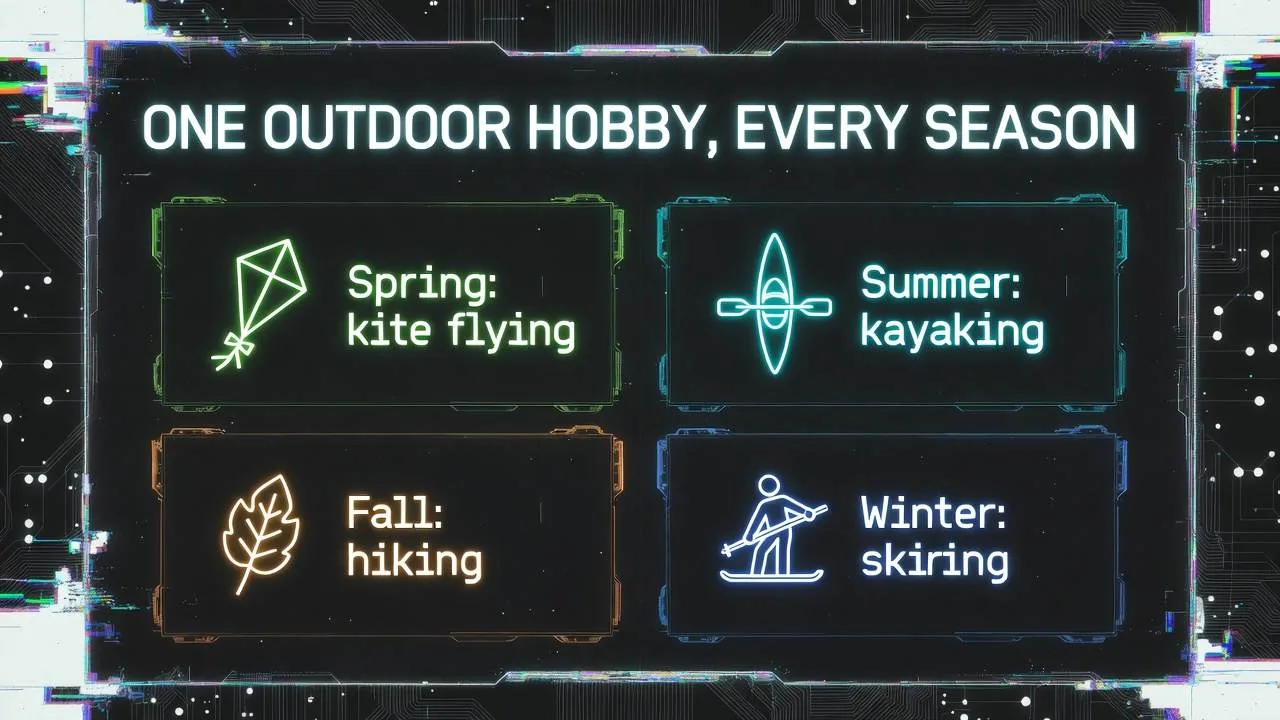
The Doorstep Radius works in every season — you just shift zones. Summer opens up water hobbies (kayaking, paddleboarding, sandboarding); winter rewards Zone 5 snow sports and Zone 1 window birdwatching; spring and fall are peak hiking, kite flying, and photography. There’s no dead season, only a different ring.
If you want a hobby that never goes out of season, choose from Zone 1: stargazing, feeder birdwatching, nature journaling, and phone photography all run year-round. Summer’s standouts are anything on water; winter’s are skiing, snowboarding, and the quiet joy of watching a busy feeder from a warm kitchen. Match the hobby to the light you actually get, and the habit sticks.
Unusual outdoor hobbies worth trying
Unusual outdoor hobbies are simply familiar ones aimed at an overlooked target: instead of “hiking,” it’s lichen-identification walks; instead of “photography,” it’s nocturnal moth-lighting. They cost little, fit the near rings of the Radius, and give you something almost no one else is doing.
A few to spark ideas: creek-bed gold panning, tidal-pool sketching, dune sunset meditation, prairie wildflower pressing, vernal-pool surveying (counting the tiny creatures in spring ponds), lava-tube exploring, and zen archery — a precision practice with roots older than most of the gear brands you’ll see at the trailhead. None of them require you to be athletic. All of them require you to be curious.
How to start without buying a pile of gear
The cheapest way into any outdoor hobby is to work the Radius inward-out: start in the smallest zone with what you own, borrow or rent before you buy, and only invest once a hobby has earned it. Nine of these 30 cost $10 or less to try, so there’s no reason to spend first.
When you’re ready to buy, buy used and buy once. Outdoor co-ops and shops resell gear at a fraction of retail, and quality names — Merrell for footwear, Patagonia, Columbia Sportswear, and The North Face for layers — last long enough to hold real resale value. Rent the expensive, occasional items (kayaks, skis, backpacking kits) until you’re certain. The gear should follow the habit, never lead it.
Natty’s take: The single biggest reason people never start an outdoor hobby is the imaginary shopping list — the belief that you need the $300 jacket before you’re “allowed” outside. You don’t. You need a door and ten minutes. Buy the jacket in year two, if ever.
One thing worth reading before you head anywhere past your own yard: the Leave No Trace Seven Principles. They’re a two-minute read, they apply just as much to a city park as to the backcountry, and they’re how the outdoors you’re about to enjoy stays worth enjoying — something conservation groups like WWF have spent decades protecting. Take photos, not souvenirs; pack out what you pack in.
What your restlessness is really telling you
If you’ve felt vaguely penned-in lately — scrolling more, sleeping worse, snapping easier — there’s a decent chance it isn’t a character flaw. It’s often a signal. Human beings are wired to spend time in natural light and open space; our circadian rhythms, our mood, and our attention all lean on it. When that input drops to zero, the body tends to notice before the mind does.
You don’t have to fix that with a grand expedition. The whole point of the Doorstep Radius is that the smallest ring counts. Ten minutes on a step with a coffee and a bird feeder is a real dose of the thing you’re missing. Start there, and let the outer rings come when they’re ready.
Frequently asked questions
Does geocaching count as an outdoor hobby?
Yes — geocaching is a legitimate outdoor hobby that combines walking, navigation, and problem-solving. It sits in Zone 2 of the Doorstep Radius (a 5-minute walk), costs nothing to start with a free app, and works solo or as a family activity.
What’s the difference between nature hobbies and outdoor hobbies?
Outdoor hobbies is the broader category — anything done outside, including sport and adventure. Nature hobbies are the subset focused on observing or interacting with the natural world, like birdwatching, foraging, and nature journaling. Every nature hobby is an outdoor hobby, but not the reverse.
Are indoor or outdoor hobbies better?
Neither is “better” — they solve different problems. Outdoor hobbies deliver natural light, movement, and stress relief; indoor hobbies win on convenience and weather-proofing. The healthiest routine usually pairs one of each, which is why our hobbies-to-do-at-home guide is a natural companion to this list.
What’s a good outdoor hobby if I have almost no free time?
Choose Zone 1. Backyard stargazing, feeder birdwatching, and nature journaling each take ten minutes and zero travel, so they fit into the gaps you already have instead of demanding a free afternoon.
What’s the cheapest outdoor hobby?
Several tie at $0: walking, rucking, neighborhood running, geocaching, tree-ID walks, and naked-eye stargazing all start with only what you already own. Nine of the 30 hobbies on this list cost $10 or less to begin.
What’s the best outdoor hobby for beginners?
Hiking and walking are the classic on-ramps because they require almost no gear or skill. If you want something that starts at your own door, feeder birdwatching or container gardening will have you hooked within a couple of weeks.
How do I find outdoor hobbies in a big city?
Lean on the inner rings of the Radius. Cities have exceptional Zone 1 and Zone 2 options — rooftop stargazing, balcony gardening, park disc golf, urban sketching, indoor-to-outdoor climbing — none of which need a car or a wilderness nearby.
Keep exploring the hobbies series
Ready to pick your ring? These guides go deeper into the hobbies world:
• Stuck inside? Start with our guide on hobbies to do at home.
• Want to wind down? See our guide on relaxing hobbies for stress relief.
• Going it alone? Browse our guide on solo hobbies to do by yourself.
• Not sure where to begin? Explore the full BoredomWizard hobbies hub for every category.
• Just plain bored? Our pillar guide on things to do when bored has a fix for every mood.