Accent Wall Paint Ideas: 18 Designs You Can Paint This Weekend (2026)
Every accent wall guide on the internet shows you a beautiful room and leaves you there. No paint name, no sheen, no idea how long it takes, no clue whether it costs $30 or $300. So this one does it differently. Every idea below comes with what paint to buy, what it costs, how hard it is, and how long it takes — because the point is not to admire a wall, it is to paint one.
The best accent wall paint ideas for 2026 are limewash in warm clay, a painted arch behind the bed, colour drenching an entire room in one deep tone, a two-tone horizontal split, and geometric tape patterns like herringbone. Flat single-colour accent walls are outdated — the trend is texture, technique and tone. A single accent wall costs $30–$80 in paint and takes 3–6 hours for most of these ideas.
Which wall should be the accent wall?
The accent wall is the one your eye hits first when you walk into the room. In most cases that is the wall you face from the doorway. Four rules:
- The wall with no doors or windows on it is almost always the right choice — interruptions break the effect.
- The wall behind the bed in a bedroom, the wall behind the sofa in a living room, the wall with the fireplace if there is one. Let the architecture decide.
- Never the biggest wall in an open-plan room. It overwhelms. Pick the smaller, defined surface — a nook, an alcove, a chimney breast.
- Test before you commit. Tape a large piece of craft paper or a bedsheet to the wall in your intended colour and live with it for a day in morning, afternoon and evening light. Colour shifts dramatically.
18 accent wall paint ideas for 2026
1. Limewash in warm clay
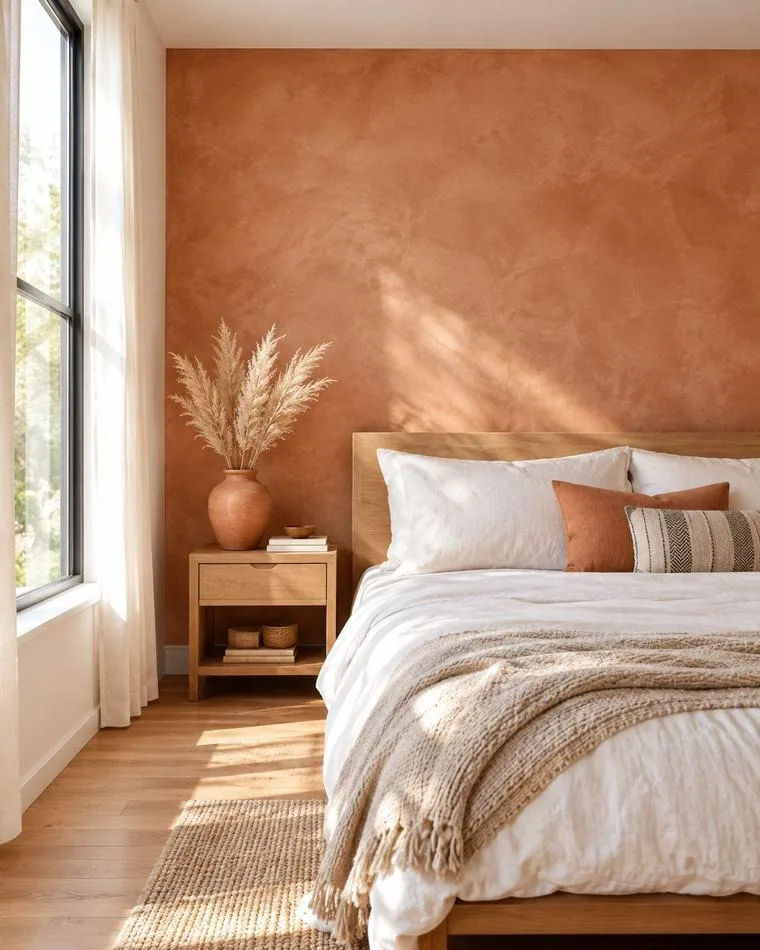
Moderate 3–5 hours (including dry time between coats) · Best for: Bedroom, living room, dining room
The single biggest accent wall trend of 2026. Limewash creates a chalky, plaster-like finish with subtle tonal variation that shifts with the light throughout the day. It looks like an Italian villa wall and it is genuinely achievable at home. The key is working in thin, overlapping strokes with a wide masonry brush and accepting the imperfection — the unevenness is the point. One coat gives a soft wash; two to three coats give a richer, more layered depth.
What to buy: Romabio Classico Limewash (Avorio warm clay or Toscana) — 1 quart covers about 120 sq ft. Apply with a 7-inch masonry brush on top of Romabio’s primer. No roller — brush only. Matte finish is the only option.
Estimated cost: $50–$70 for a quart of Romabio + $15 primer + $12 masonry brush — about $80 total for one wall
2. Painted arch behind the bed
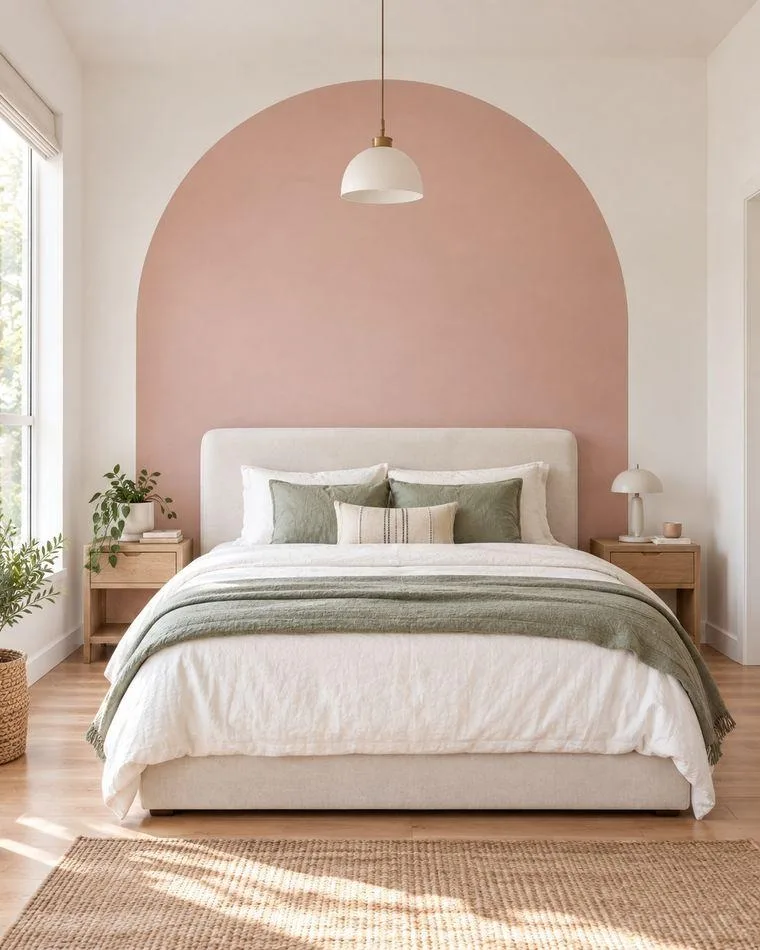
Easy 2–3 hours · Best for: Bedroom (behind the bed), nursery, reading nook
A soft arch painted directly on the wall behind the headboard, framing the bed like a built-in alcove. Use a pencil tied to a string held at the centre of the wall to sweep a half-circle, tape outside the line, and fill with your colour. The arch should extend 6–12 inches beyond the bed on each side. Dusty rose, deep teal and warm terracotta are the three colours doing the most work in this shape right now.
What to buy: One quart of any interior paint in eggshell or satin finish — Benjamin Moore Dusty Rose 2174-40, Sherwin-Williams Moody Blue SW 6221, or Behr Canyon Dusk S170-5. Pencil, string, pushpin, FrogTape multi-surface tape.
Estimated cost: $25–$40 for one quart + tape — the cheapest idea on this page
3. Colour drenching — walls, trim, ceiling, all one colour
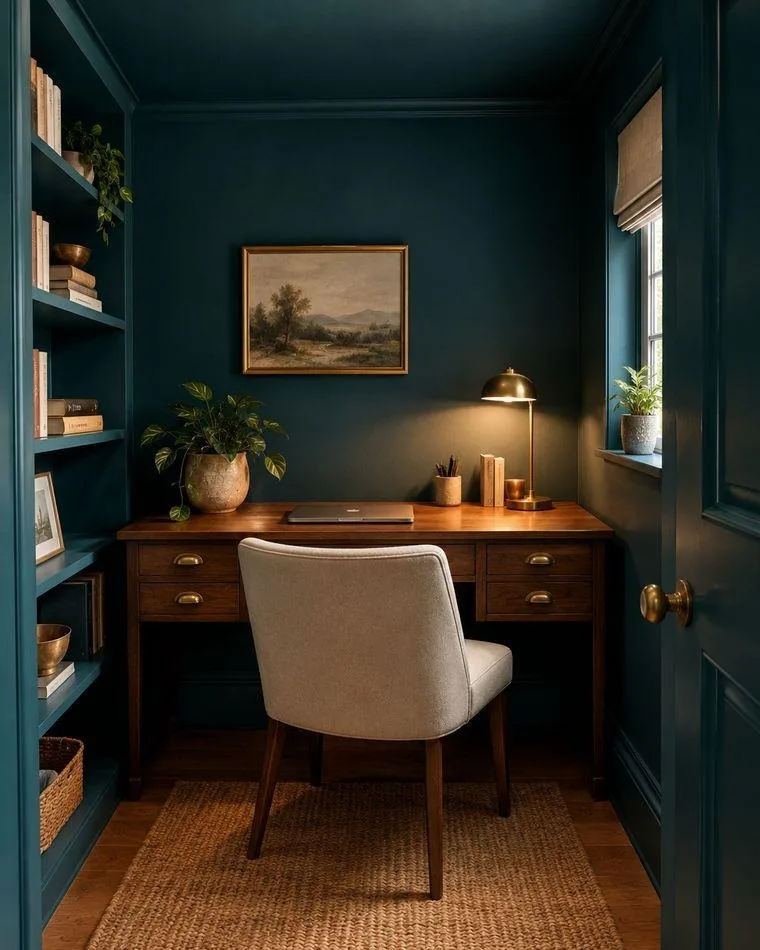
Moderate 5–7 hours (a full day project) · Best for: Powder room, home office, den, library, walk-in wardrobe
The opposite of an accent wall, and the technique that is replacing it in small rooms. Paint everything — walls, ceiling, door frames, baseboards, shelving — the same colour. The room becomes a jewel box. This works best in rooms under 12×12 ft with low ceilings: a powder room, a home office, a reading nook, a walk-in wardrobe. Dark, saturated colours read as cocooning rather than cramped.
What to buy: One gallon of premium paint in eggshell for walls and satin for trim, same colour. Sherwin-Williams Cascades SW 7623 (deep teal), Benjamin Moore Hale Navy HC-155, or Farrow & Ball Inchyra Blue No. 289. A separate small tin of the same colour in semi-gloss for the ceiling if using a flat wall paint.
Estimated cost: $55–$75 per gallon for premium paint × 1.5–2 gallons for a small room = $85–$150 total
4. Two-tone horizontal split
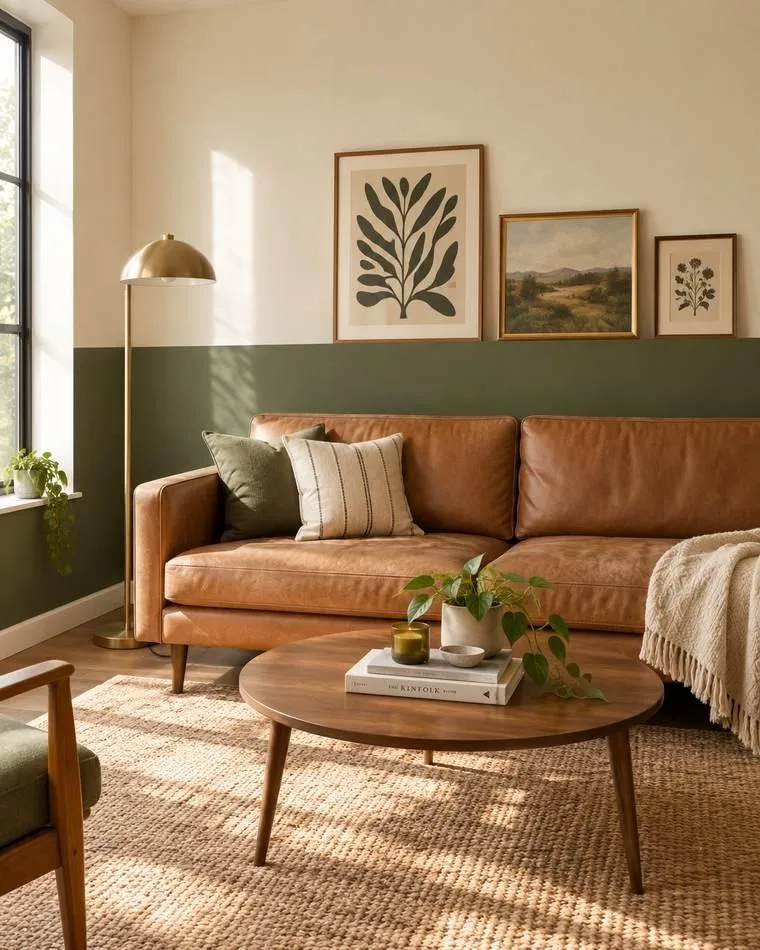
Easy 2–3 hours · Best for: Living room, hallway, dining room, bedroom
The simplest technique that still reads as a design decision. Paint the lower third of the wall a darker colour up to a crisp horizontal line at chair-rail height (32–36 inches from the floor), leave the upper two-thirds in a lighter tone or white. The proportions matter: one-third / two-thirds is more deliberate than a half-and-half split, which reads as indecisive.
What to buy: Two quarts: one darker, one lighter — or one quart plus existing wall colour. Deep olive like Sherwin-Williams Rosemary SW 6187 on the bottom, warm cream on top. FrogTape for the horizontal line. Eggshell or satin finish.
Estimated cost: $25–$50 for one to two quarts + tape
5. Herringbone tape pattern
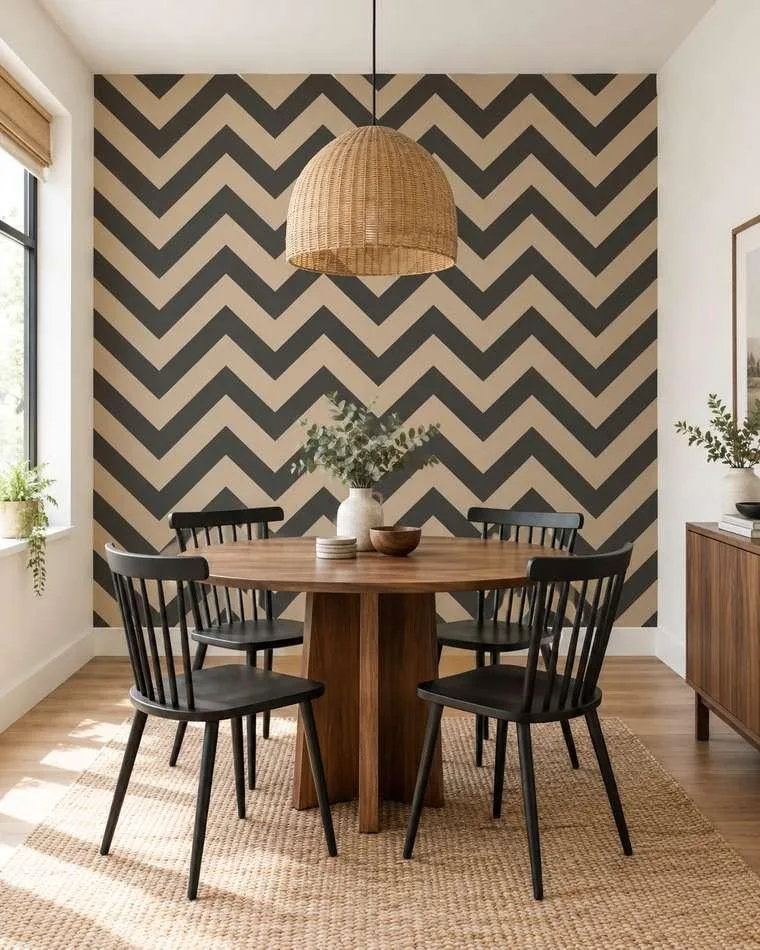
Ambitious 6–8 hours (tape layout is half the work) · Best for: Dining room, entryway, feature wall behind a console
Geometric precision using only painter’s tape and two paint colours. The herringbone V-shape is created by taping diagonal lines at 45 degrees, alternating direction. Paint the base colour first, let it dry fully, tape the pattern, then paint the second colour over the tape. Peel while the second coat is still slightly tacky for the sharpest edges. This takes patience and a laser level, but the result is a $3,000 look for under $100.
What to buy: One gallon base colour, one quart contrast colour. Warm putty beige base (Benjamin Moore Revere Pewter HC-172) with deep charcoal (Wrought Iron HC-137) herringbone. FrogTape Delicate Surface (yellow) — it peels cleaner than green. Laser level or chalk line.
Estimated cost: $55–$90 for paint + $8–12 for tape + $15–20 laser level = about $80–$120
6. Ombré gradient
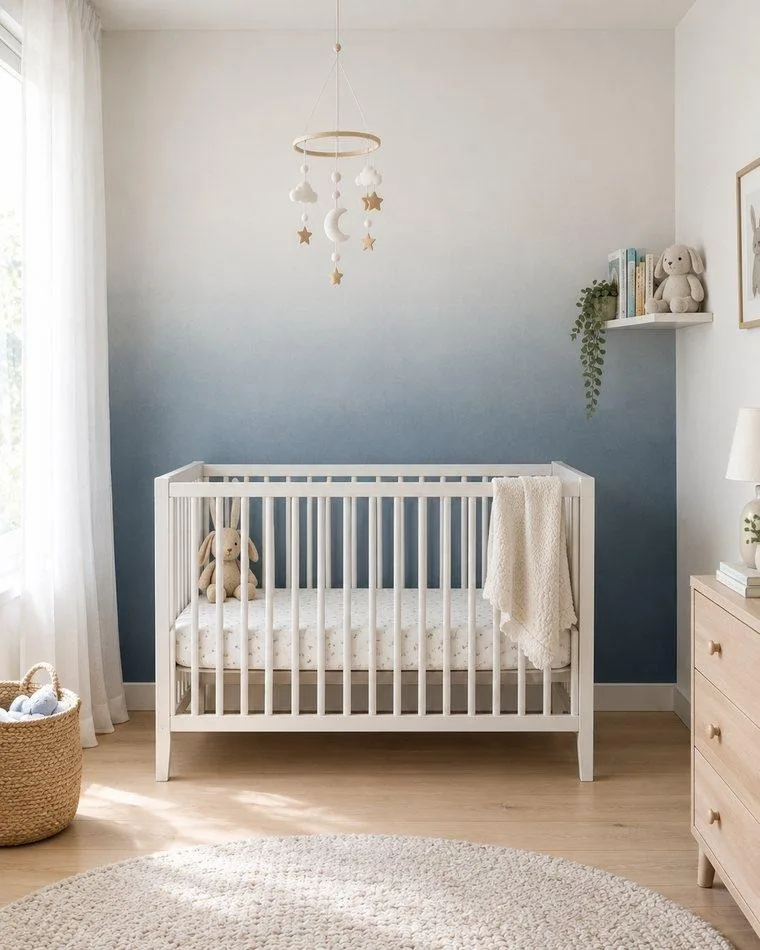
Moderate 3–4 hours (must work quickly while paint is wet) · Best for: Nursery, child’s bedroom, yoga room, reading corner
One colour fading smoothly from saturated at the bottom to white at the top. The trick is working wet-on-wet: roll your colour on the lower third, white on the upper third, and blend the middle with a clean damp roller while both sections are still wet. Work in 3-foot vertical strips from one side of the wall to the other so you always have a wet edge. Flat or matte finish blends better than satin.
What to buy: One quart of your colour, one quart of ceiling white. Dusty blue (Benjamin Moore Nimbus Grey 2131-50) or sage green (Sherwin-Williams Evergreen Fog SW 9130). Two rollers, one for colour, one for blending. Flat or matte finish only.
Estimated cost: $30–$50 for two quarts + extra roller
7. Bold diagonal colour block
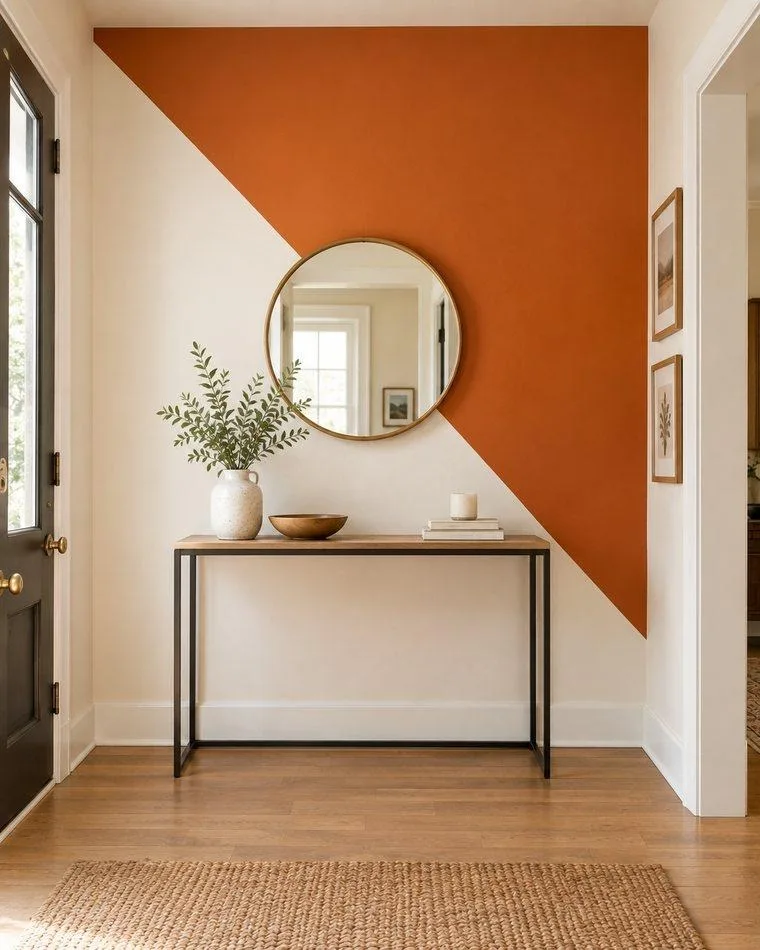
Easy 2–3 hours · Best for: Entryway, hallway, home office, teen bedroom
One sharp diagonal line from corner to corner, two contrasting colours on either side. Snap a chalk line, tape along it with FrogTape, and paint the two sides. The diagonal creates a sense of movement and energy that a horizontal split cannot. Burnt orange and warm white is the pairing that photographs best, but navy and blush or olive and cream work equally well.
What to buy: One quart accent colour — Sherwin-Williams Determined Orange SW 6635 or Behr Saffron Strands S-H-280. FrogTape. A chalk line or laser level for the diagonal.
Estimated cost: $25–$40 for one quart + tape
8. Tone-on-tone geometric triangles
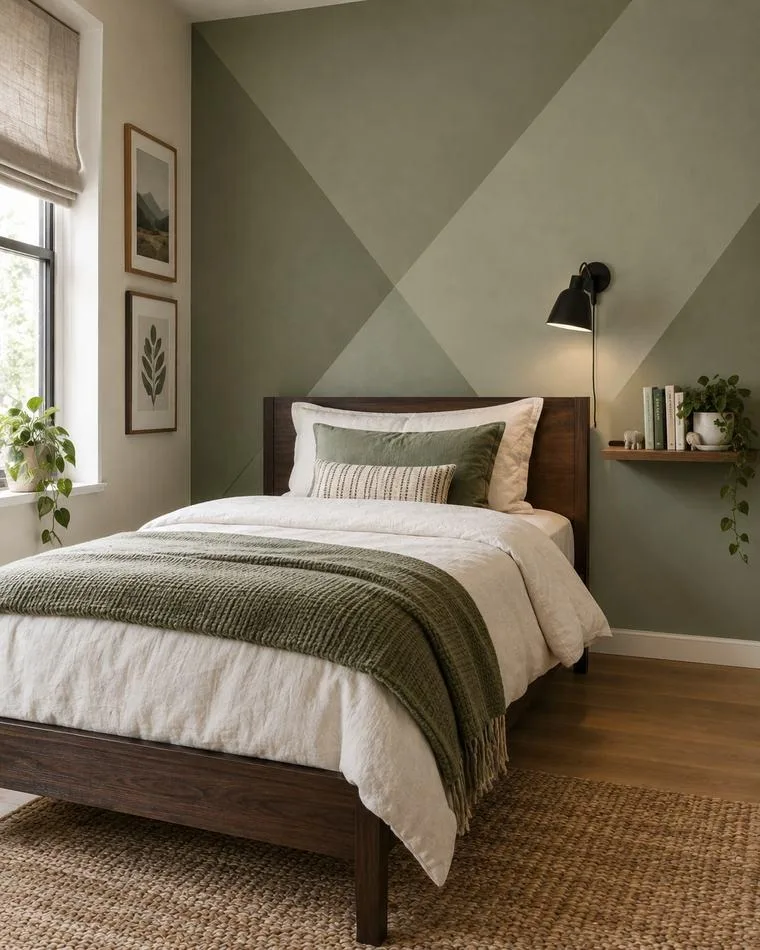
Moderate 4–6 hours · Best for: Teen bedroom, guest room, home office
Large triangles painted in three slightly different shades of the same colour — sage, or dusty blue, or warm grey. The geometry is visible from across the room but reads as textured rather than busy up close. This is the sophisticated version of geometric paint: same colour family, no contrast, pure shape. Tape is essential and the layout needs planning on paper first.
What to buy: Three quarts of the same paint in three tonal steps — e.g. Sherwin-Williams Evergreen Fog SW 9130, Clary Sage SW 6178, and Softened Green SW 6177. FrogTape. Ruler, pencil, paper plan.
Estimated cost: $40–$70 for three quarts + tape
9. Dark moody forest green
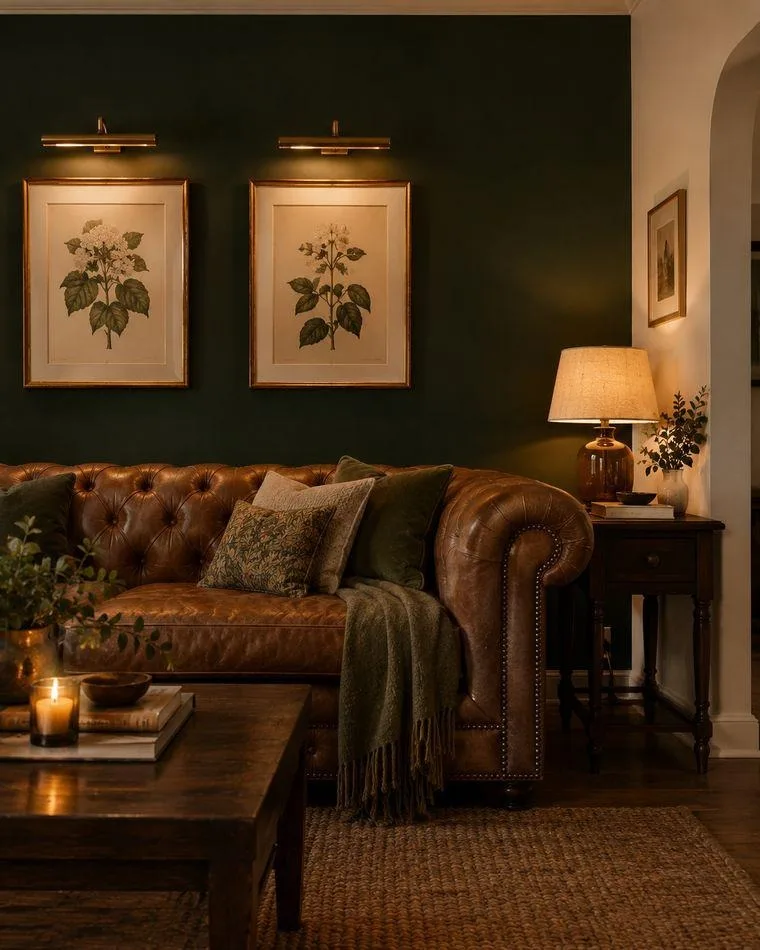
Easy 3–4 hours (two coats + primer) · Best for: Living room, dining room, bedroom, home library
The easiest dramatic transformation on this page. One wall, one deep colour, matte finish. Forest green behind warm wood and brass is the 2026 combination that replaced grey-and-chrome. The depth comes from the colour itself — no technique required. Apply tinted primer first if going from a light wall; dark colours without primer show roller marks and need three coats instead of two.
What to buy: One gallon — Benjamin Moore Essex Green HC-188 or Sherwin-Williams Rogue Green SW 6600. Matte or flat finish. Tinted primer is not optional on this one.
Estimated cost: $55–$75 for a gallon + $20–$30 tinted primer = $75–$105
10. Abstract brushstroke mural
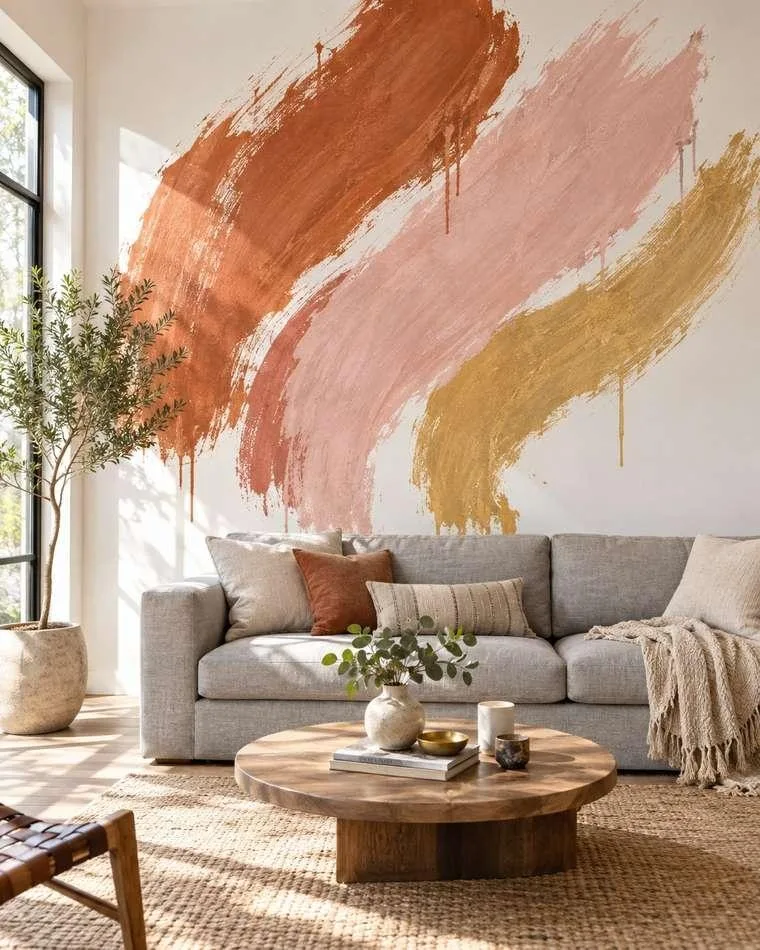
Moderate 1–2 hours (quick and spontaneous is the point) · Best for: Living room, creative studio, bedroom
Three or four sweeping, confident brushstrokes in warm terracotta, dusty pink and muted gold on a white wall, painted with a wide decorator’s brush. The key is committing to each stroke without going back over it — hesitation shows. Practice on cardboard first. Leave visible drips and texture; the imperfection is the art. This is where accent walls meet our
What to buy: Sample pots or craft acrylic in 2–3 colours (terracotta, blush, gold). A 4-inch decorator’s brush or a large artist’s brush. The base wall stays white — no need to repaint it.
Estimated cost: $15–$35 for sample pots + a wide brush — the second cheapest idea here
11. Painted mountain silhouette
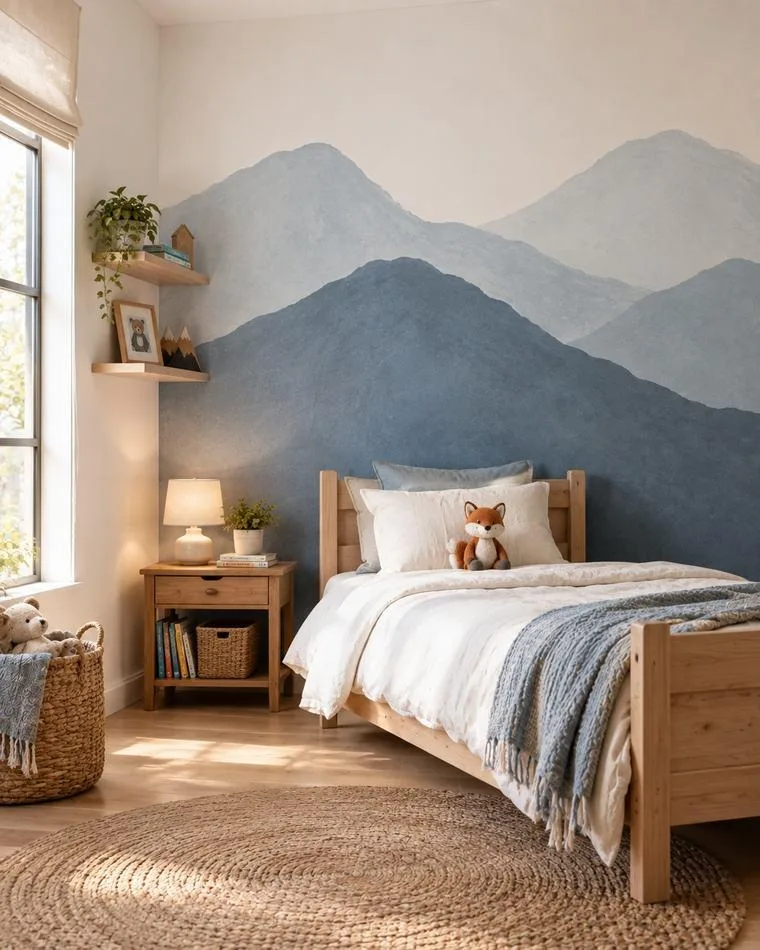
Easy 3–4 hours · Best for: Child’s bedroom, nursery, playroom
Layered mountain peaks in tonal shades — the nearest peak darkest, each receding peak lighter, fading into the white upper wall. Draw the mountain outlines freehand with a pencil (gentle curves, not jagged), tape along the lines, and paint from darkest to lightest. Three colours is the minimum; four to five gives more depth. This is genuinely easy and it is the single most-requested children’s bedroom paint treatment in 2026.
What to buy: Three to five sample pots in a tonal gradient — deep slate blue through dusty blue-grey to pale mist. Benjamin Moore Van Deusen Blue HC-156, Nimbus Grey 2131-50, and Silver Half Dollar 2121-40 is a strong three-step palette. FrogTape.
Estimated cost: $25–$50 for sample pots + tape
12. Stencilled Moroccan tile pattern
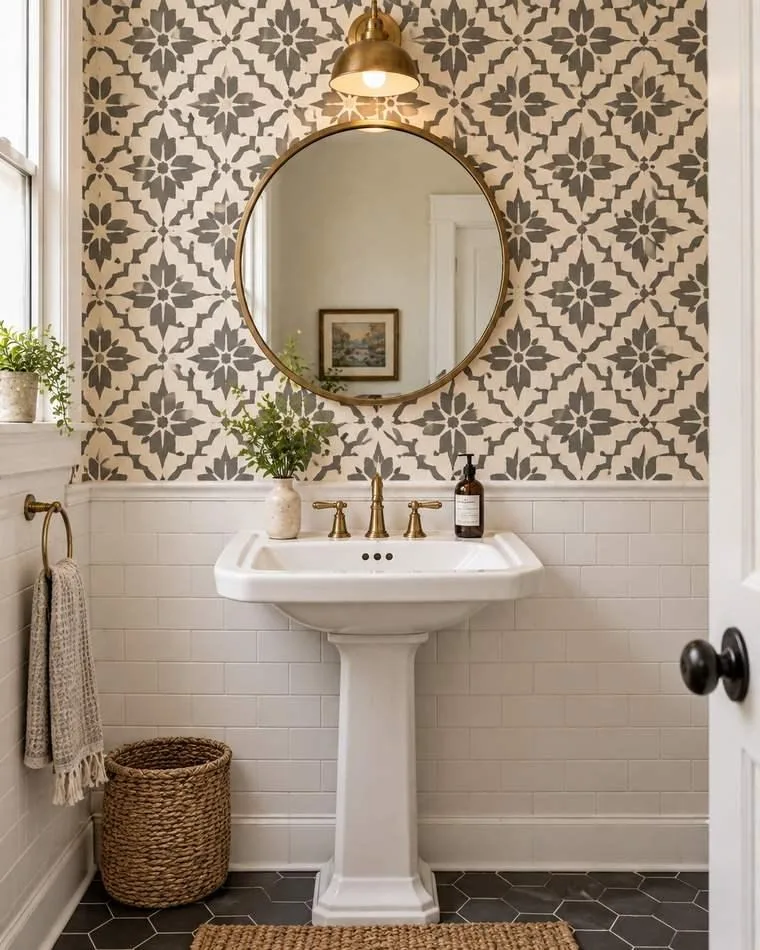
Ambitious 4–6 hours (alignment is the slow part) · Best for: Bathroom, powder room, entryway, behind a pedestal sink
A repeating geometric medallion applied with a wall stencil to mimic handmade cement tiles. The stencil does the hard work — align it, roll paint through it, lift, reposition, repeat. Charcoal on warm cream is the most versatile combination. Buy a stencil designed for walls, not crafts — wall stencils are much larger (typically 18–24 inches) and cover area dramatically faster.
What to buy: One wall stencil ($25–$40 from Cutting Edge Stencils or Royal Design Studio). One quart of contrast paint in satin finish. A small dense foam roller — not a brush, which bleeds under the stencil. Spray adhesive for the back of the stencil.
Estimated cost: $60–$100 for stencil + paint + roller + adhesive
13. Half-circle sunrise arch
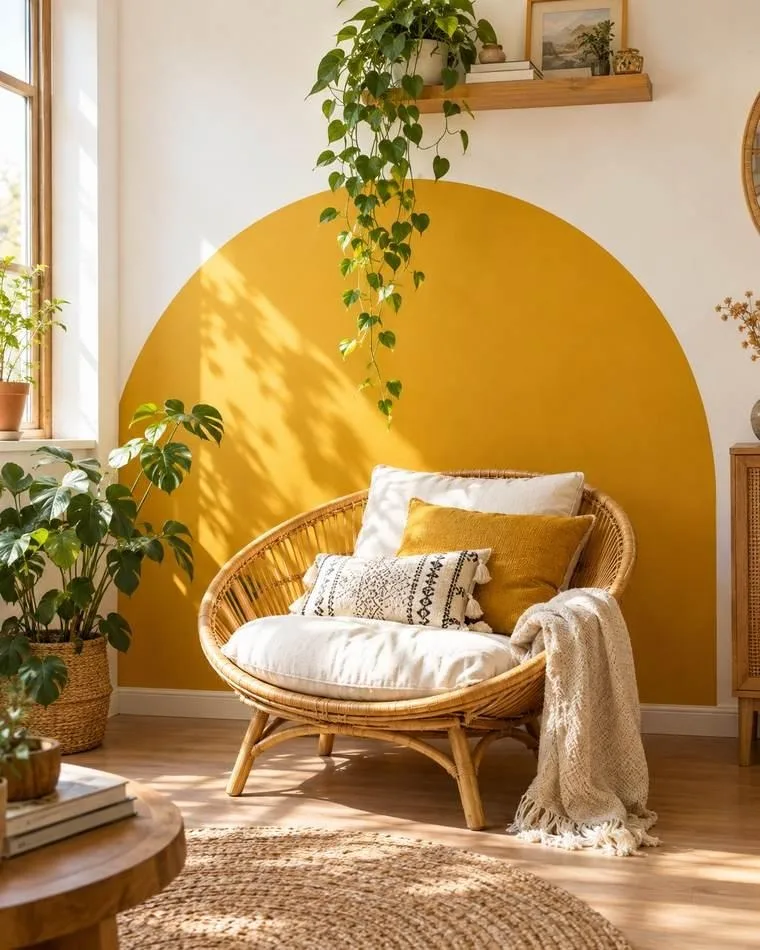
Easy 2–3 hours · Best for: Reading nook, living room corner, child’s room, behind a chair
A large half-circle rising from the floor in warm golden mustard, its curved top reaching about two-thirds up the white wall — like a rising sun. Same string-and-pencil technique as the bed arch, but anchored at the floor. One bold shape, one colour, zero complexity. This is the idea that works best in a room where every other wall is plain white.
What to buy: One quart of interior paint — Sherwin-Williams Gambol Gold SW 6690 or Behr Saffron Strands. String, pencil, pushpin, FrogTape. Satin finish.
Estimated cost: $25–$40 for one quart + tape
14. Vertical candy stripes
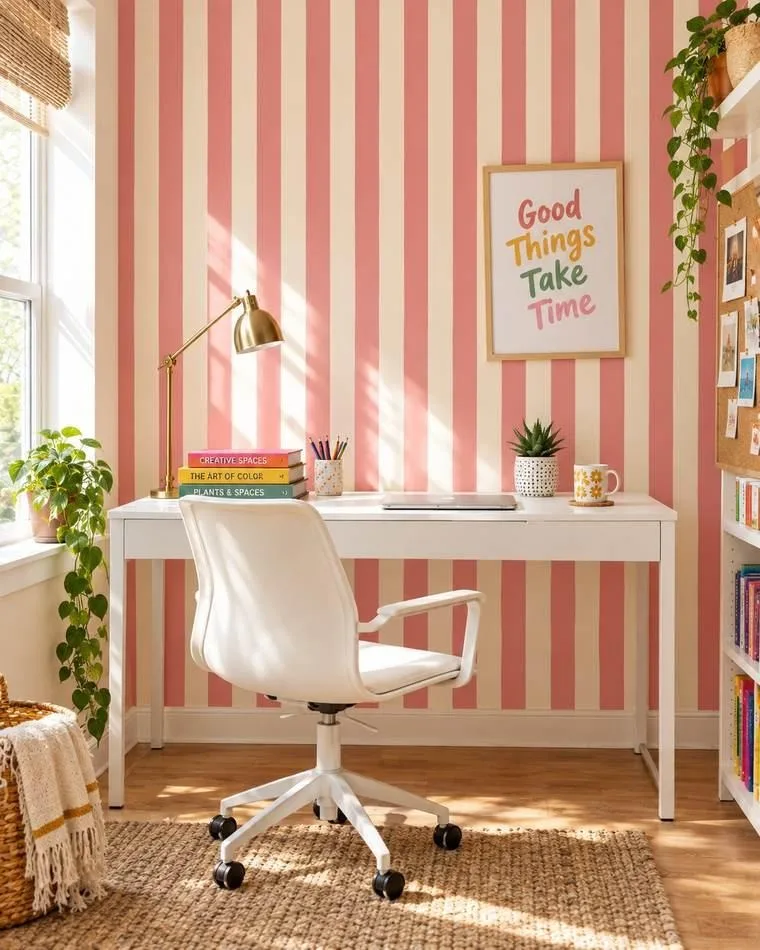
Moderate 5–7 hours (taping is 70% of the job) · Best for: Home office, powder room, child’s bedroom, creative studio
Alternating 3–4 inch stripes in two colours running floor to ceiling. Playful, graphic, and far more work than it looks — every stripe needs two edges of tape, and the tape layout for a full wall takes longer than the painting. Worth it in a small space: a powder room, a home office accent, or a child’s room. Warm dusty pink and cream is the combination that has taken over Pinterest.
What to buy: One quart of stripe colour (base wall is the other colour). FrogTape Delicate Surface. A laser level is nearly essential here for vertical accuracy. Eggshell or satin finish.
Estimated cost: $25–$45 for one quart + three rolls of tape + a laser level if you don’t own one
15. Roman clay plaster effect
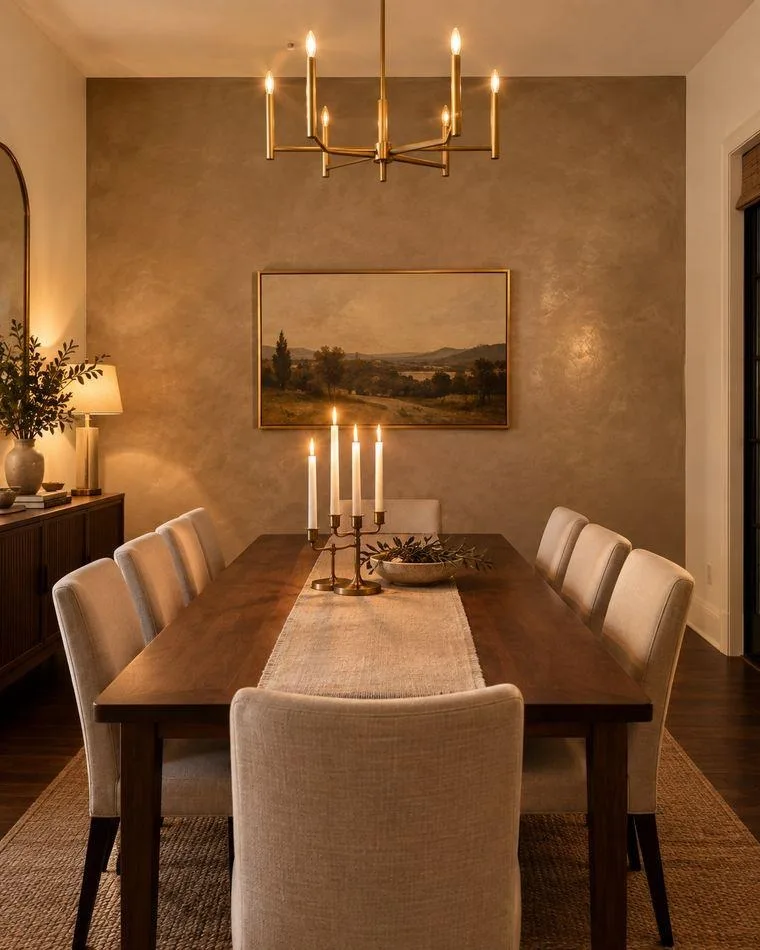
Ambitious 5–7 hours (multiple thin coats with dry time) · Best for: Dining room, primary bedroom, entryway, behind a vanity
A smooth, stone-like finish with subtle depth and a soft satin sheen. Roman clay is applied in thin layers with a flexible spatula, building up a finish that looks like polished plaster. It is more approachable than Venetian plaster but still requires practice — do a test panel on scrap drywall first. Warm mushroom, warm grey and stone beige are the colours that look best in this finish.
What to buy: Portola Paints Roman Clay (colour: Fog or Driftwood), about $85 per quart covering 60–80 sq ft. Venetian plaster spatula or Japanese taping knife. Two to three coats, sanding lightly between.
Estimated cost: $85–$130 for a quart + spatula — the most expensive idea on this page, and worth it
16. Colour capping — wall colour spills onto the ceiling
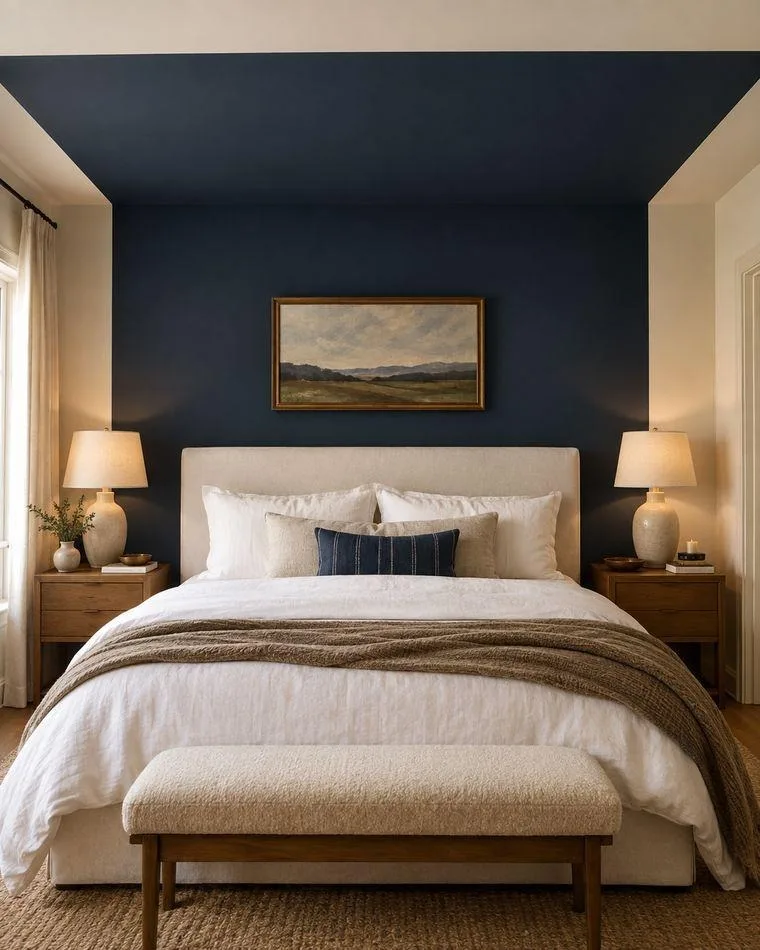
Moderate 4–5 hours · Best for: Bedroom (behind the bed), living room (behind the sofa)
The accent wall colour extends from the wall onto the ceiling by 12–18 inches, creating a painted canopy above the bed or sofa. The crisp horizontal line on the ceiling is the whole idea — it tricks the eye into reading a flat room as an architectural alcove. Tape the ceiling line with FrogTape, paint the wall and the ceiling strip in the same colour, peel. Deep navy and warm charcoal work best.
What to buy: One gallon for wall plus ceiling strip — Benjamin Moore Hale Navy HC-155 or Sherwin-Williams Iron Ore SW 7069. FrogTape for the ceiling line. Satin for walls, eggshell for the ceiling strip.
Estimated cost: $55–$80 for a gallon + tape
17. Watercolour wash effect
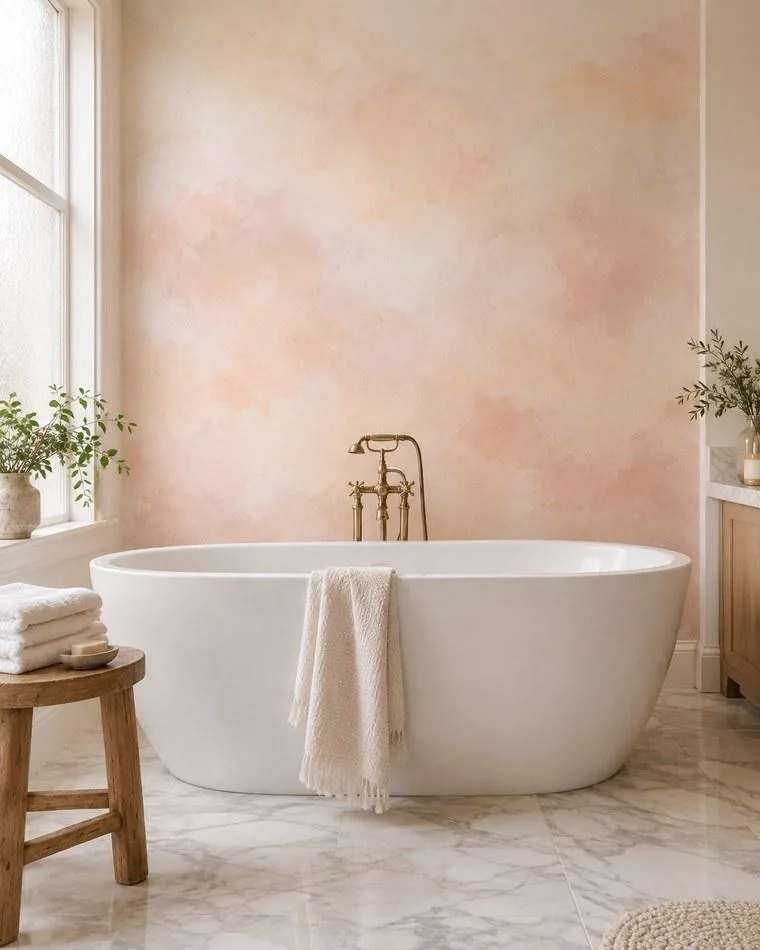
Moderate 2–4 hours · Best for: Bathroom (above a tub), bedroom, nursery, meditation room
Soft, translucent layers of colour sponged onto a white base, creating a dreamy cloud-like finish with no hard edges. Apply the base colour diluted 50/50 with water using a large natural sea sponge, dabbing and blending in random motions. Build up layers from lightest to darkest. The effect should look like a watercolour painting, not a rag-rolling job from 1994 — keep the colours pale and the touch light.
What to buy: Two to three sample pots in the same colour family — blush, pale peach, and soft coral for a warm palette. A large natural sea sponge ($8–12). Water. The base wall stays white.
Estimated cost: $20–$45 for sample pots + sponge
18. Faux wainscoting panels with tape
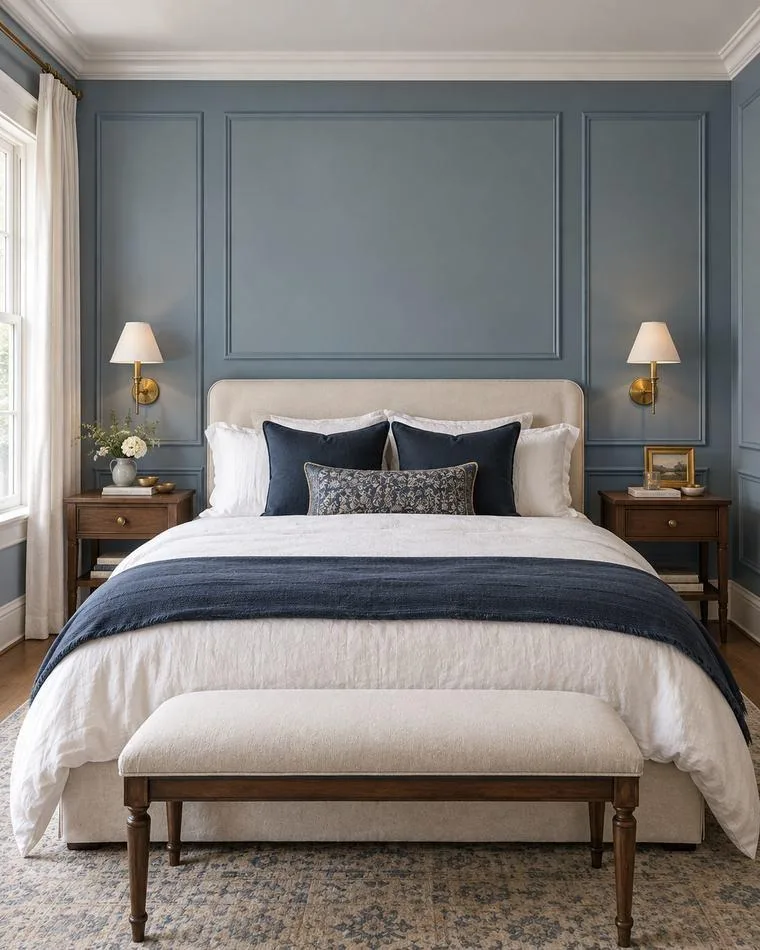
Moderate 5–7 hours (measuring and taping the grid is most of it) · Best for: Bedroom (behind the bed), dining room, living room, hallway
Paint rectangular panel outlines on a flat wall to create the illusion of recessed moulding — without buying any wood. Paint the entire wall your accent colour, let it dry, tape rectangles in a grid pattern, and paint the interior of each rectangle a slightly lighter or darker shade of the same colour. The subtle tonal shift reads as shadow and depth, tricking the eye into seeing panels that are not there.
What to buy: One gallon of base colour, one quart of the tonal shift colour (same family, 1–2 shades lighter). FrogTape. A ruler, pencil and laser level for laying out even rectangles. Satin finish for both.
Estimated cost: $55–$90 for a gallon + quart + tape
Are accent walls outdated in 2026?
The flat single-colour accent wall — one wall painted navy while the other three stay builder white — is the version that feels dated. Interior designers have been saying it for three years now, and they are right about that specific version. It looks like you ran out of paint.
But textured and technique-based accent walls are bigger than ever. Limewash plaster, colour drenching, painted arches, geometric tape patterns and Roman clay are all over every design magazine and social feed in 2026. The accent wall did not die — it evolved from “one wall, one colour” to “one wall, one technique.” Every idea on this page is the evolved version.
The supply list that works for most of these
Fifteen of the eighteen ideas above use the same core supplies. Buy these once and you are set for any of them:
- FrogTape Multi-Surface (green) for most jobs, or FrogTape Delicate Surface (yellow) for freshly painted walls. $7–$12 per roll.
- A good roller frame + 3/8-inch nap roller cover. The nap matters: 3/8 inch for smooth walls, 1/2 inch for light texture. $8–$15.
- A 2.5-inch angled sash brush for cutting in. Purdy or Wooster — do not buy the $3 brush. $10–$15.
- A canvas drop cloth. Not plastic, which is slippery and tears. $12–$20.
- Painter’s plastic or kraft paper for the floor edge. $5.
Total for the kit: about $45–$70. Add a quart of paint ($20–$40) and you are doing most of these ideas for under $100.
Best accent wall paint colours for 2026
The direction is firmly toward warmth. Cool greys are over. Here are the six colour families dominating accent walls right now, with actual paint codes:
- Warm clay / terracotta: Behr Canyon Dusk S170-5, Sherwin-Williams Cavern Clay SW 7701
- Dusty olive green: Sherwin-Williams Rosemary SW 6187, Benjamin Moore Olive Sprig
- Warm charcoal: Benjamin Moore Wrought Iron HC-137, Sherwin-Williams Iron Ore SW 7069
- Deep navy: Benjamin Moore Hale Navy HC-155, Sherwin-Williams Naval SW 6244
- Dusty rose / blush: Benjamin Moore Dusty Rose 2174-40, Farrow & Ball Sulking Room Pink No. 295
- Warm mushroom / taupe: Sherwin-Williams Accessible Beige SW 7036, Benjamin Moore Pashmina AF-100
Colours to avoid in 2026: cool greys (they feel sterile), bright primary colours (they look juvenile), and anything with a strong blue undertone unless it is intentionally navy. The direction across every brand — Sherwin-Williams, Benjamin Moore, Behr, Farrow & Ball — is warmth.
What an accent wall costs: the quick version
| Technique | Typical cost |
|---|---|
| Single colour, one wall | $30–$50 (one quart) |
| Two-tone split or arch | $25–$50 |
| Geometric tape pattern | $60–$120 (paint + tape + level) |
| Ombré or watercolour wash | $30–$50 |
| Limewash (Romabio) | $80–$100 |
| Roman clay plaster | $85–$130 |
| Colour drench (full room) | $85–$150 (1.5–2 gallons) |
| Stencilled pattern | $60–$100 (stencil + paint) |
| Brushstroke mural | $15–$35 (sample pots) |
Accent wall paint ideas: FAQ
What is the best paint colour for an accent wall?
In 2026, the strongest accent wall colours are warm clay and terracotta (Behr Canyon Dusk, Sherwin-Williams Cavern Clay), dusty olive green (Rosemary SW 6187), warm charcoal (Benjamin Moore Wrought Iron HC-137), and deep navy (Hale Navy HC-155). The common thread is warmth — cool greys are out.
What is the rule for painting an accent wall?
Paint the wall you see first when you enter the room. It should be the wall with the fewest doors and windows, and it should be the wall the room’s main furniture faces. In a bedroom that is the wall behind the bed. In a living room it is the wall behind the sofa or the fireplace wall.
Are accent walls outdated in 2026?
The flat single-colour accent wall is dated. Textured and technique-based accent walls — limewash, painted arches, colour drenching, geometric tape patterns, Roman clay — are bigger than ever. The accent wall evolved from one colour to one technique.
Should your accent wall be lighter or darker?
Darker, in almost every case. A wall lighter than the surrounding walls fades and loses its role as a focal point. A wall darker than the surrounding walls advances toward the eye and commands attention, which is the whole purpose of an accent wall.
How much does it cost to paint an accent wall?
A single-colour accent wall costs $30–$50 in paint (one quart of premium paint covers one wall in most rooms). Limewash costs about $80–$100. Roman clay plaster runs $85–$130. Geometric tape patterns cost $60–$120 including the tape and a laser level. Add $45–$70 for basic supplies if you do not already own a roller, brush and drop cloth.
Can I paint an accent wall myself?
Yes. Every idea in this guide is a DIY project. The easy ones (single colour, arch, two-tone split, mountain silhouette) take 2–4 hours. The moderate ones (limewash, ombré, faux panels, colour capping) take 4–7 hours. The ambitious ones (herringbone, stencil, Roman clay) take 6–8 hours and benefit from practice on scrap material first.
What finish should accent wall paint be?
Eggshell or satin for most accent walls. Matte or flat for dark moody walls, ombré blends and limewash — they hide roller marks and blend better. Never high-gloss on a full wall unless you want to see every imperfection in the drywall.
What is colour drenching?
Painting every surface in a room — walls, ceiling, trim, baseboards, shelving — the same colour, creating an immersive, enveloping space. It is the opposite of an accent wall and it works best in small rooms where it reads as cocooning rather than cramped.
What is limewash paint?
A mineral-based paint made from slaked limestone that creates a chalky, textured, plaster-like finish with natural colour variation. Romabio and Portola Paints are the two leading brands. It is applied with a masonry brush in thin overlapping strokes and costs about $50–$70 per quart.
Pick one, tape the wall, start painting
The hardest part of every accent wall is the forty-five minutes you spend choosing the colour. Everything after that is a weekend project. If you want to start even smaller, a painted arch (idea 2) or an abstract brushstroke mural (idea 10) can be done in under two hours with one quart and no tape at all.
Once the accent wall is done, the next question is what goes on it. Our guide to wall art for living room covers 49 pieces with sourcing and pricing for the other three walls. For paint on glass rather than drywall, window art uses many of the same techniques. And if this weekend project turns into a habit, hobbies to do at home and crafts to make and sell are where it goes next.