How to Draw a Horse: Step-by-Step for Every Skill Level
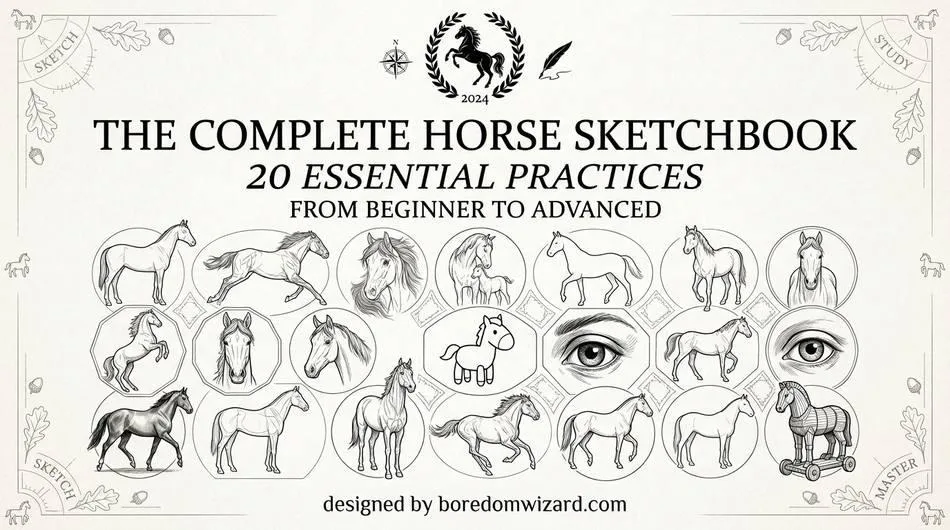
Horses are one of the hardest animals to draw and one of the most rewarding to get right. The legs bend in unexpected places, the proportions feel wrong until you learn the rules, and the head changes shape dramatically depending on the angle. This guide walks through 20 horse drawings from a five-minute cartoon to a full anatomical reference, with a free printable practice pack available at the bottom, you can download, print and trace.
The simplest answer for how to draw a horse is to start with three overlapping ovals for the body, a trapezoid for the head, and cylinders for the legs. Refine the shapes into a smooth outline, add the mane, tail and facial features, then erase the construction lines. The basic-shapes method (drawing 4 below) works at every skill level and is how professional illustrators begin every horse drawing.
Beginner horse drawings
Start here if you have never drawn a horse or if you want a quick, simple result. These four drawings use bold outlines, simplified anatomy and forgiving proportions — getting the legs slightly wrong does not matter when the style is cartoon.
1. Simple cartoon horse
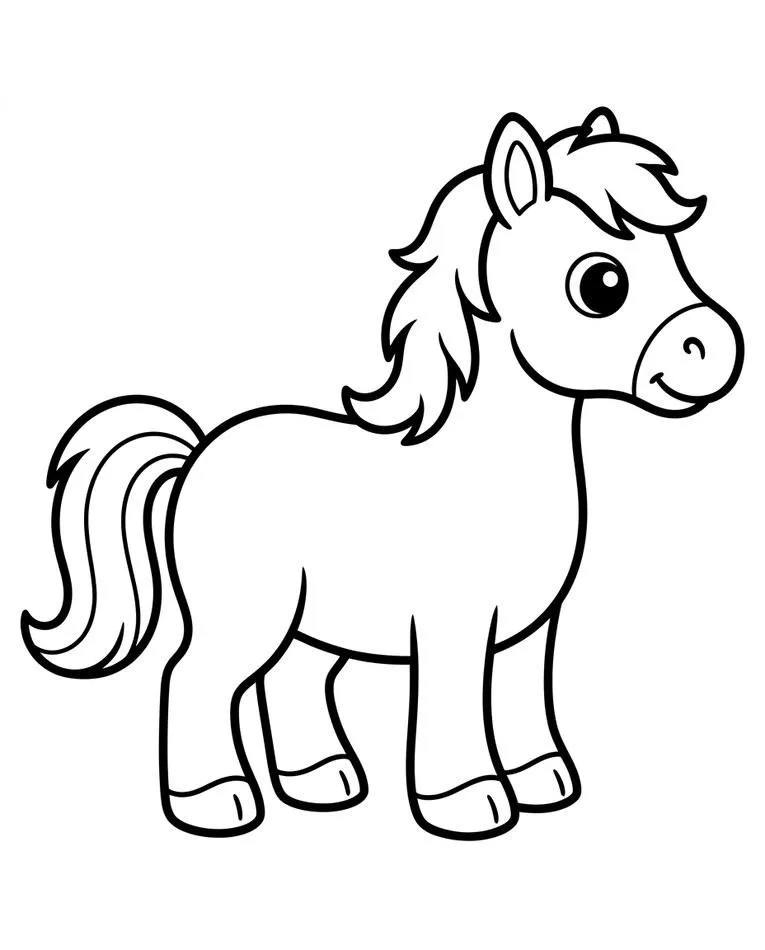
A round body, thick legs, big friendly eye, stubby muzzle and a fluffy mane. This is the five-minute horse — the one you draw on a napkin or in the margin of a notebook. Start with a large oval for the body, a smaller circle for the head, connect them with a short thick neck, and add four rectangles for legs. Round everything off, add an ear, an eye, a mane and a tail. Done.
2. Simple horse head — front view
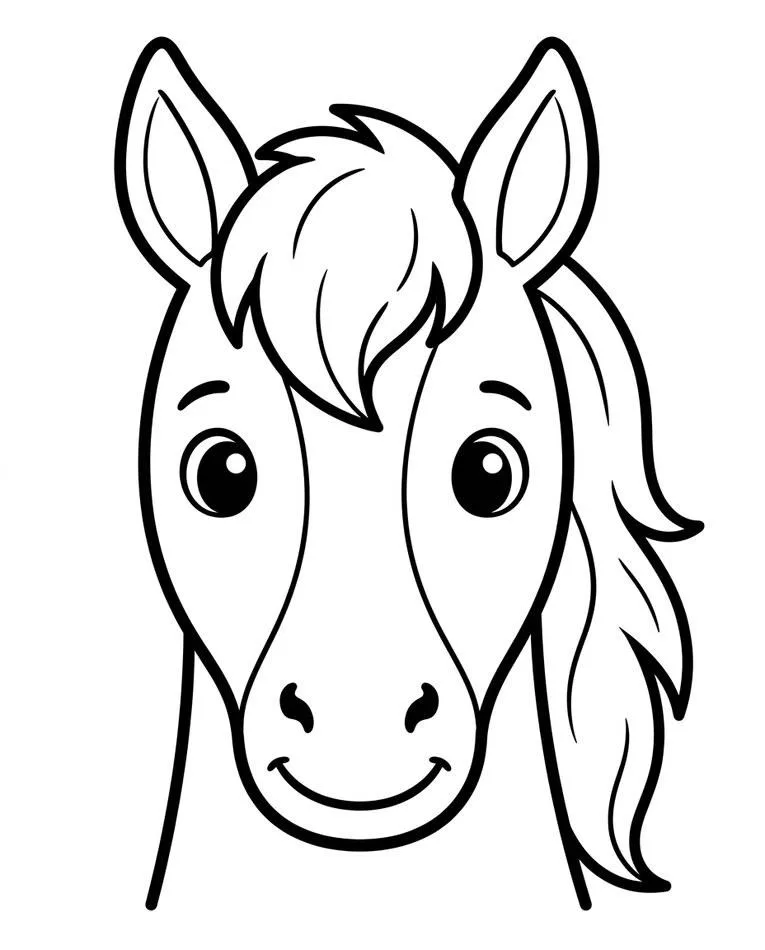
A horse head facing directly forward is surprisingly easy because the symmetry does half the work. Draw an upside-down egg shape, add two pointed ears at the top, two large round eyes on the sides, a small muzzle bump at the bottom, and a forelock falling between the ears. The front view avoids the hardest part of horse heads — the jaw angle in profile.
3. Chibi kawaii pony
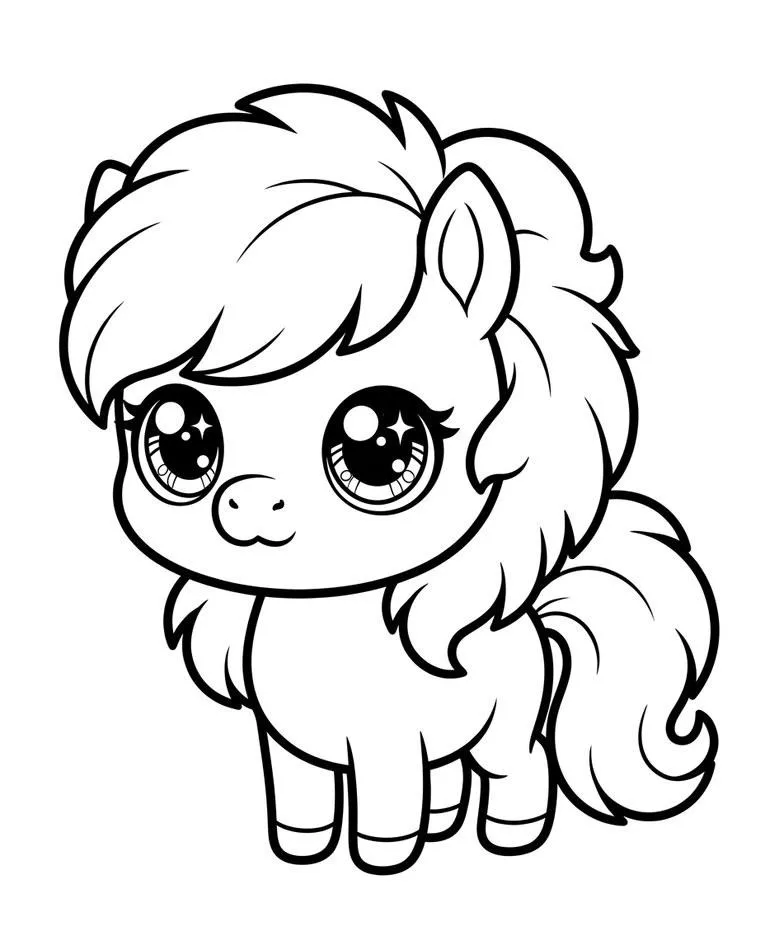
An oversized head, huge sparkly eyes, a tiny body and a cloud of mane. The chibi style breaks every proportion rule on purpose, which makes it perfect for kids and beginners. The head is roughly the same size as the body. The legs are short stubs. The eyes take up a third of the face. If your version looks slightly different from the reference, the style absorbs the difference.
4. Horse from basic shapes — the construction method
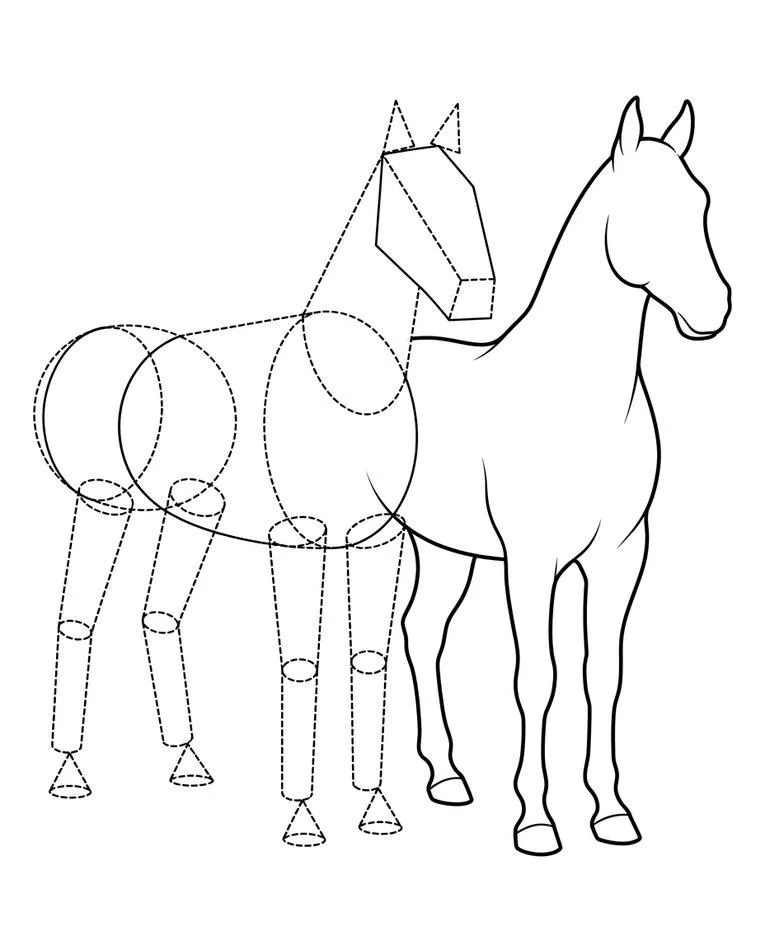
This is the single most useful drawing on this page. The left side shows the geometric skeleton: overlapping ovals for the barrel and chest, a circle for the hip, a trapezoid for the head, cylinders for the legs, triangles for the hooves. The right side shows those shapes refined into a smooth horse outline. Every horse you draw from now on — at any skill level — starts with this construction.
Intermediate horse drawings
These six drawings use correct equine proportions and natural poses. The construction-shape method from drawing 4 is the foundation for all of them — sketch the shapes first, then refine.
5. Horse standing — correct proportions
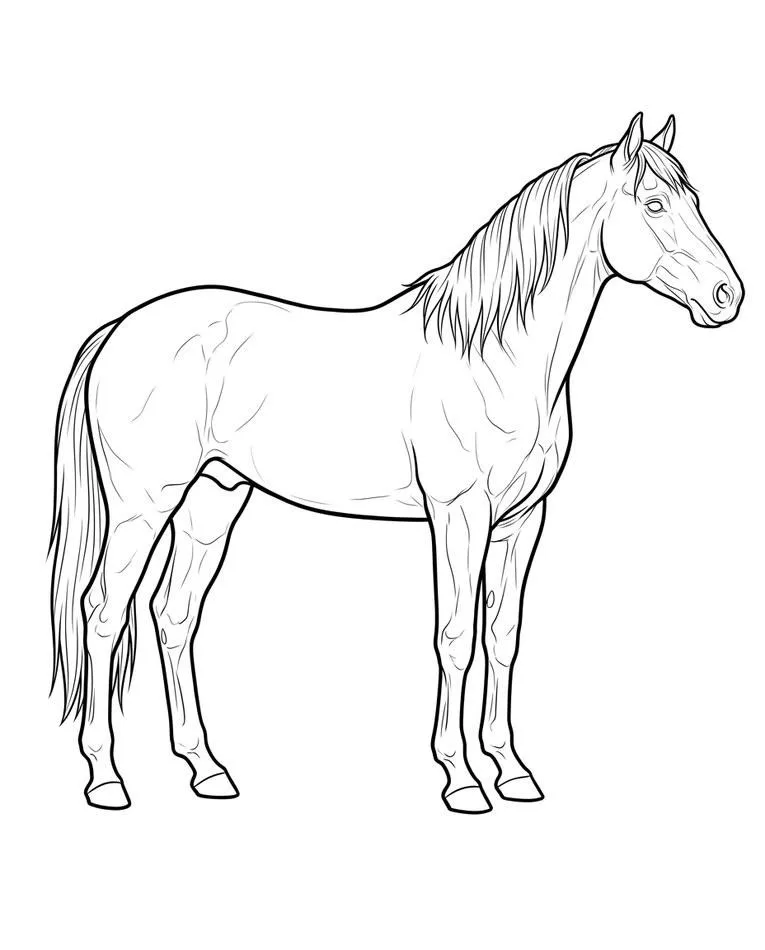
The foundation pose. A horse standing square in side view with all four legs visible and weight evenly distributed. The back slopes gently from the withers to the croup. The legs have proper joints — the front knee bends forward, the rear hock bends backward. The head is proportioned with a defined jaw and cheekbone. Get this drawing right and every other pose becomes a variation of it.
6. Horse head — three-quarter view
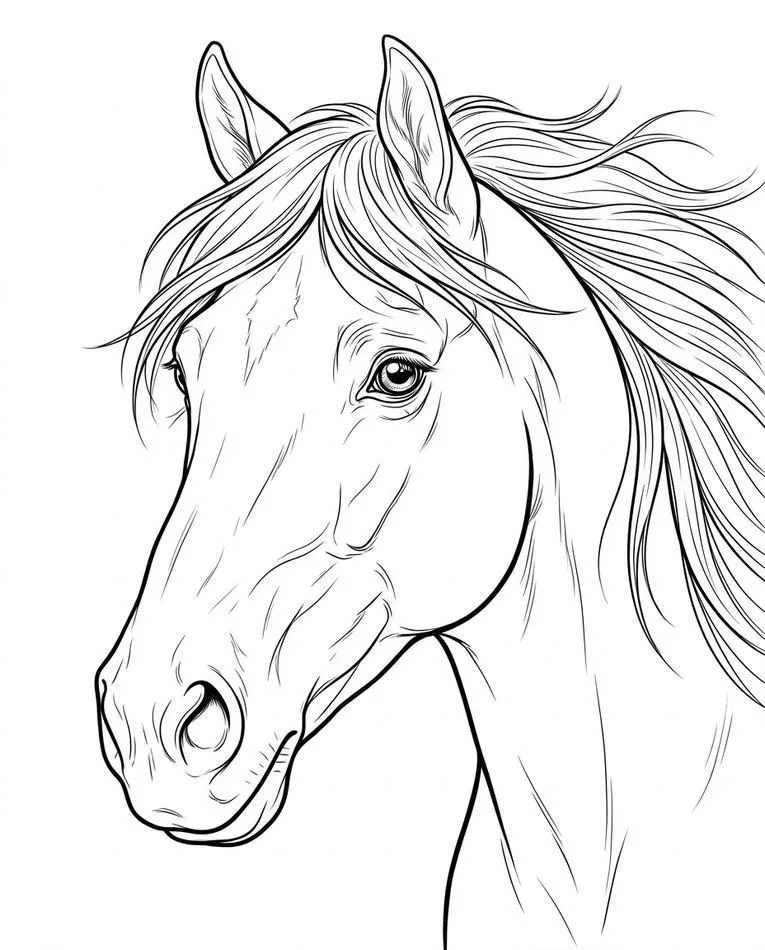
The three-quarter view is the most-drawn and most-searched horse head angle. The challenge is the foreshortening — the far eye is partially hidden by the nasal bone, the far ear is smaller than the near ear, and the jaw tapers away from the viewer. Start with an oval tilted at about 30 degrees, place the near eye at one-third from the top, and let the far side of the face curve away.
7. Horse walking
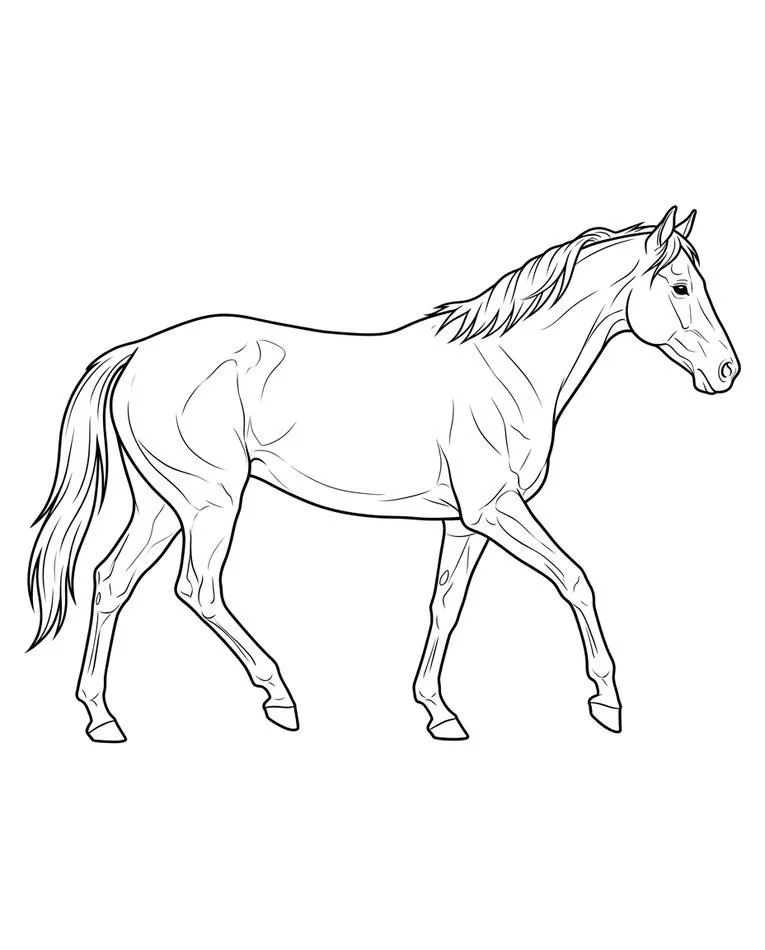
A horse walks in a four-beat gait — each leg moves independently. In this pose the left front is forward and the right hind is extended back, showing a natural mid-stride moment. The head drops slightly lower than at rest. The key mistake beginners make is drawing all four legs the same length in motion — the extended legs appear longer because the joints are straightened.
8. Horse grazing — head down
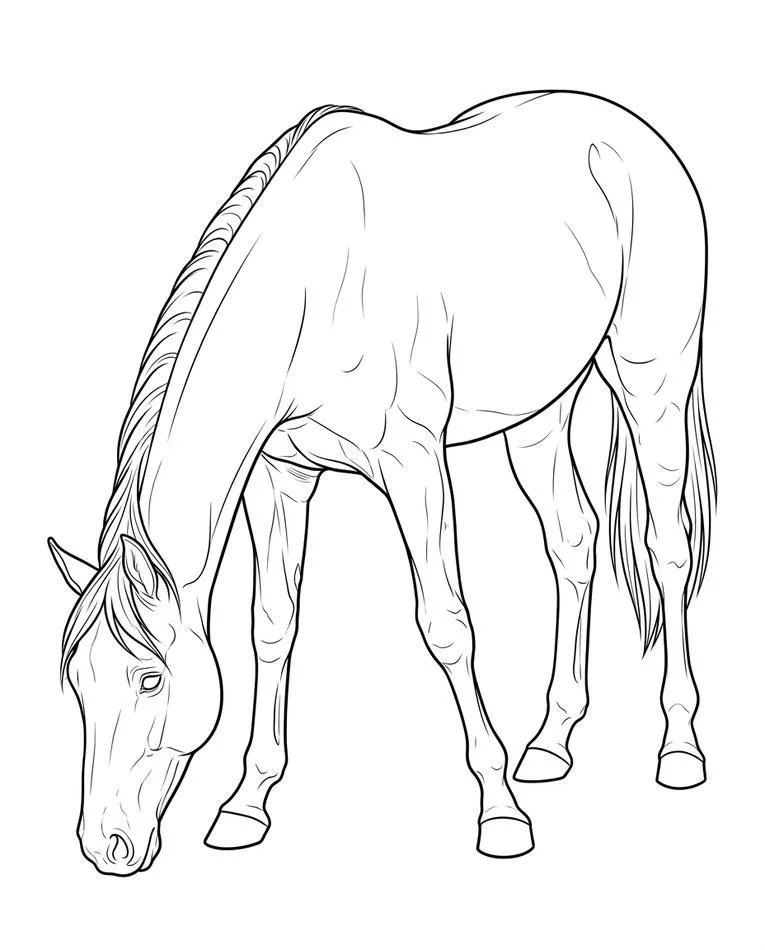
The grazing pose changes everything about the horse’s proportions. The neck stretches down and forward, becoming much longer than it appears when the head is up. The front legs splay slightly for balance. The withers become the highest point of the body. Most drawing guides skip this pose because it is hard to construct, which is exactly why practising it makes you better.
9. Mare and foal
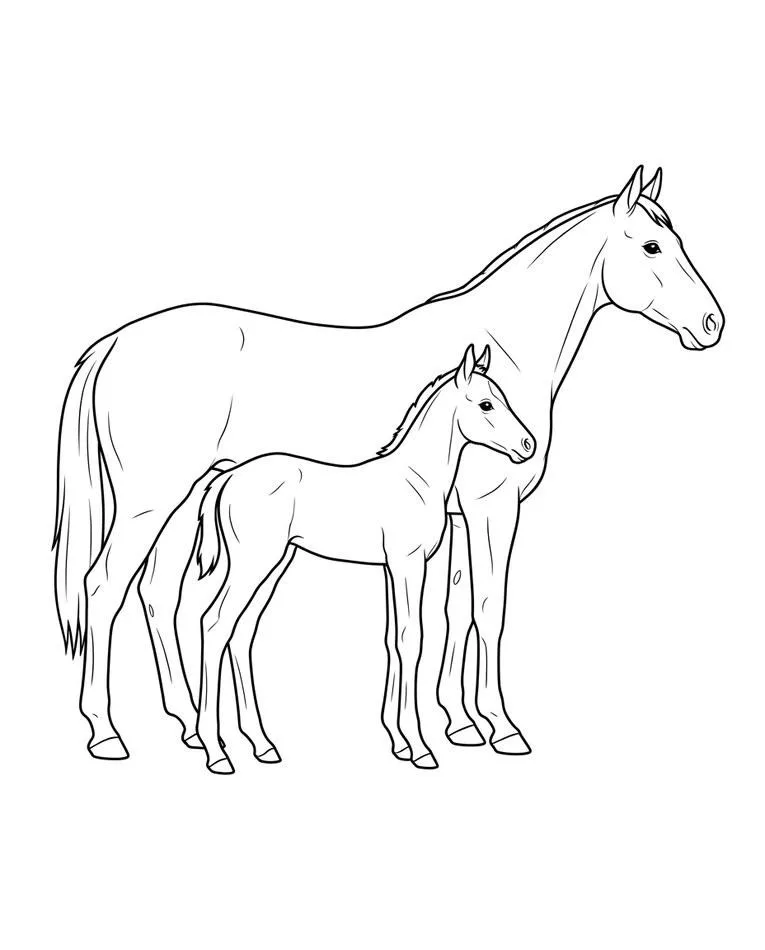
A foal’s proportions are dramatically different from an adult’s. The legs are disproportionately long relative to the body, the neck is shorter, and the head is larger compared to body size. Drawing a mare and foal together forces you to see these differences side by side. The foal’s head reaches roughly to the mare’s chest height.
10. Horse trotting
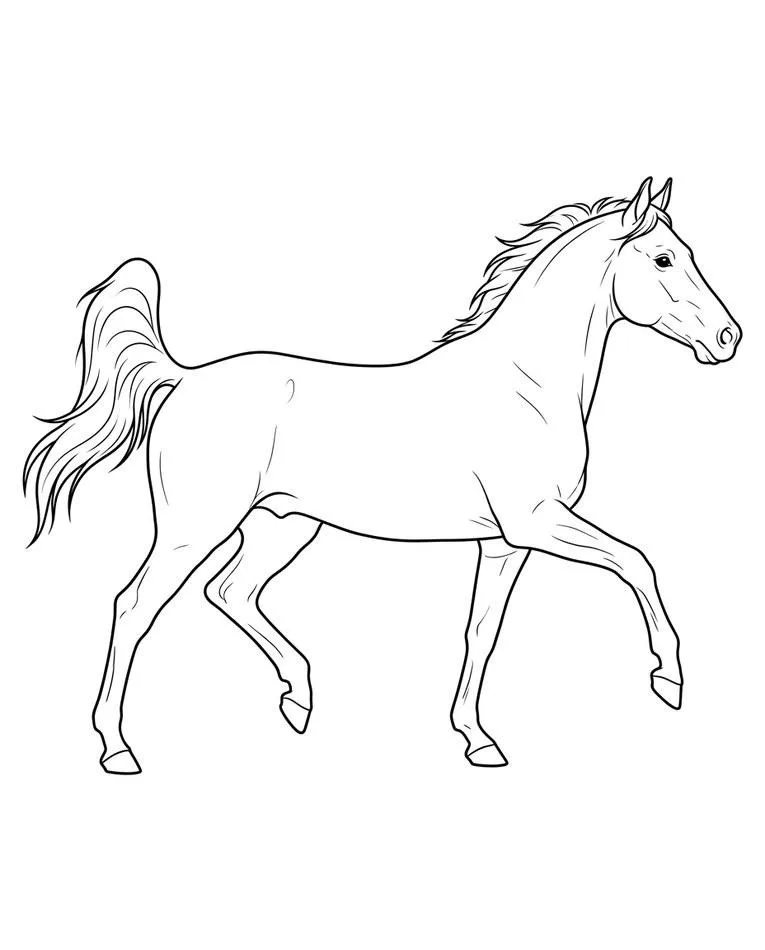
The trot is a two-beat diagonal gait — the left front and right hind move together, then the right front and left hind. The horse carries its head higher and its neck more arched than at the walk. There is a moment of suspension between each beat where no hoof touches the ground. Capturing the diagonal pair pattern is what makes a trotting horse look like it is trotting rather than walking awkwardly.
Advanced horse drawings
These five drawings demand more line control, anatomical knowledge and confidence. The poses are dynamic, the detail is higher, and small mistakes in proportion are more visible. Use the construction shapes from drawing 4, sketch lightly, and refine in stages.
11. Horse galloping at full speed
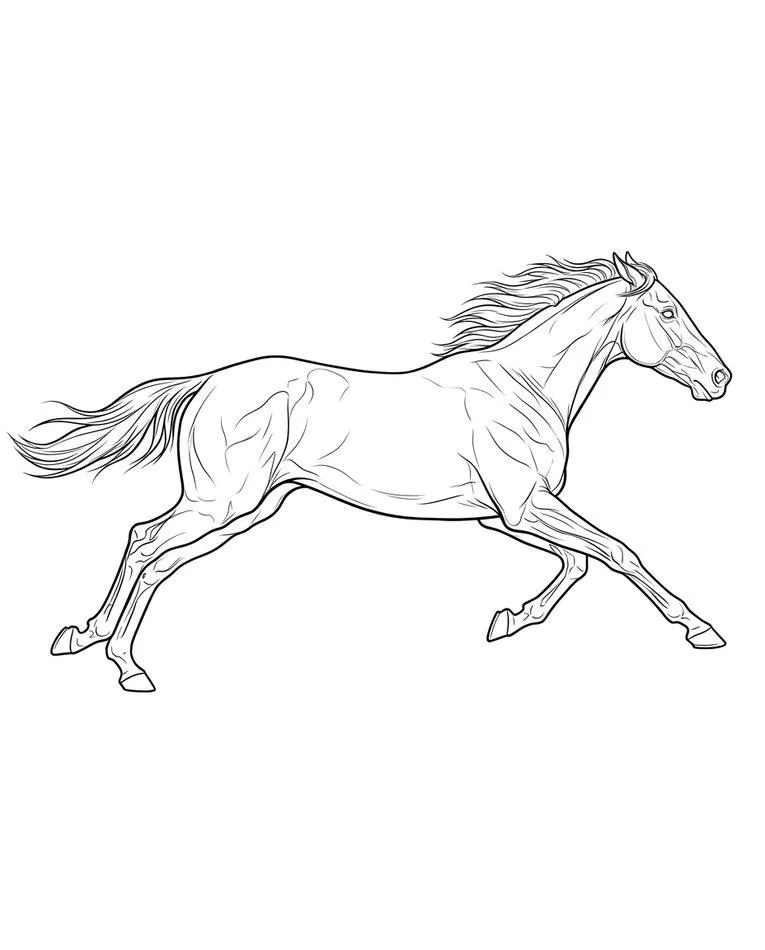
All four legs extended — the front reaching forward, the hind pushing back — capturing the moment of full suspension where no hoof touches the ground. The body is stretched and low, the mane and tail stream behind. The key is the compression and extension cycle: the body bunches at one phase and stretches at the other. This drawing shows the stretched phase, which reads as speed.
12. Horse rearing
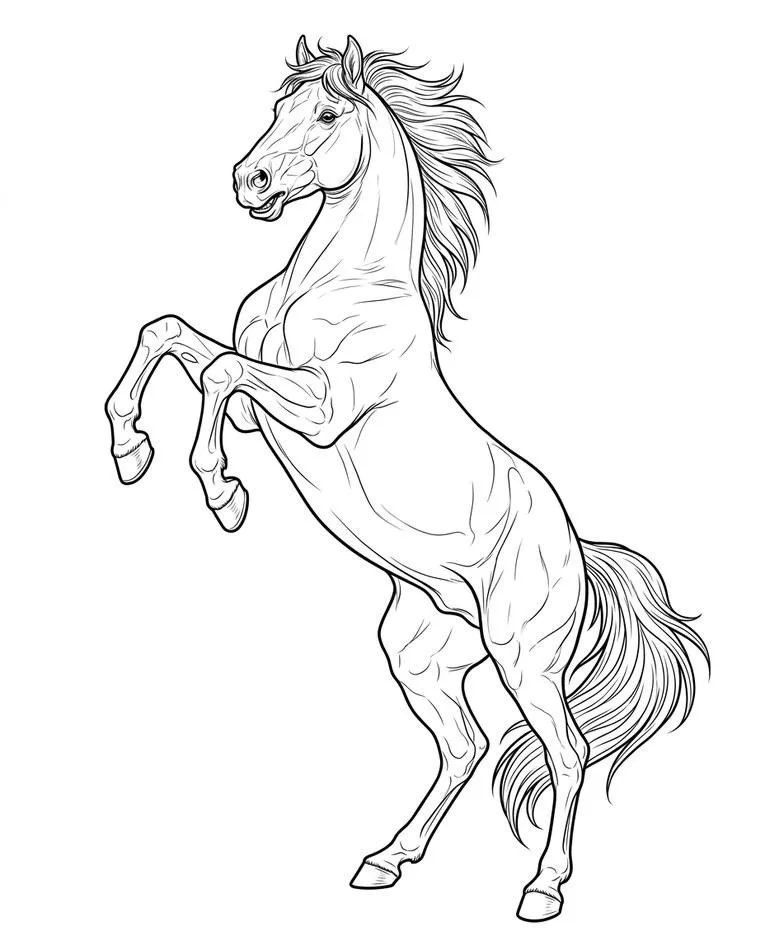
The most dramatic horse pose. The body is nearly vertical, all weight on the hind legs with bent hocks, the front hooves paw the air, the neck arches back. The difficulty is foreshortening — the barrel of the body compresses as it tilts toward the viewer, and the hind legs bear visible muscular strain. Start with a vertical oval for the body and build the limbs from there.
13. Detailed horse head — close-up
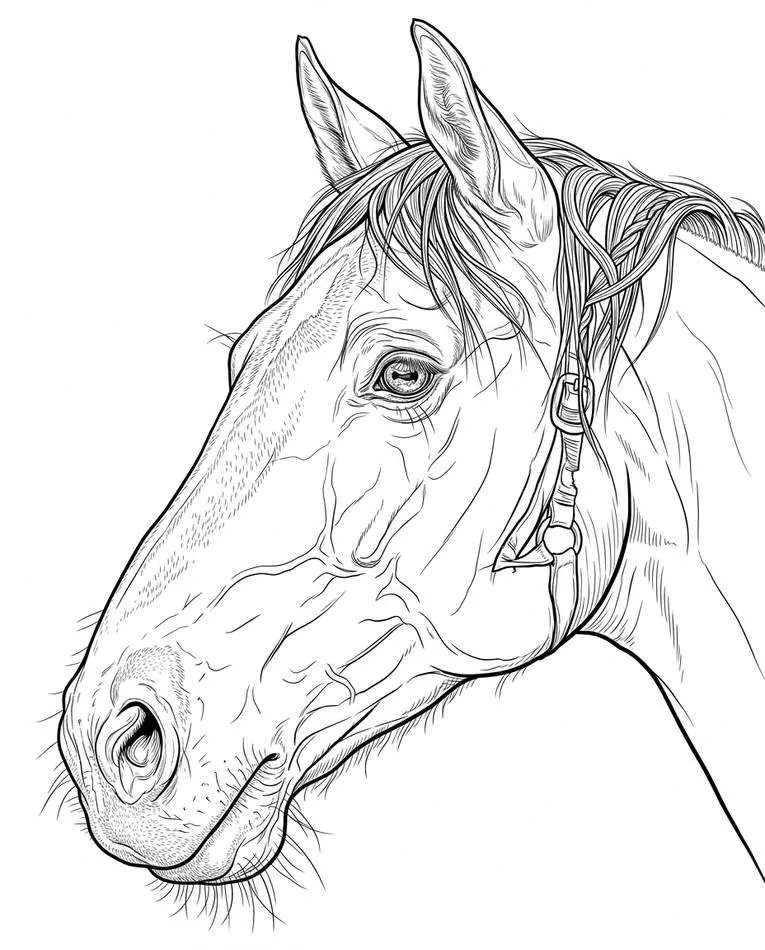
A photorealistic horse head in profile at close range, filling the entire frame. The line work shows the texture of the short coat around the muzzle, whiskers, veins visible on the face, the complex folds of the ear, individual eyelashes, and the bone structure of the jaw. This drawing is where line weight variation matters most — the thinnest lines for hair and whiskers, the heaviest for the jaw contour and nostril rim.
14. Horse in full tack — saddle and bridle
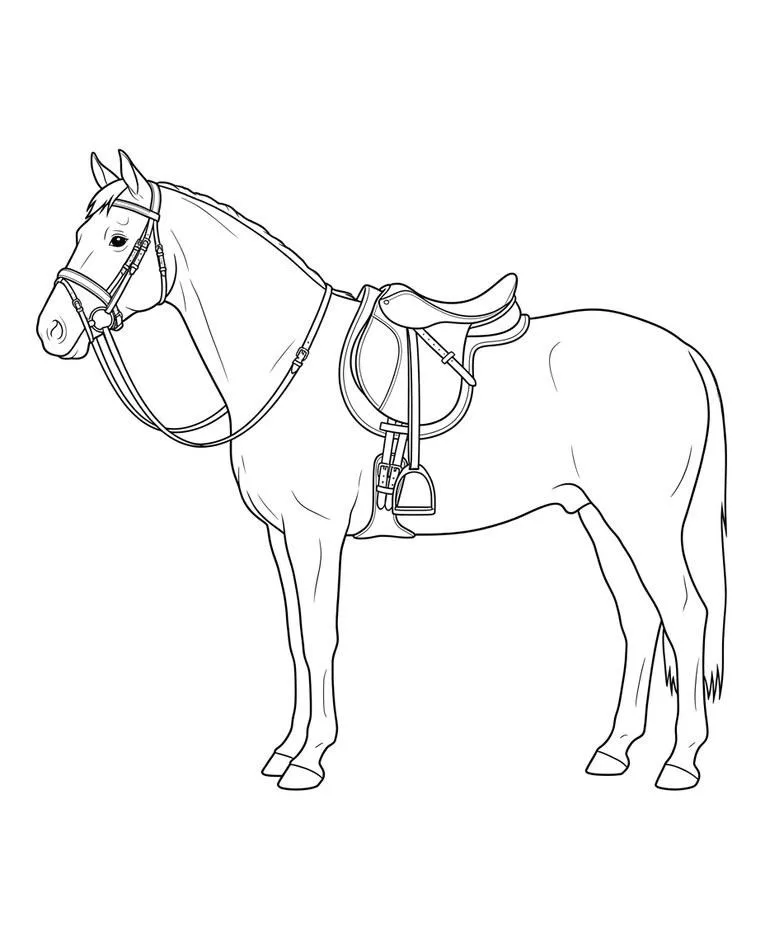
A horse standing in side view wearing full English riding tack — saddle with stirrups, bridle with reins, noseband, throatlatch and girth strap. Every piece of equipment is drawn accurately with buckles, stitching lines and strap placements. This drawing teaches both horse anatomy and equipment placement. It is one of the most requested references for equestrian illustrators.
15. Dramatic portrait — flowing mane
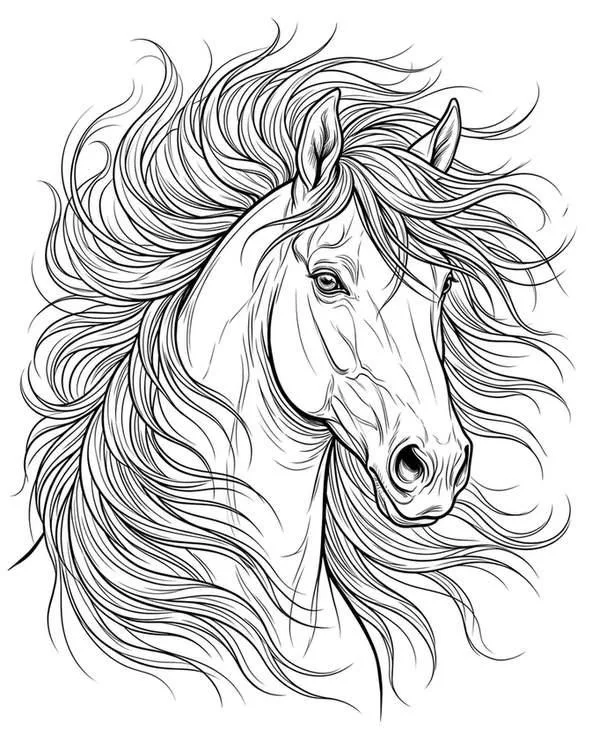
The showpiece drawing. A horse head and upper neck with an extremely long, wild, flowing mane that billows around the head. The horse has an intense, spirited expression — flared nostrils, wide eye, arched neck. The mane fills most of the frame with sweeping, dynamic lines. This is the drawing people frame, and the one that performs best on Pinterest. The line work in the mane strands is where the artistry lives.
Fantasy and special horse drawings
16. Unicorn
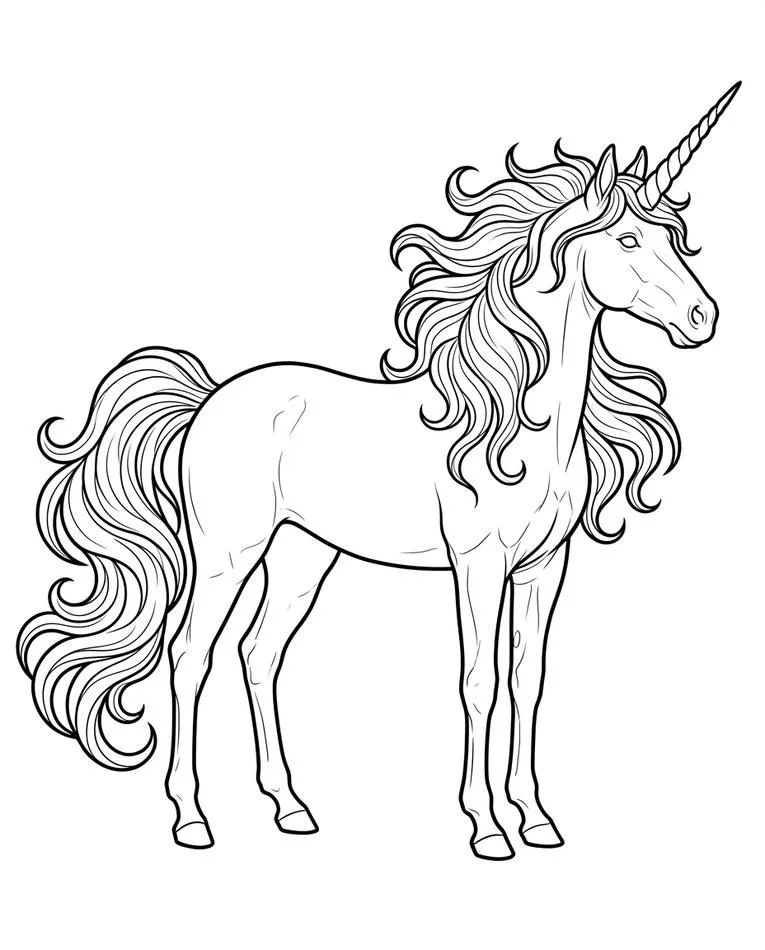
A realistic horse body with correct proportions, plus a long spiralling horn on the forehead and an extra-flowing mane and tail. The horn has a clear spiral twist. The elegance comes from slightly more elongated, refined legs than a standard horse. This is the most-printed page in the downloadable pack — it doubles as a colouring page for kids and a drawing reference for anyone practising equine proportions with a fantasy twist.
17. Pegasus — winged horse
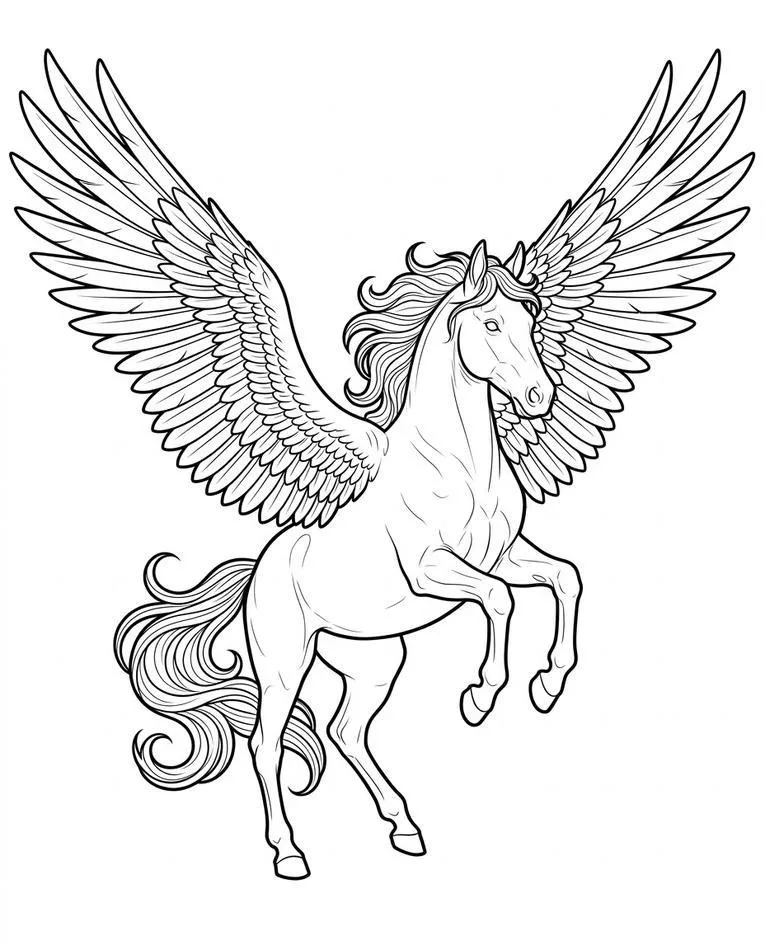
A horse with large feathered wings spread wide open, rearing slightly. The wings are anatomically inspired by eagle wings — primary feathers at the tips, secondary feathers along the trailing edge, layered coverts above. Drawing convincing wings on a horse requires understanding both equine shoulder anatomy and avian wing structure. The wings attach at the withers, where a real horse’s shoulder blade sits.
18. Proportions and anatomy reference
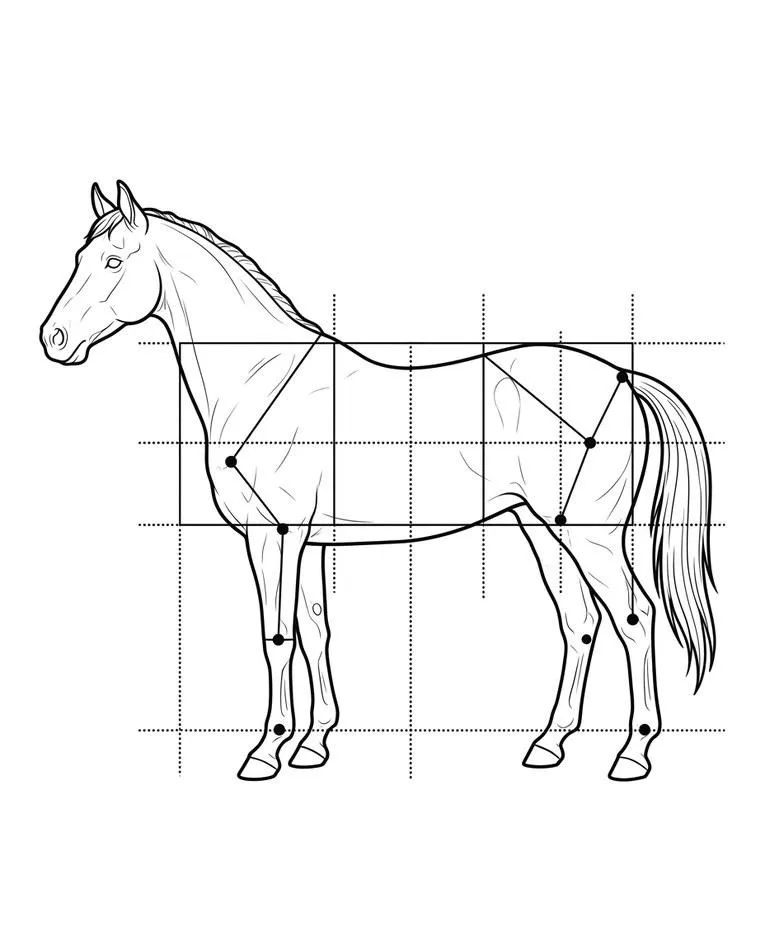
A horse in side view with proportional guidelines overlaid — the body divided into squares, dotted lines marking the height of the withers, elbow, stifle and fetlock, and small circles at every major joint. This is the cheat sheet. Print it, keep it next to your sketchbook, and check your drawings against it whenever something looks wrong. The proportions here are based on standard Thoroughbred conformation.
19. Horse in landscape — with fence and field
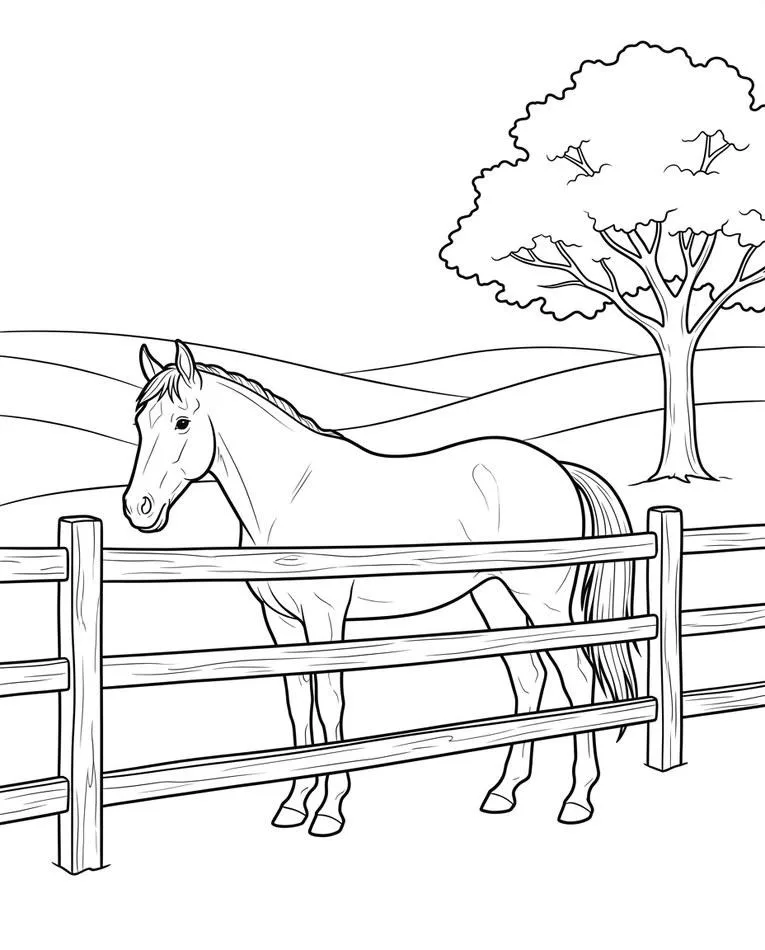
A complete scene — a horse standing behind a wooden post-and-rail fence with rolling hills and a tree in the background. The landscape is drawn with minimal detail, just enough to set the scene without overwhelming the horse. This is designed as a colouring page: print it, colour the horse and the background separately, and you have a finished piece rather than an isolated figure.
20. Trojan horse
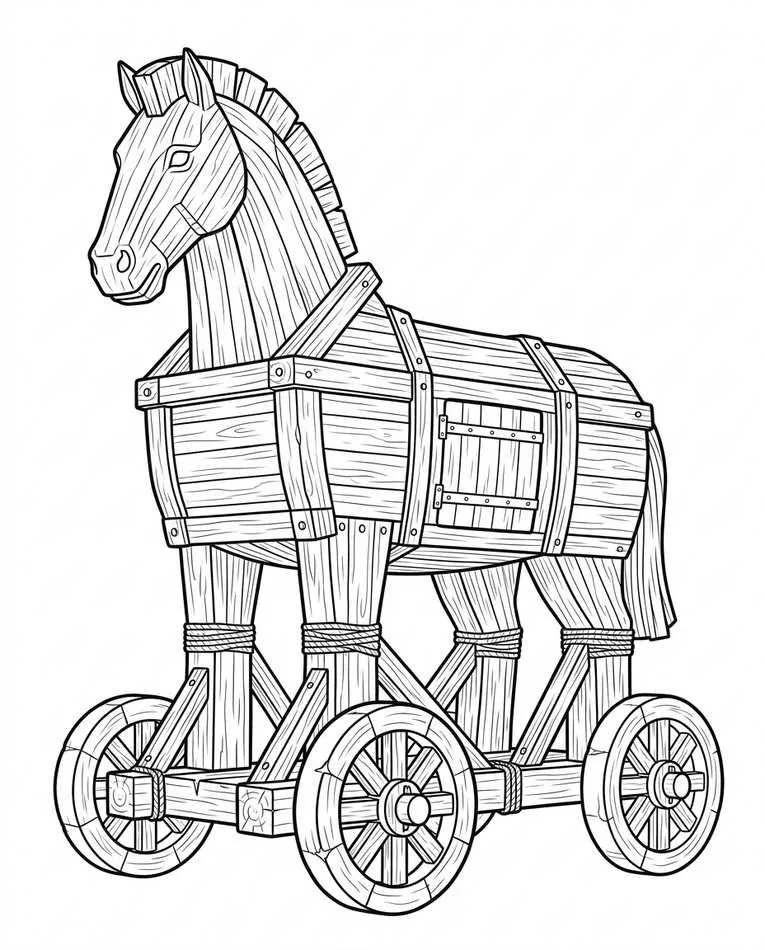
The legendary wooden horse of Troy — a giant architectural structure made of visible wooden planks and beams, with a carved horse head, a hinged door on the belly, and large wooden wheels at the base. This is a construction drawing, not an equine anatomy exercise. The wood grain lines, rope bindings and metal braces give it texture. It is the most unexpected drawing in this pack and the one that captures the “trojan horse drawing” search cluster at 1,200 searches per month.
Free printable horse drawing pack — PDF download
Download all 20 drawings as a single PDF — one drawing per page, ready to print on standard letter or A4 paper. Use them as colouring pages, tracing references or practice templates. Print as many copies as you want.
Horse drawing tips that actually help
- Start with the body, not the head. The biggest beginner mistake is drawing the head first, then trying to attach a body to it. Draw the barrel (large oval) first, then the chest and hip, then the neck, then the head last. The body sets the proportions that the head must fit.
- The eyes are on the sides of the head, not the front. Horses have nearly 360-degree vision. In profile, you see only one eye, and it sits much further back and higher on the skull than most people draw it — roughly level with the base of the ears.
- The front knee bends forward, the rear hock bends backward. Getting this wrong is the single most common error in horse drawings. The front leg from the knee down bends the same way as a human knee. The rear leg from the hock down bends the opposite way.
- The back is shorter than you think. Most of a horse’s length is neck and hindquarters. The actual back — from the withers to the croup — is surprisingly short. Drawing the back too long makes the horse look like a dachshund.
- Manes always fall to one side. Horses’ manes naturally fall to the right or the left, never split down the middle. In your drawing, pick one side and commit.
- Hooves are not flat circles. A hoof viewed from the side is a trapezoid — wider at the top (the coronet band) and narrower at the ground. From the front, it is a slightly rounded rectangle. Getting the hoof shape right anchors the entire leg.
How to draw a horse: FAQ
How do you draw a horse step by step?
Start with a large oval for the barrel body, a smaller oval for the chest and a circle for the hip. Connect them with smooth curved lines. Add a trapezoid for the head, connect it to the body with a curved neck. Draw cylinders for the legs, placing joints at the correct points (see drawing 4 and 18 for reference). Refine the shapes into a smooth outline, add the mane, tail, eye, nostril and hooves, then erase the construction lines.
How do you draw a horse easy for beginners?
Use the cartoon style from drawings 1–3 in this guide. A large oval body, a small circle head, a short neck, four rectangle legs, and rounded-off edges. Cartoon proportions are forgiving — the legs can be slightly wrong and it still reads as a horse. The chibi pony (drawing 3) is the easiest starting point because the oversized head hides most anatomy challenges.
What are the basic shapes to draw a horse?
Three ovals (barrel body, chest, hip), one trapezoid (head), cylinders (legs), triangles (ears and hooves), and curved connecting lines (neck, back, belly). The construction method from drawing 4 shows exactly how these shapes overlap and where each one goes.
How do you draw a realistic horse head?
Start with an elongated oval at a slight angle. Place the eye at one-third from the top, on the side of the head. The nasal bone runs straight from below the eye to the nostril. The jaw curves from below the ear to the muzzle. Add the ear (triangular, pointing slightly forward), the nostril (comma-shaped) and the forelock. See drawings 6 and 13 for intermediate and advanced head references.
What is the hardest part of drawing a horse?
The legs. Horse legs have multiple joints that bend in specific directions, and the proportions change dramatically depending on the gait. The front legs have a knee that bends forward, the hind legs have a hock that bends backward. Using the construction-cylinder method from drawing 4 and checking against the anatomy reference in drawing 18 are the two most reliable ways to get the legs right.
How do you draw a horse running?
A galloping horse stretches its body long with all four legs extended (see drawing 11). The front legs reach forward, the hind legs push backward, and there is a moment where no hoof touches the ground. The mane and tail stream behind. The key mistake is drawing the legs too close together — in a full gallop the front and rear hooves can be further apart than the body is long.
Pick a drawing and start sketching
The best way to learn to draw a horse is to draw one badly, then draw it again slightly less badly, then do it again. Each drawing on this page is a reference you can come back to as your skill grows. The cartoon horse you draw today leads to the galloping horse you draw next month.
For more drawing ideas beyond horses, our guide to easy things to draw has dozens of starting points for every skill level. Doodle ideas covers quick sketches for when you have five minutes and a pen. And things to draw when bored is the master list for anyone looking for their next subject.