How to Find a Hobby You Actually Enjoy in 2026 (The 5-Question Framework)
Finding a hobby as an adult should not be this hard. As a kid you tried everything — sports, instruments, art, building things, breaking things — without overthinking it. You did not research the “best hobbies for 8-year-olds.” You just picked something up and started. But somewhere between childhood and your current life, you lost that instinct. Now you Google “how to find a hobby” and get lists of 50 activities that all sound equally fine and equally forgettable. The problem is not that nothing interests you. The problem is that everything interests you slightly, and nothing interests you enough to start.
Quick Answer of How to find a hobby
The fastest way to find a hobby you actually enjoy is to answer 5 diagnostic questions that narrow the infinite list of options to the 3 to 5 hobbies that genuinely match your personality, your energy, your budget, your schedule, and your reason for wanting a hobby in the first place. This guide walks you through those 5 questions, explains the psychology behind why finding a hobby feels hard, gives you a categorized menu of 60+ hobbies organized by type, and provides a concrete action plan to start one this week.
Danielle Moss wrote about how to find a hobby you love when you are an adult, and BetterUp published a version with 4 examples. Both are good starting points. But both skip the diagnostic step: figuring out what kind of hobby your specific brain needs before throwing a list at you. A list without a filter is just a longer version of the problem. This guide is the filter.
Why Finding a Hobby Feels So Hard as an Adult
Adults struggle to find hobbies for 4 specific reasons that have nothing to do with laziness or lack of interest.
Reason 1: Decision paralysis from infinite options. As a child, your hobby options were limited to what was available: the sports league at school, the instrument your parents rented, the craft supplies in the house. The constraint made choosing easy. As an adult, you have access to every hobby in human history via YouTube, Skillshare, MasterClass, Coursera, local community centers, online classes, apps, and Amazon. The paradox of choice applies: more options produces less action.
Reason 2: Identity pressure. As a kid, a hobby was just something you did. As an adult, a hobby feels like a statement about who you are. You do not just pick up painting. You become “a person who paints.” That identity weight makes starting feel heavier than it should. The truth is that a hobby does not define you. It is something you do, not something you are.
Reason 3: Efficiency guilt. Adults evaluate hobbies through a productivity lens: “Is this a good use of my time?” “Will this lead to anything?” “Should I be doing something more productive?” This efficiency guilt kills hobbies before they start. A hobby does not need to produce income, followers, or a second career. It needs to produce enjoyment. That is enough.
Reason 4: Fear of being bad at something. As a kid, you were bad at everything and nobody cared. As an adult, the idea of being a beginner — clumsy, slow, confused — feels vulnerable. The fix is reframing: every expert was once a beginner, and the beginner phase is actually the most dopamine-rich phase because learning is where novelty lives.
The 5-Question Hobby Finder — Answer These and Your Hobby Picks Itself
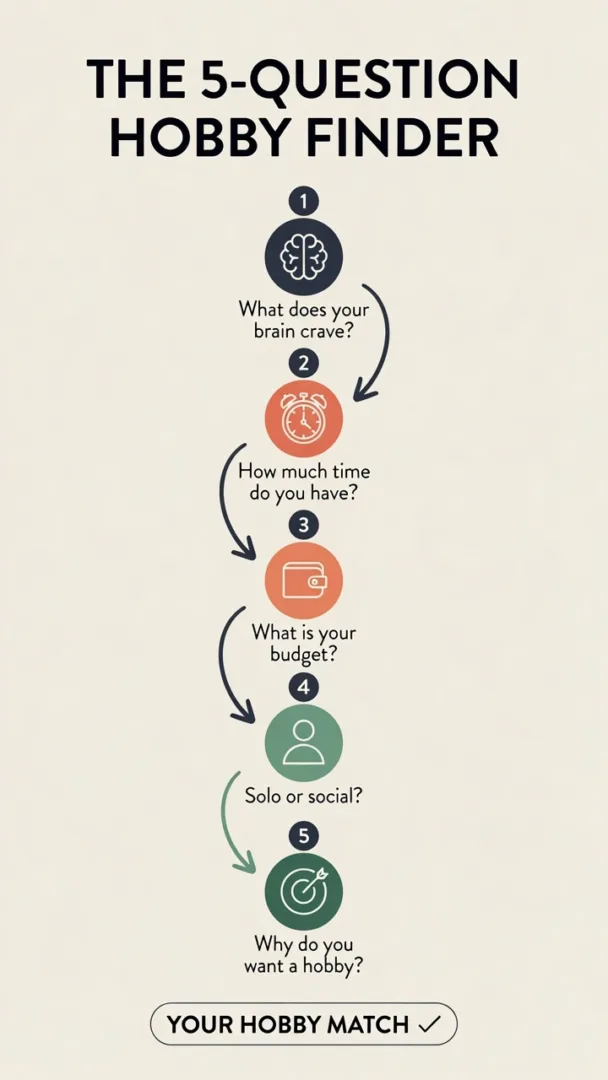
These 5 questions take 10 minutes to answer. By the end, you will have narrowed the infinite hobby list to 3 to 5 options that match your specific brain, body, schedule, and budget.
Question 1: What Does Your Brain Crave When You Are Bored?
The type of boredom you experience most often tells you which hobby category will satisfy you.
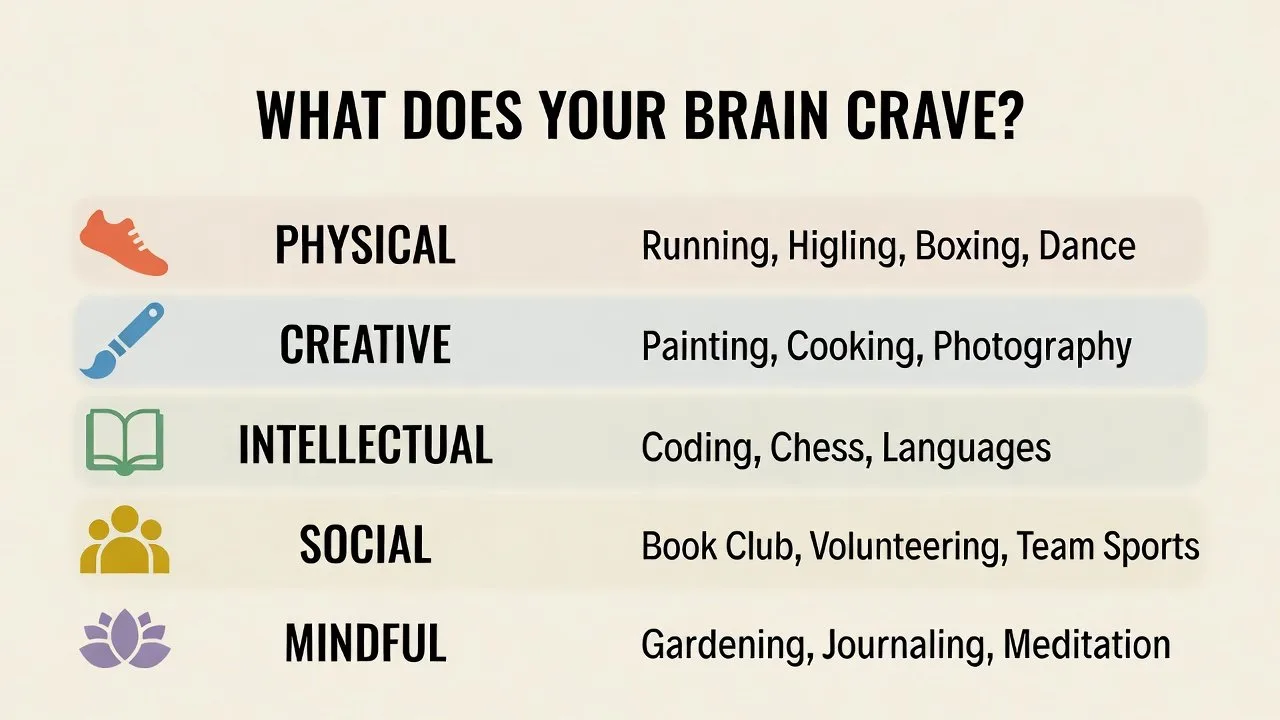
Think about the last 5 times you were bored. Not what you did — what you wanted. Did you want to move your body? Did you want to make something with your hands? Did you want to learn something? Did you want to be around people? Did you want quiet and stillness? The answer points to one of 5 hobby categories:
| If You Crave… | Your Hobby Category Is… | Example Hobbies |
| Physical movement, restlessness, energy to burn | Physical / Active | Running, hiking, rock climbing, CrossFit, yoga, dance classes, swimming, cycling, martial arts, basketball, tennis, skiing, boxing |
| Making something with your hands, creative output | Creative / Making | Painting, drawing, photography, cooking, baking, crocheting, building models, playing a musical instrument, creative writing, scrapbooking, woodworking |
| Learning, solving, understanding, intellectual input | Intellectual / Learning | Coding, reading, language learning (Duolingo), chess, crossword puzzles, online courses (Skillshare, Coursera), graphic design, astronomy, studying |
| People, conversation, shared experience, belonging | Social / Connection | Book clubs, running groups, team sports, volunteering, board games, cooking classes, dance classes, improv, community theater |
| Calm, presence, inner peace, slowing down | Mindful / Restorative | Meditation, yoga, gardening, journaling, fishing, bird watching, organizing, walking, nature photography |
Most people fall primarily into 1 or 2 categories. Circle yours. You just eliminated 60% of the hobby universe.
Question 2: How Much Time Do You Realistically Have Per Week?
The amount of free time you can dedicate to a hobby determines whether you should pursue a skill-building hobby, a drop-in hobby, or a micro-hobby.
Be honest. Not aspirational. How much unscheduled time do you actually have per week?
| Available Time | Hobby Type | Examples |
| Under 30 minutes per week | Micro-hobbies (2–5 min per session) | Duolingo, crossword puzzles, journaling, meditation apps, reading 10 pages, doodling |
| 30–60 minutes per week | Drop-in hobbies (no schedule, no progression required) | Photography, walking, cooking one new recipe, gardening, organizing, bird watching |
| 1–3 hours per week | Skill-building hobbies (consistent practice, visible improvement) | Musical instrument, painting, coding, language learning, creative writing, dance classes |
| 3+ hours per week | Immersive hobbies (deep engagement, community involvement) | Rock climbing, martial arts, running groups, woodworking, team sports, theater |
If you have under 30 minutes per week, do not pick a hobby that requires 3 hours. You will abandon it in 2 weeks and conclude that “hobbies are not for me.” Match the hobby to the time you actually have — not the time you wish you had. If you are a stay-at-home parent with fragmented time, our guide on things to do when bored as a stay-at-home mom has hobbies designed for nap-time windows.
Question 3: What Is Your Budget for Starting?
The best hobbies cost nothing to try. The worst hobbies require $500 in equipment before you know if you enjoy them.
| Budget | What’s Available | Examples |
| $0 | Free hobbies — these use what you already own or what is available publicly | Walking, running, bodyweight exercise, journaling, reading (library), bird watching, organizing, creative writing, drawing, cooking from pantry |
| Under $20 | Low-cost start hobbies — one small purchase gets you in | Crochet hook + yarn, watercolor set, Duolingo premium, used book, puzzle, seed packets for a garden |
| $20–$100 | Mid-cost hobbies — require basic equipment or a single class | Yoga mat + YouTube, beginner instrument (ukulele, keyboard), climbing gym day pass, cooking class, photography (phone camera + free editing app) |
| $100+ | Investment hobbies — only commit after you have tried the free version | DSLR camera, mountain bike, CrossFit membership, woodworking tools, Photoshop subscription, golf clubs |
The rule: always start with the free or cheapest version of a hobby before investing money. You can run in any shoes before buying running shoes. You can cook with your existing pots before buying a Le Creuset. You can take free online classes before paying for MasterClass. The cheap version tells you if you enjoy the activity. The expensive version optimizes an enjoyment you have already confirmed. If budget is a constraint, our guide on things to do when bored with no money has 47 completely free activities.
Question 4: Do You Want to Do This Alone or With People?
This question eliminates another 40% of options instantly.
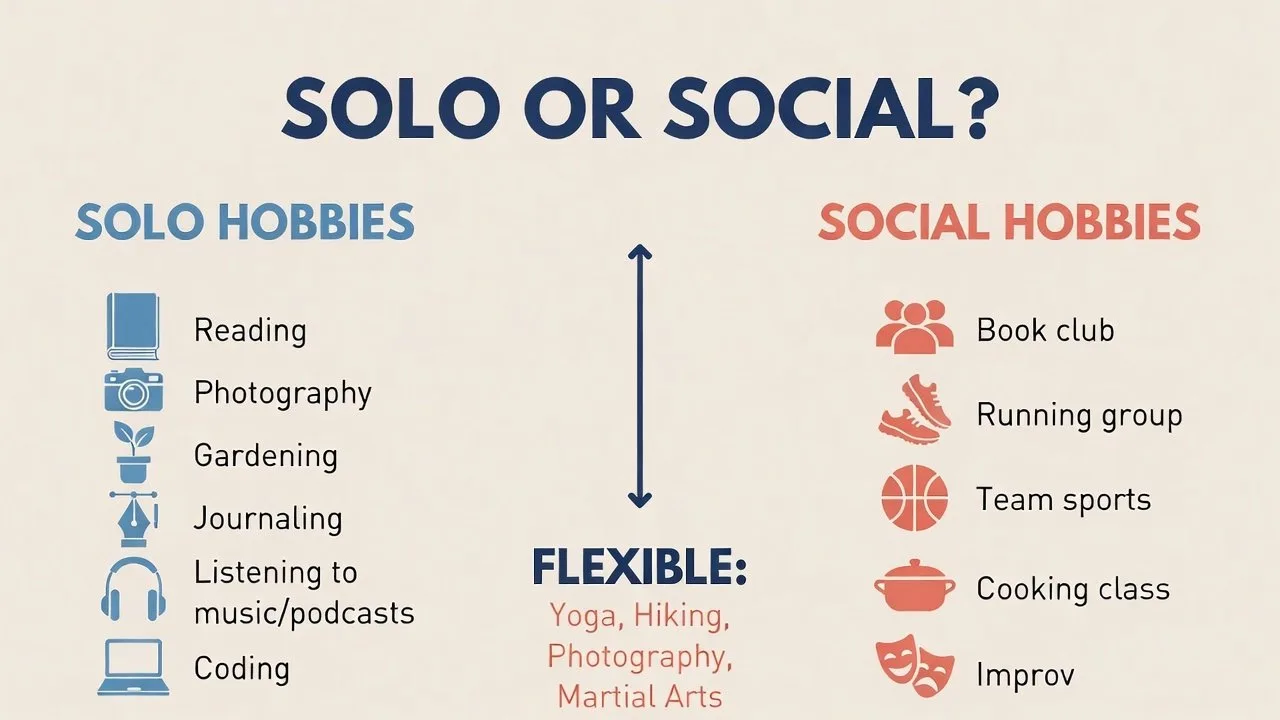
Some people seek hobbies because they want solitude — a personal space away from work, family, and social obligations. Other people seek hobbies because they want connection — new friends, shared experiences, a sense of belonging. Both are valid. They lead to different hobbies.
| Preference | Hobby Approach | Examples |
| Solo | Hobbies you do alone, on your schedule, with no social coordination | Reading, gardening, coding, painting, running, journaling, meditation, photography, organizing, cooking |
| Social | Hobbies done with others, classes, clubs, teams, communities | Book club, running group, team sports, cooking classes, rock climbing gym, dance classes, volunteer organizations, board game groups |
| Flexible | Hobbies that work both ways — solo practice, occasional social | Yoga (solo at home or studio class), hiking (solo or group), photography (solo or club), martial arts (solo practice, class sessions) |
If you want a hobby to make friends, choose the social column. If you want a hobby as an escape from people, choose solo. If you are unsure, choose flexible. For more solo activities, our guide on things to do when bored by yourself has 30 options. For social activities, our guide on things to do when bored with friends covers group ideas.
Question 5: Why Do You Actually Want a Hobby?
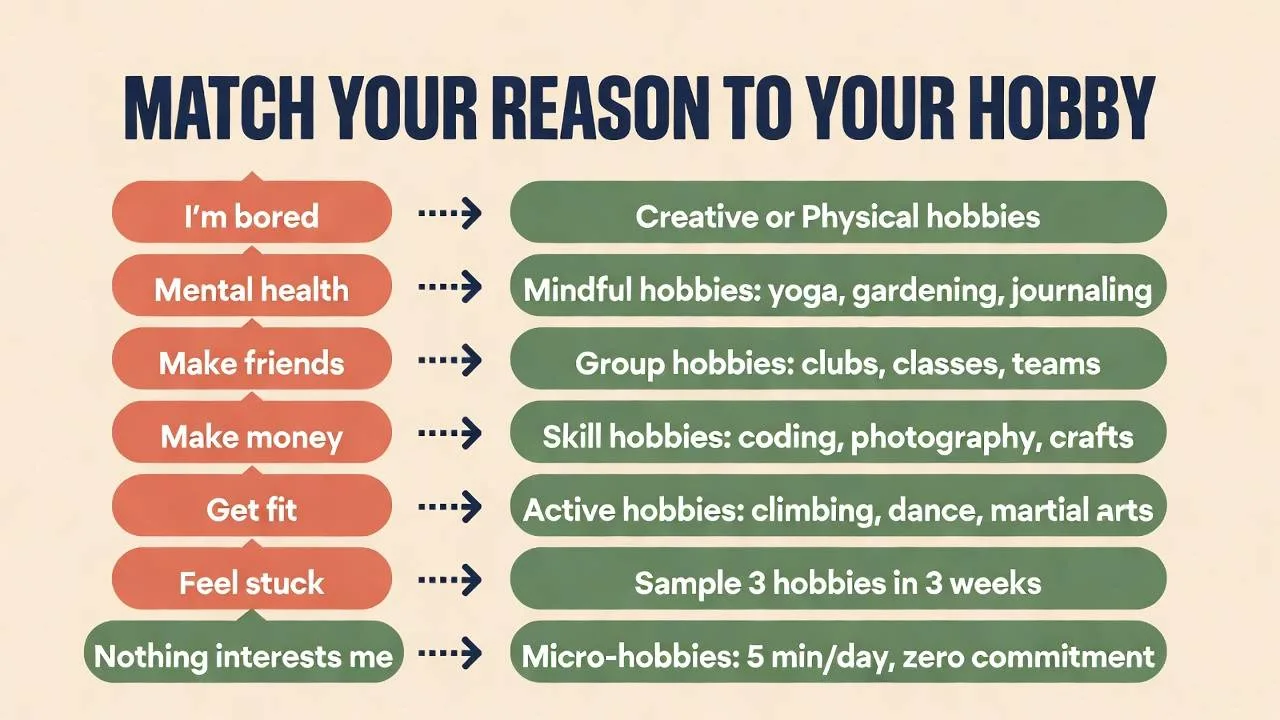
The reason you want a hobby determines which hobby will stick. Different reasons require different types of activities.
| Your Reason | What You Actually Need | Best Hobby Types |
| I’m bored and need something to do | Novelty and engagement | Creative hobbies, physical hobbies, learning hobbies — anything with visible progress |
| I want to improve my mental health | Stress relief and emotional regulation | Mindful hobbies: yoga, meditation, gardening, journaling, walking, nature activities |
| I want to make friends | Social connection and belonging | Group hobbies: book clubs, team sports, classes, volunteer groups, running groups, board game nights |
| I want a hobby that makes money | Skill-building with market value | Coding, photography, graphic design (Photoshop), cooking (catering), crafts (Etsy), blogging, freelancing |
| I want to get in shape | Physical fitness disguised as fun | Rock climbing, dance classes, hiking, martial arts, cycling, swimming, basketball, tennis |
| I feel stuck and need a change | Novelty and self-discovery | Try 3 different hobbies in 3 weeks — the variety itself is the intervention |
| Nothing interests me | You need a low-commitment sampler, not a commitment | Micro-hobbies: 5-min Duolingo, 10-min sketching, one recipe per week, one walk per day |
Your reason is the anchor. When the hobby gets boring in week 3 — and it will, because novelty fades — the reason is what keeps you going. “I do this because I need to move my body” survives the dip. “I do this because it sounded cool on a list” does not. Write your reason on a sticky note and put it on your fridge. When the enthusiasm fades, the reason remains.
If you answered “nothing interests me” and that feeling extends beyond hobbies into daily life, it may be worth exploring whether the issue is boredom or something deeper. Our guide on things to do when feeling depressed and bored addresses the overlap between apathy and boredom. And if ADHD makes the decision process feel paralyzing, our guide on things to do when bored with ADHD covers decision paralysis specifically. If you want a structured system for choosing daily activities based on neuroscience, our guide on how to build a dopamine menu when bored provides the framework.
60+ Hobbies Organized by Category — The Complete Reference
Use this table after answering the 5 questions above. Scan only the column that matches your category. Pick 3 that interest you. Try each one for 1 week.
| Physical / Active | Creative / Making | Intellectual / Learning | Social / Connection | Mindful / Restorative |
| Running | Painting | Coding | Book club | Meditation |
| Hiking | Drawing / Sketching | Language learning (Duolingo) | Running group | Yoga |
| Rock climbing | Photography | Chess | Team sports (basketball, soccer) | Gardening |
| CrossFit / Gym | Cooking | Online courses (Skillshare) | Cooking classes | Journaling |
| Yoga (active styles) | Baking | Reading (nonfiction) | Dance classes | Fishing |
| Dance classes | Crocheting / Knitting | Crossword puzzles | Volunteer organizations | Bird watching |
| Swimming | Playing an instrument | Graphic design (Photoshop) | Board game nights | Organizing |
| Cycling / Biking | Creative writing | Astronomy | Improv / Theater | Walking (no headphones) |
| Martial arts / Boxing | Scrapbooking | Podcasting / Blogging | Workshops / Adult classes | Nature photography |
| Tennis / Racquet sports | Building models | Studying a subject deeply | Community garden | Meditation apps (Headspace) |
| Skiing / Snowboarding | Woodworking | Documentary watching | Meetup groups | Slow cooking |
| Bowling | Fashion / Styling | Genealogy / Family history | Choir / Singing groups | Tea / Coffee rituals |
| Pilates | Home improvement / DIY | Puzzle solving | Local community centers | Reading (fiction) |
This table contains over 60 hobbies across 5 categories. Do not try to evaluate all of them. You already know your category from Question 1. Scan that single column. Circle 3. Try 1 this week.
The 3-Week Hobby Trial — How to Test a Hobby Without Committing
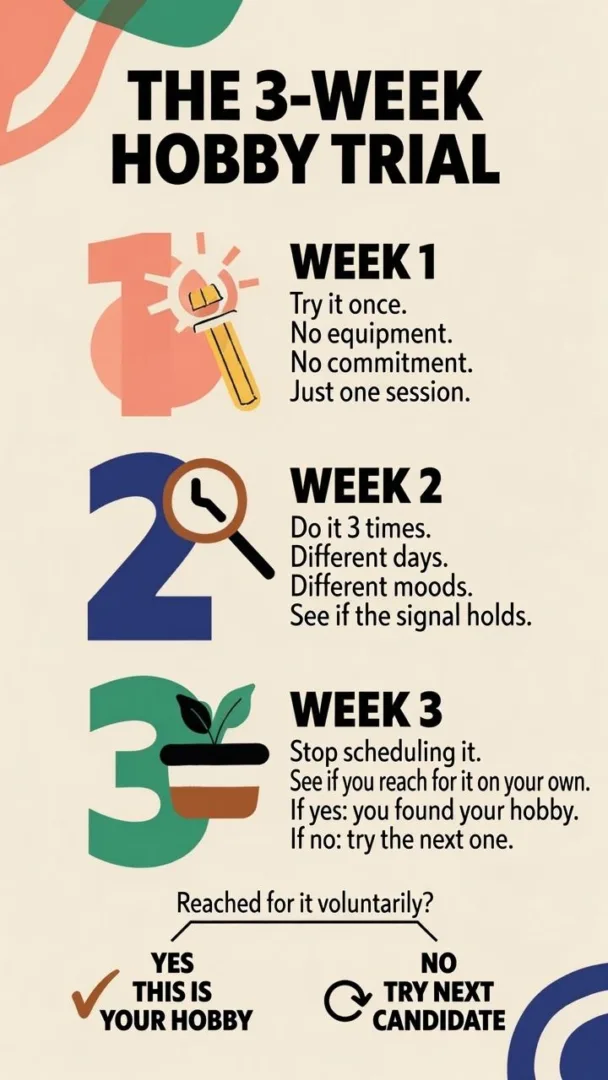
Do not commit to a hobby. Trial it. Give it 3 weeks of honest effort before deciding.
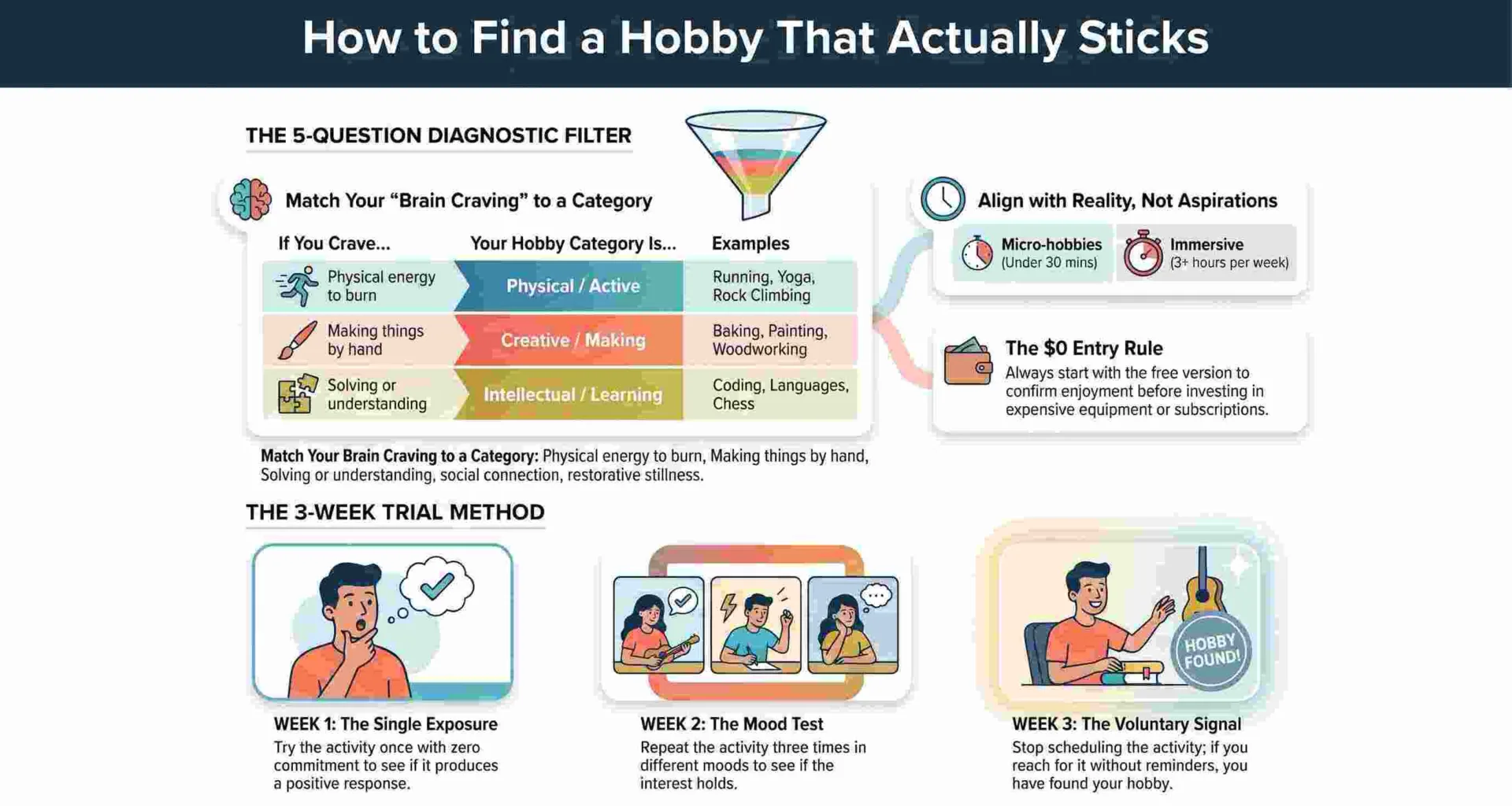
Week 1: Try it once. Do the activity one time. Do not buy equipment. Do not join a club. Use what you have or borrow what you need. If it requires instruction, watch one YouTube tutorial or attend one free class. The goal is a single exposure — enough to know if the activity produces a positive response in your brain. Not enthusiasm necessarily. Just a feeling of “I could do this again.”
Week 2: Do it 3 times. If week 1 was neutral or positive, do the activity 3 more times. At different times of day. In different moods. The single-exposure test is unreliable — you might have tried it when you were tired, distracted, or in the wrong headspace. Three exposures in different conditions gives you a real signal.
Week 3: Do it without being reminded. Stop scheduling it. Stop setting reminders. See if you reach for it voluntarily. If you find yourself thinking about the hobby between sessions, wanting to improve, looking forward to the next time — you have found a hobby. If you forget about it entirely, it is not the right one. Move to the next candidate on your list of 3.
The 3-week trial prevents 2 common mistakes: abandoning a hobby after one bad session (premature rejection) and forcing a hobby you do not enjoy because you already bought the equipment (sunk cost commitment). 3 weeks tells you the truth. Trust the result.
How to Find a Hobby in Special Situations
How to Find a Hobby When Nothing Interests You
If nothing interests you, the problem is not a lack of hobbies. It is a numbed reward system. Chronic scrolling, stress, or depression can flatten your dopamine response to the point where normal activities stop registering as interesting. The fix is not finding the right hobby. The fix is lowering the stimulation threshold. Start with micro-hobbies: 5 minutes of Duolingo, 10 pages of a book, one new recipe per week. The bar is deliberately low because your brain needs small, manageable wins to rebuild the reward pathway. Our guide on how to build a dopamine menu when bored covers this mechanism in detail.
How to Find a Hobby as a Teen
You have more time than adults and fewer obligations — use both. Try 5 hobbies in 5 weeks. Do not commit. Sample. School clubs, local community centers, YouTube tutorials, free apps, and your local library are all free entry points. The hobby you love at 15 might define your career at 25 — or it might just be fun. Both outcomes are valid. Our guide on things to do when bored for teens has more age-specific ideas.
How to Find a Hobby After Retirement
You finally have the time. The challenge is filling it with purpose, not just activity. Hobbies that combine learning, social connection, and physical movement are the most effective for post-retirement wellbeing. Volunteering. Gardening clubs. Walking groups. Adult education classes at a local college. Community theater. The social component is especially important — retirement removes the daily social structure that work provided. A hobby that includes other people fills that gap. Our guide on things to do when bored after retirement has more options.
How to Find a Hobby With ADHD
ADHD brains need novelty, visible progress, and low setup friction. Hobbies that require 20 minutes of preparation before you start are hobbies you will never start. Choose hobbies with immediate engagement: drawing (pick up a pencil, draw), cooking (open fridge, start chopping), walking (open door, walk). Rotate hobbies monthly to satisfy the novelty craving. Build a dopamine menu with 5 to 8 hobbies across different categories so you always have a match for your current state. Our guide on things to do when bored with ADHD covers the neurodivergent approach to hobby selection.
How to Find a Hobby When Depressed
Depression makes everything feel uninteresting, which is why the advice “find something you enjoy” feels impossible. The fix is not enjoyment-first. It is action-first. Pick the easiest hobby on the list — walking, organizing a drawer, reading one page, watering a plant — and do it once. Do not evaluate whether you enjoyed it. Just do it. Behavioral activation — acting before the mood arrives — is one of the most effective evidence-based techniques for depression. The enjoyment follows the action, not the other way around. Our guide on things to do when feeling depressed and bored covers this approach in detail.
How to Find a Hobby That Makes Money
Start it as a hobby first. Monetize it after you are good enough that people would pay. Coding starts on Codecademy (free). Photography starts on your phone. Graphic design starts on Canva (free). Cooking starts in your kitchen. Writing starts in a journal. Each of these can become income-generating, but only after you have built enough skill that the output has market value. The monetization timeline is 6 to 12 months for most hobbies. Start for enjoyment. Monetize when ready. Not before.
How to Find a Hobby at Home
Most hobbies on this list can be done at home with no equipment. Drawing, cooking, reading, journaling, yoga (YouTube), coding, language learning, creative writing, gardening (windowsill), photography (phone), organizing, and meditation all work in any home. Our guide on things to do when bored at home has 50+ home-based activities. Our guide on things to do when bored working from home covers hobbies that fit around remote work schedules.
Natty’s take:
I have coached people who say they do not have a hobby, and when I ask them what they did last weekend, they describe 3 hobbies they do not recognize as hobbies. You reorganized your kitchen? That is organizing — a hobby. You cooked something new? Cooking — a hobby. You went for a walk? Walking — a hobby. Most adults already have hobbies. They just do not give themselves credit because the activities are not impressive enough for Instagram. A hobby does not need to be impressive. It needs to be yours.
5 Mistakes That Prevent People From Finding a Hobby
Mistake 1: Researching Instead of Trying
Reading about hobbies is not the same as doing a hobby. You can spend 5 hours reading articles about painting without ever picking up a brush. At some point, research becomes procrastination in disguise. The 3-week trial method fixes this: try first, research later.
Mistake 2: Buying Equipment Before You Know If You Enjoy It
Do not buy a $300 guitar before you know if you like playing guitar. Borrow one. Rent one. Use a free app. The free version tells you if the activity resonates. Equipment upgrades come after the resonance is confirmed.
Mistake 3: Comparing Your Beginner Phase to Someone’s Expert Phase
Every skilled person on YouTube, Instagram, and TikTok was once as bad as you are now. Their posted content represents thousands of hours of practice. Your first attempt represents zero hours. Comparing the two is unfair and inaccurate. Give yourself permission to be bad for at least 3 months.
Mistake 4: Quitting After One Bad Session
One session is not enough data. You might have been tired, distracted, or in the wrong environment. The 3-week trial exists for this reason: 3 exposures in different conditions gives you a reliable signal. One exposure gives you noise.
Mistake 5: Choosing a Hobby for Someone Else’s Approval
If you choose a hobby because it sounds impressive, productive, or Instagram-worthy, you will abandon it within a month. Choose a hobby because it makes YOU feel good during and after the activity. Not because it makes a good story at dinner parties. The right hobby makes you lose track of time. That is the test. If you check the clock, it is the wrong hobby.
Is [Activity] a Hobby? — Common Questions Answered
People frequently search “is [activity] a hobby?” because the line between a hobby, a habit, and a lifestyle is genuinely blurry. Here is how to tell the difference.
A hobby is an activity you choose to do during free time because it brings you enjoyment, satisfaction, or personal growth. It is voluntary, recurring, and done for its own sake — not for obligation, survival, or work. By that definition:
| Activity | Is It a Hobby? | Why |
| Working out / Gym | Yes | Voluntary, recurring, done for enjoyment and personal benefit |
| Sleeping | No | Biological necessity, not a chosen leisure activity |
| Traveling | Yes | Voluntary exploration done for enjoyment and personal growth |
| Shopping | Depends | Casual browsing = hobby. Compulsive spending = not a hobby |
| Listening to music | Yes (active) / No (passive) | Curating playlists, attending concerts, studying genres = hobby. Background noise = not a hobby |
| Cooking | Yes | Chosen, creative, skill-building, done for enjoyment |
| Socializing | Depends | Intentional social activities = hobby. Default socializing = not a hobby |
| Meditation | Yes | Voluntary, practiced, done for personal benefit |
| Organizing | Yes | Chosen, satisfying, recurring, done for personal enjoyment |
| Fashion | Yes | Curating style, studying trends, experimenting = hobby |
For deep dives on specific activities, explore our full “Is It a Hobby?” series: Is Working Out a Hobby? · Is Traveling a Hobby? · Is Shopping a Hobby? · Is Sleeping a Hobby? · Is Listening to Music a Hobby? · Is Cooking a Hobby? · Is Organizing a Hobby? · Is Meditation a Hobby? · Is Fashion a Hobby? · Is Painting a Hobby? · Is Coding a Hobby? · Is Crocheting a Hobby? · Is Hiking a Hobby? · Is Boxing a Hobby?
Your Action Plan — Find a Hobby This Week
Do not read this article and do nothing. Follow these 5 steps this week.
Today: Answer the 5 questions above. Write down your category, your time, your budget, your social preference, and your reason.
Tomorrow: Scan the hobby table for your category. Circle 3 hobbies.
This week: Try hobby #1. One session. No equipment purchase. Use what you have.
Next week: Try hobby #2.
Week 3: Try hobby #3.
End of week 3: Which one made you lose track of time? Which one did you think about between sessions? Which one did you reach for without being reminded? That one is your hobby. Start it for real.
What “How to Find a Hobby” Is Actually Telling You
If you searched “how to find a hobby,” your brain is telling you something important: your current free time is not satisfying you. You have time. You are spending it on things that do not fill you up. The search is not really about hobbies. It is about wanting your life to feel richer, more varied, and more your own.
A hobby answers that want. It gives unstructured time a shape. It gives idle hands a project. It gives a restless brain a puzzle. It gives a lonely person a community. It gives a busy person a break. The specific hobby matters less than the act of having one.
You do not need to find the perfect hobby. You need to try 3 and keep the one that makes you forget to check your phone. That is the whole test. That is the whole guide. Pick up a pen, a pan, a brush, a ball, a book, a seed, or a pair of shoes. Start today. The hobby does not need to be perfect. It needs to be started. If you want a comprehensive list of options beyond the 60+ in this guide, our full guide on modern hobbies to beat boredom in 2026 covers 20 hobbies that did not exist 10 years ago. And for daily boredom between hobby sessions, our guide on things to do when bored at home has 50+ ideas for every mood and energy level.