Analog Bag Ideas: 60 Screen-Free Things to Pack in Yours
You pick up your phone to check one thing, and 40 minutes later you’re still scrolling. The analog bag is the internet’s favorite fix for that loop: a tote you fill with things your hands and brain actually enjoy, so there’s always something better to reach for than your screen.
Below are 60 analog bag ideas sorted with a simple system, ready-to-pack bags for kids, adults, travel and gifting, and honest advice on doing this trend without buying a pile of new stuff.
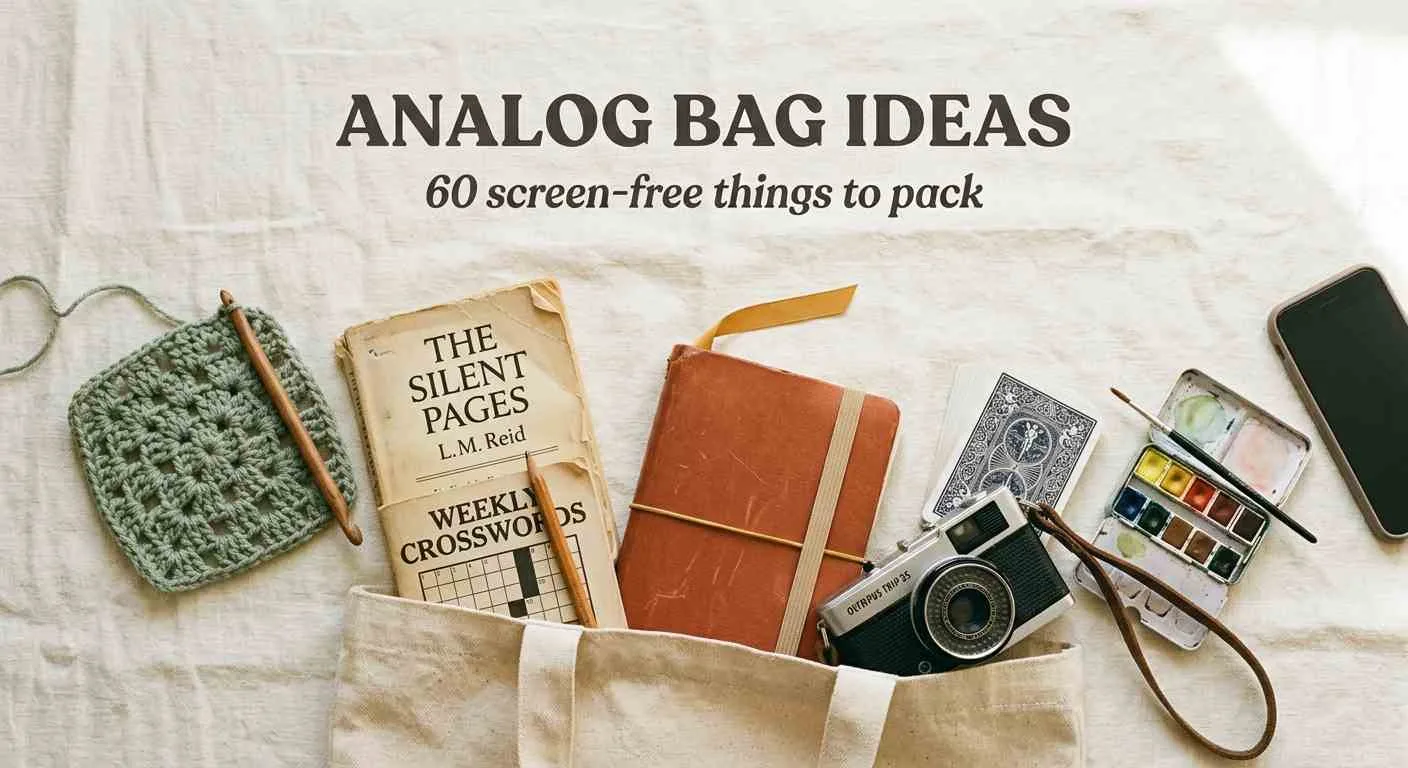
Quick answer: An analog bag is a tote or pouch filled with screen-free activities, like a crochet project, a book, a puzzle book, a journal or a deck of cards, that you grab instead of your phone. The best ones hold one thing for your hands, one for your head and one for your heart.
What is an analog bag?
An analog bag is a bag you keep packed with offline activities so that when boredom hits, the easiest thing to reach for isn’t your phone. Some people call it a “stop-scrolling bag” or a “phone replacement bag”. It’s usually a canvas tote, but any bag works, including a purse, a backpack or a zip pouch.
The point isn’t the bag. The point is friction. Your phone wins because it’s always within reach and always ready. An analog bag makes a better option just as easy to grab.
Where the analog bag trend came from
The trend took off on TikTok in 2025. Axios credits creator Sierra Campbell (@siececampbell on TikTok), who filled a bag with things to grab instead of her phone. She keeps one at home and another in her car. Axios also reported, using TikTok data, that posts tagged #AnalogLife rose more than 330% in the first nine months of 2025 compared with the year before. NPR covered the trend in April 2026 and called analog bags “Gen Z’s viral solution” to screen time.
It isn’t really new. Parents have packed busy bags for car rides and restaurants for decades. What changed is who’s packing them: adults who want their attention back.
Why an analog bag actually works
Habit expert Charles Duhigg, author of The Power of Habit, explained the idea to Axios. Scrolling runs on a cue (boredom) and a reward (entertainment). You don’t break the habit by fighting the cue. You break it by swapping in a new behavior that answers the same cue with a similar reward, and keeping it within arm’s reach. An analog bag is that swap, packed and ready.
What to put in an analog bag: the Hands–Head–Heart Pack
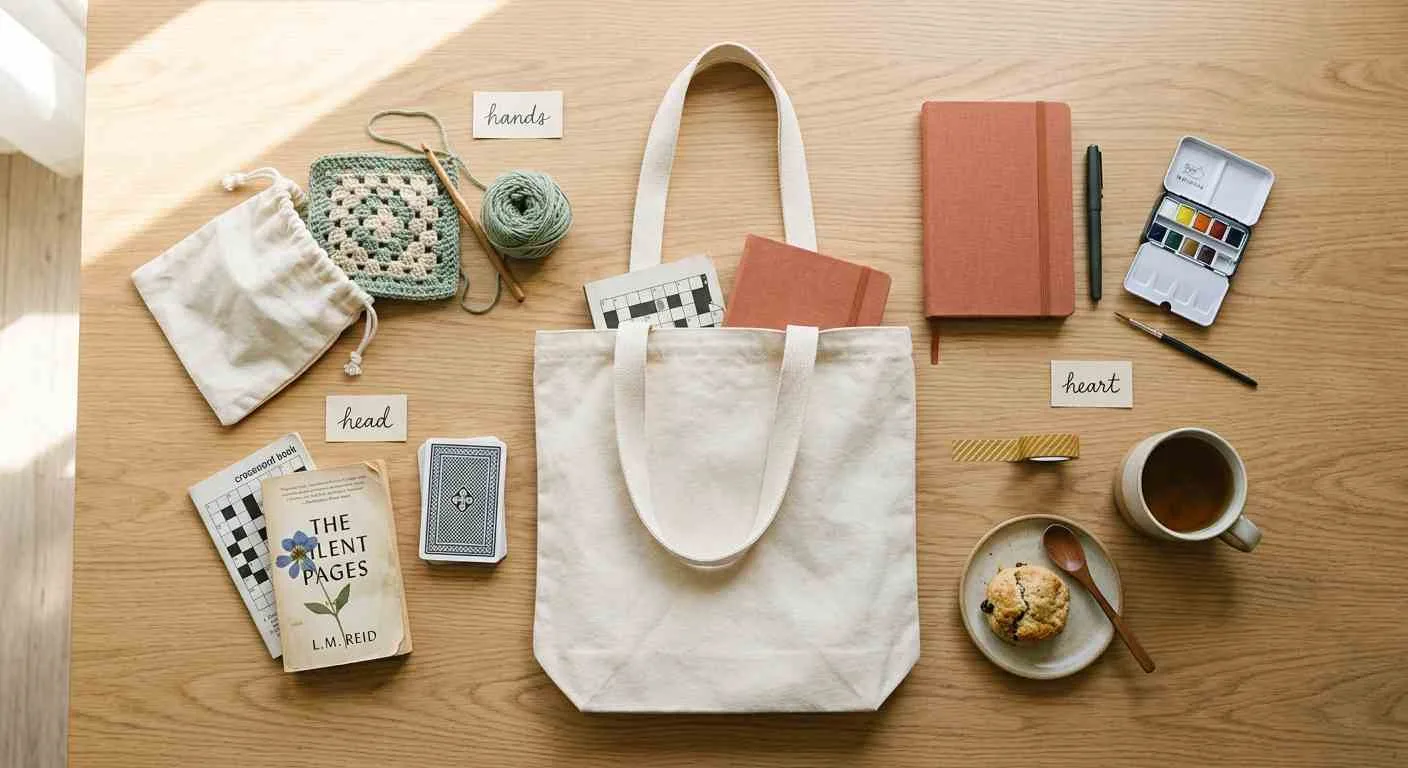
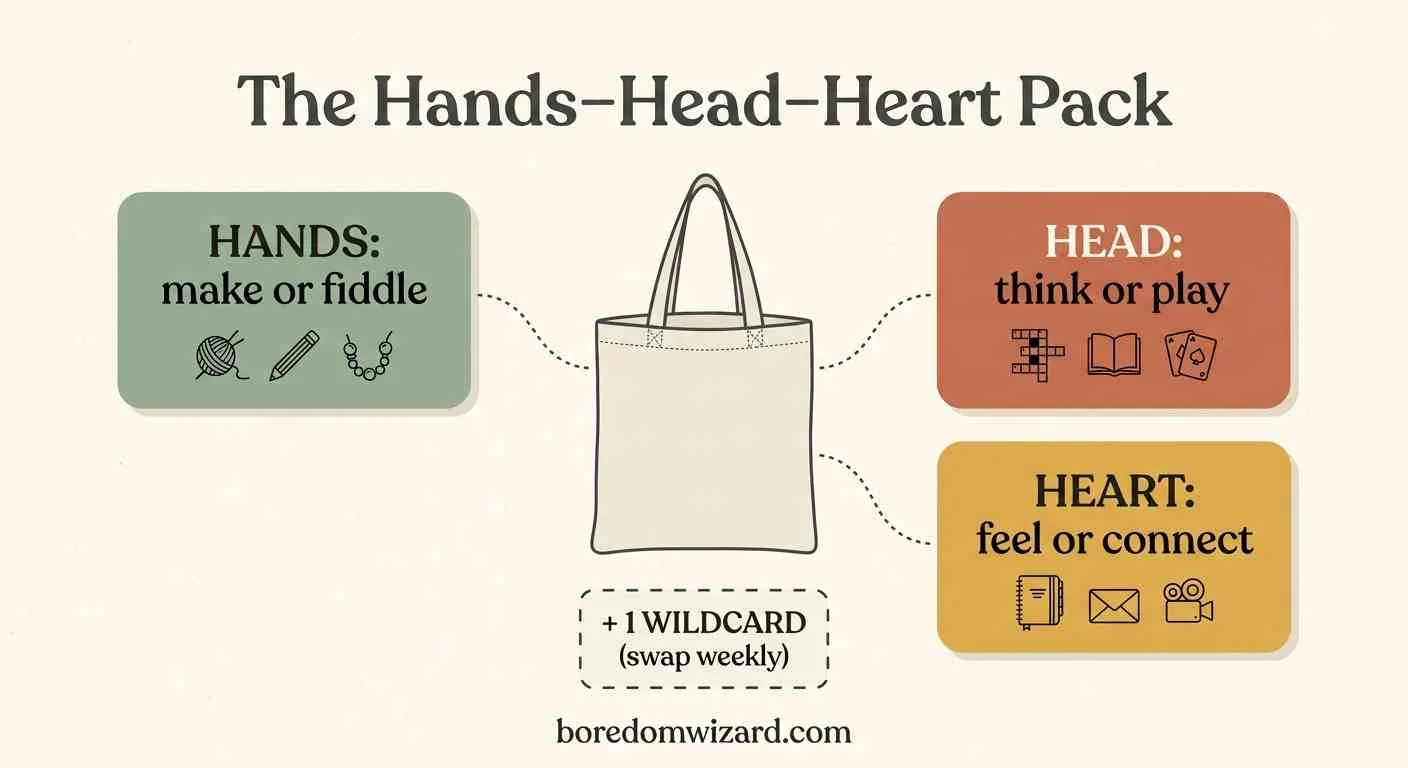
Most analog bags fail for one of two reasons. Either they’re packed with one kind of thing (five books and nothing else), or they’re stuffed so full that picking something feels like a chore. We use a simple rule called the Hands–Head–Heart Pack: pack one thing from each group, plus one wildcard.
- Hands: something tactile to make or fiddle with, like crochet, sketching, beading or origami. This is your best phone replacement because it keeps your hands busy, and busy hands can’t scroll.
- Head: something that works your brain, like a puzzle book, a novel, cards or a travel game. Good for waiting rooms and long lines.
- Heart: something that connects you to yourself or other people, like a journal, letters, a film camera or a photo-book project. This is the slow, meaningful part.
- Wildcard: one thing you’re curious about but haven’t tried yet. Swap it every week.
Three things plus one is enough to cover any mood and still fit in a regular tote. If you can’t decide where to start, our free hobby quiz matches you with hobbies by your time and budget, and many of them fit in a bag.
60 analog bag ideas
Every idea below fits in a regular tote, and most cost little or nothing. $0 means you probably already own it.
Hands: 20 things to make or fiddle with
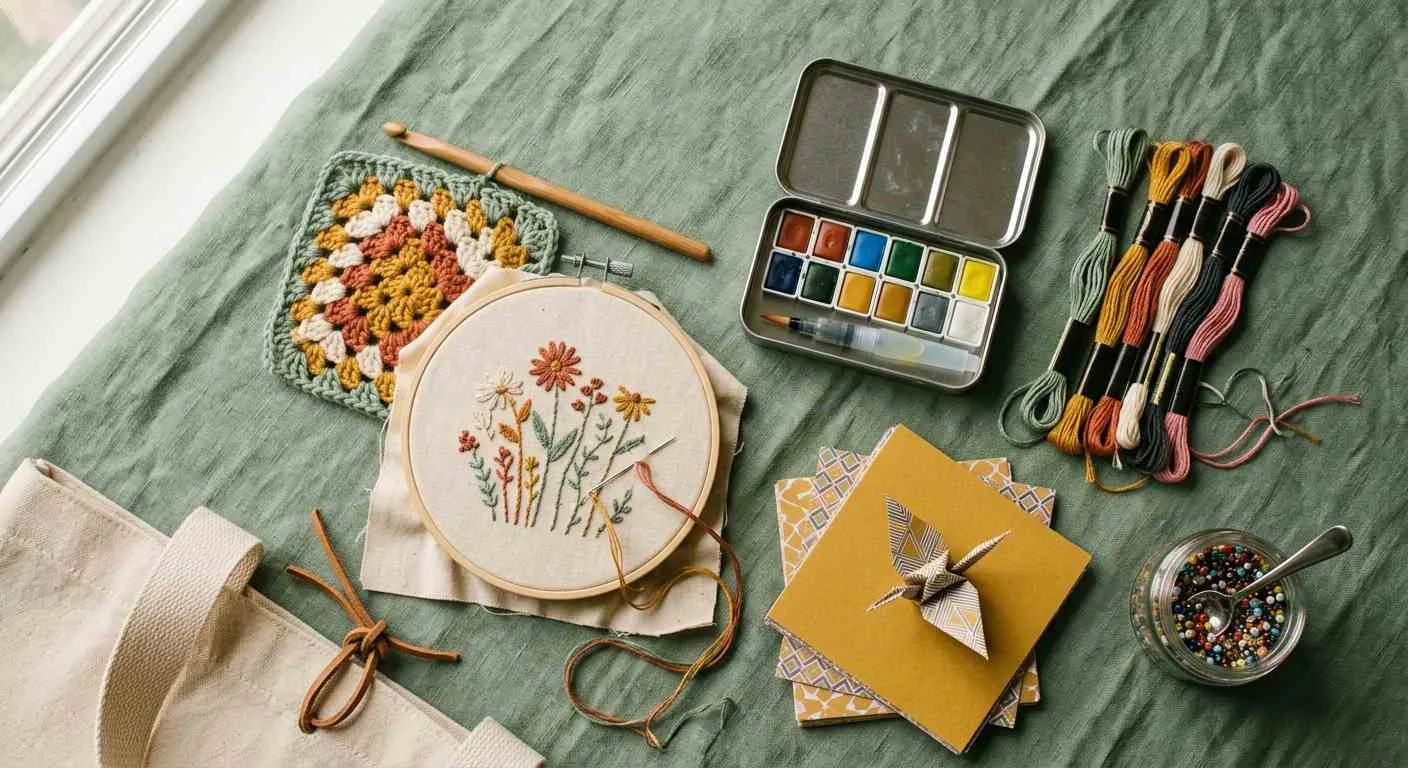
1. Crochet project — Pack a hook, one ball of yarn and a granny-square pattern. Squares are small, portable and add up to a blanket. About $10 to start.
2. Knitting — A scarf or dishcloth on circular needles won’t poke out of your bag. Pack stitch markers in a small tin.
3. Embroidery hoop — A 5-inch hoop with a pre-traced design is the perfect waiting-room project. Find easy starters in our embroidery patterns for beginners.
4. Cross-stitch — Counted cross-stitch is relaxing, and beginner kits come with everything in one pouch.
5. Sketchbook and pencil — $0. Draw what’s in front of you: your coffee, your shoes, the person across the train. Need prompts? Use our list of drawing ideas.
6. Travel watercolor set — A tin palette and a water brush (the handle holds the water) let you paint anywhere without a cup.
7. Coloring book and colored pencils — Adult coloring books are a classic for a reason. Pencils travel better than markers.
8. Mandala pages — Print or draw a few blank mandalas and fill them with patterns. Our step-by-step mandala drawing guide shows how.
9. Origami paper — A pack of 6-inch squares and one folding guide. Cranes, boxes and stars take minutes.
10. Friendship bracelet thread — Embroidery floss and a safety pin to anchor it to your jeans. Instant nostalgia.
11. Bead kit — Seed beads and elastic cord for bracelets. Spoon beading (scooping beads onto a needle from a shallow dish) is a popular analog bag pick on TikTok and Instagram.
12. Brush lettering pens — Two brush pens and a practice pad. Write your grocery list beautifully.
13. Mini paint-by-numbers — Pocket-size canvases are small enough to finish in one coffee-shop session.
14. Diamond painting card — Sticker-style dot art that’s oddly calming. Choose a small one so you can finish it.
15. Visible mending kit — A needle, thread and a holey sweater. Fixing something you own is the most anti-scroll thing there is.
16. Junk journal supplies — Washi tape, ticket stubs, old magazine pages and a glue stick. Turn your day into a collage.
17. Fineliner and pattern doodles — One black pen and a small notebook for repeating patterns. $0 if you own a pen.
18. Macramé keychain cord — A few yards of cord and three knots make a keychain or plant hanger.
19. Finger knitting yarn — No tools needed, great for kids and adults, and it turns into a cozy chunky cord.
20. Wooden 3D puzzle kit — Slot-together models of animals or buildings. Satisfying and screen-free.
Head: 20 things to think or play with
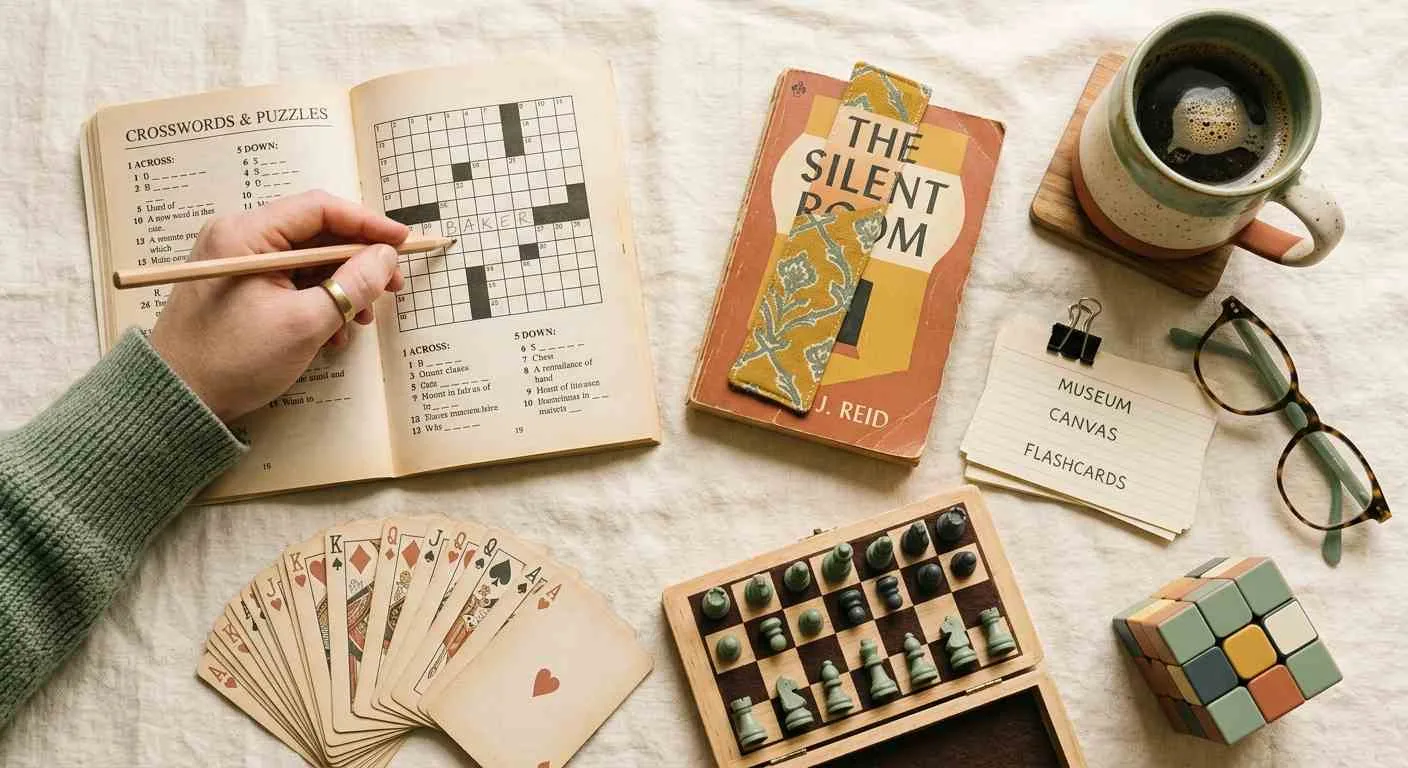
21. A paperback or library book — $0 with a library card. Paperbacks are lighter than hardcovers and you won’t worry about them in your bag.
22. Crossword book — Start with easy or Monday-level puzzles and work your way up.
23. Sudoku book — Ten minutes a day. Track your times on the inside cover.
24. Logic mystery puzzle book — Whodunit puzzle books ask you to solve a crime from a few clues. Very hard to put down.
25. Deck of cards — $0. Solitaire, learning a card trick or a new game for two. The most versatile thing in any analog bag.
26. Magnetic travel chess — Pieces stay put on buses and planes. Play a friend or work through chess puzzles.
27. Rubik’s cube — Learning to solve it takes a weekend with a beginner method, and it’s endlessly fiddly.
28. Word search book — Low-effort, high-satisfaction. Good for tired brains.
29. Language flashcards — Write 20 words on index cards. Flip through them in line at the grocery store.
30. Pocket field guide — Birds, trees or wildflowers for your region. It turns any walk into a scavenger hunt.
31. Poetry collection — One poem takes two minutes and gives you something to think about all day.
32. Trivia cards — A pack of question cards for solo play or to challenge friends.
33. Pocket word game — Travel-size letter tile games pack small and work for two players.
34. Mini jigsaw puzzle — A 100-piece puzzle in a pouch fits a coffee-shop table.
35. Riddle or brain-teaser book — Great with kids and surprisingly fun with friends.
36. Tangram set — Seven wooden shapes, hundreds of puzzles. Tiny and nearly indestructible.
37. A how-to book for a new skill — Knots, calligraphy, card magic, bird calls. Learn one thing per bag.
38. A print magazine — A copy you pick at a newsstand or library feels different from an endless feed. It ends.
39. Card game for two — Uno or any small card game for a friend, a partner or your kids.
40. Notebook of questions — Fill it with big questions to think about or ask the people you’re with. Our conversation starters list has 250 to start with.
Heart: 20 things to feel, remember or connect with
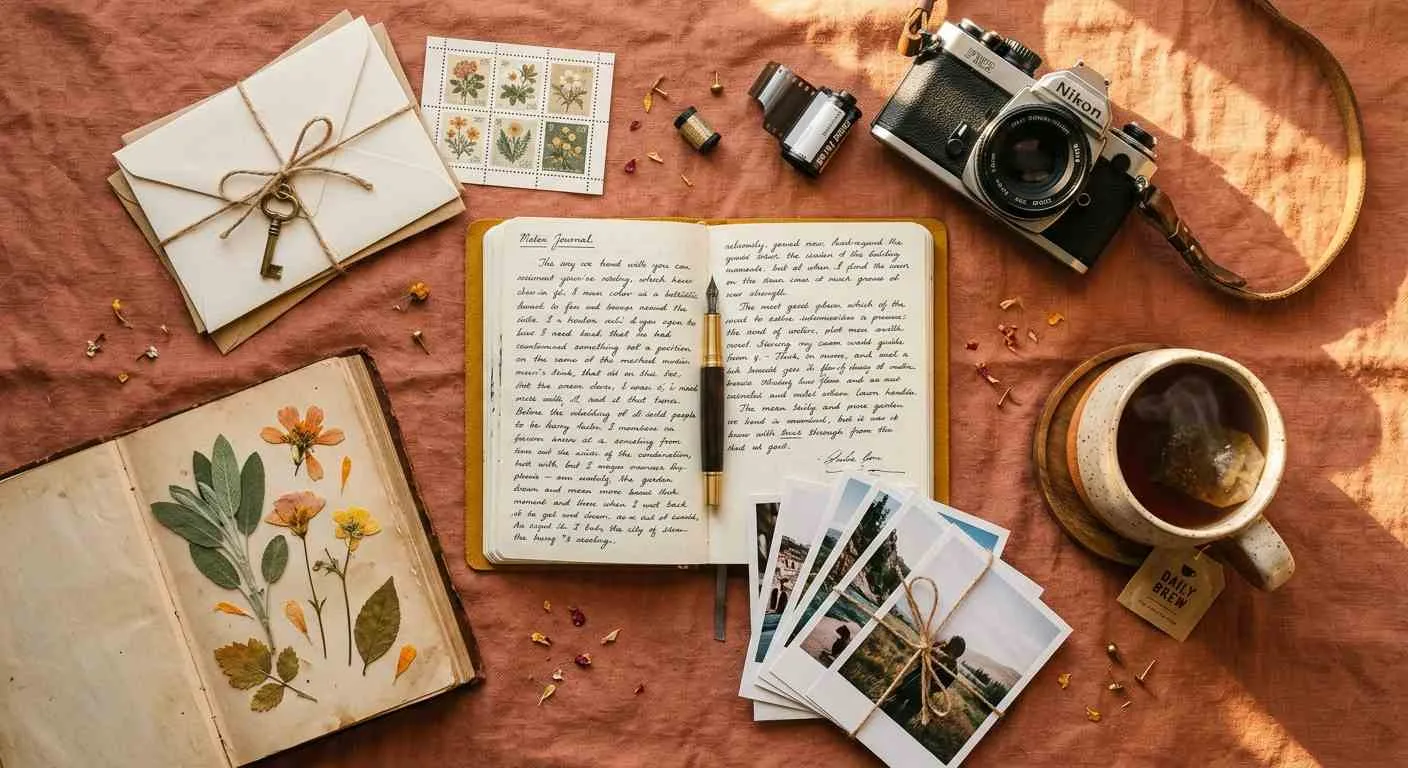
41. Journal and a prompt — Write one page about your day. For help starting, see our journal prompts.
42. Gratitude notebook — Three good things, every day. It takes two minutes and works best with pen on paper.
43. Letter-writing kit — Stationery, envelopes and a sheet of stamps. Write to a grandparent or an old friend. Real mail is a gift.
44. Postcards — Buy local postcards and mail them from wherever you are.
45. Disposable or film camera — 24 shots means you think before you shoot, and you don’t see them until they’re developed.
46. Instant camera — Print the moment right there. Pack a few extra photos to give away.
47. A photo-book project — Print 20 photos from your camera roll and build a little book of your year. Creators popularized this as a way to rescue memories from the phone.
48. Scrapbook pages — Glue in receipts, tickets and notes from a day out.
49. Commonplace book — A small notebook where you copy quotes and lines you love from what you read.
50. Pressed flower book — Any old hardcover and a few sheets of parchment. Pick a flower on a walk and press it.
51. Bucket list notebook — Plan things to do this season. Our winter bucket list has 75 ideas to copy in.
52. Letter to your future self — Seal it, date it and open it in a year.
53. Kindness notes — A pad of sticky notes to leave encouraging messages for coworkers, family or strangers.
54. Sketch-a-day memory journal — Draw one tiny picture of something that happened today.
55. Offline music player or radio — An old MP3 player with no apps or a pocket radio. Music without the feed.
56. A favorite tea bag — Pack a tea bag and make the bag a small ritual: tea, page, quiet.
57. Comfort kit — Hand cream, lip balm and a soft scarf. Analog care for long days.
58. Mini vision board kit — A few magazine pages, scissors and a card. Our vision board ideas show how.
59. Habit tracker card — One small grid to tick off a habit each day, like 20 minutes without your phone. Try our habit tracker printable.
60. Prayer, meditation or breathing card — Whatever centers you, written on one card you can hold.
Ready-to-pack analog bags for every situation
Don’t want to choose from 60? Copy one of these. Each follows the Hands–Head–Heart Pack.
| Bag | Hands | Head | Heart | Why it works |
|---|---|---|---|---|
| Commute bag | Crochet granny square | Paperback | Pocket notebook | Fits on your lap on a bus or train |
| Coffee-shop bag | Watercolor tin | Crossword book | Letter-writing kit | One table, two hours, zero scrolling |
| Travel / plane bag | Embroidery hoop | Magnetic chess | Film camera | Nothing that needs a charger or Wi-Fi |
| Evening wind-down bag (adults) | Knitting | Poetry or a novel | Gratitude notebook | Lives next to the couch where you usually scroll |
| Analog bag for kids | Coloring book + crayons | Card game for two | Sticker book | Restaurant and car-ride savior |
| Study-break bag (school or dorm) | Origami paper | Rubik’s cube | Sketchbook | Ten-minute breaks that don’t eat an hour |
| Date-night bag | Friendship bracelets for two | Card game | Question cards | Talk and play instead of scrolling side by side |
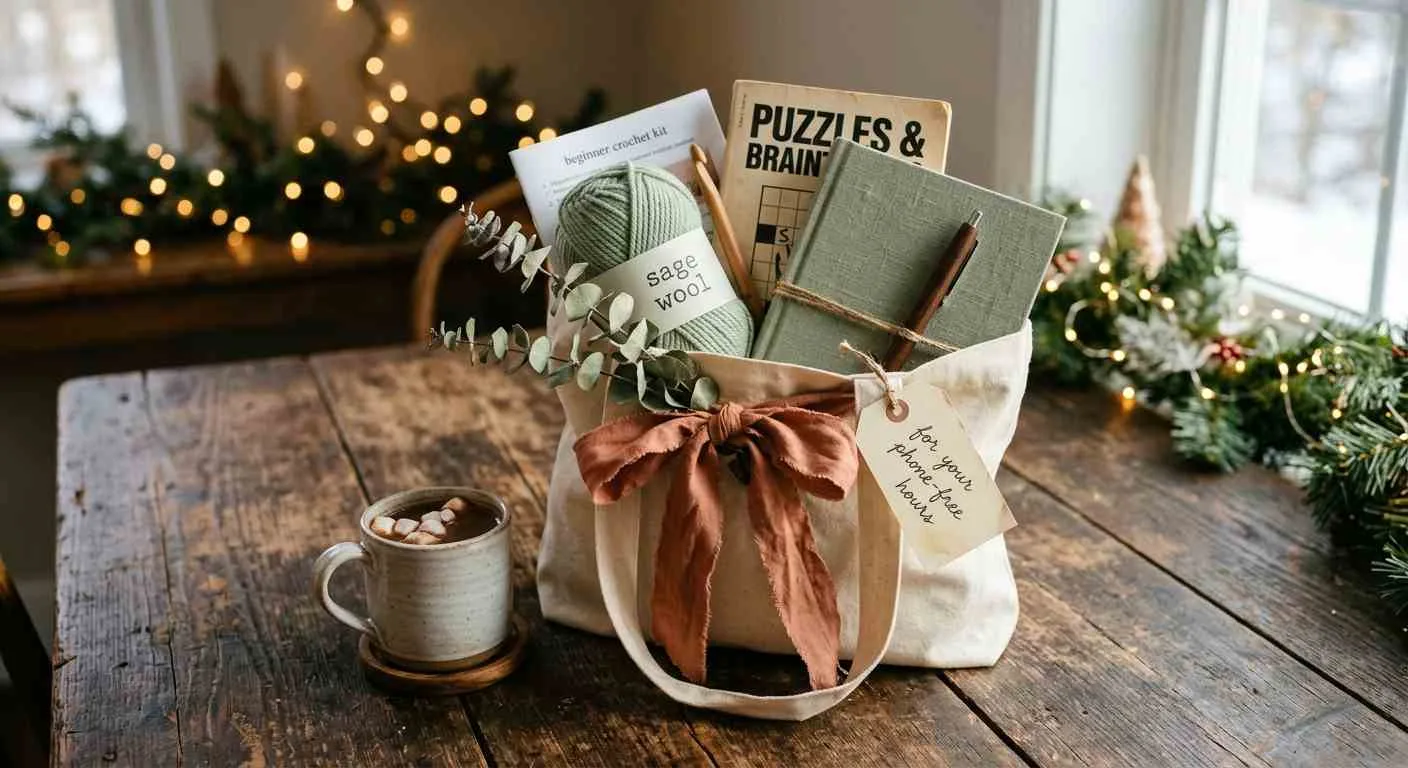
| Gift analog bag | A beginner crochet kit | A puzzle book | A journal + nice pen | A thoughtful holiday gift under $40 |
Analog bag ideas for adults
Adults usually scroll at home, at night, on the couch. So the most useful adult analog bag doesn’t leave the house. It sits where your phone habit lives. Pack something slow (knitting, a novel), something social (cards to play with your partner) and something reflective (a journal). Put your phone on the charger in another room and the bag next to your spot on the couch.
Analog bag for kids
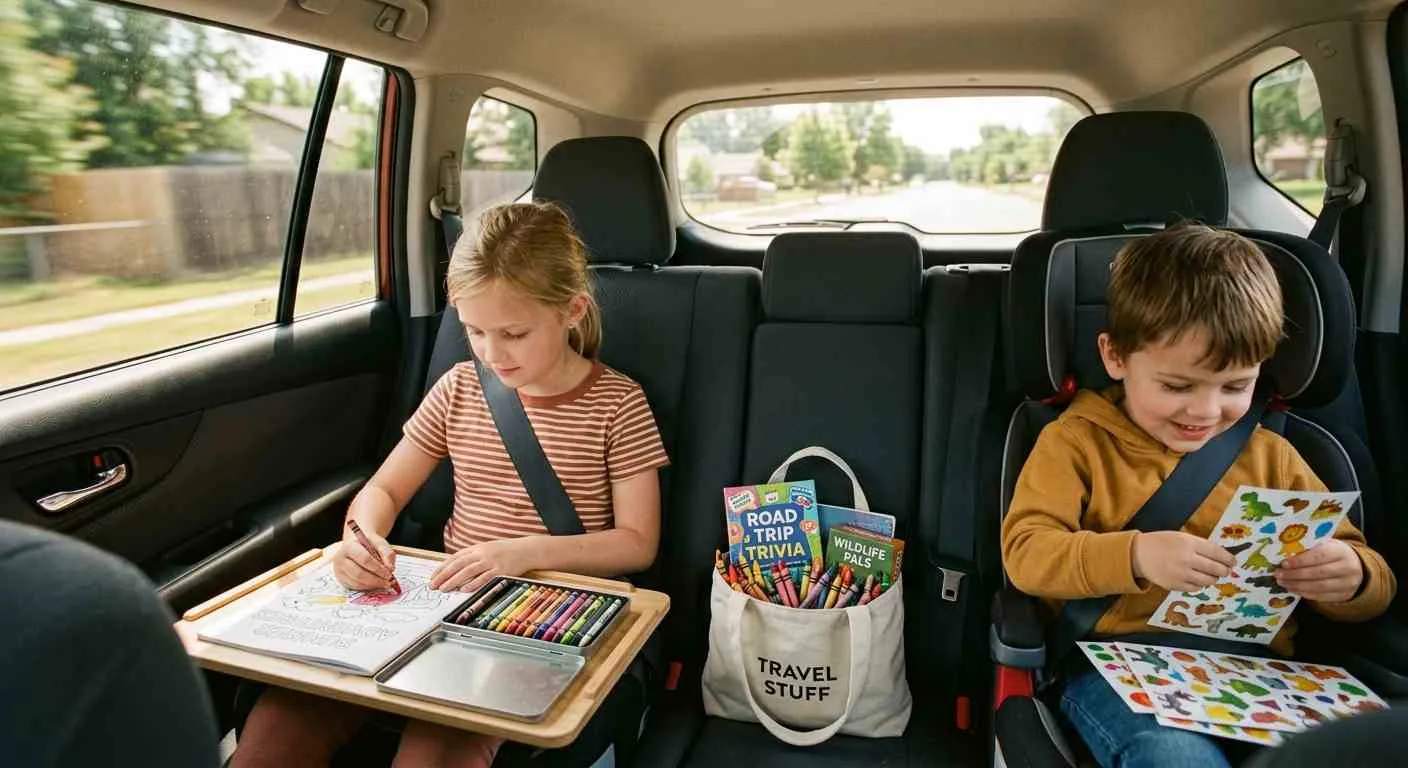
A kids’ analog bag works best with small surprises. Pack a new coloring book, a sticker book, a small card game, a pipe-cleaner pack and a mini puzzle, and rotate one item each week so it stays exciting. Keep one in the car for long drives and restaurant waits. Choose items without small parts for kids under three.
An analog bag as a gift
An analog bag makes a great holiday or birthday gift, especially for teens and anyone who says they spend too much time on their phone. Use a simple tote, add one hands, one head and one heart item, and tuck in a handwritten note explaining the idea. It’s personal, useful and easy to keep under $40.
How to make an analog bag without buying a bunch of stuff
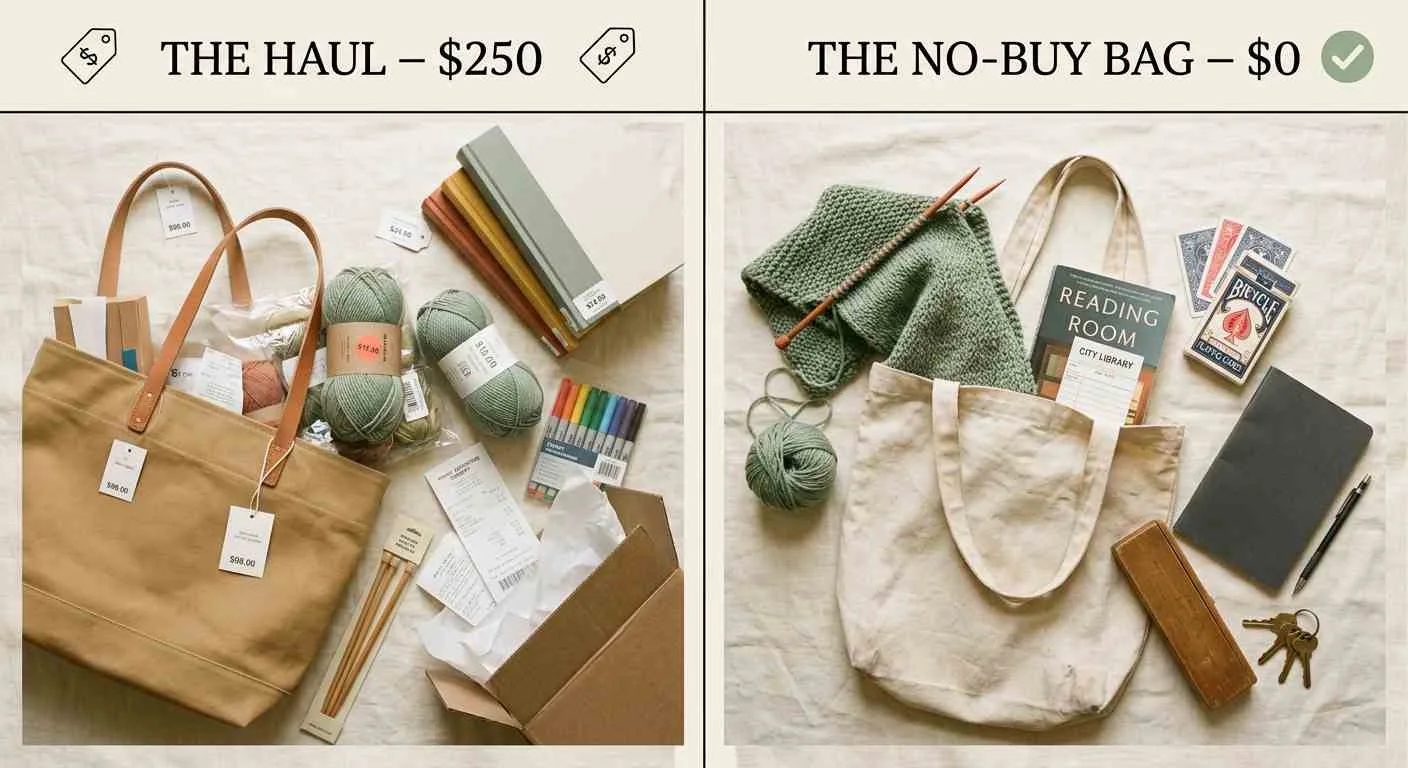
Here’s the honest part. Not everyone loves this trend. Reddit threads and YouTube videos call it “another excuse to overconsume”, and they have a point: buying a $90 tote and $200 of new hobby supplies to fix a phone habit misses the idea. A real analog bag starts with what you already have. Follow these No-Buy rules:
- Shop your home first. That half-finished scarf, the puzzle book from last Christmas, the sketchbook you bought in 2022. Your bag is probably already in your closet.
- Use any bag. A tote from the grocery store, a pencil case, an old purse. The bag doesn’t matter. What’s in it does.
- Borrow before you buy. Libraries lend books, puzzles and games, and many lend craft kits and instruments too. Buy Nothing groups give away hobby supplies all the time.
- Finish before you add. Only add a new project when you’ve finished or dropped one. One in, one out.
- Spend on one thing at most. If you buy anything, make it the one item you’ll actually use, like a good crochet hook or a puzzle book you’re excited about.
| Budget | What it looks like |
|---|---|
| $0 | A tote you own, a library book, a deck of cards, a notebook and pen, printed mandala or coloring pages |
| Under $20 | Add a crossword or sudoku book, a crochet hook and yarn, or a travel watercolor set |
| Splurge | A film or instant camera, a nicer tote, or a beginner embroidery or knitting kit |
What are the best analog bags?
The best analog bag is the one you’ll actually carry. That said, a few features make life easier:
- A wide opening, so you can see everything inside at a glance. Out of sight means out of mind.
- Inside pockets or pouches, so pens, hooks and beads don’t sink to the bottom.
- Washable canvas or cotton, because yarn fluff, paint and coffee happen.
- A zip or snap top, if you’ll carry it on public transit.
Popular choices include canvas totes from brands like Analog Company and personalized L.L.Bean Boat and Tote bags, which Axios noted are especially popular with the trend. A plain canvas tote from a craft store works just as well. Small, clear zip pouches inside the tote make swapping activities much faster.
How to make your analog bag actually work
Packing the bag is the easy part. Here’s how to make sure you reach for it instead of your phone:
- Put it where you scroll. On the couch, by your bed, in the car. The bag has to be closer than the phone.
- Move your phone farther away. Charge it in another room for an hour each evening. Even a few feet of distance helps.
- Use the 15-minute rule. When you feel the urge to scroll, do 15 minutes from the bag first. After that, decide whether you still want your phone. Often you won’t.
- Reset it every Sunday. Take out what you didn’t touch, finish or swap the wildcard, and restock pens and yarn.
- Notice what you reach for. If you always grab the crossword book, you’ve found a hobby. Lean into it.
Analog bag FAQ
What is an analog bag?
An analog bag is a tote or pouch you keep packed with screen-free activities, such as a crochet project, a book, a puzzle book, a journal or cards, so you have something to grab instead of your phone. It went viral on TikTok in 2025 as a simple way to cut down on scrolling.
What is the Gen Z analog bag trend?
The analog bag trend is a social media movement, popular with Gen Z and millennials, of packing a bag with offline hobbies to reduce screen time. Creator Sierra Campbell is credited with starting it, and it spread on TikTok before being covered by outlets like Axios and NPR.
What should I put in an analog bag?
Pack one thing for your hands (crochet, sketching, beading), one for your head (a puzzle book, novel or cards) and one for your heart (a journal, letters or a film camera), plus one new thing to try. Keep it light enough that you’ll actually carry it.
What are the best analog bags?
The best analog bag is any tote with a wide opening, inside pockets and washable fabric. Canvas totes from brands like Analog Company and L.L.Bean are popular, but a grocery tote or old purse you already own works just as well.
Is the analog bag just overconsumption?
It can be if you buy everything new. The trend works best when you build your bag from things you already own, borrow from the library, and only add a new project when you finish an old one.
Can kids have an analog bag?
Yes. Kids’ analog bags (also called busy bags) are great for car rides and restaurants. Pack coloring books, stickers, a small card game and a mini puzzle, rotate one item weekly, and avoid small parts for kids under three.
How often should I change what’s in my analog bag?
Swap your wildcard item weekly and refresh the rest whenever something is finished or hasn’t been touched in two weeks. A quick reset every Sunday keeps the bag interesting.
Does an analog bag really reduce screen time?
It helps because it makes a better option as easy to reach as your phone. Habit expert Charles Duhigg told Axios that the way to change a habit is to answer the same cue, such as boredom, with a new behavior that’s within arm’s reach. Pair the bag with keeping your phone in another room for best results.
Pack your first analog bag tonight
You don’t need a new tote or a shopping list. Grab any bag, walk around your home, and find one thing for your hands, one for your head and one for your heart. Put it next to the spot where you usually scroll. That’s it. Your first analog bag is done.
Want more ideas for your phone-free hours? Try things to do when bored, find a craft you could even sell with crafts to make and sell, or take the hobby quiz to find the hobby your bag is missing.