Paper Airplane Designs: How to Make 6 Planes That Fly Far
A sheet of printer paper, two minutes and a hallway is all it takes. Folding paper airplanes is one of the best boredom busters there is, and it works at any age. It also teaches real flight science without anyone noticing.
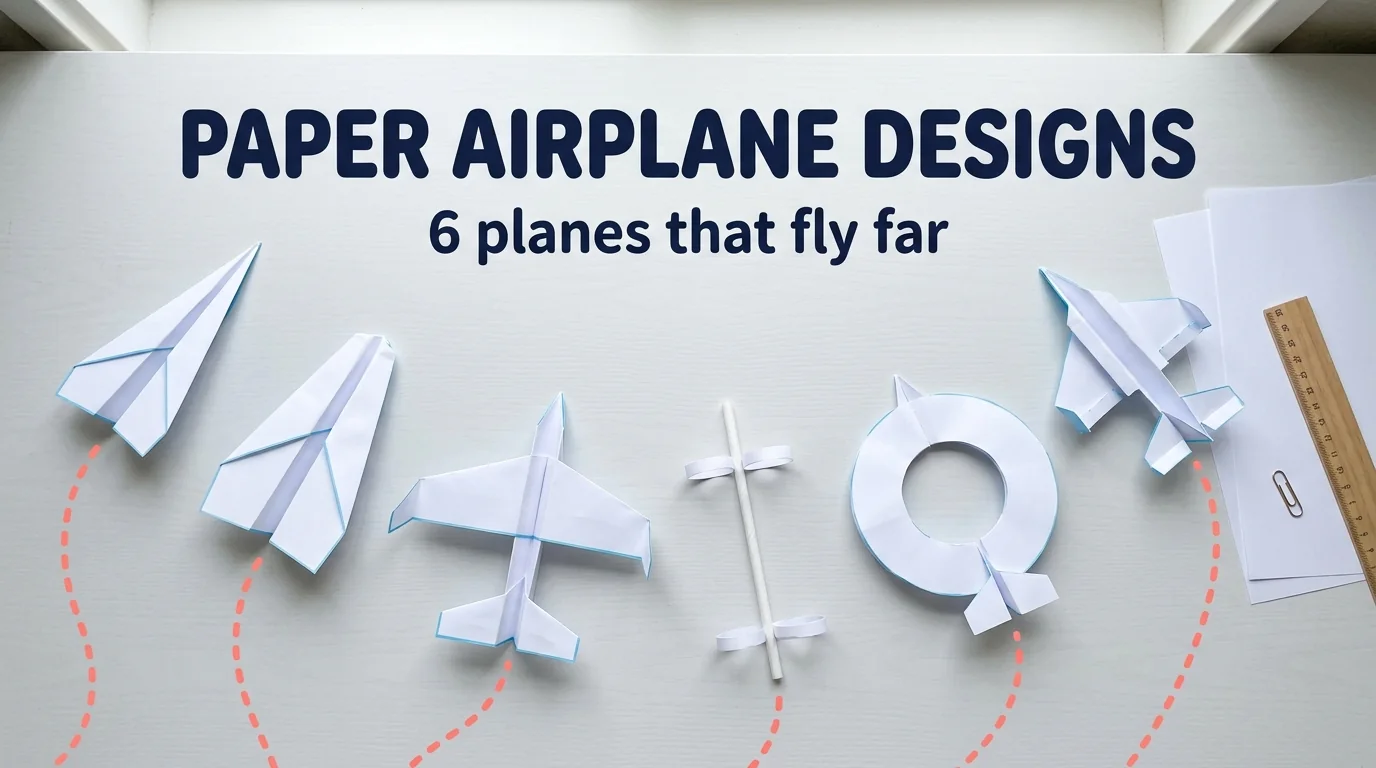
Below are six of the best paper airplane designs, from a fast dart to a straw glider that floats across the room. Each has clear, step-by-step diagrams we drew ourselves, plus the tricks that make any plane fly farther.
Quick answer: To make a paper airplane, fold a sheet of paper in half lengthwise, fold the top corners to the center, fold the new edges to the center again, fold the plane in half, then fold down both wings. That’s the Classic Dart, the best paper airplane for distance. For long, floaty flights, fold a Nakamura Lock or a Hoop Glider.
Free printable: all 5 paper airplane fold guides (PDF)
Print the step-by-step diagrams for the Classic Dart, Blunt-Nose Dart, Nakamura Lock, Hoop Glider and Ring Wing. US Letter or A4. No signup.
Which of these paper airplane designs should you fold?
Pick from these paper airplane designs by what you want the plane to do. Darts are built for speed and distance. Gliders are built to stay in the air. Hoops and rings look strange but fly beautifully.
| Design | Best for | Difficulty | Folds | How to throw |
|---|---|---|---|---|
| Classic Dart | Distance and speed | Easy | 5 | Hard and straight |
| Blunt-Nose Dart | Indoor distance, younger kids | Easy | 6 | Firm and level |
| Nakamura Lock | Long, steady glides | Easy–medium | 8 | Gentle and level |
| Hoop Glider | Longest float, no folding skill | Super easy | 0 (tape) | Soft push, small hoop first |
| Ring Wing | Surprising “wow” flights | Easy | 4 + tape | Gentle flick, like a dart |
| Stunt Loop Plane | Loops and tricks | Easy | Dart + 2 flaps | Hard and slightly upward |
The Nose–Wing–Throw Formula: why some planes fly farther
Every paper airplane is balancing the same four forces that keep real planes up: lift, weight, thrust and drag (NASA explains them here). Your throw is the thrust. Paper is the weight. The wings make the lift. We boil it down to the Nose–Wing–Throw Formula, three things you can actually control:
- Nose: a little extra weight up front keeps the plane pointed forward. That’s why most designs pile folds into the nose. If a plane climbs, stalls and drops, the nose is too light; add a fold or a paper clip.
- Wing: narrow, stiff wings cut through the air for distance. Wide wings make more lift for slow, floaty glides. Match the wings to the job.
- Throw: darts want a hard, straight throw. Gliders want a gentle, level push. Most “bad” planes are actually good planes thrown the wrong way.
Keep this formula in mind as you fold any of the paper airplane designs below. When a plane misbehaves, one of these three is almost always the fix.
1. Classic Dart: the best paper airplane for distance
Best for: distance and speed · Difficulty: easy · You need: one sheet of printer paper
This is the paper airplane almost everyone learns first, and for good reason. Its narrow wings and sharp nose slice through the air, so it flies fast and straight. It’s also forgiving: even slightly uneven folds still fly.
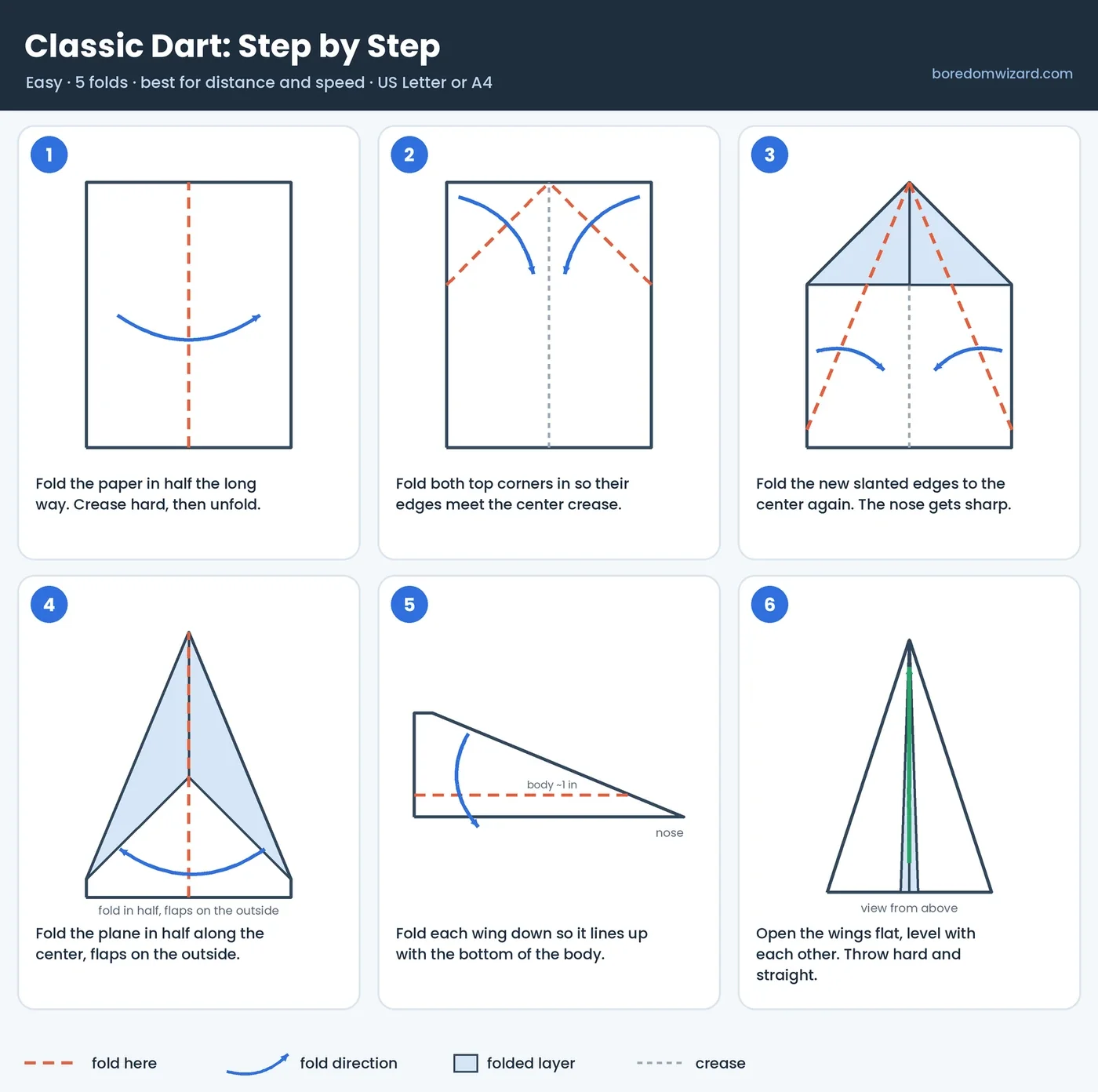
- Fold in half lengthwise. Line up the long edges, crease hard, then unfold. This center crease is your guide.
- Fold the top corners to the center. Each top corner folds in so its edge sits right on the center crease.
- Fold the slanted edges to the center again. This makes a long, sharp nose.
- Fold the plane in half along the center crease, with the flaps on the outside.
- Fold down the wings. Fold each side down so its top edge lines up with the bottom of the body, leaving about 1 inch for the body.
- Level the wings and throw. Open the wings so they’re flat and even. Throw hard and straight, slightly upward.
Make it fly farther: run your fingernail or a ruler along every crease. Crisp folds mean less drag, and that’s free distance.
2. Blunt-Nose Dart: a tougher dart for indoors
Best for: indoor flights and younger kids · Difficulty: easy
A sharp dart nose crumples the first time it hits a wall, and it can poke. Folding the tip back gives you a flat, sturdy nose and moves weight forward, so the plane stays stable. It’s a great first plane for kids.
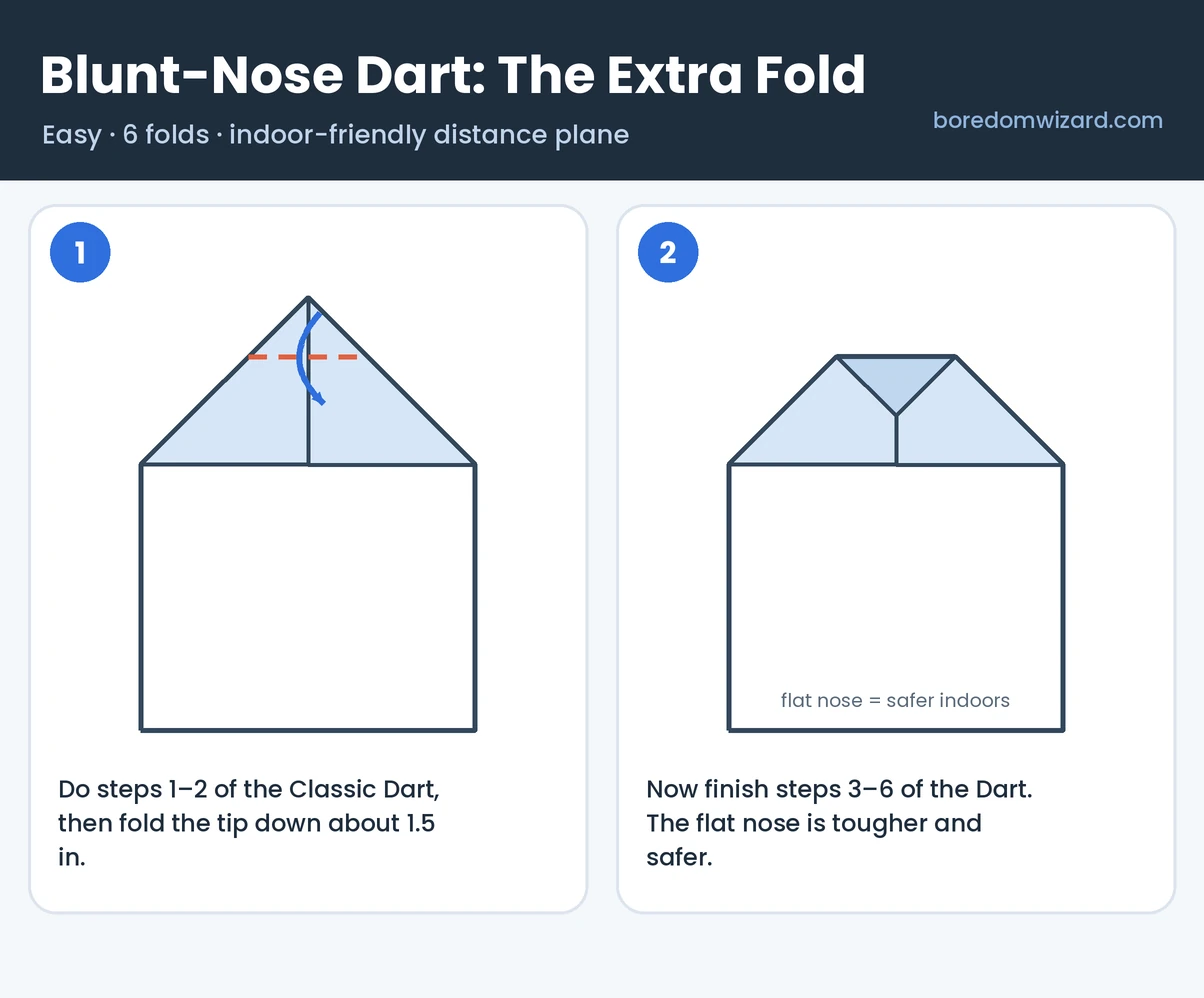
- Do steps 1–2 of the Classic Dart (center crease, then corners to the center).
- Fold the tip down about 1.5 inches, so the point becomes a flat edge.
- Finish like a dart: fold the slanted edges to the center, fold the plane in half, then fold down the wings.
3. Nakamura Lock: the best paper airplane for gliding
Best for: long, steady glides and accuracy · Difficulty: easy–medium
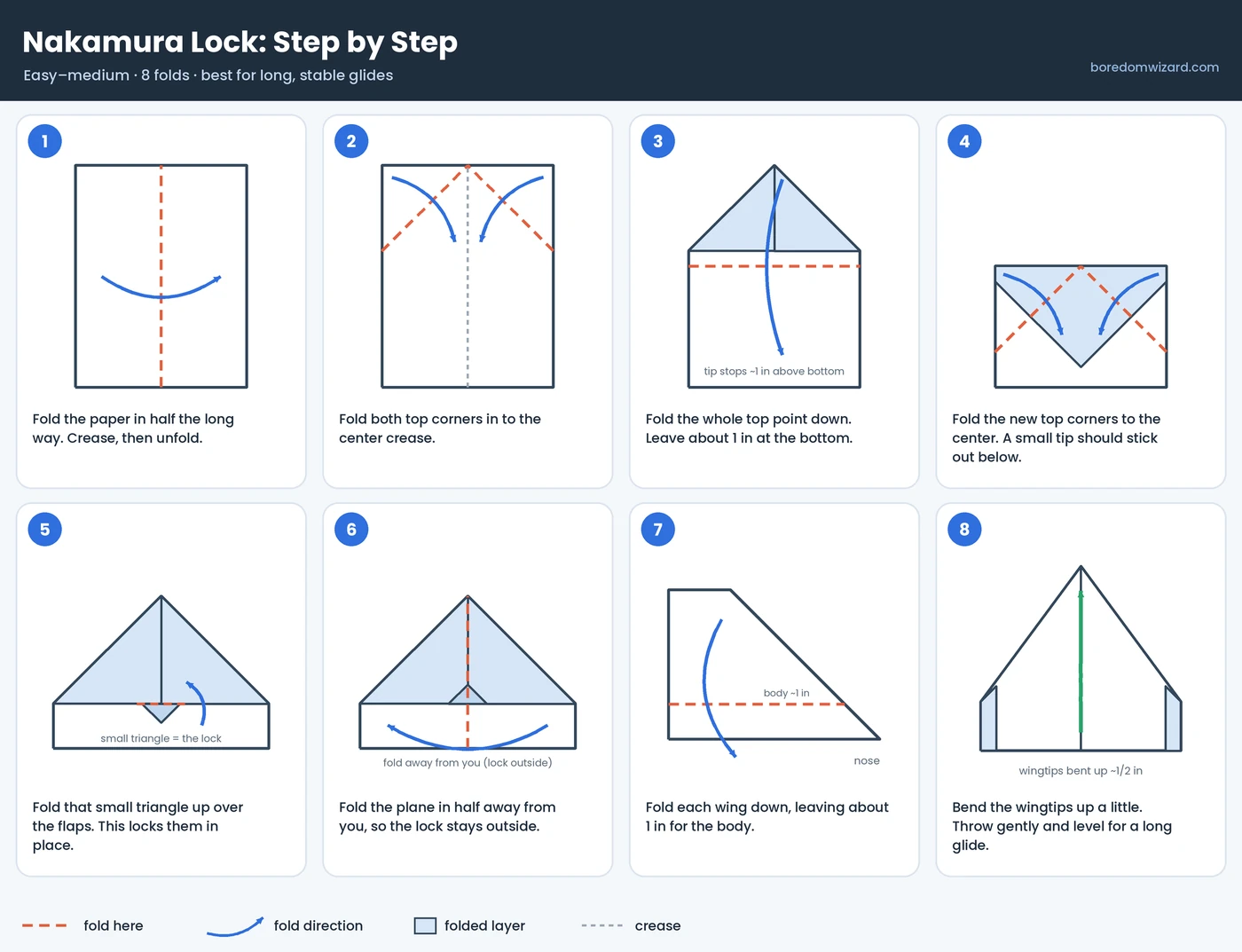
The Nakamura Lock is a classic glider design, famous for its small “lock” triangle. That triangle holds all the layers together, so the plane keeps its shape throw after throw. It flies slower than a dart, but it’s smooth and steady and very accurate.
- Fold in half lengthwise and unfold.
- Fold the top corners in to the center crease.
- Fold the whole point down, leaving about 1 inch of paper below the tip.
- Fold the new top corners to the center. A small triangle tip should stick out below where they meet.
- Fold that small triangle up over the flaps. This is the lock.
- Fold the plane in half away from you, so the lock stays on the outside.
- Fold down each wing, leaving about 1 inch for the body.
- Bend the wingtips up about ½ inch and throw gently and level.
Wide-wing tip: for even floatier flights, fold the wings with only a ½-inch body. Bigger wings mean more lift and slower, longer glides.
4. Hoop Glider: the easiest paper airplane that glides the farthest
Best for: long floating flights, no folding skill · Difficulty: super easy · You need: paper, a drinking straw, tape, scissors
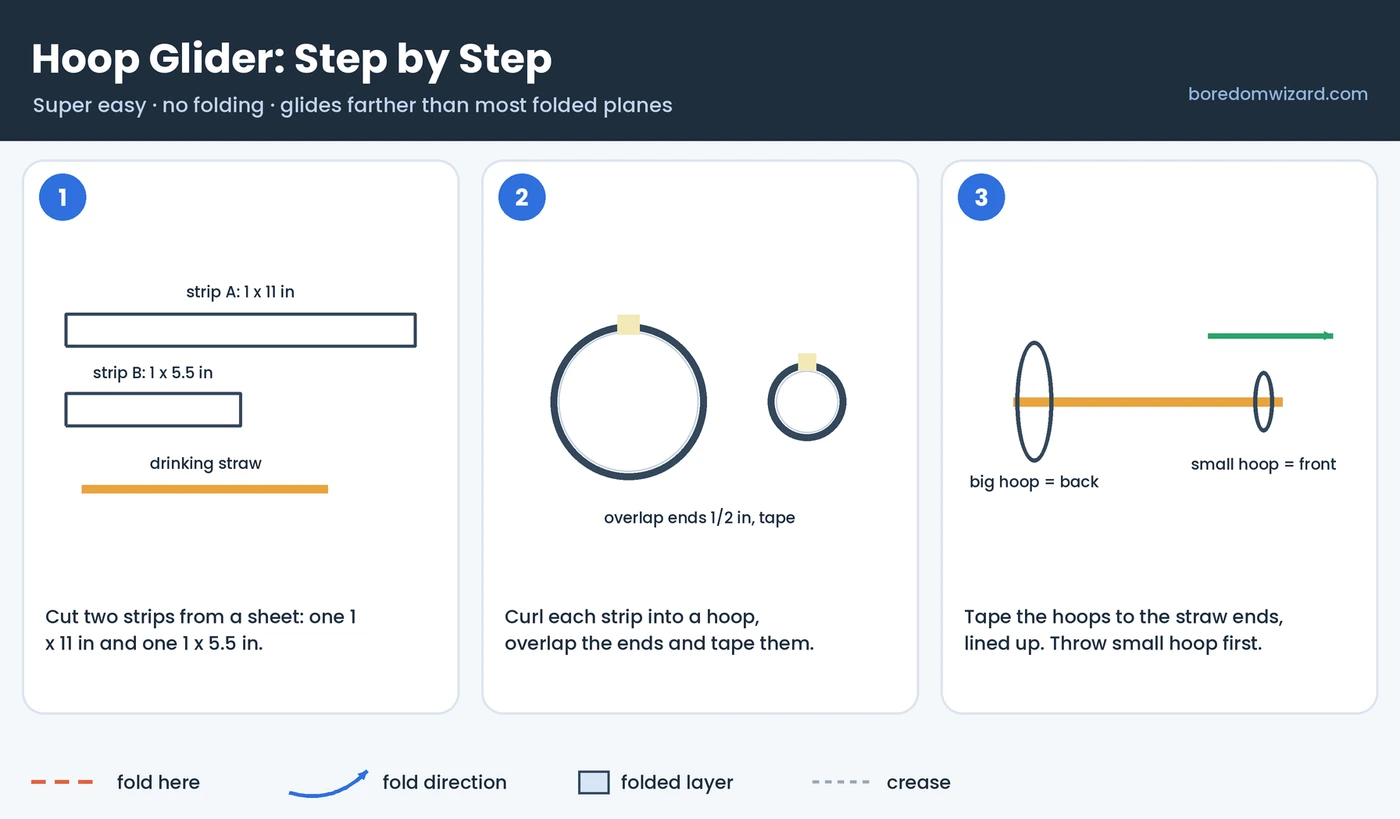
It doesn’t look like an airplane at all, but the hoop glider is a crowd favorite in classrooms and science museums. The two loops act as wings, and it glides surprisingly far with a soft push. No folding skills needed.
- Cut two strips from a sheet of paper: one 1 × 11 inches and one 1 × 5.5 inches.
- Make two hoops. Curl each strip into a loop, overlap the ends by about ½ inch, and tape.
- Tape the hoops to the straw ends, the big hoop at the back and the small hoop at the front, lined up with each other.
- Throw it small hoop first with a gentle, level push, like tossing a dart.
5. Ring Wing: the round paper plane that really flies
Best for: “how does that fly?!” moments · Difficulty: easy · You need: paper and tape
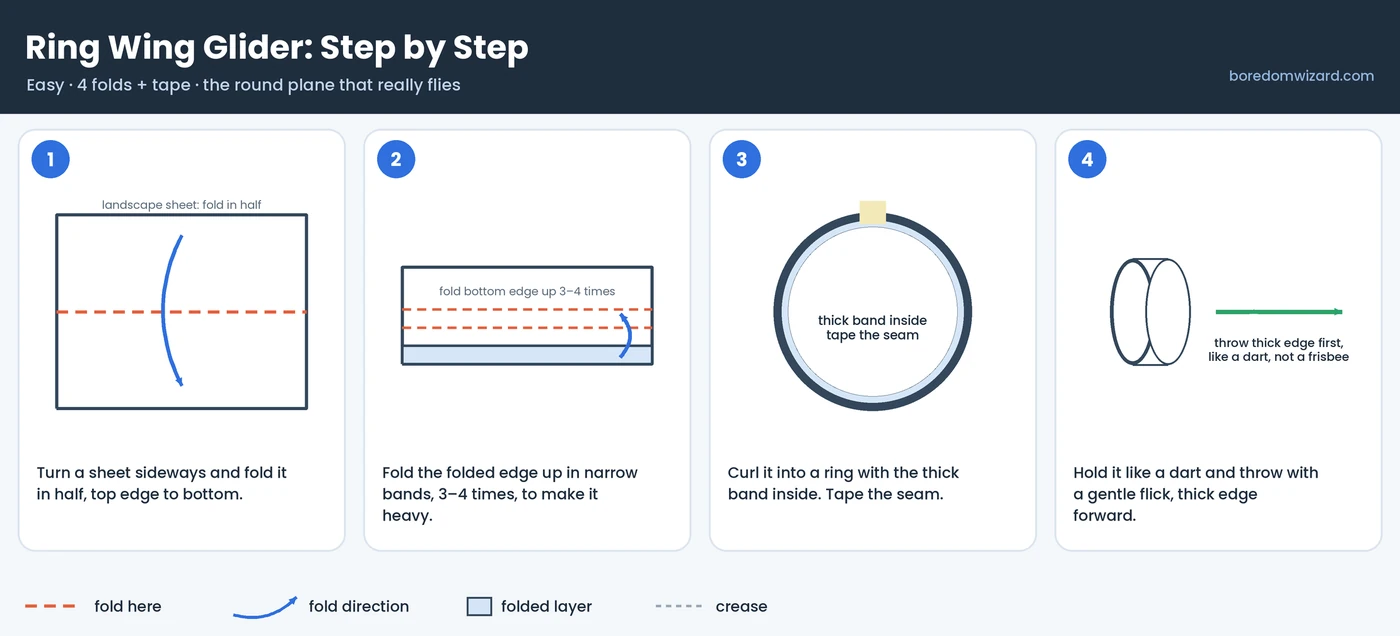
The ring wing is a tube with a heavy front edge. The ring works as one big curved wing, and the thick band keeps the front heavy, just like the nose of a dart. Thrown right, it flies straight and smooth.
- Fold a sheet in half the short way: turn it sideways and bring the top edge down to the bottom.
- Fold the folded edge up in narrow bands, about ½ inch each, three or four times. This heavy band is the “nose”.
- Curl it into a ring with the thick band on the inside, and tape the seam.
- Throw it thick edge first, holding it from behind like a dart, with a gentle forward flick. Don’t throw it like a frisbee.
6. Stunt Loop Plane: how to make a paper airplane that does loops
Best for: loops and tricks · Difficulty: easy
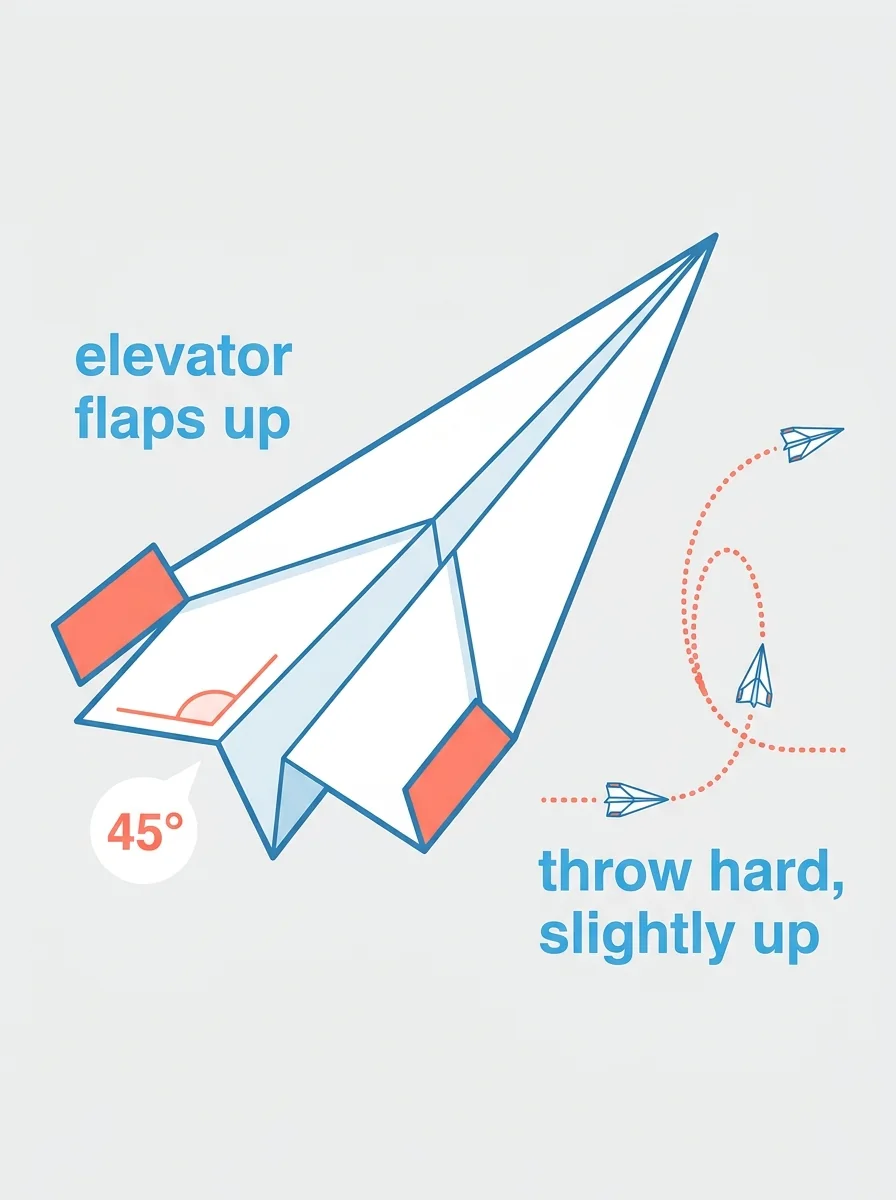
You don’t need a special design for loops. You need elevators: small flaps on the back of the wings that push the tail down and the nose up.
- Fold a Classic Dart (design 1).
- Make two flaps. At the back edge of each wing, about 1 inch from the body, make two small cuts ½ inch deep and 1 inch apart. Or just pinch the back edge.
- Bend both flaps up at about 45°.
- Throw hard and slightly upward. The plane climbs, flips over the top and loops back down. Bend the flaps more for tighter loops.
How to make a paper airplane that flies far: 10 tips
- Use plain printer paper. Standard 20 lb (75 gsm) copy paper is the sweet spot. Construction paper is too heavy, and notebook paper is too floppy.
- Crease every fold sharply with a fingernail or a ruler edge. Soft folds add drag.
- Keep it symmetrical. Line up corners exactly. A lopsided plane always turns.
- Load the nose. If it stalls, add a paper clip to the nose or one extra fold.
- Make a slight “Y” shape. Seen from the front, angle the wings up just a little (this is called dihedral). It keeps the plane from rolling over.
- Match the throw to the plane. Darts: hard and straight. Gliders: gentle and level.
- Aim a little up, about 10–15° above level for distance throws.
- Fly indoors or on a calm day. Hallways and gyms beat a windy backyard.
- Trim, don’t refold. Small bends to the back edges fix most problems (see the table below).
- Fold a fresh one. Crashes soften the nose. A new sheet often flies better than a fixed one.
| If your plane… | Try this fix |
|---|---|
| Dives into the floor | Bend the back edges of both wings up slightly |
| Climbs, stalls, then drops | Bend the back edges down slightly, or add a paper clip to the nose |
| Turns left | Bend the back edge of the right wing up a little |
| Turns right | Bend the back edge of the left wing up a little |
| Rolls over or wobbles | Angle the wings into a slight “Y” and check both sides match |
Can you make a paper airplane from A4 paper?
Yes. Every design here works with A4 paper as well as US Letter. A4 is slightly longer and narrower, so your darts will be a touch slimmer, which often helps them fly straighter. Follow the same steps.
What is the paper airplane world record?
According to Guinness World Records, the farthest flight by a paper aircraft is 98.43 meters (322 feet 11 inches), set by Liu Liwen in Shanghai, China, on December 28, 2025. That’s longer than a football field.
The record for the longest time aloft is 31.2 seconds, set by a Chinese team in Kunshan on February 11, 2026. Record planes are carefully designed and thrown with huge force, but they still use the same ideas as the Classic Dart: a heavy nose, stiff wings and a strong, straight throw.
Paper airplane games and challenges
Once everyone has folded one of the paper airplane designs above, turn it into a game. These work for birthday parties, classrooms and rainy afternoons.
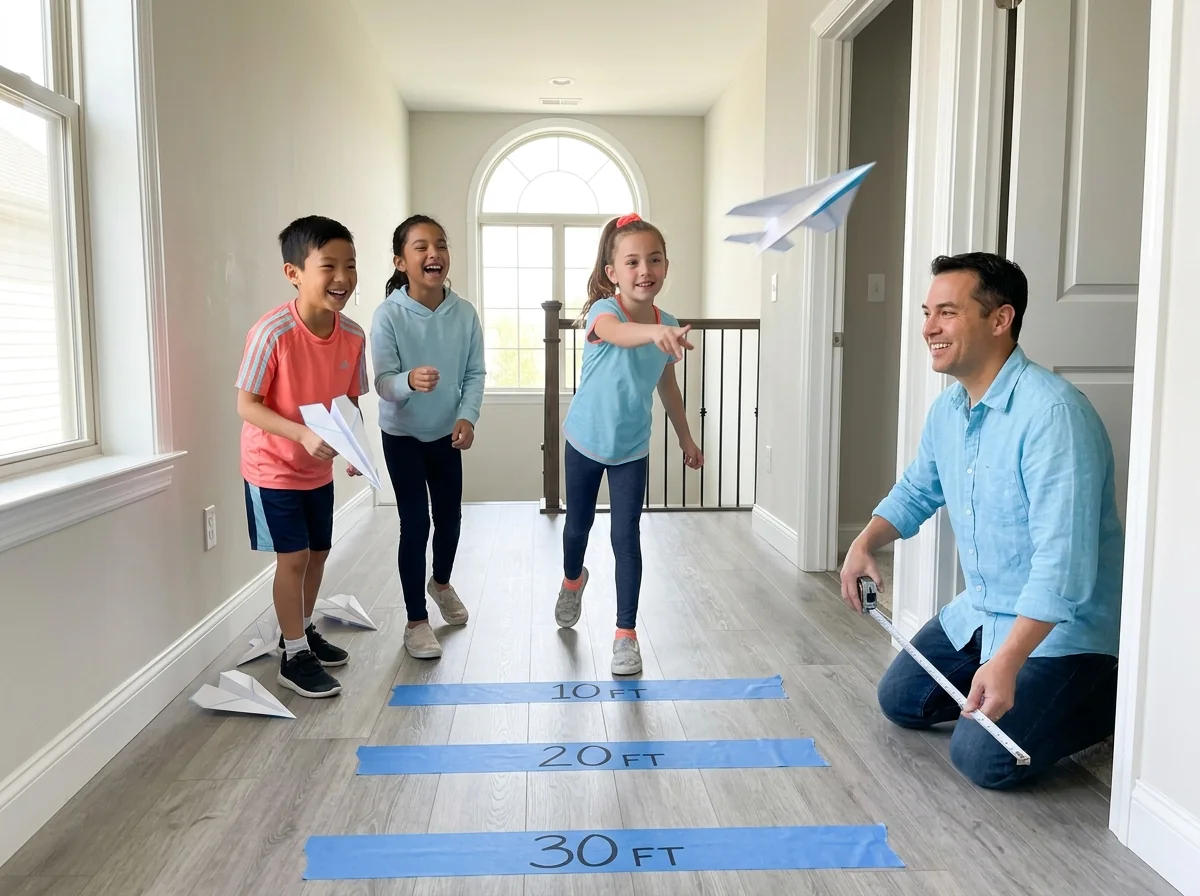
- Distance challenge: tape a starting line and mark 10-foot intervals. Three throws each; longest flight wins.
- Hang time: one person times each flight with a phone stopwatch. Gliders shine here.
- Target landing: put a hula hoop or a laundry basket on the floor. Closest landing scores the most points.
- Fly-through hoop: hold a hoop up in the air, and score a point for every plane that flies through.
- Design-off: everyone folds a different design from this list, then you vote on the best flight.
Looking for more screen-free fun? Pack a few sheets of paper in your analog bag, try some things to draw when bored, or make a paper squishy next.
Paper airplane designs FAQ
What is the best paper airplane design?
For distance, the Classic Dart is the best all-around paper airplane design: it’s easy, fast and forgiving. For long, smooth glides, the Nakamura Lock is the best choice. If you want the floatiest flight with no folding at all, make a Hoop Glider.
What paper airplane flies the farthest?
Dart-style planes fly the farthest because their narrow wings and heavy nose create little drag. Fold a Classic Dart with sharp creases, add a paper clip to the nose if it stalls, and throw it hard and slightly upward.
How do you make a paper airplane fly longer?
Use wider wings, a light nose and a gentle throw. The Nakamura Lock with wingtips bent up, or a Hoop Glider, will stay in the air longer than a dart. Fly indoors so wind doesn’t knock it down.
What is the easiest paper airplane to make?
The Classic Dart is the easiest folded paper airplane, with just 5 folds. The Hoop Glider is even easier because it uses tape and a straw instead of folding.
How do you make a paper airplane do loops?
Fold a Classic Dart, then bend small flaps at the back of both wings up at about 45 degrees. Throw it hard and slightly upward, and it will loop.
What kind of paper is best for paper airplanes?
Regular 20 lb (75 gsm) printer or copy paper works best. It’s stiff enough to hold crisp folds but light enough to glide. Avoid construction paper (too heavy) and tissue paper (too floppy).
What is the world record for a paper airplane?
The Guinness World Record for the farthest paper aircraft flight is 98.43 meters (322 feet 11 inches), set in Shanghai in December 2025. The longest time aloft is 31.2 seconds, set in February 2026.
Why does my paper airplane keep diving?
A diving plane usually has too much weight in the nose or flaps bent down. Bend the back edges of both wings up slightly and try again.
Grab a sheet and start folding
Of all the paper airplane designs here, start with the Classic Dart to learn the basics, fold a Nakamura Lock when you want a smooth glider, and build a Hoop Glider just to see everyone’s face when it flies. Print the free fold guides, set up a hallway runway, and see whose plane goes farthest.
Love quick, hands-on projects? Try our perler bead ideas or take the hobby quiz to find your next favorite hobby.