40 Hobbies for Men in 2026 That Are Actually Worth Your Time
Hobbies for men have a credibility problem. Ask Google and you get the same 2008 list: fishing, woodworking, golf, reading. All fine. None of them wrong. But if you are a man who finds himself sitting on the couch at 9 PM wondering what you are actually doing with your free time, a list that looks identical to your grandfather’s bulletin board is not going to help.
This article is not that list.
What I have built here — after analyzing every major competitor page, the Ahrefs search data, and the behavioral patterns I see as a wellness coach working with men across four decades of life — is a map. Not a dump of 100 activities padded out to fill a page, but 40 hobbies organized by the thing no other guide addresses: how you feel right now, not what sounds good in theory.

Quick Answer:
The best hobbies for men in 2026 are the ones that match your current energy state, not someone else’s idea of what a man should be into. Physical hobbies for men who need movement. Hands-on hobbies for men who need to make something. Quiet hobbies for men who are actually exhausted and need to recover. Tech hobbies for men whose brains want a puzzle without a commute attached.
That is the framework. Let’s get into it.
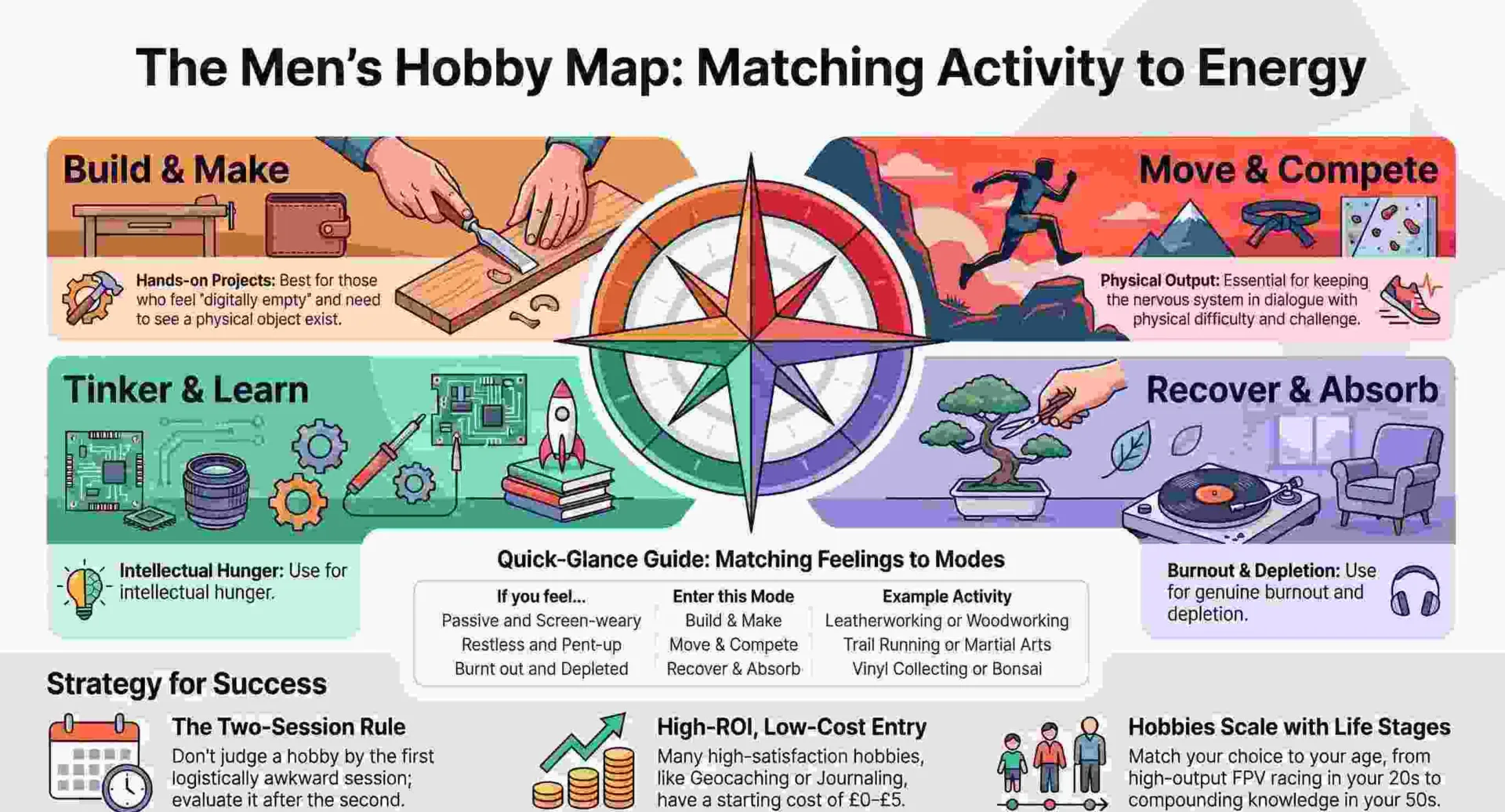
The Men’s Hobby Map: 4 Modes, 40 Hobbies
Before the list: figure out which mode you are in right now. Not which category sounds impressive. The one that matches today.
| Mode | What It Means | Hobbies in This Section | Best For |
| Build & Make | Hands want a project. Wants to see something exist that did not before. | 1–10: Leatherworking, Woodworking, Homebrewing, Blacksmithing, Knife Making, Mechanical Watch Repair, Soap Making, Aquascaping, Model Building, Candle Making | After a passive week. When screens feel empty. |
| Move & Compete | Body needs output. Sitting still is making things worse. | 11–20: Trail Running, Martial Arts, Rock Climbing, FPV Drone Racing, Mountain Biking, Archery, Geocaching, Obstacle Racing, Swimming/Scuba, Golf | Restless. Pent up energy. Need to prove something to yourself. |
| Tinker & Learn | Brain is hungry. Wants a problem to solve that is not work. | 21–30: No-Code App Building, FPV Drone Building, Smart Home Automation, Retro Game Modding, Astrophotography, Amateur Radio, Chess/Competitive Strategy, Language Learning, Genealogy Research, Coffee Roasting | Intellectually understimulated. Work is on autopilot. Need depth. |
| Recover & Absorb | Actually exhausted. Needs engagement without expenditure. | 31–40: Vinyl Collecting, Bonsai, Sourdough/Fermentation, Journaling, Urban Sketching, Bird Watching, Fishing, Reading (Actually), Cooking as Art, Citizen Science | Depleted. Burnt out. Needs pleasure not performance. |
Mode 1: Build and Make
These hobbies produce something tangible. The dopamine hit here comes not from watching or scrolling, but from standing back and looking at a physical object that you made with your hands. Research consistently links craft hobbies to reduced cortisol levels and higher reported life satisfaction — the Popular Mechanics reader who spends Saturday afternoon in the garage is not wasting time; he is doing something his brain genuinely needs.
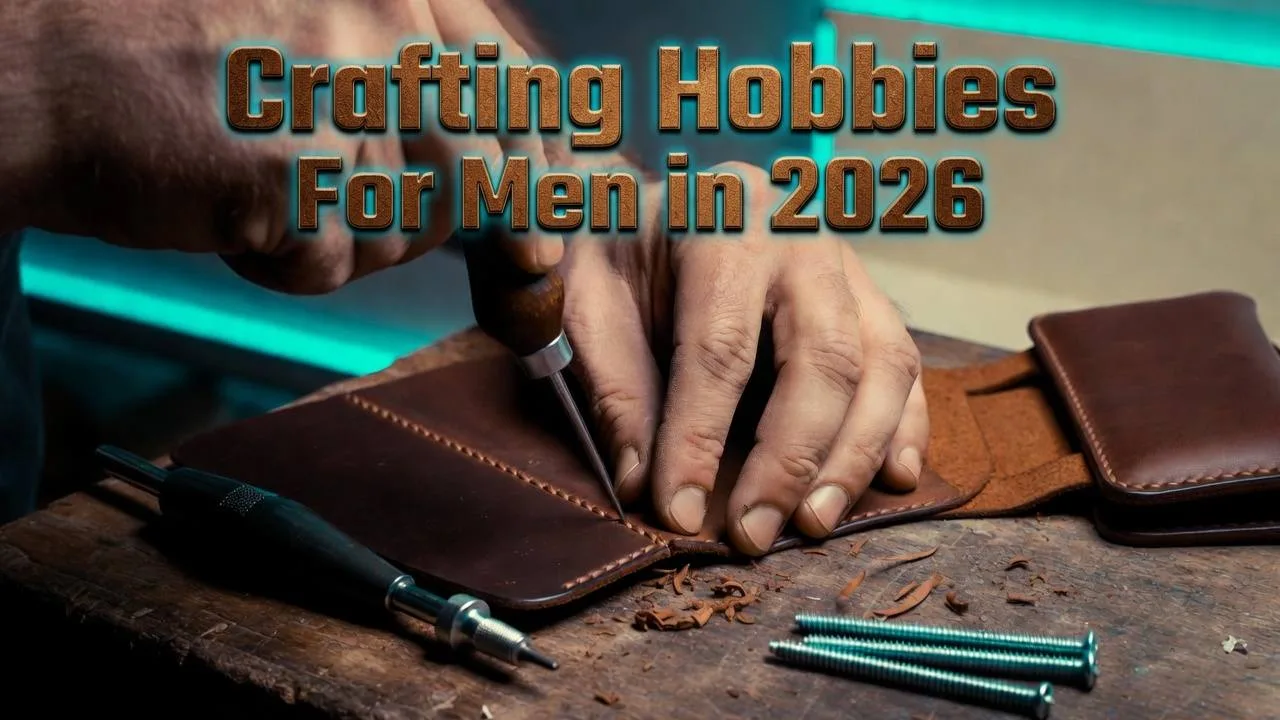
1. Leatherworking
Leatherworking is a physical hands-on hobby for men that produces wallets, belts, bags, sheaths, and journals using nothing more than leather panels, a few punches, and thread — and it is one of the most satisfying solo hobbies for men to start under $75.
The smell alone is half the appeal. Leatherworking hits the hands-on hobby itch at a very deep level: you feel the resistance of the material, you hear the punch going through, and you end up holding something that will outlast a smartphone by fifteen years. Tandy Leather ships beginner kits that include everything you need to make your first wallet in a single afternoon. The Leatherman community on Reddit is detailed and welcoming. Within six months of consistent weekend sessions, most men are making gifts people actually want to own.
| Detail | Info |
| Start Cost | $40–$75 for a beginner kit (tools + leather panel) |
| Time Per Session | 2–4 hours |
| Difficulty | Low start, high ceiling — complex saddle stitching and carving take years to master |
| Best For | Men over 30 who want a hands-on hobby for men with visible results |
| Income Potential | Medium — handmade leather goods sell well on Etsy |
2. Woodworking
Woodworking is the original physical hobby for men using hands — shaping raw lumber into furniture, bowls, cutting boards, shelving, and structural pieces — and it rewards patience, spatial thinking, and progressive skill in a way that almost no digital activity can replicate.
The Art of Manliness has documented the psychological case for woodworking for years: lower stress, improved focus, increased patience. Home Depot and Lowe’s both run beginner woodworking workshops. Craftsman and Stanley make solid entry-level tool sets. The first project should be a small cutting board — achievable in a weekend, practical, and genuinely impressive when you hand it to someone. Nick Offerman (Ron Swanson) was not wrong about this one.
| Detail | Info |
| Start Cost | $150–$300 for basic hand tools; $500+ for power tools |
| Time Per Session | 2–6 hours |
| Difficulty | Medium — joint work and finishing take time to master |
| Best For | Hands-on hobbies for men who want a dedicated workshop space |
| Income Potential | High — custom furniture and homeware sell for significant margins |
3. Home Brewing (Beer, Cider, Kombucha)
Home brewing is a hands-on hobby for men that combines science, patience, and the genuine pleasure of consuming something you made — starting at $35 for a basic beer kit and scaling into a full fermentation station over time.
Mr. Beer’s Complete Beer Making Kit is the standard entry point. Within two weeks you have your first batch. The depth here is enormous: you can spend years refining recipe formulations, learning water chemistry, sourcing specialty hops, and eventually moving into lager fermentation and barrel aging. The Wine Enthusiast community covers beer, cider, and mead. Kombucha brewing is a lower-alcohol entry point that has its own deep culture and a SCOBY community that takes the hobby as seriously as any craft beer club.
| Detail | Info |
| Start Cost | $35–$150 for beginner kit |
| Time Per Session | 2–3 hours brew day, then 1–2 weeks waiting |
| Best For | Solo hobbies for men who like science and patience |
| Income Potential | Low legally (home brewing) — but strong gift and social capital |
4. Blacksmithing
Blacksmithing — forging steel into tools, knives, hardware, and art using heat and hammer — is one of the most ancient hands-on hobbies for men and is experiencing a genuine 2026 revival driven by YouTube channels, local forge clubs, and the allure of forging Damascus knives from scratch.
You do not need a full smithy to start. A small propane forge ($200–$400), an anvil (often found used for $150), and a 3 lb cross-peen hammer will let you make your first hook, leaf, or blade in a weekend class. Forge clubs exist in most mid-sized cities — a two-day beginners workshop is the standard on-ramp. The act of drawing out steel, bending it, and watching it cool into something structural is viscerally satisfying in a way that is hard to explain until you have experienced it.
| Detail | Info |
| Start Cost | $400–$800 for beginner forge setup (or $150–$250 for a workshop) |
| Difficulty | Medium-High — heat management and hammer technique take months |
| Unique Phrases | forging damascus knives, dry stone walling, blacksmithing rustic furniture |
5. Knife Making
Knife making is the most accessible entry point into metalworking for men — you can grind your first blade from a piece of high-carbon steel bar stock using a $30 angle grinder, a bench vise, and sandpaper — and the resulting object is useful, beautiful, and entirely yours.
The stock removal method (grinding rather than forging) means you do not need a forge to start. You shape the blade profile, grind the bevels, heat treat in a kitchen oven, and then shape and attach a handle from wood, bone, or G10 composite. The KnifeMaking subreddit is one of the most detail-rich communities in any hobby. A finished chef’s knife or hunting blade that you made is one of those objects that never stops meaning something.
6. Mechanical Watch Repair
Repairing mechanical watches — disassembling, cleaning, servicing, and reassembling vintage timepieces — is one of the most precise and meditative hands-on hobbies for men, requiring no more than a $50 watchmaker’s tool set and a vintage watch purchased for $15 at a thrift store.
This is the hobby for men who want absolute focus for 2–3 hours. Every component in a mechanical watch movement is a purpose-built engineering marvel operating at tolerances of fractions of a millimeter. When you lift a balance wheel out under a loupe and then get it back in beating correctly, you feel something specific. The Watch Repair channel on YouTube by Mark Lovick is the standard learning resource. Bormioli Rocco’s large glass movement display cases make excellent storage when you start accumulating donors.
| Detail | Info |
| Start Cost | $50 tool set + $15–$50 donor watches from thrift stores |
| Time Per Session | 2–5 hours per movement service |
| Difficulty | High — patience and clean technique required |
| Best For | Men who want total focus and zero interruption |
7. Soap Making
Soap making is a chemistry-based hands-on hobby that produces functional products — cold-process soap, shaving soap, beard bars — from oils, lye, and essential oils, and is one of the few hands-on hobbies for men at home that generates genuinely useful gifts within 30 days of starting.
The cold-process method requires a digital scale, a stick blender, silicone molds, and a basic understanding of saponification values. The first batch takes about two hours and cures for four weeks. The depth runs surprisingly deep: water discounting, superfat percentages, fragrance blending, and specialty oils (tallow, lard, kokum butter) give you years of experimentation.
8. Aquascaping
Aquascaping — designing planted freshwater aquariums using stones, driftwood, substrate, and live plants — is one of the most visually arresting hands-on hobbies for men, producing living landscapes that function as both art and ecology inside a glass tank.
The entry point is a 10-gallon tank, a bag of aqua soil, a handful of stem plants from a local fish store, and a basic LED light. The Takashi Amano style (Nature Aquarium) is the canonical inspiration. The aquascaping subreddit documents competitive tank builds with the same intensity as architectural photography. Once you have a planted tank running well, it becomes one of the most calming objects in any room.
9. Scale Model Building
Scale model building — assembling and detailing plastic or resin kits of aircraft, ships, tanks, or cars — is a patient hands-on hobby for men that develops eye for detail, knowledge of military history, and meditative focus over multi-week projects.
Tamiya 1:35 armor kits are the standard entry point for detail work. Eduard produces aircraft models with pre-cut photo-etch detail parts that take the builds to professional diorama level. The modeling community is detailed, generous, and has some of the most impressive hobbyist photography anywhere online. Model shops often stock techniques books that read like engineering manuals.
10. Candle Making
Candle making is a hands-on hobby for men at home that requires only a double boiler, wax, wicks, and fragrance oils — and produces objects that people genuinely want to buy, gift, and display, making it one of the highest-ROI entry-level craft hobbies available.
Soy wax and coconut wax perform better than paraffin and are cleaner to work with. Wooden wicks produce the crackle of a fireplace. Once you understand fragrance load percentages and cure time, you can produce professional-quality candles that sell at $20–$45 each at local markets. Many men start this as a creative release and end up with a side income before they realize it happened.
Mode 2: Move and Compete
These are physical hobbies for men. The body needs output. Sitting still is making things worse. The specific physicality here matters — not just exercise for health, but physical engagement that produces a result, a score, a route completed, an opponent handled. The runner safety apps built into most GPS devices now make solo trail running significantly safer. The multi-tool in your cycling pack is your first line of mechanical defense on remote routes.

11. Trail Running
Trail running — running on unpaved surfaces, technical terrain, and elevation — is the physical hobby for men that most directly addresses the four things that 2026 sedentary life removes: varied movement, natural light, spatial navigation, and genuine physical challenge.
Road running is fine. Trail running is different. Your brain engages with the terrain — every footfall requires a micro-decision. The GPS device on your wrist, runner safety apps like AllTrails Lifeline, and a basic hand pump and multi-tool in a vest pocket are the standard kit for solo runs beyond 10 miles. Trail running also scales indefinitely: 5k trail races exist alongside 100-mile ultras. The community at local trail clubs is one of the most welcoming of any physical hobby.
| Detail | Info |
| Start Cost | $120–$180 for trail shoes; GPS device optional at first |
| Best For | Men over 30 who need outdoor physical hobbies that scale with fitness |
| Safety Gear | Runner safety apps, GPS device, hand pump for blisters, ID band |
| Meet People | Local trail running clubs, parkrun, trail race volunteer events |
12. Martial Arts
Martial arts — whether Brazilian jiu-jitsu, boxing, Muay Thai, wrestling, or Kyudo archery — is the physical hobby for men that provides the rarest thing in modern male life: structured physical conflict with clear feedback on whether you are improving.
The BJJ on-ramp is the most popular for adult men right now for good reason: you can participate while learning, injuries are relatively low, and the community is structured around growth rather than ego (at good gyms). Boxing is the most direct. Muay Thai adds the complexity of eight limbs. Practicing Kyudo archery (Japanese ceremonial archery) is the meditative end of the martial arts spectrum — extraordinarily precise, ceremonially structured, and deeply calming despite being a combat form.
13. Rock Climbing
Rock climbing — indoor bouldering or outdoor sport and traditional climbing — is the physical hobby for men that best combines full-body strength, problem-solving, fear management, and community in a single activity.
Indoor climbing gyms have reduced the barrier to entry dramatically. A $35 day pass gets you shoes, harness, and access. The bouldering circuit at most gyms is its own complete puzzle system with difficulty ratings, allowing you to track objective improvement week over week. When you move to outdoor climbing, every route has a history, a first ascent, a community of people who have projected it and failed and come back.
14. FPV Drone Racing
FPV (first-person view) drone racing is the physical hobby for men that puts you inside the cockpit of a 90mph aircraft the size of your palm — flying through gates, around trees, and across open fields with goggles on your face and a controller in your hands.
Flying FPV drones requires learning to build and repair them (crashes are constant and expected), understand basic electronics, and develop hand-eye coordination that takes approximately 20 hours to reach functional competence. The MultiGP Racing League hosts club events across the US and Europe. The Betaflight community produces the flight controller firmware that runs most racing quads. This is one of those hobbies that sounds like a toy until you see what serious pilots do with it.
15. Mountain Biking
Mountain biking is the physical outdoor hobby for men most accessible from most locations — one quality hardtail, a helmet, and a trail within driving distance is enough to begin a hobby that scales from Sunday morning singletrack to multi-day bikepacking expeditions.
Cycling and mountain biking as hobbies for men rewards incremental technical improvement in the way that road cycling often does not: every corner, every rock garden, every drop has a better line to find. The hand pump, master chain link, and zip ties are the minimum field repair kit for trail rides. YETI, Santa Cruz, and Trek dominate the mid-to-high end market; quality entry-level hardtails from Giant or Marin get you on the trail for $700–$900.
| Detail | Info |
| Start Cost | $700–$1,200 for a quality hardtail; plus helmet, gloves, shoes |
| Field Kit | Hand pump, master chain link, zip ties, tire plug kit |
| Best Gear | YETI, Santa Cruz, Trek, Giant — avoid department store bikes |
| Best For | Men who want outdoor physical hobbies with a technical skill ceiling |
16. Archery
Archery is a physical hobby for men that sits at the intersection of repetitive precision and meditative focus — a recurve or compound bow in the backyard, a paper target at 20 yards, and an hour of practice produces one of the most complete mental resets available.
Practicing Kyudo archery (Japanese ceremonial bow) is the most meditative version of the sport: form and ceremony are as important as accuracy, and a single arrow takes minutes of preparation. Western compound and recurve archery move faster and allow for competitive league play and bowhunting. The local archery club is one of the most welcoming sporting communities; coaches at range shops will sight your bow and teach the fundamentals in a single afternoon.
17. Geocaching
Geocaching — using a GPS device or the Geocaching app to find containers hidden by the community in public spaces worldwide — is the physical outdoor hobby for men that is completely free, available everywhere, and rewards curiosity, navigation skills, and the specific pleasure of the hunt.
There are over three million active geocaches in the world. Some are magnetic nano-caches on signposts. Some are multi-stage puzzle caches requiring navigation across several kilometers. Some are full containers with trade items in them. The Geocaching.com app runs the largest network. This is one of those physical hobbies for men that works equally well solo or with kids, making it one of the best hobbies for men with families.
18. Obstacle & Adventure Racing
Obstacle and adventure racing — Spartan, Tough Mudder, GORUCK, or multi-sport adventure races — is the physical hobby for men that requires months of purposeful training, produces genuine suffering on race day, and finishes with one of the most complete forms of earned satisfaction available.
The training arc for an obstacle race is as valuable as the event itself. Eight to twelve weeks of progressive running, loaded carries, grip work, and swimming transforms baseline fitness. GORUCK events push this further with military-style team-based suffering over 12–24 hour periods. The running and trail walking component is central — these are not gym-only preparations.
19. Swimming and Scuba Diving
Swimming and scuba diving occupy opposite ends of the water-sport spectrum for men — competitive Masters swimming provides lane-based fitness and community, while scuba certification opens underwater environments that most humans never see in their lifetimes.
A basic swimsuit, goggles, and pool membership is the entry point for swimming. Scuba diving requires PADI or NAUI certification (approximately $300–$500), plus equipment (swimsuit, wetsuit, buoyancy compensator, regulator, mask, fins). The equipment costs are significant but rent is available at dive shops. Dive travel — to reefs, wrecks, and cenotes — becomes its own travel hobby after certification.
| Detail | Swimming | Scuba Diving |
| Start Cost | $60–$150 (goggles, swimsuit, pool fee) | $300–$500 cert + $800–$2,000 equipment |
| Certification | None required | PADI or NAUI Open Water required |
| Best For | Full-body fitness with low joint impact | Men who want to access an entirely different world |
| Travel Potential | Masters swim meets in most cities | High — reef, wreck, and cenote diving globally |
20. Golf
Golf is the classic hobby for men over 40 — a four-hour walking meditation that combines fresh air, spatial problem solving, and social ritual in a format that scales from municipal par-3 courses to private clubs and international travel around great courses.
Golf equipment, green fees, membership fees, and lessons represent the main cost categories. A starter set of clubs runs $300–$600. Green fees at public courses range from $20 to $150+ depending on location. A full set of golf equipment (bag, clubs, glove, shoes, balls) represents a $1,000–$2,500 investment for someone who plays regularly. Golf apparel has become a style category of its own. The mental game — specifically the management of bad shots — is what makes golf uniquely frustrating and uniquely rewarding.
Natty’s Take:
Physical hobbies for men are not just about fitness. They are about keeping your nervous system in dialogue with difficulty. Trail running, martial arts, climbing, cycling — the specific activity matters less than the principle: your body should regularly encounter something it is not certain it can handle. That uncertainty is where you recover yourself.
Mode 3: Tinker and Learn
These are hobbies for men whose brains are hungry for a problem that is not work. The defining characteristic is that they reward depth — the more you understand, the more interesting they become. No quick completion. No achievement badge. Just the accumulating pleasure of knowing something well.
21. No-Code App Building
No-code app building — using tools like Bubble, Glide, or Webflow to create functional web and mobile applications without writing traditional code — is the modern tech hobby for men that turns ideas into working products without requiring a computer science degree.
The constraint of no-code tools is surprisingly generative: you learn to think in systems, data models, and user flows without getting lost in syntax. Bubble is the most powerful platform for complex apps. Glide turns Google Sheets into mobile apps in hours. Webflow handles design-rich web builds. The result is a working, shareable product — something most hobbies cannot say. Men who build even a simple tool that solves a real problem often end up with something people pay for.
22. FPV Drone Building (Not Just Flying)
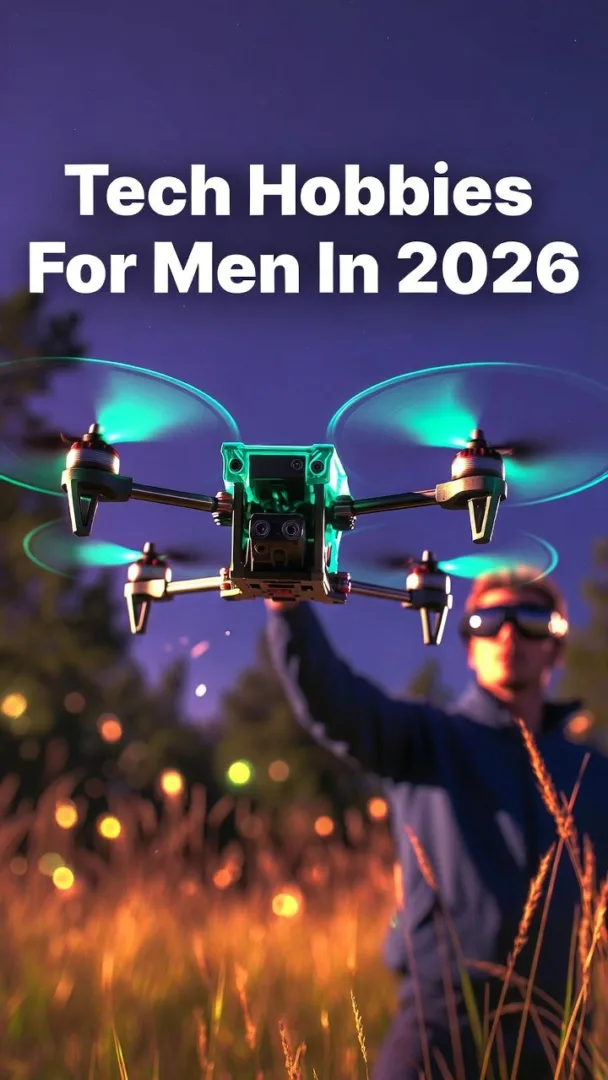
Building FPV drones from components — selecting frame, motors, flight controller, VTX, camera, and ESCs, then soldering and configuring Betaflight — is the tech hobby for men that combines electronics, aerodynamics, and continuous improvement into a project that literally flies.
The distinction between buying a pre-built drone and building one is significant. Building requires understanding what every component does, why it matters, and how to diagnose when something fails. Betaflight, the open-source flight controller firmware that most racing quads run, has a learning curve that rewards patience. The FPV community produces some of the most technically detailed beginner resources of any hobby online.
23. Smart Home Automation
Smart home automation — building rule-based, sensor-driven control systems for lighting, climate, security, and appliances using platforms like Home Assistant — is the tech hobby for men that turns your living space into an ongoing engineering project with no finish line.
Home Assistant is the open-source platform that serious hobbyists use because it keeps all data local and allows unlimited customization. Z-Wave and Zigbee device ecosystems give you reliable, low-latency local control. The HomeLab and HomeAssistant subreddits document multi-year projects of extraordinary complexity. This hobby starts with a Raspberry Pi board ($35), a Zigbee coordinator, and one smart bulb — and expands as far as you want it to go.
24. Retro Game Modding and Restoration
Retro game modding — installing IPS displays, rechargeable battery packs, and custom shells in original Game Boys, restoring vintage consoles, and building custom arcade cabinets — is the tech hobby for men that combines nostalgia, electronics, and preservation into objects you can actually play.
The modded Game Boy community on Reddit is one of the most detailed in any hobby. A Game Boy Color with a Q5 IPS display, USB-C charging, and a custom shell is a 3-4 hour project that produces something worth $80–$120. Classic console restoration (NES, SNES, N64) involves capacitor replacement, shell retrobrite, and RGB output mods. Building a Raspberry Pi arcade cabinet from a flat-pack kit is a weekend project that produces something children and adults both want to use.
25. Astrophotography
Astrophotography — capturing images of the night sky using a DSLR, star tracker, and processing software — is the tech hobby for men that sits at the intersection of astronomy, photography, and data processing, and produces images of objects that are genuinely millions of light-years away.
Mapping night constellations is the first step. A basic DSLR on a tripod can capture the Milky Way core with a 30-second exposure at ISO 3200. A motorized star tracker ($200–$400) opens up deep sky objects: nebulae, galaxies, and star clusters. Processing in Adobe Lightroom, PixInsight, or free Siril stacking software turns raw sensor data into finished images. This is the hobby where patience directly equals output quality.
26. Amateur Radio (Ham Radio)
Amateur radio — obtaining an FCC Technician or General license and operating on HF, VHF, and UHF bands — is the tech hobby for men that connects you directly with operators anywhere on Earth without the internet, and provides emergency communications capability that no other hobby offers.
The Technician license exam covers basic radio theory and regulations and requires roughly 10 hours of study. The ARRL (Amateur Radio Relay League) is the 100-year-old organization that manages licensing resources. Once licensed, a $40 handheld radio lets you access local repeater networks. A $300 HF transceiver opens worldwide communication on shortwave bands. This is the hobby that keeps working when everything else goes down.
27. Chess and Competitive Strategy Games
Chess is the tech-adjacent hobby for men that requires no equipment beyond a board and an opponent, produces measurable improvement through a global Elo rating system, and connects you to a 1,500-year-old intellectual tradition that still produces its deepest puzzles every day.
Chess.com provides free rated play, opening databases, and puzzle training. Lichess.org is the open-source alternative with no paywall. The standard improvement arc for adult beginners — tactics puzzles daily, game review, opening study — produces visible rating gains within 90 days. Competitive strategy games like Go, Settlers of Catan, Dominion, and Netrunner offer different cognitive textures for the same itch.
28. Language Learning
Language learning is the intellectual hobby for men that rewires neural architecture, opens travel experiences that monolingualism blocks, and produces the specific satisfaction of a mind working at a problem every single day with measurable forward progress.
Duolingo is the app most men start with, though serious learners eventually move to Anki for vocabulary, Pimsleur for audio processing, and iTalki for conversation practice with native speakers. Spanish and Mandarin dominate the search volume for this topic. French remains one of the most practically useful for travel. The one-year mark in serious daily study (30 minutes minimum) is when most learners hit conversational threshold.
29. Genealogy Research
Genealogy research — tracing family lineage through vital records, census data, DNA testing, and archival sources — is the intellectual hobby for men that regularly produces genuine historical discoveries about where you actually came from and who made your existence possible.
Ancestry.co.uk and Ancestry.com hold the largest genealogical record collections. 23andMe and AncestryDNA provide genetic ancestry data that connects you with living relatives you did not know existed. The FamilySearch database (free) contains hundreds of millions of records. Researching a single great-grandparent’s immigration record, census entries, military service, and eventual death certificate can take 20 hours and produce a story worth writing down.
30. Coffee Roasting
Home coffee roasting — taking green coffee beans and roasting them to your preferred development level using a popcorn popper, drum roaster, or dedicated home roaster — is the sensory hobby for men that produces the best coffee you will ever drink and costs less per pound than grocery store pre-ground.
Sweet Maria’s is the leading green bean supplier. A Whirley-Pop popcorn popper on a gas grill is the minimum viable setup at $30. A FreshRoast SR800 is the standard dedicated home roaster at $250. The variables — bean origin, roast level, development time ratio, first and second crack — give years of experimentation. And every morning you use the beans you roasted, you drink something that tasted the same way to no one else.
Mode 4: Recover and Absorb
These hobbies are for men who are actually depleted. Not lazy — depleted. The distinction matters because the solution to depletion is not aggressive activity. It is low-demand, high-absorption engagement. Something that fills without requiring output. The mistake men make when burnt out is either doing nothing (which spirals into dissatisfaction) or pushing into high-intensity activity (which does not actually restore the nervous system). These hobbies are the correct answer.

31. Vinyl Record Collecting
Vinyl collecting — hunting for records at charity shops, estate sales, and specialist record stores, then listening to albums as complete objects on a turntable — is the recover-and-absorb hobby for men that forces the single most therapeutic thing modern life has nearly eliminated: uninterrupted, undistracted listening.
A used Audio-Technica AT-LP120 turntable runs $250–$300. A Denon DP-300F is clean and reliable at $200. Charity shops sell records at $1–$3 each; used record stores are $5–$30 for standard pressings, more for originals. The collecting behavior — crate digging with no specific plan — is pleasurably different from algorithm-driven music discovery. The physical ritual of pulling a sleeve, reading liner notes, and dropping the needle is genuinely distinct from any digital streaming experience.
| Detail | Info |
| Start Cost | $200–$300 for a good entry turntable; $1–$30 per record |
| Best For | Men over 30 who want to recover from screen saturation |
| Space Required | A shelf per 50 records; storage boxes or dedicated shelving for larger collections |
| Community | Record Store Day, Discogs.com marketplace, local record shops |
32. Bonsai
Bonsai — growing and shaping miniature trees in containers according to Japanese horticultural tradition — is the recover-and-absorb hobby for men that requires patience on a timescale of years, rewards careful daily observation, and produces living sculptures that outlive their growers.
Growing bonsai junipers is the recommended starting point: juniper bonsai are forgiving, widely available, and respond well to beginner pruning. A starter juniper from a nursery or bonsai shop runs $20–$50. Specialized bonsai tools (concave cutters, knob cutters, bending wire) are the investment over time. The YouTube channel of Nigel Saunders (The Bonsai Zone) documents real trees in real time with exceptional detail. This is a 5-year hobby before you have anything to show visitors, and that patience is exactly the point.
33. Sourdough Baking and Fermentation
Sourdough baking — maintaining a live starter culture and using it to leaven bread without commercial yeast — is the recover-and-absorb hobby for men that produces a tangible, edible object every weekend and teaches the specific skill of working with living biological systems on their own schedule, not yours.
Brewing sourdough starters takes 7–10 days: equal parts flour and water, daily discard and feed, room temperature, patience. The Tartine Bread book by Chad Robertson is the canonical text. Once active, a starter kept in the refrigerator needs feeding once per week. A loaf takes 24–36 hours start to finish (including bulk fermentation and proofing). The crumb structure of a well-proofed sourdough loaf is genuinely satisfying to cut into at the table.
34. Journaling
Journaling — writing daily or weekly entries that capture thought, feeling, observation, and intention on paper — is the recover-and-absorb hobby for men most directly supported by psychological research, with consistent evidence linking regular reflective writing to reduced anxiety, improved emotional regulation, and greater clarity of decision-making.
The format matters less than the consistency. A $3 composition notebook and a Pilot G2 pen is enough. The Stoic journaling practice — Marcus Aurelius’s Meditations was his private journal — involves writing what you can control, what you cannot, and what you intend to do about the former. Morning pages (three stream-of-consciousness pages immediately on waking) come from Julia Cameron’s framework. Evening review (what happened, what you felt, what it means) is the therapeutic version.
35. Urban Sketching
Urban sketching — drawing buildings, street scenes, cafés, transit, and public spaces from observation in a small sketchbook — is the creative hobby for men that requires only a $5 sketchbook and a $3 pen, produces a permanent record of wherever you go, and trains observational skills no other activity develops as directly.
The Urban Sketchers organization has chapters in most major cities and meets for regular sessions in public spaces. The appeal is the permission structure: urban sketching is explicitly about sketching quickly and imperfectly, not about producing finished art. You are recording what you actually see. Over time, a filled sketchbook of a year’s worth of locations becomes one of the most interesting personal artifacts you own.
36. Bird Watching
Bird watching — identifying, tracking, and recording bird species using binoculars, a field guide, and apps like eBird or Merlin — is the recover-and-absorb hobby for men that rewards the rarest of skills in modern life: the ability to be quietly attentive to what is already happening.
A pair of Nikon Monarch 7 binoculars ($250) and the free Merlin Bird ID app (Cornell Lab of Ornithology) is the full initial kit. eBird, also from Cornell, lets you log sightings to a global database and contributes to citizen science data used by conservation researchers. A life list — the running total of every species you have identified — becomes its own long game. The Audubon Society has chapters in most cities with organized bird walks.
37. Fishing
Fishing is the classic solo hobby for men that has survived every technological revolution because it addresses something no app can replicate: extended, undemanding time in natural environments with occasional moments of genuine excitement.
A decent spinning rod and reel setup runs $50–$120. State fishing licenses are $20–$50 annually. Every state’s game and fish department publishes stocking schedules, access points, and regulation summaries. Fishing scales from simple bank fishing to fly fishing (fly rod, waders, wading boots, $400+ to start), ice fishing, kayak fishing, and offshore deep-sea charters. The social version — fishing with a friend who also enjoys quiet — is one of the better male bonding formats available.
38. Reading (Actually Reading)
Reading — deliberately sitting with a physical book for uninterrupted blocks of time — is the recover-and-absorb hobby for men that requires the most discipline to maintain in 2026, produces the broadest cognitive and emotional returns, and costs nothing if you have a library card.
The distinction between reading as a hobby and reading articles on a phone is the uninterrupted time block. A 45-minute undistracted reading session processes approximately 30–40 pages of a typical nonfiction book. The Men’s Health reading list, Art of Manliness reading recommendations, and the Goodreads Men Read challenge are all entry points for building a reading practice. The habit requires protecting 30–45 minutes of phone-free time, which is either easy or impossible depending entirely on how you structure your evenings.
39. Cooking as Art (Not Just Cooking)
Cooking as a deliberate hobby — not making dinner but experimenting with technique, cuisines, and ingredients as a creative and sensory practice — is one of the recover-and-absorb hobbies for men most directly tied to wellbeing, because every session produces something you can eat with people you want to eat with.
The distinction between cooking because you have to and cooking as a hobby is intention. Gordon Ramsay’s MasterClass, Jacques Pépin’s YouTube channel, and Samin Nosrat’s Salt Fat Acid Heat framework are the standard skill accelerators. Cooking a Japanese kaiseki meal for four, a classic French cassoulet from scratch, or an elaborate mezze spread are multi-hour creative sessions. The knife skills and pantry-building knowledge transfer to every meal you cook for the rest of your life.
| Detail | Info |
| Best Upgrade | A high-carbon steel chef’s knife ($80–$200) and a whetstone ($40) |
| Cost Spectrum | $0 (using what you have) to $300+ for specialty ingredients and equipment |
| Social Value | Extremely high — feeding people is one of the most direct forms of care |
| Internal Link | See: things to cook when bored — boredomwizard.com/things-to-cook-when-bored/ |
40. Citizen Science
Citizen science — contributing systematic observations to research projects through platforms like Zooniverse, eBird, iNaturalist, or CoCoRaHS — is the recover-and-absorb hobby for men that turns routine outdoor walks and backyard observation into data points in real scientific studies.
Zooniverse hosts over 100 active projects spanning astronomy, biology, ecology, and climate science that need human classification of images and data. iNaturalist turns every plant and animal you photograph into a species observation uploaded to global biodiversity databases. CoCoRaHS (Community Collaborative Rain, Hail, and Snow Network) collects daily precipitation data. Collecting meteorite fragments for classification is the most adventurous version of this hobby. You are not just observing — you are contributing to knowledge.

Natty’s Take: What Your Hobby Choice Reveals
After twenty-six years of wellness coaching, I have noticed one consistent pattern: the men who say they have no hobbies do not mean they have no interests. They mean they have not given themselves permission to take their interests seriously.
A man who says “I do not really have hobbies” almost always has a thing. He reads obsessively about military history. He restores old motorcycles in his head but has not touched one. He thinks about building a raised bed vegetable patch every spring and does not. He knows more about a particular era of analog photography than most professional photographers.
The interest is already there. The only thing missing is the decision to act on it before it becomes something you wished you had started sooner. Pick one thing from this list. Not the most impressive. The one that made you feel something reading it.
Which Hobby For Which Situation
| Your Situation | Best Hobby Match | Why |
| Men in their 20s | FPV Drone Racing, Martial Arts, Rock Climbing | High physical output, strong community, competitive structure |
| Men in their 30s | Woodworking, Home Brewing, Trail Running, No-Code Apps | Builds something tangible alongside a career with increasing responsibility |
| Men over 40 | Golf, Mechanical Watch Repair, Bonsai, Sourdough, Vinyl | Patience rewards accumulate; physical output is sustainable long-term |
| Men over 50 | Amateur Radio, Genealogy, Bird Watching, Citizen Science, Reading | Knowledge compounds; social community is welcoming across ages |
| Men after retirement | Woodworking, Model Building, Bonsai, Coffee Roasting, Urban Sketching | Time-rich hobbies that benefit from extended uninterrupted sessions |
| Hobbies for men at home | Leatherworking, Candle Making, Smart Home Automation, Sourdough, Journaling | Require no commute; work within domestic space |
| Hobbies to meet people | Martial Arts, Trail Running Club, Golf, Amateur Radio, Geocaching | Built-in community and club structure |
| Hobbies that make money | Leatherworking, Woodworking, Candle Making, No-Code App Building, Home Brewing | All produce sellable outputs with genuine market demand |
| Budget hobbies for men | Geocaching (free), Archery ($120), Trail Running ($150), Chess (free), Journaling ($5) | Low barrier to entry; no ongoing significant cost |
| Hobbies with kids | Geocaching, Mountain Biking, Model Building, Sourdough, Urban Sketching | Scale to child participation; produce shared experiences |
| Solo hobbies for men | Watch Repair, Bonsai, Astrophotography, Vinyl, Reading, Knife Making | Complete within a solo session; no schedule coordination required |
All 40 Hobbies: Quick Cost and Mode Reference
| Hobby | Mode | Start Cost | Income Potential |
| Leatherworking | Build & Make | $40–$75 | Medium (Etsy) |
| Woodworking | Build & Make | $150–$500 | High |
| Home Brewing | Build & Make | $35–$150 | Low |
| Blacksmithing | Build & Make | $400–$800 | Medium |
| Knife Making | Build & Make | $50–$200 | Medium |
| Watch Repair | Build & Make | $50–$120 | Medium |
| Soap Making | Build & Make | $40–$80 | Medium |
| Aquascaping | Build & Make | $80–$200 | Low |
| Scale Model Building | Build & Make | $30–$100 | Low |
| Candle Making | Build & Make | $40–$80 | Medium-High |
| Trail Running | Move & Compete | $120–$180 | None |
| Martial Arts | Move & Compete | $80–$150/month | None |
| Rock Climbing | Move & Compete | $35/day rental | None |
| FPV Drone Racing | Move & Compete | $200–$400 | Low |
| Mountain Biking | Move & Compete | $700–$1,200 | None |
| Archery | Move & Compete | $150–$300 | None |
| Geocaching | Move & Compete | $0 (free app) | None |
| Obstacle Racing | Move & Compete | $75–$150 race entry | None |
| Swimming/Scuba | Move & Compete | $60 to $2,000+ | None |
| Golf | Move & Compete | $300–$2,500 | None |
| No-Code App Building | Tinker & Learn | $0–$50/month | High |
| FPV Drone Building | Tinker & Learn | $200–$400 | Low |
| Smart Home Automation | Tinker & Learn | $35 Pi + $20/device | Low |
| Retro Game Modding | Tinker & Learn | $15–$80 per console | Medium |
| Astrophotography | Tinker & Learn | $200–$800 | Low |
| Amateur Radio | Tinker & Learn | $40–$300 | None |
| Chess/Strategy Games | Tinker & Learn | $0 (Chess.com free) | None |
| Language Learning | Tinker & Learn | $0–$15/month | Low |
| Genealogy Research | Tinker & Learn | $0–$100 (Ancestry sub) | None |
| Coffee Roasting | Tinker & Learn | $30–$250 | Low |
| Vinyl Collecting | Recover & Absorb | $200–$300 turntable | Low |
| Bonsai | Recover & Absorb | $20–$80 | Low |
| Sourdough/Fermentation | Recover & Absorb | $0–$30 | Low |
| Journaling | Recover & Absorb | $3–$30 | None |
| Urban Sketching | Recover & Absorb | $5–$20 | Low |
| Bird Watching | Recover & Absorb | $0–$250 (binoculars) | None |
| Fishing | Recover & Absorb | $50–$200 | None |
| Reading (Seriously) | Recover & Absorb | $0 (library card) | None |
| Cooking as Art | Recover & Absorb | $0–$300 | None |
| Citizen Science | Recover & Absorb | $0 (apps are free) | None |
Frequently Asked Questions
What are the best hobbies for men over 40?
The best hobbies for men over 40 are ones with a depth ceiling you have not hit in twenty years of casual interest. Woodworking, golf, bonsai, mechanical watch repair, genealogy research, home brewing, and sourdough baking all reward patience that compounds with time. None of them require peak physical condition. All of them produce something: an object, a skill, a record, an experience. That is the test for hobbies for men over 40 — does it produce something that accumulates?
What are good hobbies for men at home?
The best hobbies for men at home are ones where your home becomes the workshop. Leatherworking, candle making, soap making, smart home automation, retro game modding, coffee roasting, sourdough baking, aquascaping, scale model building, and journaling all operate within domestic space. None of these require a studio, gym, or outdoor access. They transform a spare corner or a workbench in the garage into a productive creative space.
What are the best solo hobbies for men?
The best solo hobbies for men are ones that complete within a single session without requiring another person’s schedule. Mechanical watch repair, bonsai, astrophotography, vinyl collecting, reading, coffee roasting, whittling wooden spoons, and urban sketching are all completely solitary activities. This is not a deficiency. Solo hobbies are often where men find the deepest engagement, because there is no performance component — you are doing it entirely for yourself.
What are cheap or free hobbies for men?
Geocaching is completely free. Chess on Chess.com is free. Journaling costs $3 for a notebook. Trail running costs $0 if you own a pair of shoes. Bird watching costs $0 with the Merlin app. Citizen science platforms are free. Reading costs $0 with a library card. Sourdough baking costs $5 for flour and water. The most expensive hobby on this list is scuba diving or golf. The assumption that hobbies require significant money is mostly wrong.
Are there hobbies for men to meet people?
Yes. Martial arts gyms have training partners and class communities. Trail running clubs meet weekly in most cities. Golf is inherently a social format. Amateur radio connects you with operators worldwide. Geocaching has community events. The key is that these hobbies have built-in community structures — you do not have to construct the social context yourself. You join something that already exists.
Final Thought: The Two-Session Rule
I tell every client the same thing when they are choosing a hobby: do not evaluate it after one session. Evaluate it after two. The first session is always about logistics — where to buy materials, how to do the first step, what tools you need, how it feels awkward. The second session is where you find out if there is something there for you.
Pick one hobby from this list. Do the first session. Do not abandon it and jump to another. Do the second session. If it still has nothing for you, pick a different mode and try again. Most men find their thing within three attempts. And once you find it — once you have a thing that is yours, that you do because you want to do it, that makes Saturday morning feel different than Monday morning — you will wonder what you were doing with yourself before.
That question has a useful answer. You were scrolling. Now you’re not.
More From BoredomWizard.com
• How to Find a Hobby — boredomwizard.com/how-to-find-a-hobby
• 50 Hobbies to Try in 2026 — boredomwizard.com/hobbies-to-try
• Hobbies for Women in 2026 — boredomwizard.com/hobbies-for-women
• Is Working Out a Hobby? — boredomwizard.com/is-working-out-a-hobby
• Is Traveling a Hobby? — boredomwizard.com/is-traveling-a-hobby