Junk Journal Ideas: 50 Pages, Spreads and Prompts for Every Skill Level
A junk journal is the opposite of a perfect notebook. It is a handmade book assembled from scrap paper, old envelopes, cardboard, fabric and whatever else you have lying around, filled with collage, writing, drawing and ephemera. There are no rules, no mistakes, and no way to do it wrong — which is exactly why blank-page anxiety hits harder here than anywhere else. You have infinite freedom and zero structure, so your brain freezes.
This guide fixes that. 50 junk journal ideas organised by type — page layouts, themes, writing prompts, techniques and materials to use — so you can pick one, open your journal, and start without spending 40 minutes on Pinterest first. Every idea includes what to do and why it works, and the whole set is designed for beginners who have never made a junk journal page and experienced crafters who need fresh inspiration.
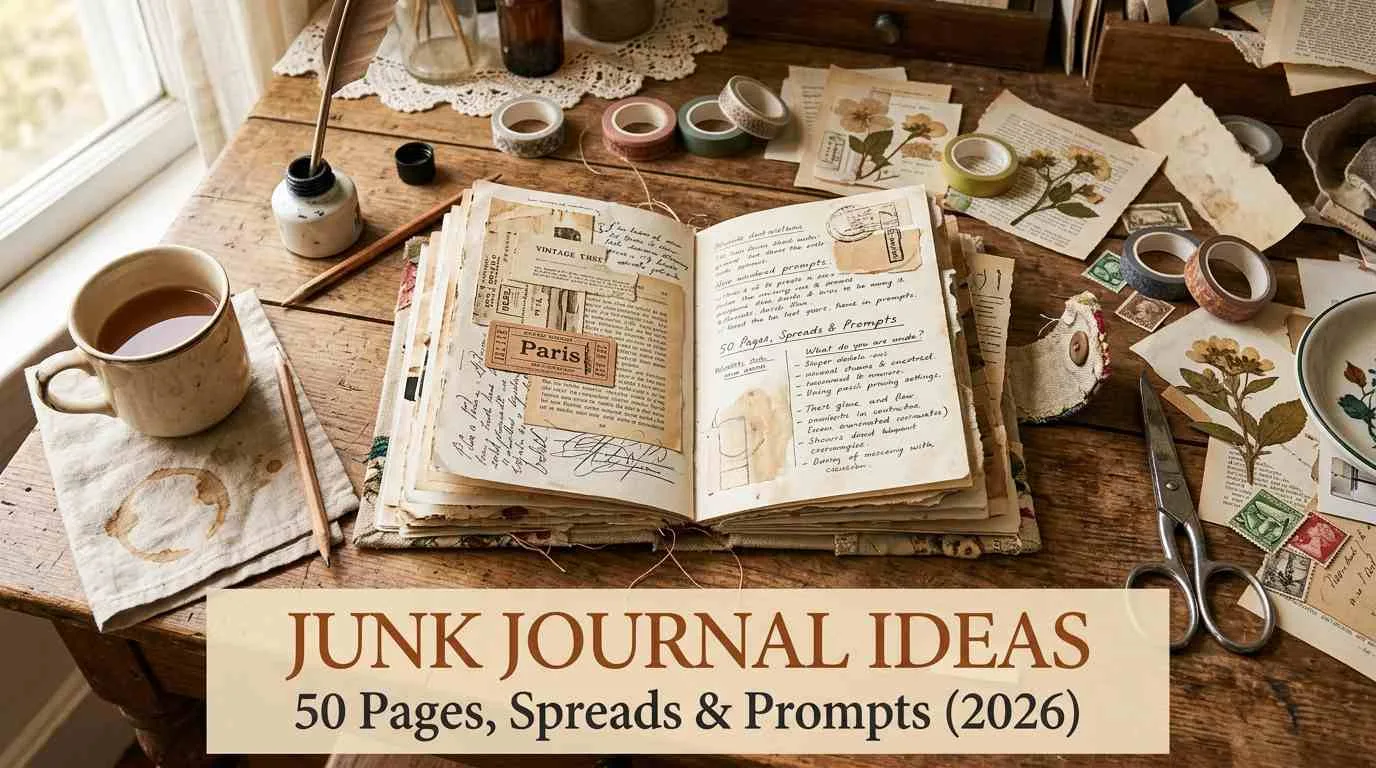
A junk journal is a handmade book made from recycled, repurposed and found materials — old book pages, envelopes, cardboard, fabric, scrap paper — filled with collage, writing, sketches and collected ephemera like ticket stubs, stamps and pressed flowers. Unlike a traditional journal, junk journals have no rules about what goes on each page. They are part scrapbook, part diary, part art project, and the “junk” in the name refers to the materials, not the quality.
What you need to start junk journaling
You do not need to buy anything. The entire point of junk journaling is using materials you already have. That said, here is what makes the process smoother:
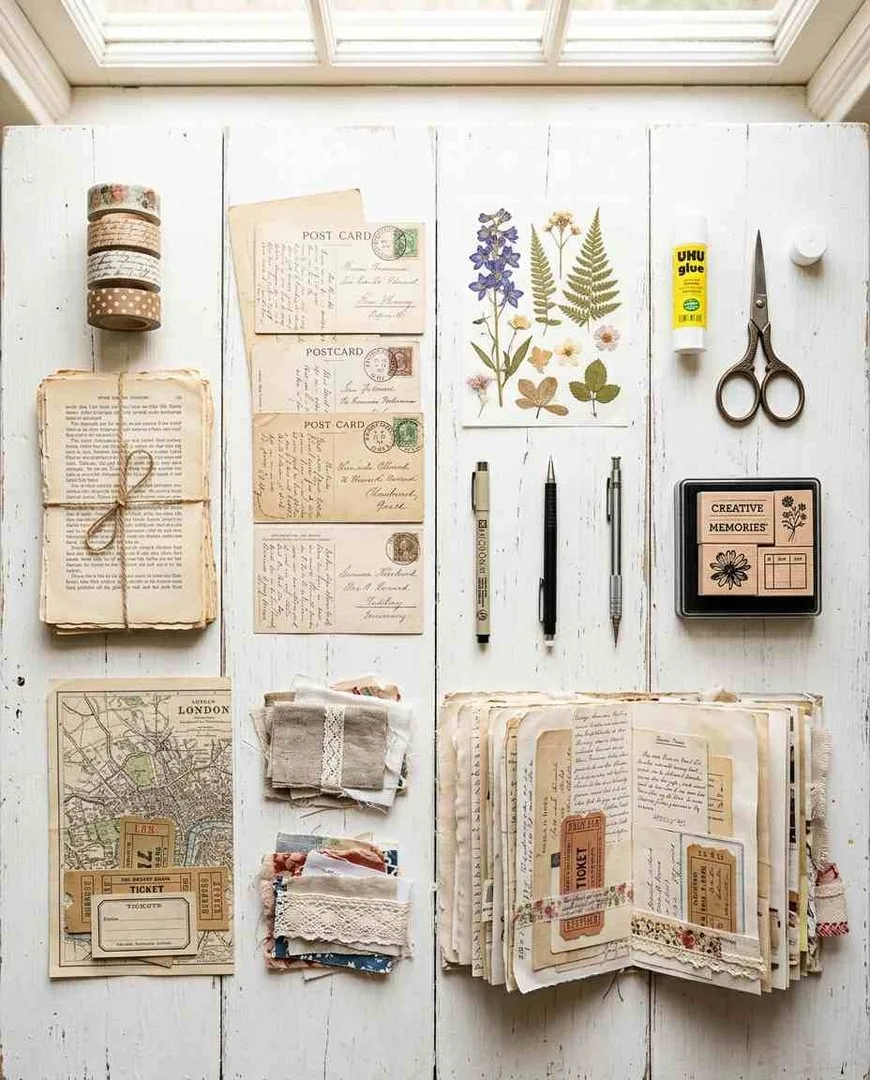
- A base journal. Any old book, a composition notebook, or pages sewn or stapled together. Hardcover books from thrift shops work perfectly — you glue and collage over the existing pages.
- Glue. A glue stick for paper, PVA glue for heavier materials. A glue gun for fabric and dimensional items.
- Scissors and a craft knife. For cutting paper, creating windows and trimming edges.
- Paper scraps. Old book pages, maps, sheet music, scrapbook paper, wrapping paper, newspaper, magazine pages, envelopes, cardstock.
- Washi tape. The single most useful junk journaling supply. Use it for borders, to attach items, to create patterns, and to cover mistakes.
- Ephemera. Ticket stubs, receipts, stamps, postcards, pressed flowers, labels, stickers, fabric swatches, photos.
- Pens and markers. Fine-tip pens for writing, brush pens for lettering, markers for colour.
- Optional extras. Ink pads and stamps, paint (acrylic or watercolour), tea bags for staining pages, a sewing machine for stitched pages, a ruler, a bone folder.
Junk journal page layout ideas
These are structural ideas — how to build the page itself before you decide what goes on it.
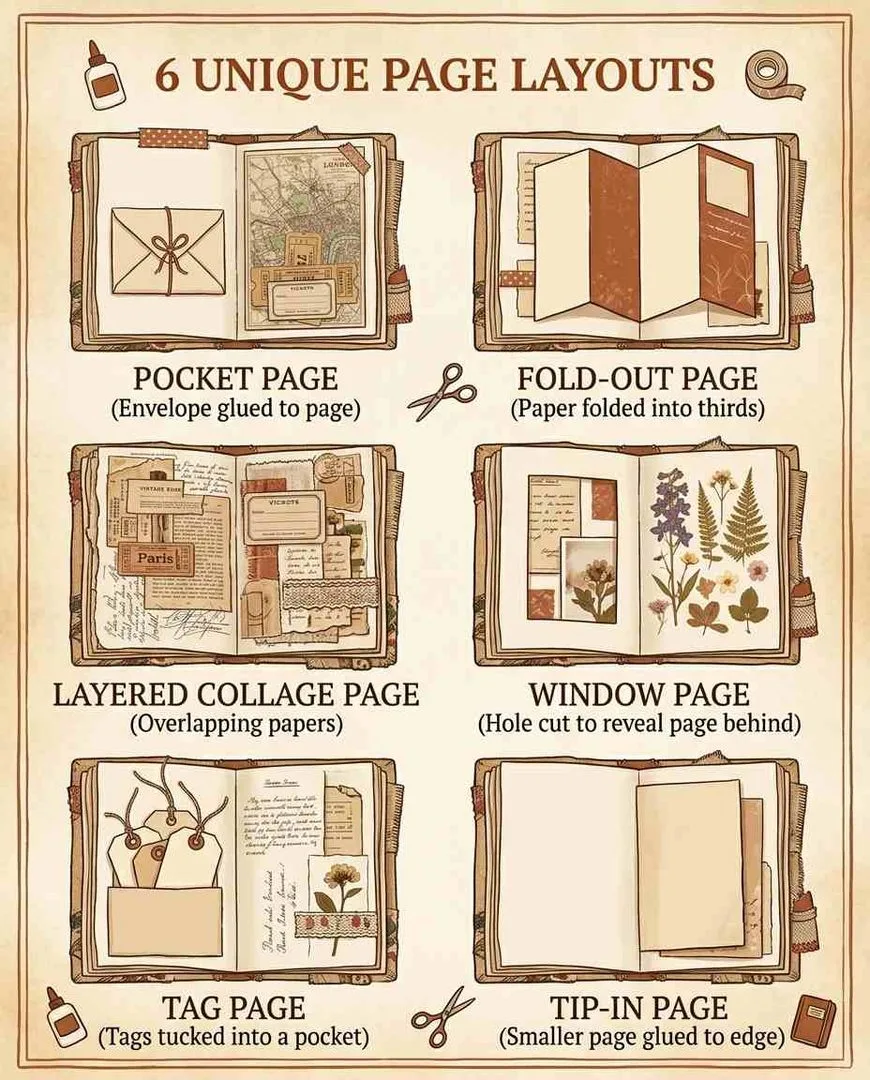
1. Pocket page
Glue an open envelope or a folded piece of cardstock to the page to create a pocket. Fill it with tags, notes, photos or small ephemera that you want to keep but not permanently attach. The pocket becomes interactive — the person looking through the journal gets to pull things out and discover them.
2. Fold-out page
Fold a larger piece of paper into thirds or quarters and glue one panel to the page. The fold-out opens to reveal a hidden collage, a map, a letter or an extended piece of artwork. It adds dimension and surprise to what would otherwise be a flat spread.
3. Window page
Cut a small window — a circle, a rectangle, a heart — through the page so the content on the next page is visible through it. Frame the window with washi tape or a border. This creates a visual connection between two pages and makes the viewer want to turn to the next one.
4. Tag page
Attach three to five tags of different sizes and shapes to the page using twine, ribbon or washi tape. Write prompts, quotes or memories on each tag. The tags can be lifted and read, adding a tactile dimension.
5. Tip-in page
A smaller piece of paper glued along one edge so it flips like a miniature page within the page. Use it for a hidden note, a before-and-after comparison, or an extra collage layer.
6. Layered collage page
Build the page in layers: a base of old book text, a middle layer of torn paper or maps, and a top layer of photos, stickers or stamps. Each layer is partially visible, creating depth. Tear rather than cut for organic edges.
7. Sewn page border
Run your sewing machine (or hand-stitch) along the edges of the page or around a collaged element. The stitching adds texture that glue alone cannot achieve and makes the page feel genuinely handmade.
8. Accordion insert
Fold a long strip of paper into a zigzag accordion and glue one end to the page. The accordion pulls out to reveal a series of connected panels — perfect for a timeline, a photo strip or a sequential story.
9. Fabric page
Glue a piece of fabric (cotton, lace, burlap, an old handkerchief) directly onto the page as the background. Write or collage on top. The texture difference between a fabric page and a paper page is immediately satisfying.
10. Washi tape sampler page
Fill an entire page with strips of washi tape in different patterns, laid edge to edge like tiles. Label each strip with its pattern name or where you bought it. A functional reference page that also looks beautiful.
Junk journal theme ideas
A theme gives the whole journal or a single spread a focus, which makes the blank-page decision easier because you know what belongs and what does not.
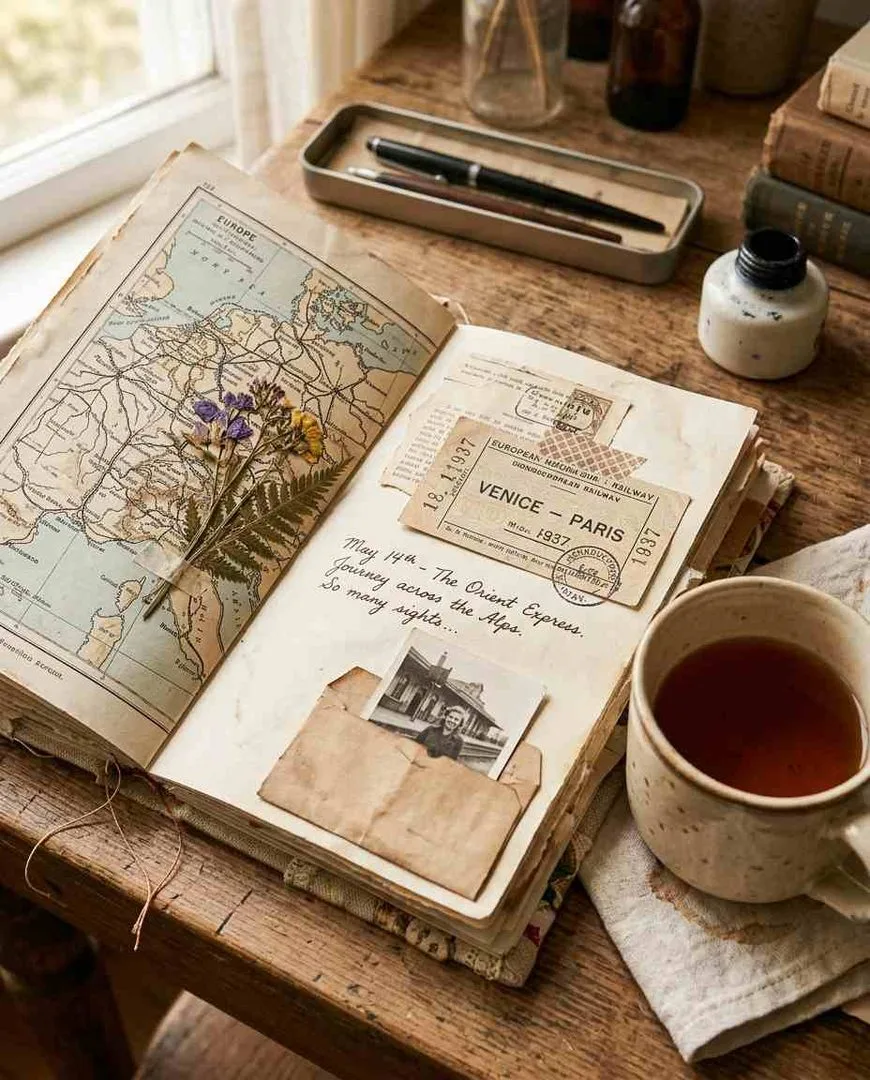
11. Travel journal
Collect maps, boarding passes, restaurant receipts, postcards, pressed leaves from the place, and photos. Layer them chronologically across spreads. A junk journal is the best travel journal format because it is designed to hold exactly the kind of flat ephemera you collect while travelling.
12. Seasonal journal — one spread per season
Divide the journal into four sections. Each season gets a spread using colours, textures and ephemera that match: pressed spring flowers, summer ticket stubs, autumn leaves, winter fabric and ribbon. The journal becomes a year in four pages.
13. Gratitude spread
A page where you write or collage one thing you are grateful for each day for a month. Use small tags, sticky notes or strips of paper so each entry is its own object. The accumulation over 30 days is visually powerful.
14. Recipe collection
Handwrite family recipes on aged paper, stain the pages with tea, and attach real labels from the ingredients. A junk journal recipe book looks and feels like an heirloom the moment you finish it.
15. Music journal
Each page is dedicated to a song or album: write the lyrics, glue in the concert ticket, sketch the album cover, note when and where you first heard it. A vinyl-era listening diary made from paper.
16. Vintage ephemera journal
Source old postcards, stamps, letters and book pages from thrift shops, estate sales or printable archives online. Build every page from genuinely old materials. The journal looks like it was assembled in 1920.
17. Dream journal
Record dreams on torn paper, collage surreal images from magazines, and use watercolour washes for dreamlike backgrounds. The imperfect, fragmented style of junk journaling suits dream recording better than any lined notebook.
18. Self-portrait journal
Each spread is a version of you: your current mood, your favourite things, your handwriting, a photo, your daily routine, your comfort foods, your playlist. Not a diary — a self-portrait in collage form.
19. Nature journal
Pressed flowers, leaves, bark rubbings, sketches of birds or insects, soil colour swatches, weather notes. A junk journal nature log turns a walk into source material.
20. Memory box journal
Dedicate each page to a single memory: a day, a person, a place, an event. Attach whatever physical item you have from that memory — a photo, a receipt, a note, a wrapper, a ticket. The journal becomes a portable memory box.
Junk journal writing prompts
A junk journal does not have to be all visual. Writing prompts give the pages meaning beyond the collage. Write on tags, on torn paper, on sticky notes — the format is as flexible as the content.
21. Write a letter to your future self
Seal it in an envelope glued to the page. Date the envelope with a “do not open until” date. The act of writing it is therapeutic. The act of finding it later is something else entirely.
22. List 10 things that made you smile this week
Small things. Not achievements — moments. The barista who remembered your order. The song that came on at the right time. Write each one on a separate strip of paper and layer them on the page.
23. Describe today in exactly six words
Hemingway was once challenged to tell a story in six words. He wrote: “For sale: baby shoes, never worn.” Your six words about today go on a tag in the centre of the page.
24. Write the conversation you wish you had
A letter you will never send, written for your own clarity. Glue it into the journal folded, so only you know what it says.
25. Document your morning routine
Every step, from alarm to leaving the house, written in sequence on a strip of paper that folds out. Attach the coffee sleeve, the toothpaste label, the hair tie. A still life of your first hour.
26. List your comfort items
The hoodie, the mug, the blanket, the pillow, the song. Write each one on a small card and arrange them on the page like a museum exhibit, with tiny handwritten labels.
27. Write down the last text conversation that made you laugh
Not the joke — the exchange. Write it by hand on two different colours of paper, one colour per person, and glue the strips in sequence like a real chat thread.
28. One sentence per day for a month
Write one sentence about each day on a tiny strip of paper. At the end of the month, collage all 30 strips onto a single page. The month appears all at once.
29. Write a review of your current life
Rate it out of five stars. List the pros and cons. Be honest and be funny. Glue the review onto the page like a product listing.
30. Things I know to be true
A list of personal truths — things you have learned, things you believe, things you know from experience rather than theory. Write them on aged paper and layer them into a collage of certainty.
Junk journal techniques to try
These are the craft techniques that transform a pile of paper into something that looks and feels intentional.
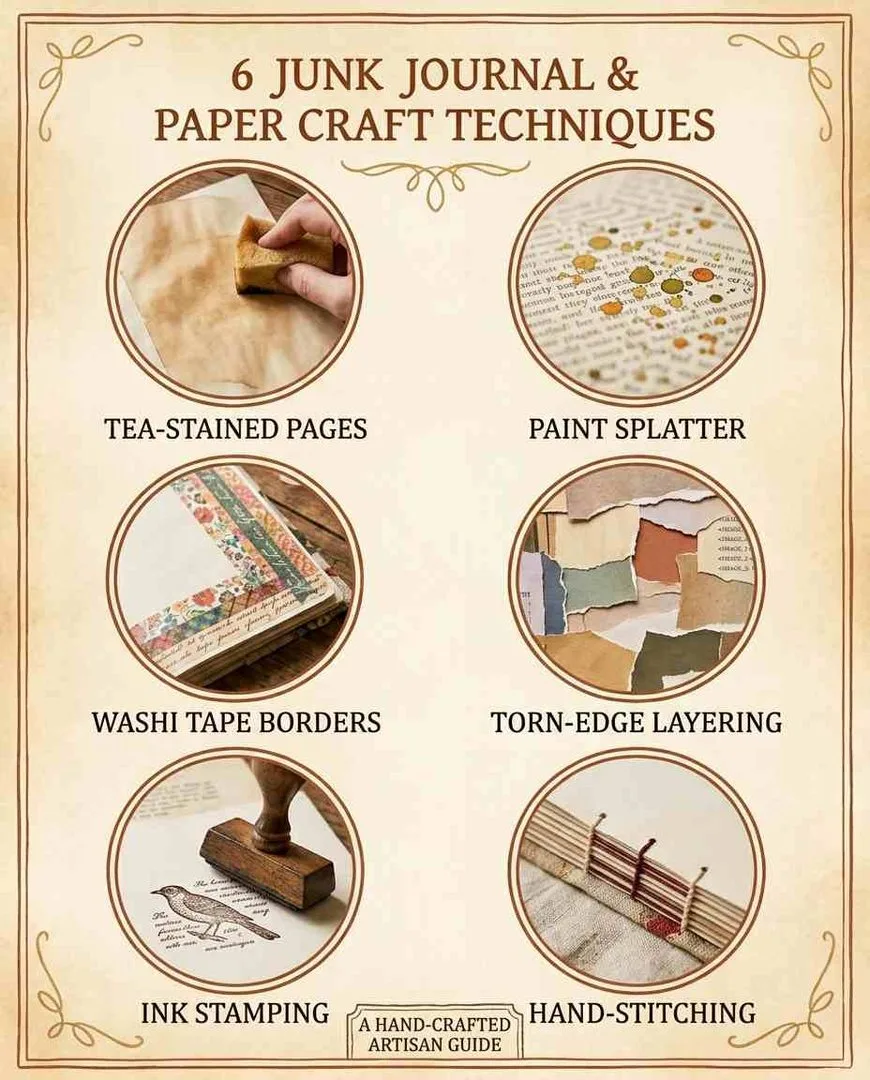
31. Tea staining
Brew a strong cup of tea, let it cool slightly, and brush or dab it onto white paper with a sponge. Let it dry. The paper ages by 100 years in 10 minutes. Crumple the paper before staining for extra texture. Coffee works too and gives a deeper brown.
32. Distress ink edges
Run a distress ink pad along the edges of paper to create a soft, aged border. Brown, sepia and walnut inks create a vintage look. Black creates drama. Apply lightly and build up — you can always add more but you cannot take it back.
33. Washi tape borders and frames
Use washi tape to frame photos, create borders around the page edge, or divide the page into sections. The tape is repositionable for the first few seconds, so you can adjust placement before it sets.
34. Gesso base layer
Paint a thin layer of white gesso onto the page before collaging. Gesso creates a smooth, slightly textured surface that accepts paint, ink and glue better than bare paper. It also covers existing text in old books, giving you a blank canvas.
35. Paint splatter
Load a paintbrush with diluted acrylic or watercolour and flick it across the page. The splatter creates an organic, artsy background layer. Use gold or white paint on dark pages for a dramatic effect.
36. Image transfer
Print an image on regular paper using a laser printer, lay it face-down on the journal page, rub the back with a bone folder or spoon, and peel carefully. A ghost of the image transfers to the page. Imperfect by design and unique every time.
37. Stamping with found objects
Dip the bottom of a bottle cap, a piece of bubble wrap, a leaf or a piece of string into ink or paint and press it onto the page. Found-object stamps create textures that manufactured stamps cannot replicate.
38. Edge burning
Hold the edge of a page near a candle flame (carefully) and let the paper brown and curl slightly. The singed edge adds a dramatic, aged effect. Do this outdoors or over a sink. Safety first, aesthetic second.
39. Sewing into paper
Stitch around a collaged element, along a page border, or in a decorative pattern using a needle and embroidery thread. The texture of thread on paper is one of the most distinctive junk journal effects.
40. Gel medium transfer
Paint a layer of gel medium over a printed image, let it dry, soak the paper in water and rub away the paper backing. The image remains embedded in the gel medium, which you can then glue into the journal. The result is a translucent, ethereal image transfer.
Found materials to put in a junk journal
The “junk” in junk journal. These are the everyday items that most people throw away but junk journalers hoard with intent.
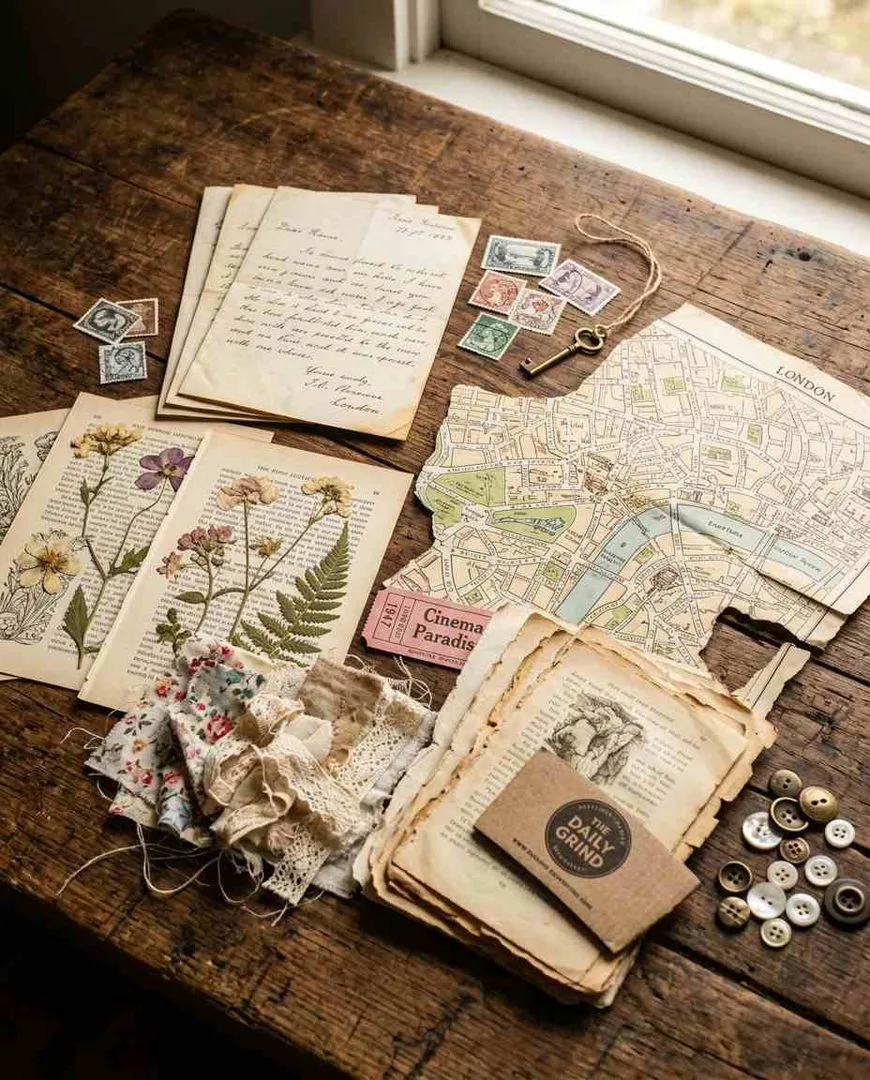
41. Old book pages
The single most versatile junk journal material. Use them as page backgrounds, cut out individual words for found poetry, or fold them into envelopes and pockets. Thrift shops sell old books for less than the price of scrapbook paper.
42. Maps and atlases
Old road maps, atlas pages, airline route maps. Use as full-page backgrounds or cut out specific regions that mean something to you. Maps automatically create a sense of place and adventure.
43. Sheet music
Vintage sheet music pages have a warm, aged aesthetic that works as a background for almost any style of junk journal. The musical notation adds visual rhythm to the page.
44. Fabric and lace scraps
Glue or sew small pieces of cotton, linen, lace, burlap or felt directly onto pages. Fabric adds a tactile dimension that paper alone cannot achieve.
45. Pressed flowers and leaves
Press flowers between book pages for two weeks, then glue them into the journal. They add natural colour and dimension. Seal with a thin layer of Mod Podge to prevent crumbling.
46. Postage stamps
Used stamps from received mail, or vintage stamps from collectors. They are tiny pieces of designed art and they fill small gaps in collage perfectly.
47. Coffee sleeves and tea tags
The cardboard sleeve from a takeaway coffee and the tag from a teabag are junk journal gold. They carry a specific memory (that morning, that conversation) in a physical form.
48. Ticket stubs and receipts
Concert tickets, cinema stubs, museum receipts, boarding passes. Date-stamped ephemera that anchors a journal page to a specific moment in time.
49. Greeting card fronts
Cut the front panel from birthday cards, postcards and holiday cards you have received. The artwork is already done — you are just giving it a second life inside a journal.
50. Packaging and labels
Tea box labels, jam jar labels, vintage-style packaging from artisan products. The typography and design on food packaging is often beautiful and completely free.
Junk journal ideas: FAQ
What are good things to put in a junk journal?
Old book pages, maps, sheet music, pressed flowers, ticket stubs, postcards, stamps, fabric scraps, washi tape, photos, handwritten notes, receipts, greeting card fronts, coffee sleeves and packaging labels. The only rule is that if it is flat enough to glue onto a page, it belongs in a junk journal.
What is a junk journal used for?
Creative expression, memory keeping, stress relief, scrapbooking, art journaling, and collecting ephemera. Some people use junk journals as travel journals, gratitude journals, recipe books, dream journals or nature logs. The format is flexible enough to serve any purpose a traditional journal serves, with the added dimension of collage and mixed media.
Is junk journaling the same as scrapbooking?
No. Scrapbooking typically uses purchased, coordinated supplies (patterned paper, die cuts, embellishments) to document events in a polished, photo-centred format. Junk journaling uses found, recycled and repurposed materials in a deliberately imperfect, mixed-media format. Scrapbooking aims for polish; junk journaling embraces mess. There is overlap, but the philosophy is different.
How do you start a junk journal for beginners?
Start with a base — an old hardcover book, a composition notebook, or a stack of paper stapled together. Gather materials you already have: old papers, envelopes, washi tape, a glue stick, scissors and a pen. Open to the first page and glue something down. A piece of scrap paper, a torn book page, a strip of washi tape. The first mark breaks the blank-page anxiety. After that, layer, write, collage and fill the page however feels right. There is no wrong way to start.
What is the difference between a junk journal and an art journal?
An art journal focuses on original artwork — painting, drawing, mixed media on blank pages. A junk journal focuses on collage, found materials and ephemera, building pages from collected items rather than creating from a blank surface. Many junk journals include original art, and many art journals include collage, so the line is blurry. The key difference is the starting material: an art journal starts blank; a junk journal starts with junk.
Where do you find materials for junk journaling?
Your own recycling bin is the first source: old mail, packaging, receipts, magazines, greeting cards. Thrift shops sell old books, maps and sheet music for under a dollar. Nature provides pressed flowers and leaves. Online, search for “free printable junk journal ephemera” for hundreds of downloadable vintage papers, labels and images. The best junk journal materials are the ones you did not pay for.
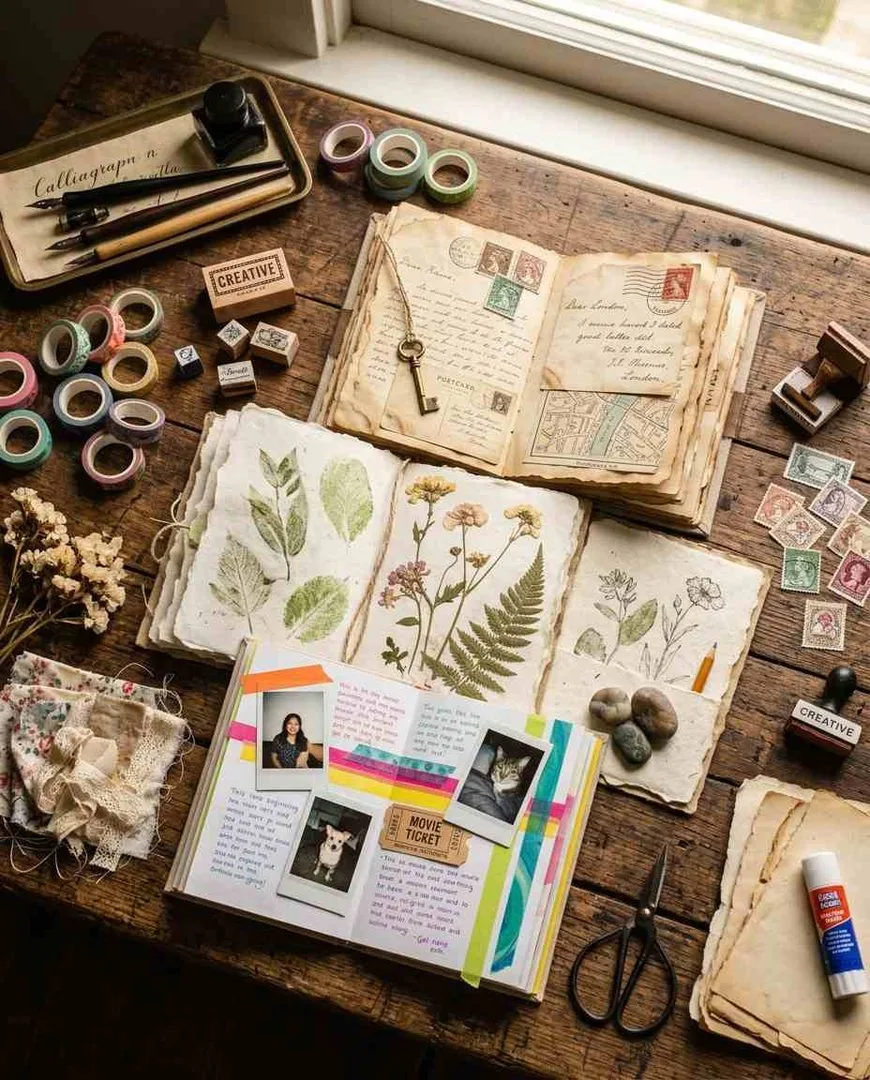
Open your journal and glue something down
The hardest part of junk journaling is the same as the hardest part of drawing, writing or any other creative act: starting. The blank page is intimidating precisely because there are no rules. So here is one rule to get you moving: open your journal, glue one thing onto the page, and build around it. A strip of washi tape. A torn piece of an old map. A pressed leaf. Once the first thing is down, the page is no longer blank, and the ideas follow.
For more creative boredom-killers, things to draw when bored has 100 drawing ideas sorted by mood, doodle ideas covers quick five-minute sketches, and hobbies to do at home has more hands-on projects. If junk journaling clicks for you, our things to do when bored master list has more ways to channel the creative energy.