Gen Z Slang: 150 Words and Phrases You Need to Know (2026)
Every generation invents its own language. Gen Z turned it into a competitive sport. Words appear on TikTok, spread to group chats, get adopted by brands, and die within months — sometimes all in the same week. This glossary covers 150 Gen Z slang terms verified as current in September 2026, with a real-sentence example for every single one. Terms that have already died get an honest tombstone. Terms that arrived in 2026 get a “new” badge. No corporate cringe, no “fellow kids” energy — just what the words mean and how they are actually used.
The most important Gen Z slang words in 2026 are: slay (to do something exceptionally well), no cap (not lying), rizz (charisma, especially romantic), bet (agreement or challenge accepted), bussin (extremely good, usually food), ate (performed perfectly), era (a life phase you are currently in), delulu (delusional but self-aware), ick (an instant turn-off), and brainrot (when too much internet consumption visibly affects how you talk).
A
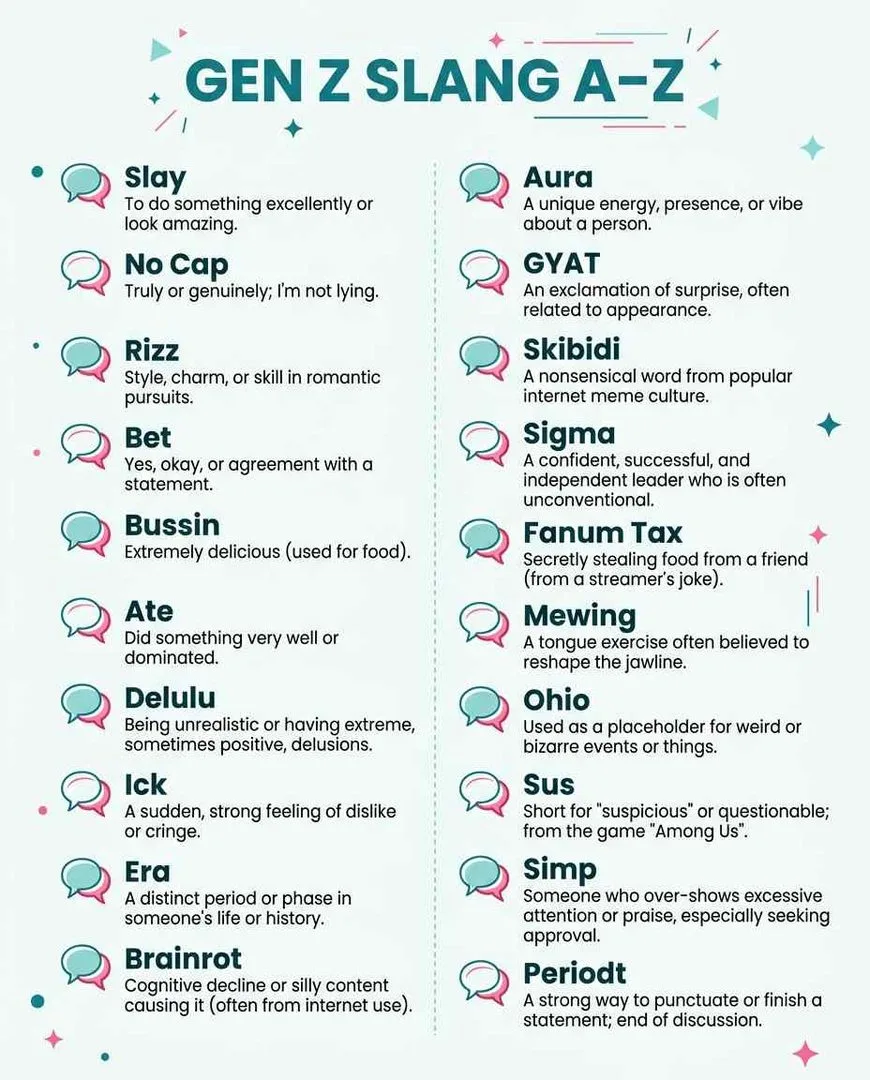
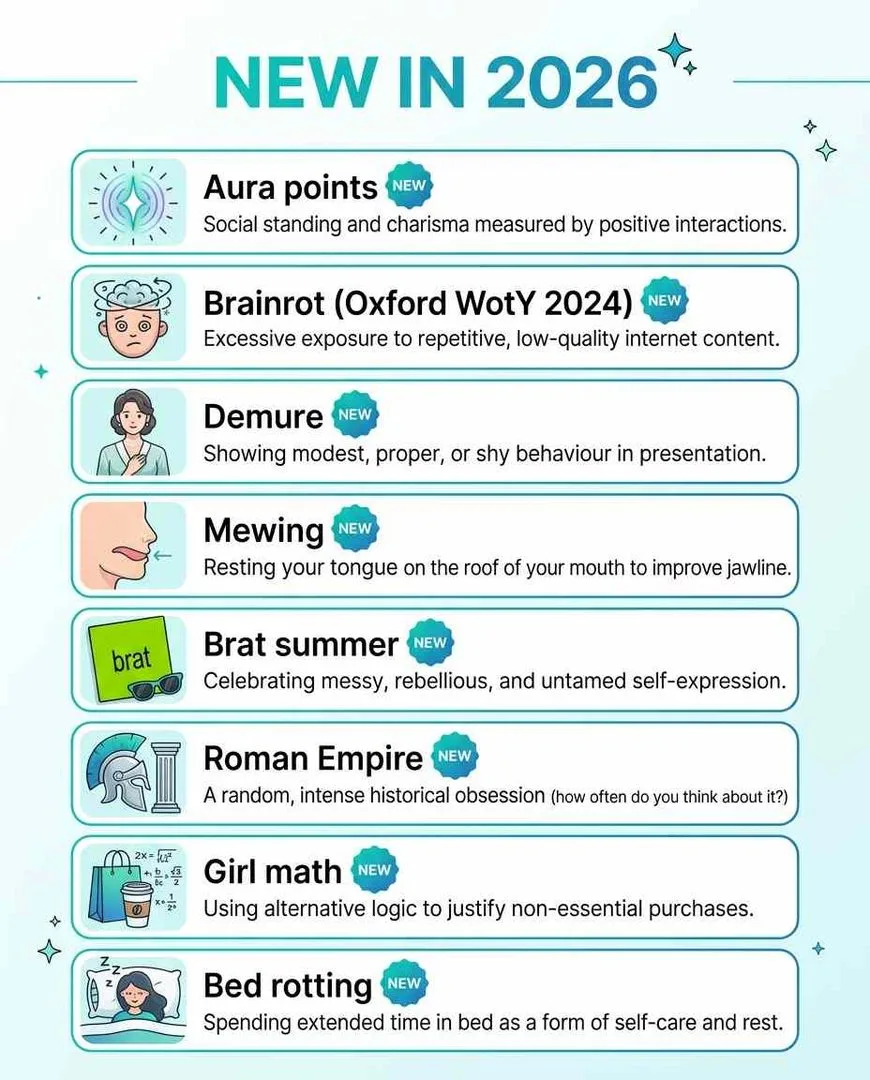
Aura — An invisible quality or energy someone radiates. Can be gained or lost based on actions.
“He tripped walking into the party — lost 50 aura points.”
Became a meme in 2024 with the “aura points” scoring system.
Ate — Performed something so well there was nothing left to criticise. Often used for fashion, performances or comebacks.
“She walked into the interview and absolutely ate.”
Short for “ate and left no crumbs.”
ASMR brain — The pleasantly tingly feeling from watching or hearing something satisfying.
“That pen on paper sound is giving ASMR brain.”
Crossover from the ASMR content community.
Aw nah — An expression of disbelief, shock or second-hand embarrassment. Often the entire reaction.
“He texted his ex at 3am? Aw nah.”
B
Bestie — A term of endearment used for close friends or even strangers in a friendly context.
“Bestie, you need to hear this.”
Can be genuine or ironic depending on tone.
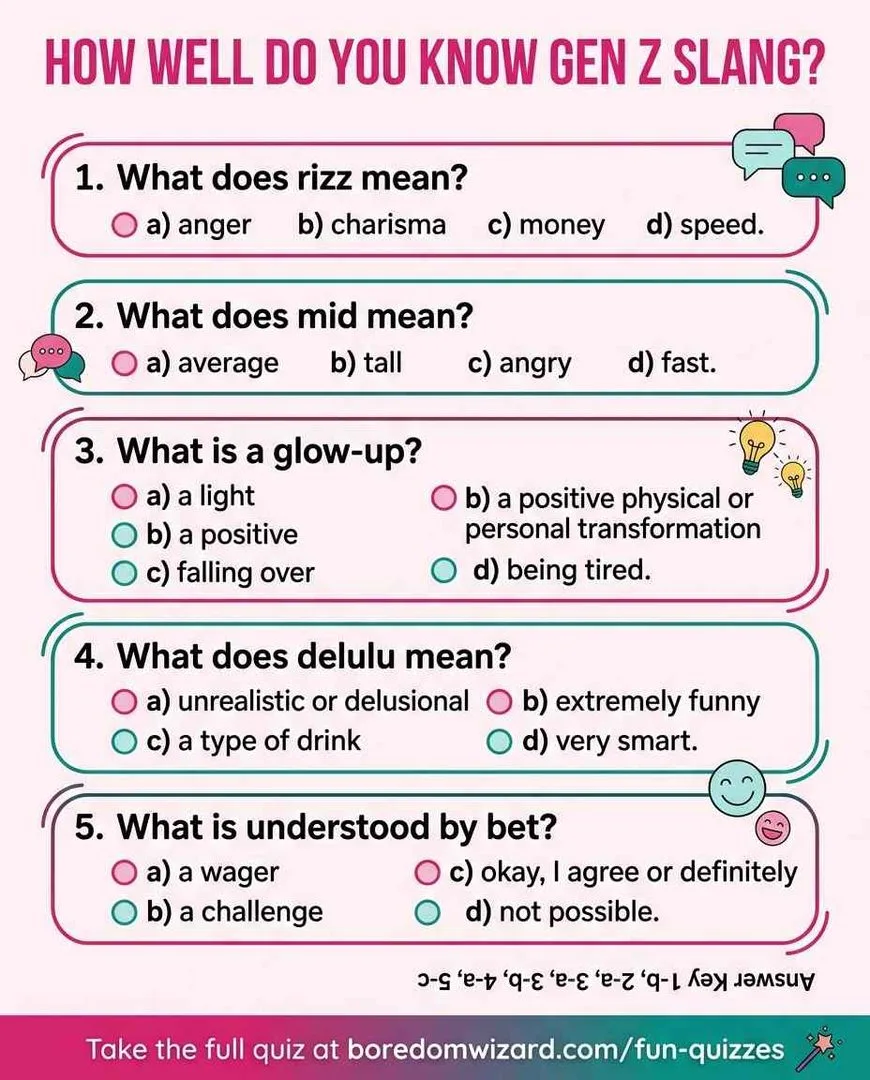
Bet — Agreement, acknowledgment or challenge accepted. Functions as “okay,” “sounds good” or “you’re on.”
“Want to grab food? — Bet.”
One of the most versatile words on this list.
Big yikes — An amplified version of “yikes.” Used when something is so awkward or bad that a normal yikes is insufficient.
“She posted their private messages on her story. Big yikes.”
Bop — A song that is undeniably good. Often used for songs you did not expect to like.
“I thought I’d hate it but that new track is a bop.”
Brainrot — The state of having consumed so much internet content that it visibly affects your vocabulary, references and thought patterns.
“He said ‘sigma rizz’ in a job interview. Terminal brainrot.”
The defining self-aware Gen Z term of 2024–2026.
Bussin — Extremely good, usually describing food but applied to anything excellent.
“These tacos are bussin, no cap.”
Popularised by TikTok food reviews.
Bffr — Be f***ing for real. Used when someone says something so absurd it demands a reality check.
“You think you can learn guitar in a week? Bffr.”
Texting abbreviation that crossed into speech.
C
Canon event — A defining life experience that someone must go through to become who they are. Cannot be prevented.
“Getting your heart broken in Year 10 is a canon event.”
From Spider-Verse (2023), where disrupting canon events destroys the timeline.
Caught in 4K — Caught doing something undeniable, with evidence so clear there is no excuse.
“She said she was staying home but someone caught her at the club in 4K.”
References high-definition security footage.
CEO of — The best at something, self-appointed. Often ironic.
“She’s the CEO of leaving parties early.”
Cheugy — Outdated, trying too hard, or associated with millennial trends that Gen Z considers over.
“Live laugh love signs are cheugy.”
Peaked in 2021. Ironically, using “cheugy” is now itself cheugy. ☠️ Already fading.
Clapped — Ugly, broken, or in terrible condition. British Gen Z slang that crossed the Atlantic.
“That car is absolutely clapped.”
Core — A suffix added to any aesthetic or vibe to create a micro-genre: cottagecore, goblincore, cluttercore, Barbiecore.
“Her whole room is giving cottagecore.”
The suffix that launched a thousand TikTok aesthetics.
Cooked — Done for. Beyond recovery. Can describe a person, a situation or a test result.
“I studied for the wrong exam. I am absolutely cooked.”
Australian slang adopted globally via gaming.
Crop top weather — Good weather. Used when the temperature is warm enough to dress lightly.
“Finally, it’s crop top weather.”
D
Dead — So funny you have figuratively died. Also used as “I’m dead” to express being overwhelmed by humour.
“He walked into the glass door. I’m dead.”
Preceded Gen Z but remains core vocabulary.
Delulu — Delusional, but used self-awarely. Often about crushes or career ambitions that are statistically unlikely.
“I’m fully delulu thinking he likes me back but it’s fine.”
Short for delusional. “Delulu is the solulu” (the solution) is the follow-up phrase.
Demure — Modest, reserved, and mindful. Went viral in mid-2024 as a TikTok trend about being “very demure, very mindful.”
“See how I packed my lunch? Very demure.”
The Jools Lebron trend. The word is old; the usage is 2024.
Drip — Style, usually referring to expensive or fashionable clothing and accessories.
“That fit has serious drip.”
Originally hip-hop slang, now mainstream Gen Z.
Dupe — A cheaper alternative to an expensive product, especially in beauty and fashion.
“This $12 lip gloss is a dupe for the $40 one.”
From “duplicate.” Dupe culture is a major Gen Z consumer trend.
E–F
Era — A phase of your life defined by a specific interest, behaviour or aesthetic. Used self-awarely.
“I’m in my gym era. I’m in my reading era. I’m in my villain era.”
The most versatile framing device in Gen Z vocabulary.
Extra — Over the top, dramatic, doing too much. Can be positive or negative.
“She brought a three-tier cake to a casual picnic. So extra.”
Fanum tax — Taking a portion of someone’s food, usually without asking. Named after streamer Fanum.
“He took half my fries. That’s fanum tax.”
Peaked as a meme in 2023–2024. Still used but fading.
Feral — Acting wild, unhinged or uncivilised, usually in an endearing way.
“She’s been feral since they announced the tour dates.”
Fire — Excellent, amazing, top-tier. The predecessor to “bussin.”
“That playlist is fire.”
Older slang that remains in active use.
Fit — An outfit. Short for “outfit.”
“That fit is hard.”
British slang adopted widely.
Flex — To show off, or the thing being shown off.
“Nice car — weird flex but okay.”
Flop era — A period of failure or poor decisions, embraced with self-deprecating humour.
“My entire April was a flop era and I’ve accepted it.”
For real for real (frfr) — An intensified version of “for real.” Used to emphasise sincerity.
“That movie was terrible, frfr.”
G
Gaslight — To manipulate someone into questioning their own reality. Originally psychological term, now used loosely and often humorously.
“She ate my leftovers and then gaslit me into thinking I already ate them.”
The loose usage bothers some people. Gen Z knows this and uses it anyway.
Ghost — To abruptly stop all communication with someone without explanation.
“He ghosted her after three dates.”
Girl dinner — A low-effort meal assembled from random items: crackers, cheese, pickles, a handful of cereal. No cooking.
“Tonight’s girl dinner is hummus and whatever’s left in the fridge.”
Viral TikTok trend from 2023 that became permanent vocabulary.
Girl math — A humorous justification framework where purchases are rationalised through creative accounting.
“If I return this $50 top, buying a $40 one means I made $10. Girl math.”
Giving — Evoking, serving, radiating a specific energy or aesthetic.
“That outfit is giving main character.”
Always followed by what it is “giving.”
Glazing — Excessively praising or flattering someone, often to the point of being insincere.
“He wrote a 500-word comment about how the CEO is a genius. He’s glazing.”
Go off — Encouragement to continue, often used when someone is passionately ranting or performing.
“You wrote a 10-page essay on why pineapple belongs on pizza? Go off.”
GOAT — Greatest Of All Time. An acronym that functions as a noun or adjective.
“Federer is the GOAT, no debate.”
Predates Gen Z but remains in constant use.
GYAT — An exclamation of attraction or surprise, typically at someone’s physique.
“She walked in and everyone said gyat.”
Popularised by streamer YourRAGE. Often spelled GYATT.
Grind — Relentless work or effort. “On the grind” = working hard. “Grindset” = the mentality behind it.
“Can’t hang out, I’m on the grind.”
H–I
Hits different — Feels uniquely good in a specific context that cannot be replicated.
“Water at 3am hits different.”
One of the most poetic Gen Z phrases.
Highkey — Openly, obviously, without reservation. The opposite of lowkey.
“I highkey want to quit my job.”
Ick — An instant, irrational turn-off. A feeling of sudden repulsion toward someone you were previously attracted to.
“He ran for the bus with his arms flailing. Instant ick.”
From Love Island originally. Now universal.
I’m weak — I am laughing so hard I have lost the ability to function.
“He pronounced quinoa as ‘quinn-oh-ah.’ I’m weak.”
It’s giving — Same as “giving” — used to describe the vibe or energy something radiates. Can be a compliment or an insult.
“That PowerPoint is giving corporate millennial.”
Iykyk — If you know, you know. Used to reference something only a specific group would understand.
“The bench outside Tesco at midnight. Iykyk.”
Texting abbreviation that crossed into captions and speech.
J–L
Jit — A younger person, sometimes used dismissively.
“That jit just tried to cut the whole line.”
Florida slang that went national via TikTok.
Karen — A person (typically a woman) who is entitled, demanding and often asks to speak to the manager.
“She complained about the font on the menu. Total Karen.”
Peaked 2020 but remains in use.
L — A loss. The opposite of W. Used for failures, bad decisions and unfortunate events.
“He showed up to the wrong airport. Massive L.”
Let him cook — Let someone continue what they are doing without interruption, because it might turn out well.
“I know it sounds crazy but let him cook.”
From sports commentary. Applied to everything now.
Living rent-free — Occupying someone’s thoughts constantly without their permission.
“That embarrassing thing I said in 2019 is living rent-free in my head.”
Lowkey — Subtly, privately, or to a moderate degree. Used to soften an opinion or confession.
“I lowkey want to watch that show again.”
Lore — Someone’s backstory or personal history, framed as if they are a fictional character.
“You don’t know about their breakup? That’s essential lore.”
From gaming/fantasy. Now applied to real people.
Locks in — Focuses intensely, gets serious, stops messing around.
“He locks in during exam season and becomes a different person.”
L take — A bad opinion. The opinion itself is an L.
“You think winter is better than summer? L take.”
M–N
Main character — The person at the centre of their own narrative. Living as if life is a movie and they are the protagonist.
“She put on sunglasses, played her own soundtrack and walked through the airport like the main character.”
Main character energy = the confidence of someone who knows the camera is on them.
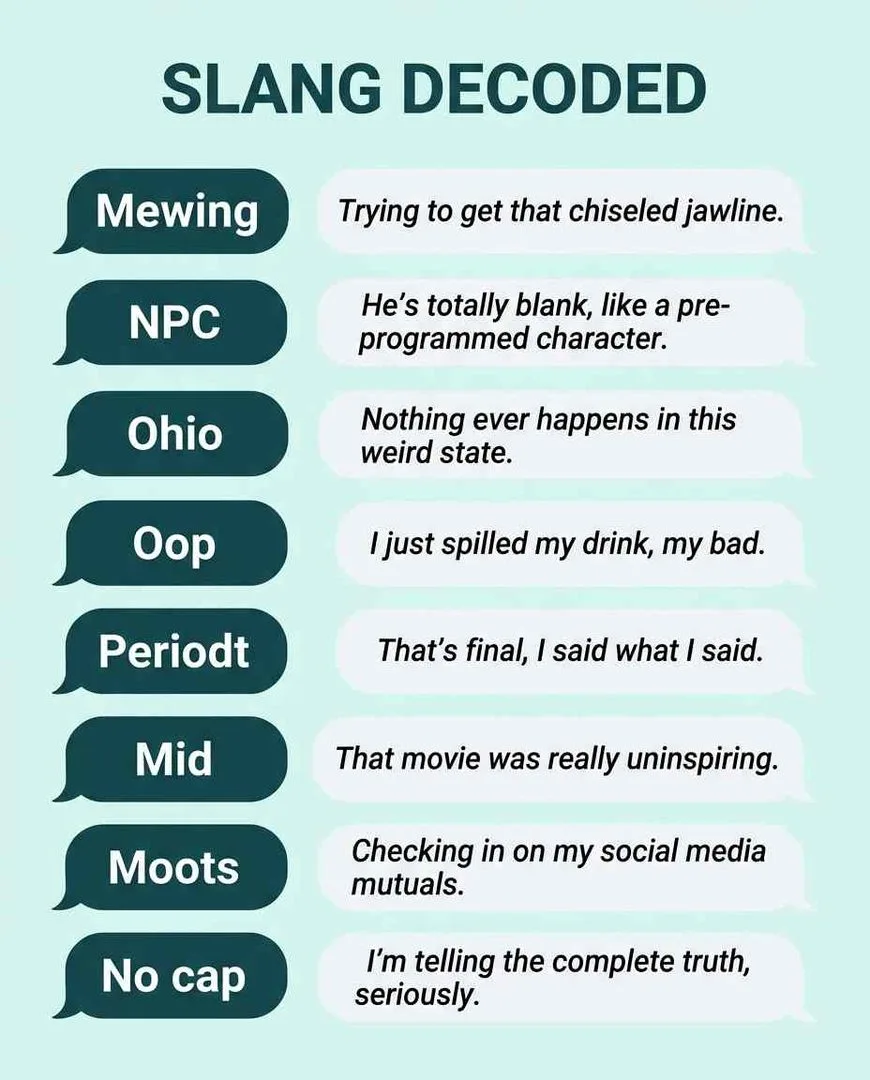
Mewing — The practice of pressing the tongue against the roof of the mouth to supposedly improve jawline definition.
“He’s been mewing for six months and swears his jaw changed.”
From Dr. Mike Mew. Became a meme faster than a health trend.
Mid — Average, mediocre, nothing special. A damning assessment because it implies something is not even bad enough to be interesting.
“That movie was mid. Not terrible, just mid.”
The word that makes everything worse by being indifferent.
Moots — Mutuals. People who follow each other on social media.
“Any moots going to the concert?”
Short for mutuals. Primarily Twitter/X vocabulary.
Ate that — Variation of “ate” — performed something perfectly.
“She ate that presentation and left no crumbs.”
NPC — Non-player character. Someone who appears to have no independent thoughts, acting on autopilot.
“He walks the same route, orders the same coffee and says the same things. Total NPC.”
From gaming. NPC behaviour became a TikTok trend in 2023.
No cap — Not lying, completely serious, no exaggeration.
“That was the best meal I’ve ever had, no cap.”
Cap = lie. No cap = no lie. One of the foundational Gen Z terms.
Not me — Used at the start of a sentence to describe embarrassing behaviour you are admitting to, often ironically.
“Not me spending three hours on a playlist nobody asked for.”
O–P
Ohio — A mythical place where strange, surreal or unhinged things happen. Has nothing to do with the actual state.
“Only in Ohio would you see a raccoon driving a shopping cart.”
The meme turned Ohio into Gen Z’s version of the Twilight Zone.
On God — An emphatic affirmation meaning “I swear” or “this is completely true.”
“That test was impossible, on God.”
Oop — A mild exclamation of surprise, awkwardness or second-hand embarrassment.
“She just called the teacher ‘mum.’ Oop.”
Panna — A nutmeg in football/soccer. Used more broadly to mean embarrassing someone with skill.
“He panna’d three defenders and scored. Unreal.”
British/European slang crossing over.
Peak — The worst, most unfortunate version of something. British slang meaning “that is terrible.”
“You failed by one mark? That’s peak.”
Confusing because “peak” also means the best. Context decides.
Period / Periodt — An emphatic full stop. Used to close a statement with finality and confidence.
“She is the best player on the team. Period.”
The “t” adds extra emphasis.
Pick me — Someone who seeks validation by acting different from their peer group, often by putting down others.
“She said she’s not like other girls. Pick-me energy.”
Pookie — A term of affection for a partner, friend, pet or anyone cute. Used sincerely or ironically.
“Look at my pookie all dressed up.”
Revived by TikTok from older slang.
Pressed — Upset, bothered, taking something too seriously.
“Why are you so pressed about a meme?”
Put on blast — To publicly expose or call out someone’s behaviour.
“She put him on blast for not texting back.”
R
Ratio — When a reply to a post gets more likes than the original post, indicating the original take was bad.
“He tweeted a bad opinion and got ratioed in 20 minutes.”
Originally Twitter-specific, now used broadly.
Red flag — A warning sign in a person or relationship that signals trouble.
“He said he doesn’t like dogs. Red flag.”
Paired with the 🚩 emoji in lists of deal-breakers.
Rent-free — See “living rent-free.” Occupying someone’s mind without permission.
“That song has been rent-free in my head all week.”
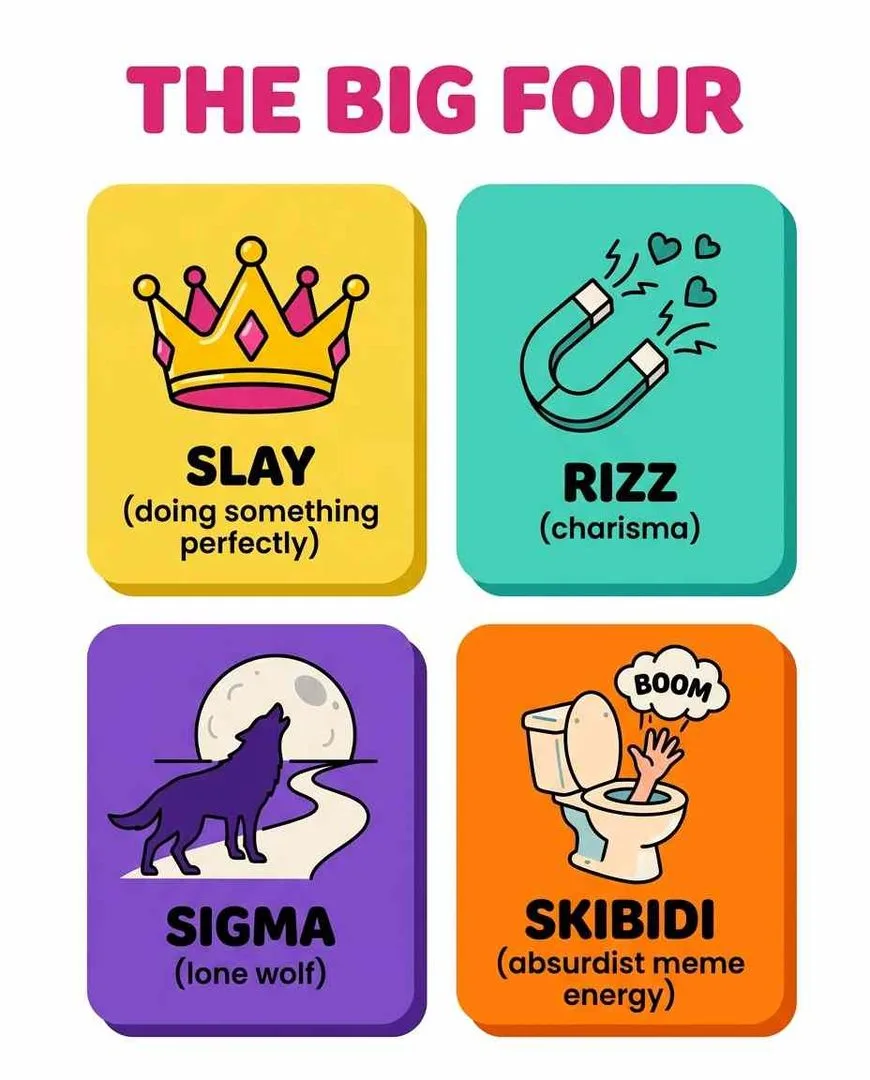
Rizz — Charisma, particularly the ability to attract romantic interest through charm and conversation.
“He walked up, said three words, and she was laughing. Unspoken rizz.”
Word of the Year 2023 (Oxford). From “charisma.” Coined by streamer Kai Cenat.
Roman Empire — Something a person thinks about with surprising frequency. Originates from a TikTok trend where women asked men how often they think about the Roman Empire.
“Self-checkout machines are my Roman Empire. I think about them constantly.”
Rotting — Lying in bed doing absolutely nothing for an extended period. Romanticised inactivity.
“I’ve been bed-rotting since Friday and I feel incredible.”
Bed-rotting became a TikTok wellness trend, which is deeply ironic.
S
Salty — Bitter or upset about something, often something minor.
“He’s still salty about losing that game three weeks ago.”
Secure the bag — To achieve a financial or personal goal. Get the money, the job, the opportunity.
“She got the promotion. Secured the bag.”
Sending me — Making me laugh uncontrollably. Similar to “I’m dead.”
“That video of the cat falling off the table is sending me.”
Serve — To present oneself exceptionally well, especially in fashion or appearance.
“She served at the Met Gala. Absolute serve.”
Related to drag culture and ballroom.
Sigma — A person (usually male) who is independent, self-reliant and operates outside traditional social hierarchies. Often ironic.
“He eats lunch alone by choice. Sigma grindset.”
From the debunked “sigma male” concept. Mostly used as a meme now.
Simp — Someone who does too much for a person they are attracted to, often without reciprocation.
“He drove two hours to bring her coffee. Certified simp.”
Can be affectionate or mocking depending on context.
Situationship — A romantic relationship without clear definition or commitment. More than friends, less than official.
“We’ve been in a situationship for four months and neither of us will define it.”
One of the most culturally significant Gen Z terms.
Skibidi — Originated from “Skibidi Toilet,” a surreal YouTube animated series. Used as a nonsense modifier or exclamation, often associated with brainrot humour.
“He said skibidi toilet in the middle of a presentation. We are doomed as a species.”
The word that proves Gen Z can make anything go viral.
Slay — To do something exceptionally well. To succeed with style and confidence.
“You got the job? Slay!”
One of the most enduring Gen Z terms, borrowed from drag and ballroom culture.
Slaps — Something that is really good, often used for music.
“This song absolutely slaps.”
Snack — An attractive person.
“Have you seen the new barista? Total snack.”
Soft launch — Subtly introducing a new relationship on social media, usually by posting a photo that includes a hand, a shadow or a partial silhouette without identifying the person.
“She soft-launched her boyfriend with a photo of two coffee cups.”
Stan — An extremely devoted fan. Can be a noun or verb.
“I stan that artist — I’ve been to every tour.”
From the Eminem song “Stan.” Now mainstream.
Sus — Suspicious, shady, untrustworthy. Popularised by Among Us.
“He left the group chat right before the drama started. Sus.”
Snatched — Looking extremely good. Describes a look, body or outfit that is perfectly put together.
“That dress? Snatched.”
From drag culture. Similar to “serve.”
T–U
Tea — Gossip, drama, inside information. “Spill the tea” = share the gossip.
“Okay sit down and spill the tea. What happened?”
From drag and ballroom culture via RuPaul’s Drag Race.
That’s cap — That is a lie.
“He said he ran a 4.3 forty. That’s cap.”
Toxic — Harmful, manipulative, emotionally damaging. Applied to people, relationships, workplaces and fandoms.
“That relationship was toxic from the start.”
Overused to the point where Gen Z itself memes about overusing it.
Understood the assignment — Performed exactly as required, met or exceeded expectations.
“She wore the theme perfectly. Understood the assignment.”
Red carpet and fashion commentary term that went mainstream.
Unalive — A euphemism created to bypass content moderation filters on TikTok and YouTube. Used in place of words that trigger content removal.
“I can’t say the real word or the algorithm will unalive my video.”
A term born from platform censorship. Linguistically significant.
Unhinged — Behaving in a wild, unpredictable, chaotic way. Often used as a compliment.
“Her Twitter posts are completely unhinged and I am here for it.”
V–W
Valid — Acceptable, understandable, legitimate. Used to affirm someone’s feelings or choices.
“You don’t want to go? That’s valid.”
Vibe — The overall feeling or energy of a person, place or situation. Also used as a verb: “just vibing.”
“This coffee shop has such a good vibe.”
Vibe check — An assessment of someone’s energy or mood. Can be a question or a statement.
“Vibe check — how are we feeling about tonight?”
W — A win. The opposite of L. Used for successes, good decisions and fortunate events.
“She got accepted to her first choice. Massive W.”
Woke — Politically and socially aware. Originally from Black American English, now used broadly and often politically.
“The word ‘woke’ now means different things depending on who is using it.”
One of the most politically contested words of the decade.
X–Z
Yap — To talk excessively about nothing. Also “yapper” — someone who talks too much.
“He’s been yapping for 20 minutes and hasn’t said anything.”
Yeet — To throw something with force and enthusiasm. Also used as an exclamation.
“She yeeted her phone across the room when she saw the results.”
Peaked in 2019 but remains in use as a verb.
Zesty — Flamboyant, energetic, extra — sometimes used to describe someone with expressive or animated mannerisms.
“He’s a little zesty and that’s why everyone loves him.”
Can be affectionate or mocking. Context matters.
Zzz — Boring. Used to dismiss something uninteresting.
“That lecture was zzz.”
The visual representation of falling asleep, turned into slang.
Gen Z slang that is already dead — stop using these
These were peak Gen Z vocabulary in their moment, but using them in 2026 will immediately date you. They have been replaced, overused to death, or co-opted by brands to the point where they feel corporate.
Cheugy ☠️ — Died when the word itself became the thing it described. Using “cheugy” is now cheugy.
“”
Retired 2022.
It’s the ___ for me ☠️ — Overused by brands in 2021 and became instantly cringe.
“”
Retired 2022.
And I oop ☠️ — The Jasmine Masters phrase that every brand adopted and killed within six months.
“”
Retired 2020.
OK boomer ☠️ — Effective for about three months in 2019 before it was printed on merchandise.
“”
Retired 2020.
Fam ☠️ — Replaced by “bestie” and “pookie.” Sounds dated.
“”
Fading since 2022.
Gucci ☠️ — Meaning “good” or “cool.” Replaced by “bet.”
“”
Retired 2021.
Clout ☠️ — Still understood but sounds 2019. Replaced by “aura” as the social currency metaphor.
“”
Fading.
Gen Z slang: FAQ
What are the top 10 Gen Z slang words?
Slay, no cap, rizz, bet, bussin, ate, era, delulu, ick and brainrot. These ten are the most widely used across TikTok, Instagram and real-life conversation in 2026.
What do Gen Z call cool people?
There is no single word. A cool person might be described as having rizz (charisma), main character energy (protagonist confidence), or aura (an intangible quality). Someone who does something impressive is told they “ate” or “slayed.”
How do Gen Z talk?
Gen Z communication is heavily influenced by meme culture, TikTok trends and internet humour. The vocabulary borrows from Black American English, drag and ballroom culture, gaming and anime. The most distinctive feature is self-awareness — many Gen Z slang terms are used ironically, and the line between sincere and ironic usage is intentionally blurred.
What Gen Z slang is outdated?
Cheugy, “and I oop,” “OK boomer,” “it’s the ___ for me,” fam and Gucci (meaning good) are all outdated. A general rule: if a brand has used it in a marketing campaign, Gen Z has already moved on.
What is brainrot?
Brainrot describes the state of having consumed so much internet content that it affects how you talk, think and make references in real life. Someone with brainrot might say “skibidi sigma rizz” in casual conversation and not realise how unhinged that sounds to anyone over 25. Oxford named it their Word of the Year for 2024.
Is Gen Z slang just AAVE?
A significant portion of Gen Z slang originates from African American Vernacular English (AAVE): slay, tea, no cap, bussin, finna, periodt, ate. This is a well-documented pattern in American English where Black cultural vocabulary is adopted by the mainstream, often without credit. The borrowing is real, the lack of attribution is a valid criticism, and Gen Z is more aware of this dynamic than previous generations were.
Bookmark this and come back in three months
Gen Z slang moves faster than any glossary can keep up with. Terms that do not exist today will be everywhere next month, and terms on this list will be declared dead by Christmas. This page is updated regularly — the “verified September 2026” date at the top tells you how current it is.
For more ways to kill boredom, our guide to funny things to ask Alexa has 100 voice commands, Google Easter eggs covers 45 hidden surprises, and things to do when bored is the master list.
![49 Upcoming Car Models to Explore When Bored in 2026 [Sports, Luxury, EVs & Future Cars]](https://boredomwizard.com/wp-content/uploads/2026/03/Upcoming-Car-Models-to-Explore-When-Bored-1-768x768.webp)