24 Best Hobbies for Retirees to Stay Active (Mapped by Distance From Your Door)
The best hobbies for retirees to stay active are the ones that push your world outward — walking soccer, pickleball leagues, e-bike touring, rowing crews, VR workouts — not the “gentle chair activities” the internet keeps prescribing. Let’s name the problem with most articles on this topic: they’re written like care-home pamphlets, for an imaginary fragile person. You just finished a 40-year career. You don’t need gentleness. You need a plan.
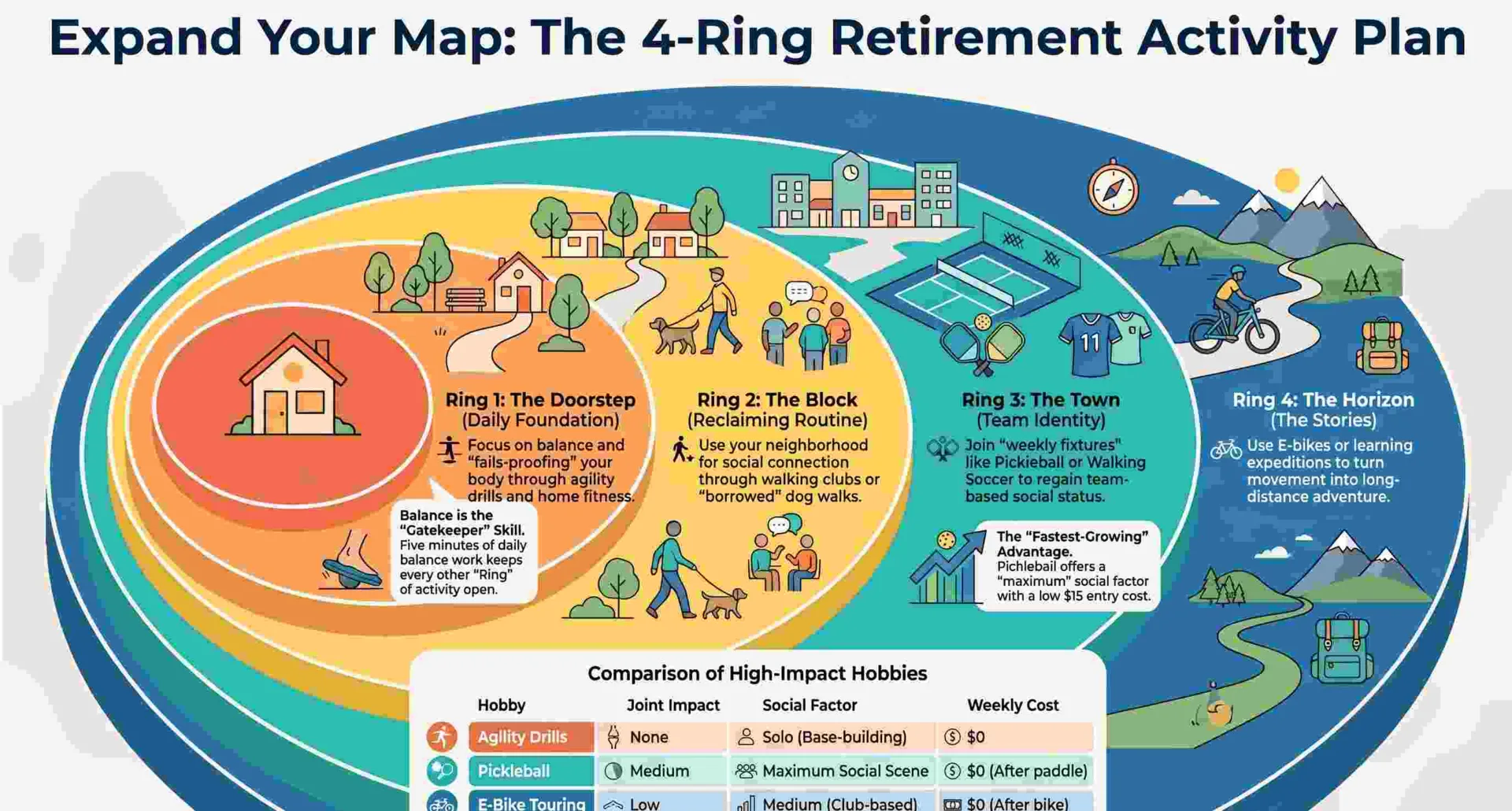
Here’s the insight this whole article is built on: the real enemy in retirement isn’t inactivity — it’s the shrinking world. When the commute, the office, and the schedule disappear, your daily radius quietly collapses from twenty miles to twenty steps, and body, brain, and mood shrink with it. Research collected by the National Institute on Aging ties physical activity, social connection, and purpose to nearly every measure of healthy aging — and all three live outside the recliner’s orbit. So these 24 hobbies aren’t sorted by category. They’re sorted by how far from your front door they take you — four rings, each one pushing the map back out.
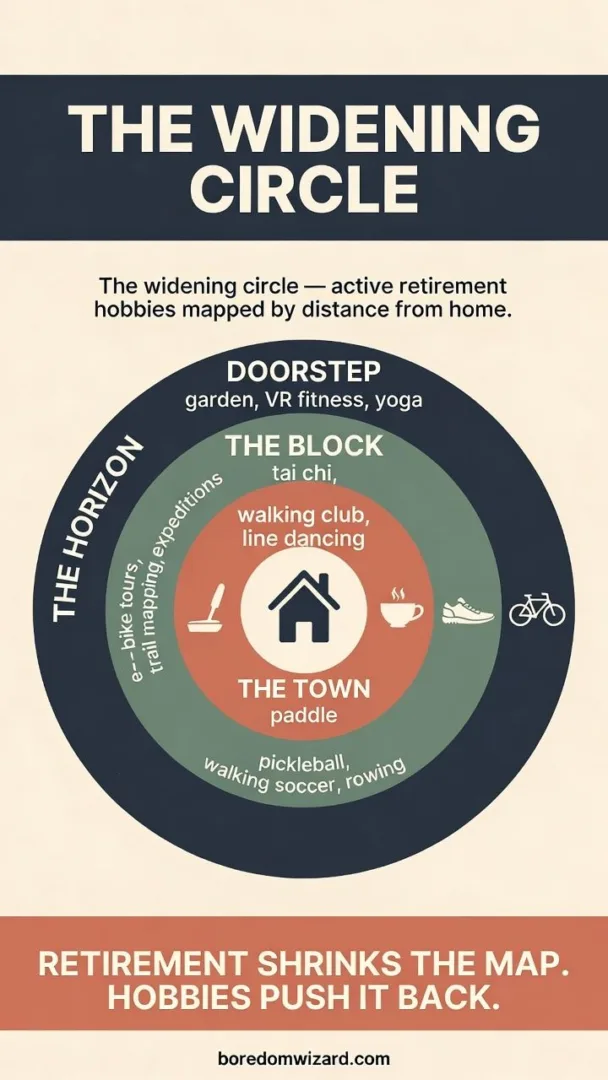
The Widening Circle: Four Rings, 24 Hobbies
| Ring | Range | What It Rebuilds | Hobbies |
|---|---|---|---|
| 1. DOORSTEP (1–6) | Home & yard | Daily movement baseline + balance | Zen rock gardening, pollinator garden, VR fitness, agility drills, chair-to-mat yoga, online circuit classes |
| 2. THE BLOCK (7–12) | Your neighborhood | Routine, fresh air, familiar faces | Tai chi in the park, walking club streaks, line dancing, memory lane tours, urban foraging walks, dog-borrowing walks |
| 3. THE TOWN (13–18) | Courts, pools, clubs | Team identity + weekly fixtures | Pickleball, walking soccer, rowing crews, aqua circuits, volunteer trail building, telescope nights |
| 4. THE HORIZON (19–24) | Trails & trips | Adventure + the stories worth telling | E-bike touring, digital cartography hikes, learning expeditions, movement-confidence training, historical reenactment, virtual challenge walks |
Ring 1 — The Doorstep: Build the Base
1. Zen Rock Gardening
Raking gravel, placing stones, pruning one stubborn juniper — zen rock gardening is strength-in-disguise (kneeling, lifting, reaching) wrapped in genuine calm. Unlike vegetable beds, it’s beautiful in every season and forgiving in every climate. Joints: very low impact · Cost: $0–40 · Start this week: rake one corner of the yard into deliberate lines and see how you feel.
2. Pollinator Garden Stewardship
Turn a strip of lawn into a pollinator pathway — native flowers, a water dish, a log pile — and you’ve joined a national conservation effort from your own yard, with bending, digging, and hauling as the membership fee. The bees show up like grateful tenants. Joints: low · Cost: ~$30 in seeds · Start this week: kill one square meter of lawn. The neighborhood bees will handle the ribbon-cutting.
3. VR Fitness
The most future-proof entry here: a VR headset turns your living room into a boxing ring, a mountaintop tai chi deck, or a rhythm game that somehow burns 300 calories. Adoption among 60+ users is climbing fast for one reason — it makes cardio feel like play, and it works rain or shine, knees permitting and knees consulted. Joints: low-medium (self-paced) · Cost: headset ~$300 once · Start this week: try a demo at a store or a grandkid’s house before buying.
4. Daily Agility Drills
Five minutes of deliberate balance work — heel-to-toe lines down the hallway, single-leg stands while the coffee brews, gentle direction changes in the garage. Call them twilight agility drills, call them falls-proofing, call them nothing at all — they’re the highest-return five minutes in this entire article, because balance is the skill that keeps every other ring open. Joints: none stressed · Cost: $0 · Start this week: stand on one leg while brushing your teeth. Tonight.
5. Chair-to-Mat Yoga
Start seated if that’s honest, progress to the mat as hips allow — yoga’s whole genius is that it meets you exactly where you are and then quietly moves the goalposts. Flexibility, breath, and the best sleep of your week. Joints: restorative · Cost: free on YouTube · Start this week: one 20-minute beginner video, living room, door closed.
6. Online Circuit Classes
SilverSneakers and YMCA-style live online classes put a coach and a roomful of peers on your screen at 9 a.m. — structure without a commute, and many Medicare Advantage plans include membership free. The camera-on crowd becomes real friends faster than you’d expect. Joints: scaled to you · Cost: often $0 via insurance · Start this week: check whether your plan already includes it. Most people never look.
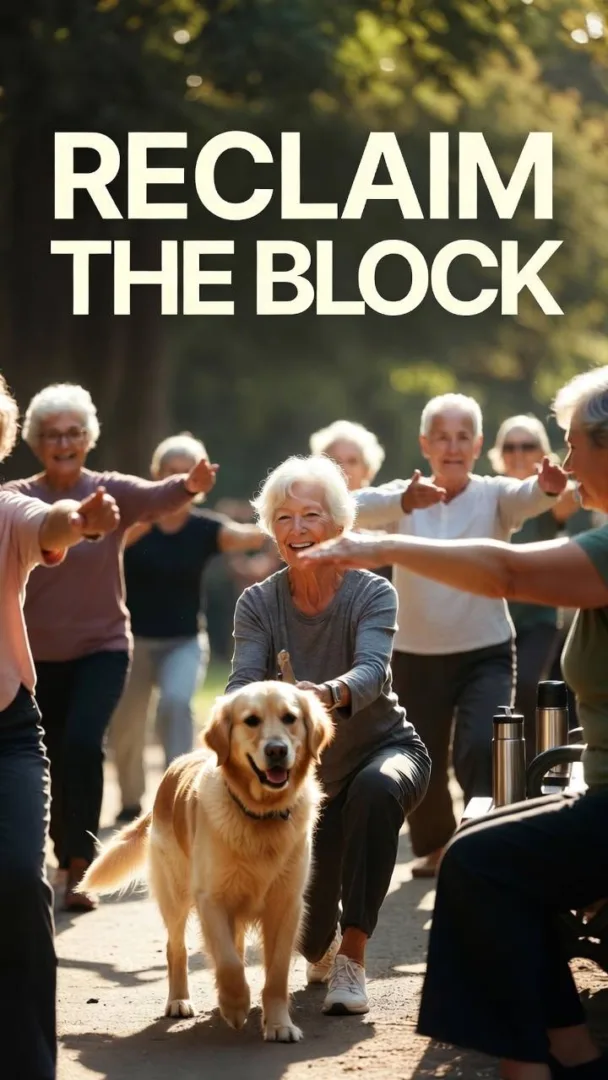
Ring 2 — The Block: Reclaim the Neighborhood
7. Tai Chi in the Park
The slow-motion martial art with the loudest evidence file: better balance, lower blood pressure, calmer mind. Outdoor group sessions turn a park corner into a standing appointment, and the movements scale from post-surgery to genuinely athletic. Joints: famously kind · Cost: $0–10/session · Start this week: search ‘[your town] tai chi park’ — there’s almost certainly a morning group.
8. Walking Club With Streaks
A neighborhood walking group plus a fitness tracker equals the oldest hobby with a modern engine: step streaks, friendly leaderboards, and the accountability of Doris texting “where were you?” when you skip. Walking is boring alone and weirdly addictive in company with a number attached. Joints: low · Cost: $0 (tracker optional ~$30) · Start this week: recruit two neighbors. Tuesday and Friday, 8 a.m. That’s a club.
9. Line Dancing
Community-center line dancing is coordination training, cardio, memory work, and a social scene wearing boots — the research on dance and healthy brains keeps getting stronger, and nobody notices because everyone’s having too much fun. Joints: low-medium · Cost: $5–10/class · Start this week: one beginner class. You’ll be wrong about hating it.
10. Memory Lane Walking Tours
Walk your own town like a historian: the school that’s now condos, the route you biked at twelve, the storefront that’s been four restaurants. Memory lane walking tours are exercise fused with life review — and recorded on your phone for the grandkids, they become the family archive nobody knew they wanted. Joints: low · Cost: $0 · Start this week: one 40-minute loop through your oldest neighborhood, narrating aloud. Feel free to feel things.
11. Urban Foraging Walks
Learn five safe, unmistakable edibles — mulberries, dandelion greens, wild chives — and every neighborhood walk becomes a low-stakes treasure hunt. Take a local class first, follow the forager’s iron rule (never eat what you can’t identify with certainty), and enjoy being the person who came home from a walk with dessert. Joints: low · Cost: $0–25 for a class · Start this week: ID one mulberry tree. They’re everywhere and nobody picks them.
12. Dog-Borrowing Walks
No dog? Borrow one. Neighbors, busy adult kids, and shelter walking programs are full of dogs who need miles, and a borrowed dog delivers everything the research says retirees need — daily walks, spontaneous conversations with strangers, and a creature ecstatic to see you — with none of the 2 a.m. vet bills. Joints: low · Cost: $0 · Start this week: one shelter dog-walking shift. Warning: this hobby has a high adoption rate.
Ring 3 — The Town: Join Something
13. Pickleball
Yes, everyone says pickleball — because for once, everyone is right. It’s the fastest-growing sport in America and retirees built it: small court, huge social scene, rallies on day one, and a league ladder whenever you’re ready to get competitive. The paddle costs $15 and the friend group is included. Joints: medium (court shoes matter) · Cost: $15 + free courts · Start this week: show up at open play. Someone will hand you a paddle within four minutes.
14. Walking Soccer
The trend arriving from the UK: real soccer, no running allowed. Walking soccer keeps the tactics, the teamwork, and the post-match coffee while deleting the sprinting and most of the injuries — and U.S. clubs are multiplying fast. If you played anything, ever, this is your sport back. Joints: low-medium · Cost: $0–5/session · Start this week: search ‘walking soccer near me’ — and if nothing exists, your Y will help you start it, which is its own hobby.
15. Rowing Crews
Masters rowing crews recruit total beginners in their 60s and 70s constantly — rowing is low-impact, full-body, and done sitting down, which makes it the sneakiest serious workout available to creaky knees. Dawn on the water with a crew that needs your seat filled: purpose, scenery, and shoulders. Joints: very kind · Cost: club dues ~$30–60/mo · Start this week: every rowing club runs a learn-to-row day. Book one.

16. Aqua Circuits
Water aerobics grew up: aqua circuits, aqua cycling, and deep-water running give a real training effect with the pool absorbing every impact. It’s the ring’s best option after joint replacements — and community pools schedule these classes at retiree-friendly hours because they know exactly who their athletes are. Joints: near zero impact · Cost: $3–8/class · Start this week: one class. Bring goggles, leave your dignity concerns in the locker.
17. Volunteer Trail Building
Parks departments and trail associations run volunteer crews that clear brush, build steps, and maintain the paths everyone else hikes — outdoor strength training with a crew, a purpose, and a visible result you can walk your grandkids down. Find crews through VolunteerMatch or your county parks page. Joints: medium (tasks are chosen, not assigned) · Cost: $0, gloves provided · Start this week: one Saturday shift. You’ll sleep like a teenager.
18. Community Telescope Nights
Astronomy clubs host public observation nights where members share telescopes and enthusiasm in equal measure — the gateway to a hobby that combines evening walks, gentle equipment-hauling, lifelong learning, and the particular awe that resets a person. Joints: low · Cost: $0 to attend · Start this week: find your county astronomy club’s next public night. Bring a thermos.
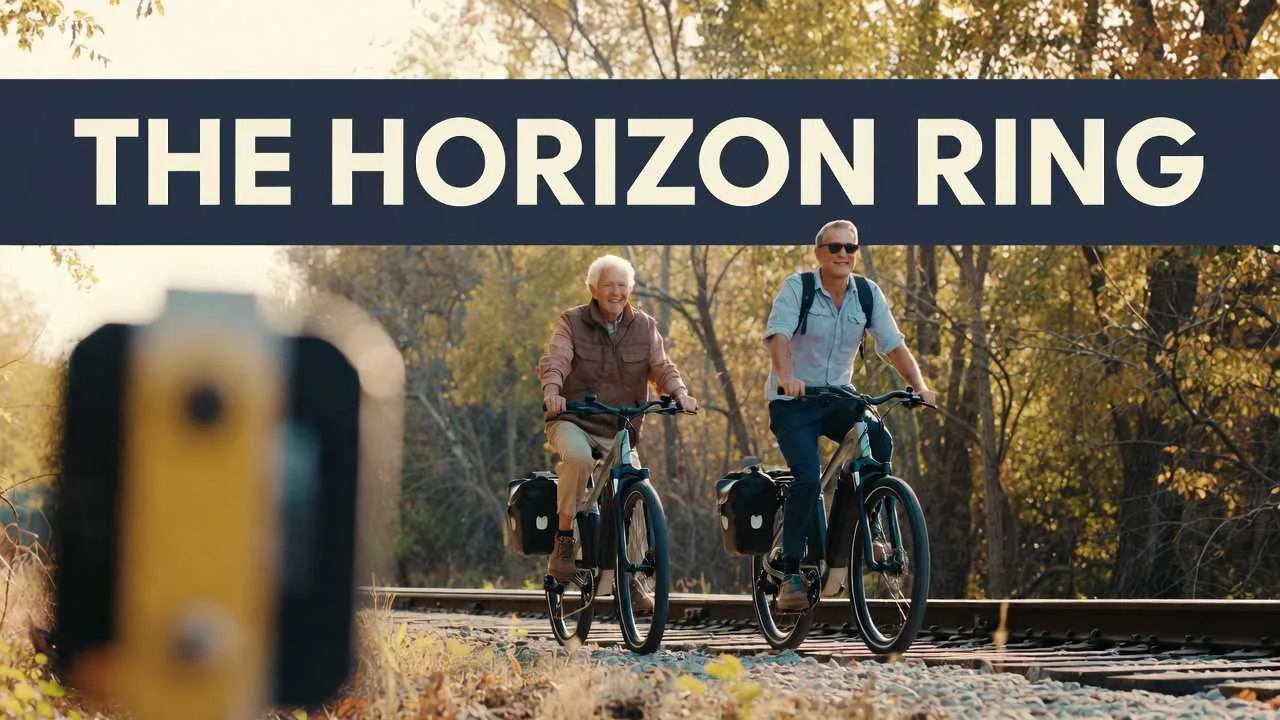
Ring 4 — The Horizon: Go Farther
19. E-Bike Touring
The e-bike is the single best piece of retirement technology ever built: it flattens hills, doubles range, and returns cycling to knees that thought they’d retired from it. Day tours become weekend tours become the rail-trail trip you talk about all winter. Joints: low (the motor absorbs the hard parts) · Cost: $900+ or rent first · Start this week: rent one for two hours. This purchase decision makes itself.
20. Digital Cartography Hikes
Hiking plus purpose: record trails on AllTrails, photograph trail conditions, contribute corrections mappers actually use — digital cartography hikes turn every walk into fieldwork. The tech-forward version of the hobby your boots already wanted. Joints: self-paced · Cost: $0 · Start this week: record one local trail and write the review you wish you’d had.
21. Learning Expeditions
Travel with a syllabus: birding trips with naturalists, archaeology digs that take volunteers, walking tours of Civil War routes with historians. Educational travel programs for older adults are a thriving industry because they solve retirement’s twin hungers — movement and meaning — in one itinerary. Joints: activity-rated in catalogs · Cost: varies widely · Start this week: request one catalog. Circling trips is itself excellent cardio for the imagination.
22. Movement-Confidence Training
Quietly trending in physical therapy circles: parkour-derived classes for older adults — how to fall safely, get up from the floor smoothly, step over obstacles with confidence. Call it senior parkour basics or call it applied not-fearing-the-ground; graduates describe the same thing: they stopped moving like something might break. Joints: carefully progressive · Cost: $15–25/class · Start this week: practice one floor-to-standing transfer without using hands. Harder than it sounds; trainable within weeks.
23. Historical Reenactment
Reenactment is secretly a fitness program in wool: marching, drilling, camp-building, and swordwork, plus a research hobby and a ready-made community of obsessives. Historical reenactment fitness is real — ask anyone who’s done a July encampment in period dress. Joints: role-dependent (surgeons and cooks welcome) · Cost: borrowed kit at first · Start this week: attend one public event and talk to the least busy person in costume. They’ll recruit you by sundown.
24. Virtual Challenge Walks
Walk the length of Route 66 — from your own neighborhood. Virtual challenge apps convert your daily steps into progress along famous routes, mailing real medals at milestones. It’s Ring 2 walking with Ring 4 storytelling, and the finisher’s medal for ‘walking to Machu Picchu’ is a better conversation piece than most actual trips. Joints: low · Cost: ~$30 per challenge · Start this week: pick the route you’d never fly to. Start walking there.
The Practical Table: Impact, Cost, and Social Factor
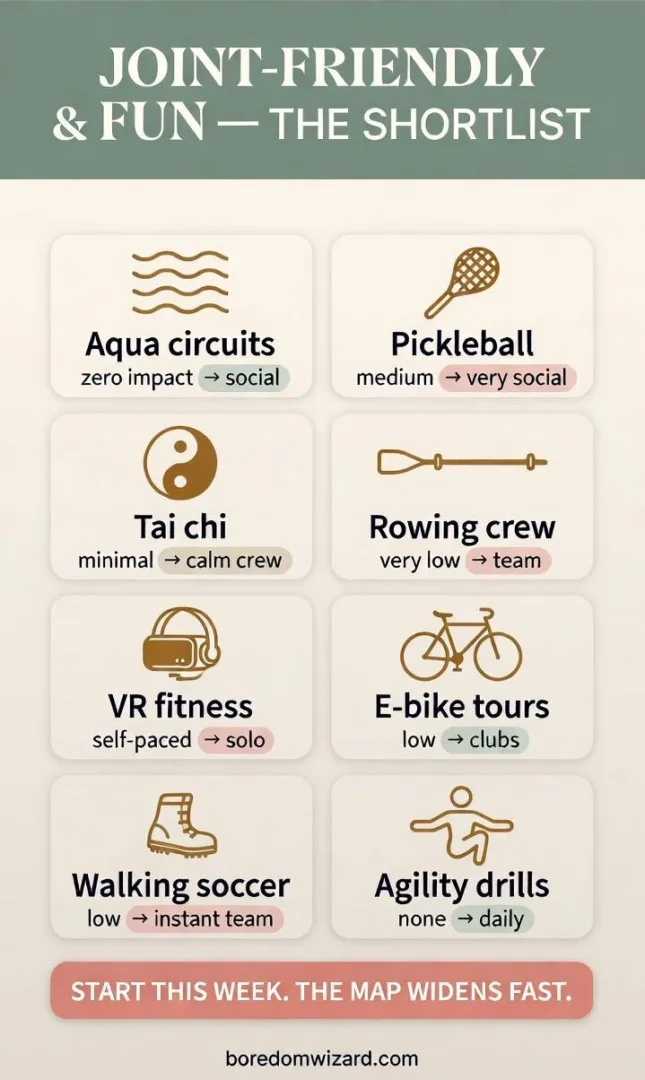
| Hobby | Joint Impact | Weekly Cost | Social Factor |
|---|---|---|---|
| Tai chi | Minimal | $0–10 | Medium — regulars become friends |
| Pickleball | Medium | $0 after paddle | Maximum — it’s 40% sport, 60% scene |
| Walking soccer | Low-medium | $0–5 | High — instant team |
| Rowing crew | Very low | $8–15 | High — the boat needs you |
| Aqua circuits | Near zero | $3–8 | Medium-high |
| VR fitness | Low, self-paced | $0 after headset | Low (solo) — pair with Ring 2 |
| E-bike touring | Low | $0 after bike | Medium — clubs everywhere |
| Agility drills | None | $0 | Solo — but protects everything else |
| Trail building | Medium, chosen tasks | $0 | High — crews bond fast |
| Line dancing | Low-medium | $5–10 | Maximum |
Natty’s take: My favorite client story in twenty-six years of coaching is a 71-year-old who came to me ‘bored and stiff’ eight months into retirement. We didn’t build a fitness plan — we drew his map: everywhere he’d physically been in the last month fit inside one grocery-store loop. So we worked the rings instead of the reps. Balance drills at the sink, then the tai chi group two streets over, then — his idea, month four — learn-to-row day. He texted me last spring from a masters regatta: ‘Tell your clients the world doesn’t shrink. People just stop pushing on it.’ I’ve been quoting him ever since.
FAQs (enable FAQ schema on these)
What are the best hobbies for retired couples?
Pick from Ring 3 and 4 together: pickleball doubles, walking soccer (many clubs are mixed), e-bike touring, and learning expeditions are all better as a pair — and a shared fixture on the calendar does more for a retired marriage than most date nights. Our full hobbies for couples guide has 35 more, including a by-decade section.
What are the Best Hobbies for Retirees to Stay Active ?
Ring 1 is built for exactly this: VR fitness, agility drills, chair-to-mat yoga, online circuit classes, and both garden projects. The honest caveat: home-only is a starting line, not a strategy — pick one Ring 2 hobby within the first month, because the front door is the whole game.
What about hobbies for over 50s who aren’t retired yet?
Same rings, compressed schedule: pickleball, walking club streaks, and VR fitness all fit around a job, and starting them at 55 means arriving at retirement with the map already wide. The broader lists in hobbies for women and hobbies for men cover the non-active categories too.
I’m looking for hobbies for my retired dad — where do I start?
The gift isn’t equipment — it’s the first session, booked and accompanied. Take him to pickleball open play, a learn-to-row day, or rent two e-bikes for an afternoon. Ring 3 hobbies work best for dads because they arrive with a built-in crew, and the crew — not the sport — is usually what he’s missing. (A borrowed dog also has an outstanding success rate.)
What if mobility is genuinely limited?
Start where the impact column says ‘near zero’: aqua circuits, chair yoga, tai chi, and VR fitness scaled gently — and loop in your doctor or a physical therapist on sequencing; that’s not a disclaimer, it’s how the athletes in Ring 3 got there. The rings still apply; they just widen more gradually. For low-energy days between sessions, our retirement boredom guide covers the quieter hours.
Final Thoughts: Push On the Map
Retirement hands you the two things every hobby on this list requires — time and choice — and quietly takes away the thing none of them can survive without: a reason to leave the house. So borrow this article’s only rule: one hobby per ring, starting from the doorstep, each ring opening the next. Balance drills make the walking club possible; the walking club makes pickleball plausible; pickleball makes the e-bike trip inevitable. The map doesn’t shrink. People just stop pushing on it. Push — and if you’re still choosing, the five-question hobby finder will pick your Ring 1 opener in two minutes.
Explore More on BoredomWizard
Things to Do When Bored Post-Retirement · How to Find a Hobby You Actually Enjoy · 35 Hobbies for Couples · 25 Analog Hobbies · 30 Fun Hobbies for 2026 · 30 Cheap Hobbies That Pay You Back · 20 Hobbies That Make Money · Exercises to Do When Bored · 50 Hobbies to Try in 2026