How to Play Mah-Jongg: The Beginner’s Guide to American Mah Jongg
Mah-jongg is having a moment. Google says searches for “mahjong for beginners” are up 230% in a year (Google Search trends, July 2026), and it’s easy to see why. It’s a phone-free, four-person game that’s part puzzle, part luck and mostly conversation.
The catch is that most mah jongg rules are taught by a friend at a table, and the videos online move fast. This guide slows it down. You’ll learn the 152 tiles, how to build the wall, how the Charleston works, what jokers can and can’t do, how to read the National Mah Jongg League card, and how to win your first hand. Then you’ll use a simple four-game plan to go from total beginner to playing for real.
How to play mah-jongg? (The 50-word answer)
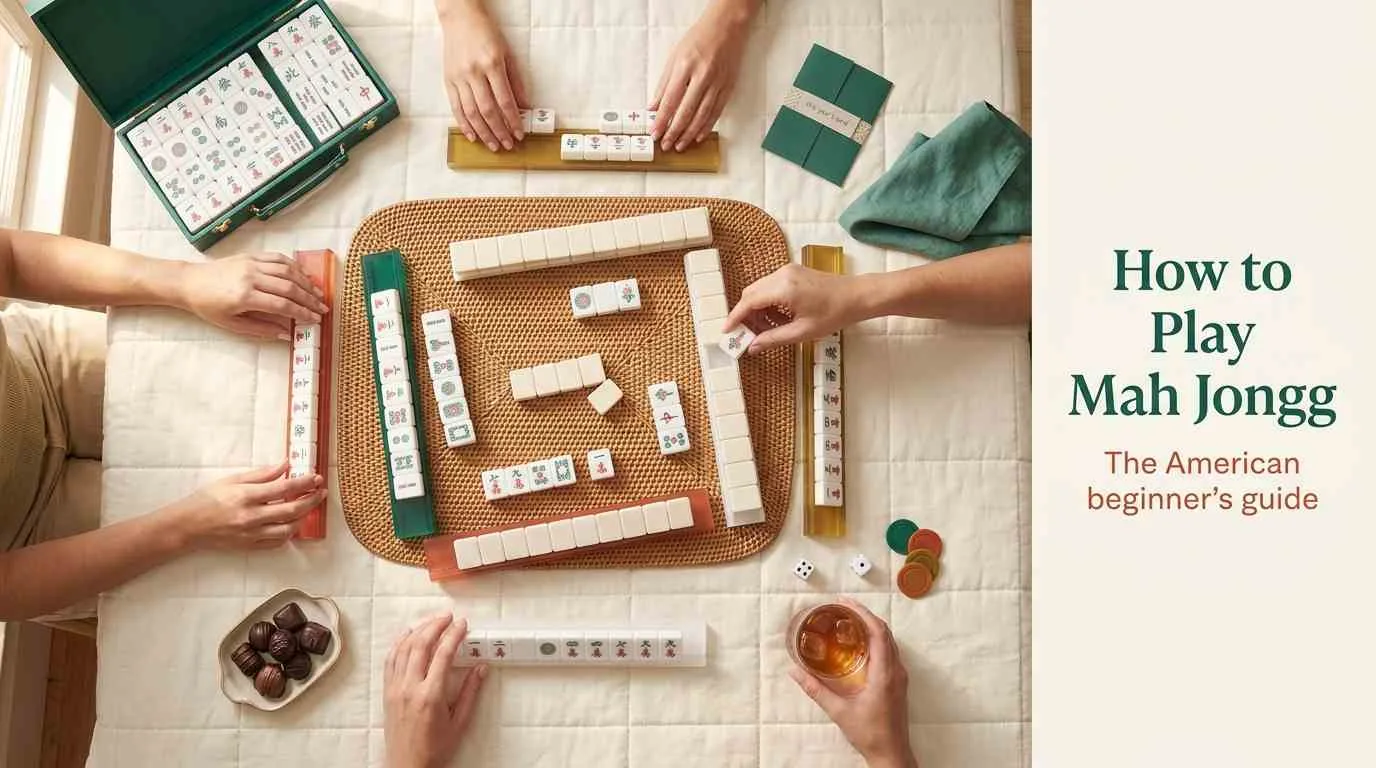
American mah jongg is a four-player tile game. Each player starts with 13 tiles, trades unwanted tiles in a passing round called the Charleston, then draws and discards one tile per turn. The first player to complete 14 tiles that exactly match a hand on the current National Mah Jongg League card calls “Mah Jongg” and wins.
Mah jongg rules at a glance
Bookmark this table. It’s the whole game on one screen, and you’ll check it constantly during your first few games.
| Rule | American mah jongg |
|---|---|
| Players | 4 (3- and 2-player versions exist with a shorter Charleston) |
| Tiles | 152: three suits, winds, dragons, flowers and 8 jokers |
| Goal | Be first to match one hand on this year’s League card with 14 tiles |
| Start | East gets 14 tiles, everyone else gets 13 |
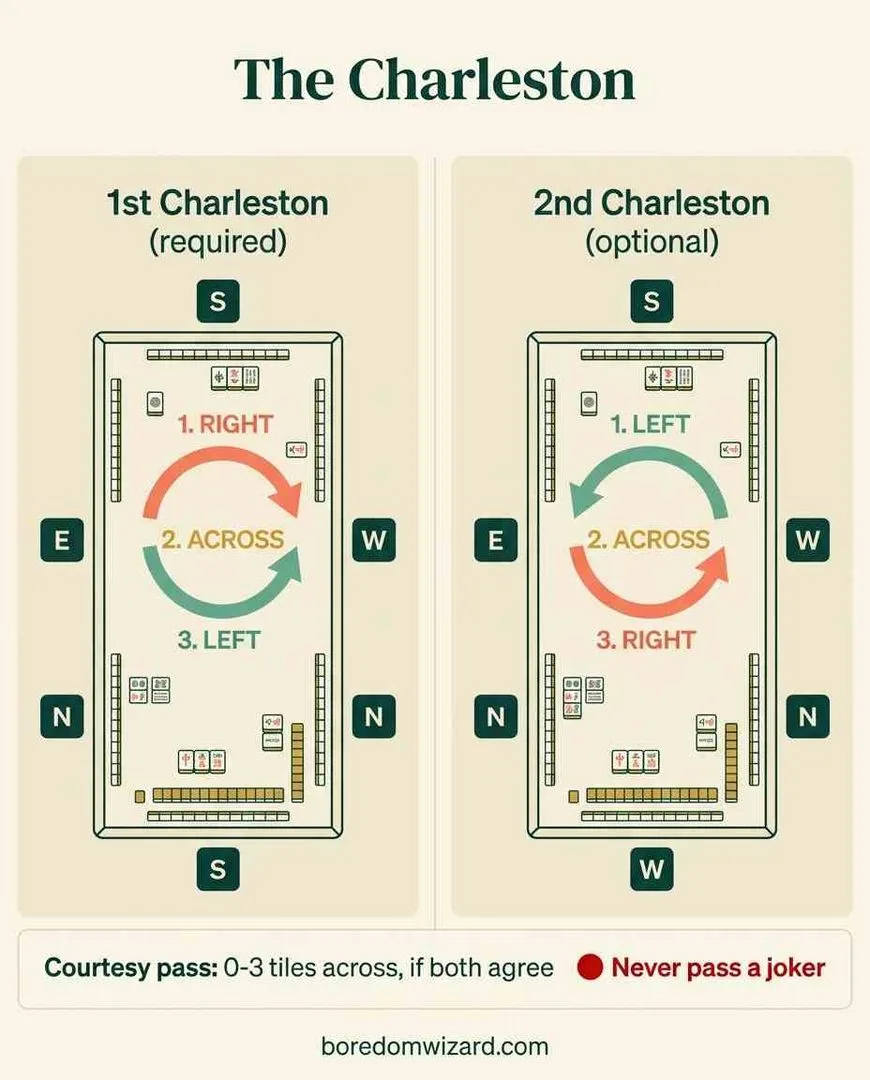
| Charleston | Pass 3 tiles right, across, left; an optional second round goes left, across, right |
| Turn | Draw one tile, discard one tile and say its name out loud |
| Direction | Counterclockwise (to the right) |
| Calling | Take the latest discard to finish a group of 3 or more, or to win |
| Jokers | Only in groups of 3 or more; never in a single or a pair |
| Winning | Call “Mah Jongg”, show all 14 tiles, and collect the value printed on the card |
Mahjong, mah jongg or mah-jongg? (and how to spell it)
All three spellings name the same family of games. “Mahjong” is the most common spelling worldwide. “Mah jongg” (often written mah-jongg) is the spelling used by the National Mah Jongg League, which sets the rules for the American version, so most American players write it that way. If you’re searching for lessons, sets or the yearly card in the US, use “mah jongg”.
What does change between versions is the game itself. American mah jongg uses jokers, a passing round called the Charleston and a printed card of winning hands that changes every year. Chinese and Japanese mahjong use neither. There’s a full comparison table further down.
What you need to play: choosing a mah jongg set
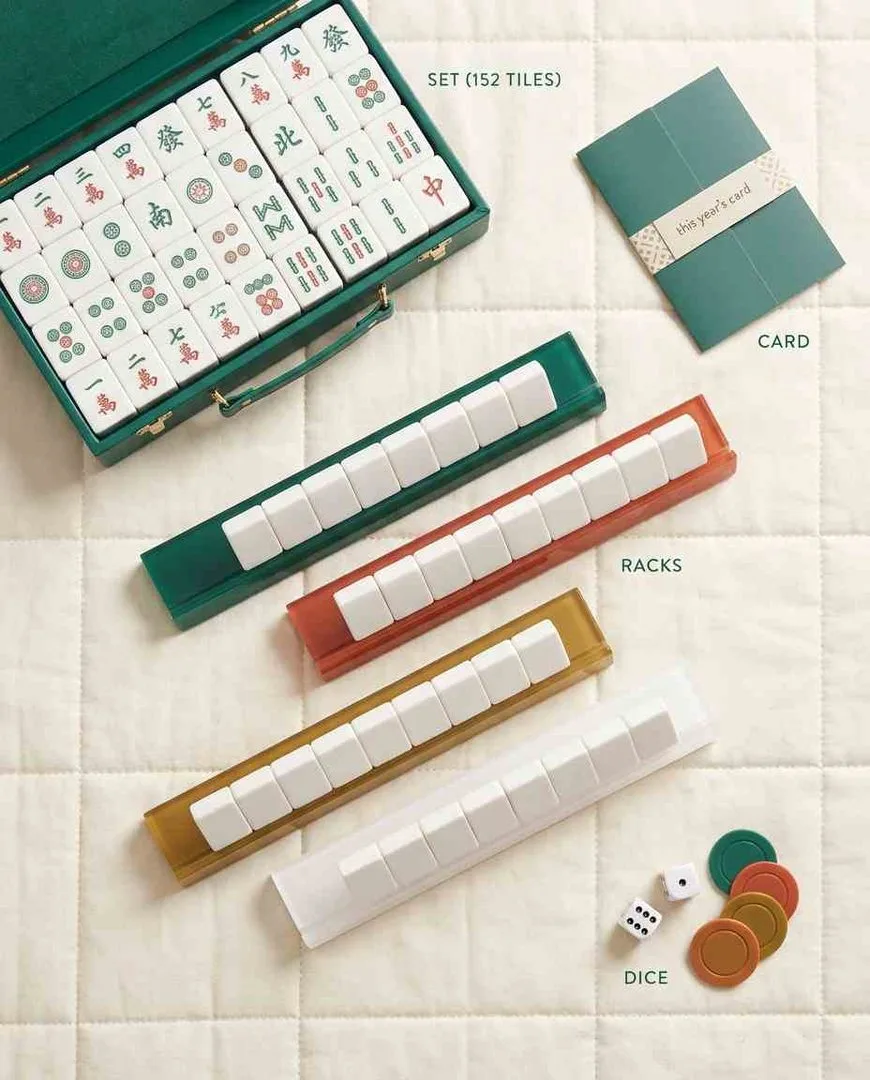
You need four things: an American mah jongg set, four racks, two dice and one copy of this year’s League card per player. A table mat is nice to have, because it keeps the tiles quiet and stops them sliding.
When you buy mah jongg sets, check these before you pay:
- It says “American”. Chinese sets look similar but have no jokers, so you can’t play the American game with them.
- It has at least 152 tiles, including 8 jokers. Many American sets come with 166 tiles; the extras are usually blank or spare jokers you can ignore.
- The racks have pushers. Racks with a lip that slides tiles forward make building the wall much easier.
- The tiles are easy to read. Pretty designer tiles are everywhere right now, but beginners learn faster with clear numbers in the corners.
A mah jongg set also makes a lovely gift for a friend who keeps talking about learning. Mats, tile bags and the yearly card are good stocking-stuffer mah jongg gifts.
Mah jongg tiles explained: what’s in a 152-tile set
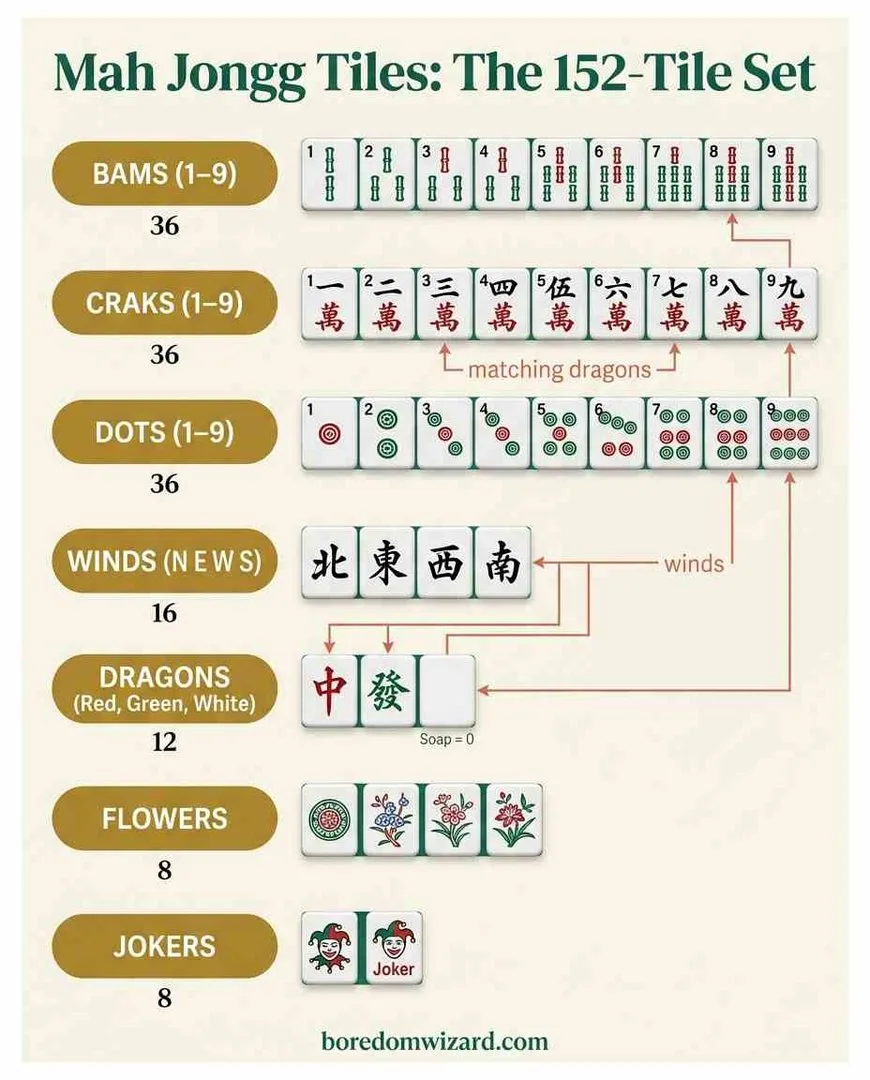
An American mah jongg set has 152 tiles. Most of them belong to three suits numbered 1 to 9, and the rest are special tiles. Once you can sort them into these seven groups, you can play.
| Tile group | How many | What to know |
|---|---|---|
| Bams (bamboo) | 36 (1–9, four of each) | The 1 Bam is usually a bird |
| Craks (characters) | 36 (1–9, four of each) | Look for the number in the corner |
| Dots (circles) | 36 (1–9, four of each) | Count the circles |
| Winds | 16 (N, E, W, S, four of each) | Not tied to any suit |
| Dragons | 12 (Red, Green, White, four of each) | Red goes with Craks, Green with Bams, White with Dots |
| Flowers | 8 | All flowers count as the same tile |
| Jokers | 8 | Stand in for any tile in a group of 3 or more |
Two quirks trip up every beginner. First, the White Dragon is nicknamed “Soap”, and on the card it also stands in for zero (as in the year hands, like 2026). Second, the dragons are matched to suits: if a hand on the card shows a Red Dragon next to Crak tiles, that dragon belongs with that suit.
The National Mah Jongg League card (and the 2026 card)
American mah jongg has one rule that surprises everyone: you can’t win with just any good-looking hand. You win only by matching one of the hands printed on the current card from the National Mah Jongg League. The League publishes a new card each spring, and every player at the table needs this year’s copy. It’s the single most important thing to buy.
The card groups its hands into sections, such as a year hand (like 2026), even numbers (2468), like numbers, addition hands, quints, consecutive runs, odd numbers (13579), winds and dragons, 369, and singles and pairs. Each hand shows exactly which tiles you need, and the colors tell you whether the groups must be in one suit or different suits.
Each hand also has two markings: an “X” or “C” and a value. “X” means exposed, so you’re allowed to call discards and show groups on your rack. “C” means concealed, so you must draw every tile yourself except the one that wins. The value is what the winner collects.
Why we don’t print the card here: the card is the League’s copyrighted work, and it changes every year. Searching for a free “2026 mah jongg card PDF” usually leads to an old card or a pirated copy. Buy it directly from the League; it costs less than a set of tiles, and the money supports the organization that keeps the game going.
How to play mah jongg. step by step
This is a full game from sitting down to calling Mah Jongg. Read it once, then follow along with tiles in front of you.
Step 1: Pick seats and find East
Each player rolls the two dice, and the highest total becomes East, the dealer for the first game. The other seats are South, West and North, going counterclockwise around the table. The dealer role moves to the right after each game.
Step 2: Build the wall
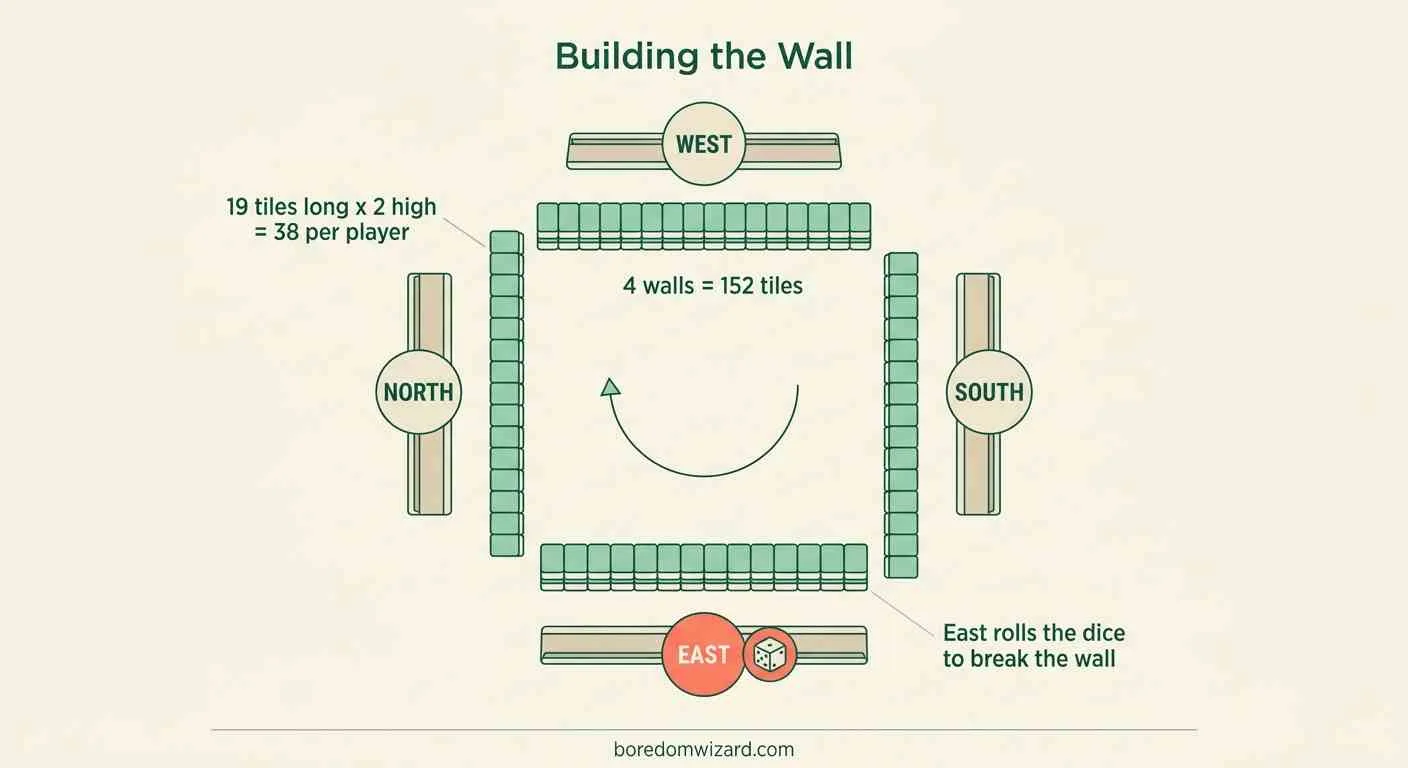
Turn every tile face down and shuffle them on the table (players call this “the wash”). Each player then builds a row 19 tiles long and 2 tiles high in front of their rack: 38 tiles each, 152 in total. Push the four rows together into a square. That square is the wall.
Step 3: Break the wall and deal
East rolls the dice and counts that many stacks along East’s own wall, from the right end, then separates the wall there. Starting at the break, East takes two stacks (4 tiles), then each player in turn takes two stacks, until everyone has 12 tiles. Each player then takes one more tile for 13, and East takes one extra tile for 14. Set your tiles on your rack facing you.
Step 4: Do the Charleston (the passing round)
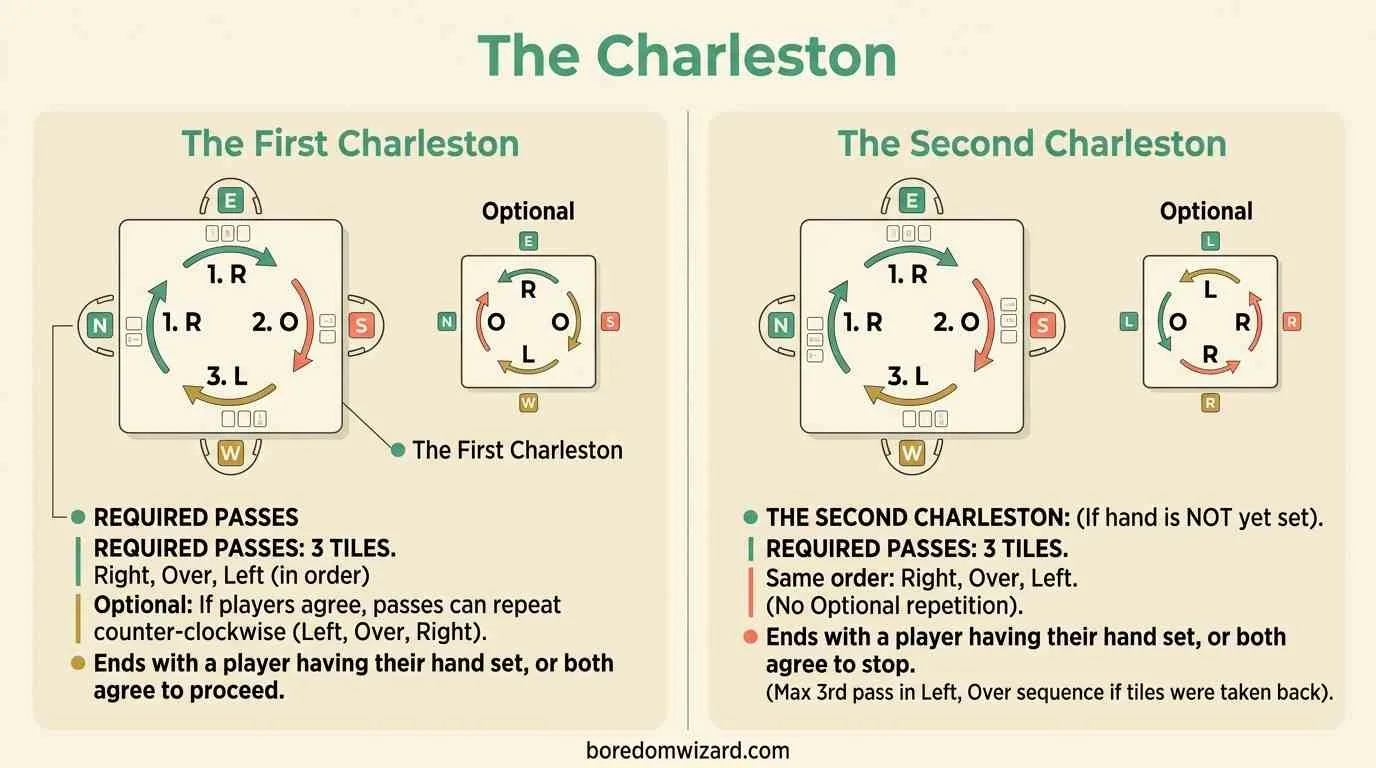
The Charleston is how American mah jongg lets you trade away tiles you don’t want before play starts. Look at your rack and the card, pick a rough direction, then pass three tiles at a time, face down:
- First Charleston (required): pass 3 tiles to the right, then 3 across, then 3 to the left.
- Second Charleston (optional): pass 3 to the left, then 3 across, then 3 to the right. Any player can stop it before it starts.
- Courtesy pass (optional): the two players sitting opposite each other can swap 0 to 3 tiles, but they must agree on the same number.
Two rules to remember: you can never pass a joker, and on the last pass of each Charleston you may do a “blind pass”, passing on tiles you just received without looking at them.
Step 5: Start play
East starts by discarding one tile face up into the middle and naming it out loud (“5 Dot”, “North”, “Flower”). Play then moves to the right, counterclockwise. On your turn you draw one tile from the wall and discard one tile, so you always keep 13 tiles on your rack between turns.
Step 6: Call discards and expose groups
When someone discards a tile you need, you can call it before the next player draws. You may call a discard to finish a group of three (a pung), four (a kong), five (a quint) or six (a sextet), or for the tile that completes your whole hand. You can’t call a tile just to make a pair, unless that pair wins the game.
When you call, you take the tile, place the finished group face up on top of your rack (this is an “exposure”), and then discard. Play continues to your right, so anyone between you and the discarder loses their turn. Remember that exposed groups can’t be changed, and a hand marked “C” on the card can’t have exposures at all.
Step 7: Use jokers the right way
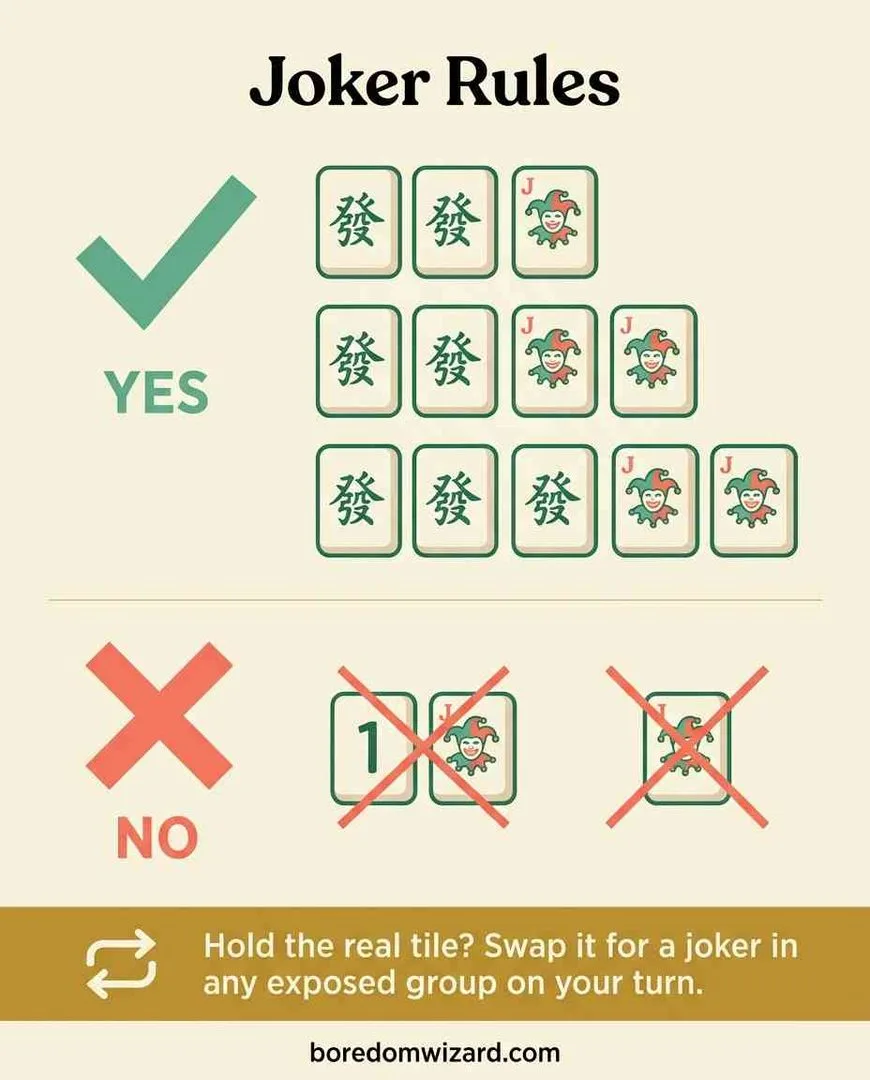
Jokers are the friendliest tiles in the set, but they have strict rules:
- Groups only: a joker can stand in for any tile in a pung, kong, quint or sextet.
- Never singles or pairs: not even to win. Singles-and-pairs hands can’t use jokers at all.
- Swap them back: on your turn, if someone has an exposed group with a joker in it and you hold the real tile it stands for, you can trade your tile for the joker.
- Never discard one casually: jokers are your most flexible tiles, and one thrown away early is a chance you rarely get back.
Step 8: Call Mah Jongg
When you draw or call the tile that completes a hand on the card, say “Mah Jongg!” and lay all 14 tiles face up. Your hand has to match one line on the card exactly, with the right suits and numbers, so let the table check it before anyone mixes the tiles.
Step 9: Dead hands and wall games
If a player’s exposures can’t possibly match any hand on the card, or they have the wrong number of tiles, their hand is “dead”. They stop playing, but they still pay the winner. If the wall runs out before anyone wins, it’s a wall game: nobody pays, the tiles are reshuffled and the deal passes to the right.
How scoring works
Every hand on the card has a value, usually 25 or more. In standard League scoring the winner collects that value from every player. The player who threw the winning discard pays double. If the winner drew the last tile from the wall themselves, everyone pays double. A hand made without any jokers (except singles-and-pairs hands, which can’t use jokers anyway) also doubles.
Most friendly groups play for points on paper or small change like nickels and quarters. The scoring matters less than the habit of checking the card, which is what makes you a better player.
The 4-Game Learning Ladder: how to learn mah jongg fast
Trying to learn every rule in your first game is why beginners quit. Instead, add one layer per game. Four games, usually one afternoon, and you’re playing the real thing.
- Game 1: open hands. Everyone plays with their tiles face up, no Charleston and no jokers. Just practice drawing, discarding and spotting hands on the card together.
- Game 2: add the Charleston. Play the first Charleston only. Talk out loud about why you’re passing each tile.
- Game 3: add jokers and calling. Tiles go back on racks facing you. Practice calling discards and swapping jokers.
- Game 4: full rules. Both Charlestons, the courtesy pass and scoring. You’re now playing American mah jongg.
Beginner strategy: 7 tips to win your first hand
- Choose your hands after the Charleston, not before. Look for two or three hands your tiles fit, then narrow to one as you draw.
- Use the Charleston to dump what fits nothing. Lonely winds and stray middle numbers usually go first.
- Keep every joker. They’re the most valuable tiles in the game.
- Remember pairs are hard. Jokers can’t help with pairs, so a hand that needs several pairs is harder than it looks.
- Don’t expose too early. Every exposure tells the table what you’re building and locks you in.
- Watch the discards. If everyone is throwing Dots, a Dot hand is probably safe to chase.
- Stay flexible. If the tiles you need are all gone, switch hands. Pivoting is a skill, not a failure.
Mah jongg rules for beginners: 6 common mistakes
- Using a joker in a pair. Never allowed, even for the winning tile.
- Passing a joker in the Charleston. Also never allowed.
- Calling a discard too late. Once the next player has drawn, the discard is gone.
- Mixing two hands from the card. Your 14 tiles must match one single line exactly.
- Forgetting to name your discard. Always say it out loud so others can call it.
- Playing with last year’s card. Hands change every year, so check the year on your card.
American vs Chinese vs Japanese mahjong
If you’ve played mahjong elsewhere, this is what’s different about the American game:
| Feature | American mah jongg | Chinese mahjong | Japanese (Riichi) |
|---|---|---|---|
| Tiles | 152, with 8 jokers | 136 or 144, no jokers | 136, no jokers |
| Winning hands | Must match the yearly League card | Four groups and a pair | Four groups and a pair, plus a scoring condition |
| Passing round | Yes, the Charleston | No | No |
| Runs (1-2-3) | Only when the card shows one | Yes | Yes |
| Rules body | National Mah Jongg League | Varies by region | Varies by club and league |
How to host a mah jongg night
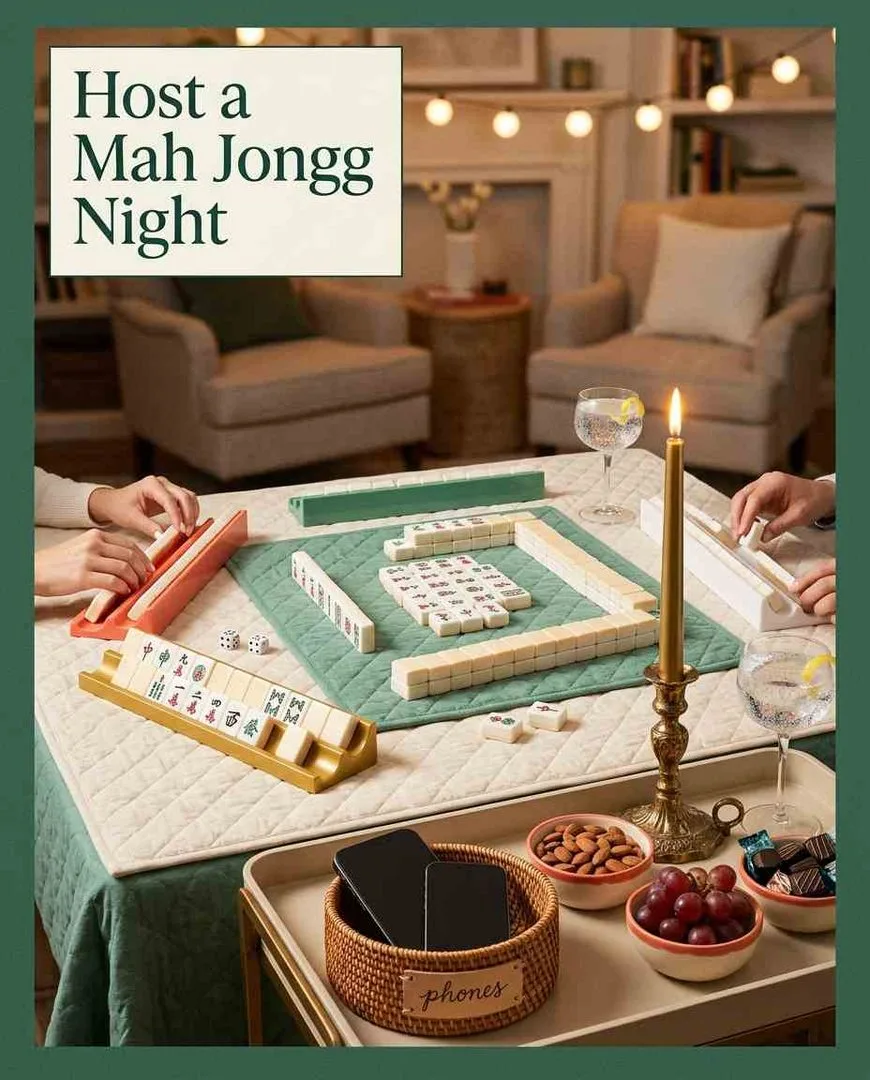
Mah jongg is a party game in disguise. A good night needs a square table for every four people, one set per table, a card for every player, and snacks you can eat without touching the tiles: think nuts, grapes and chocolate rather than chips. Put phones in a basket and let the conversation do the rest; a few good conversation starters help new groups relax between hands.
No one to play with yet? Search for mah jongg lessons or groups near you through your local library, community center or senior center, many of which host beginner nights. It’s also on our winter bucket list as the cozy skill to learn this year, and our hobbies to do at home guide has more if you’re collecting new ones.
Mah jongg FAQ
Is mah jongg hard to learn?
Mah jongg takes about an afternoon to learn and a few weeks to feel comfortable with. The rules are simple (draw, discard, match a hand on the card); what takes practice is reading the card quickly and choosing hands. Learning one rule layer per game makes it much easier.
Is American mah jongg the same as National Mah Jongg?
Yes, in everyday use. “National Mah Jongg” refers to the National Mah Jongg League, the organization that publishes the yearly card and official rules for American mah jongg. When people say they play “National” or “League” rules, they mean the American game.
Is American or Chinese mahjong harder?
Neither is harder overall; they’re hard in different ways. American mah jongg gives you a printed card of winning hands, which helps beginners, but adds the Charleston, jokers and a new card every year. Chinese mahjong has simpler winning shapes but more scoring variations between groups.
What is the object of mah jongg?
The object of mah jongg is to be the first player to collect 14 tiles that exactly match one hand on the current National Mah Jongg League card. You get there by passing tiles in the Charleston, drawing and discarding, and calling the tiles other players throw away.
How many tiles are in a mah jongg set?
An American mah jongg set has 152 tiles: 108 suit tiles (Bams, Craks and Dots, numbered 1 to 9, four of each), 16 winds, 12 dragons, 8 flowers and 8 jokers. Many sets include extra blank or spare tiles, which is why some are sold as 166-tile sets.
Can you play mah jongg with 3 people?
Yes. Three-player and two-player versions use the same card with a shortened Charleston and some adjusted rules. Four players is the standard and the most fun, so most groups use the smaller versions only when someone can’t make it.
Is mahjong gambling?
Mahjong is a game of skill and luck, and how it’s played is up to the group. Most home and club games use paper scoring, points or small change like quarters, and many play for no money at all. It’s a social game first.
Is mah jongg fun to play?
Most people find it addictive by the third game. It mixes the puzzle of building a hand with the social side of a weekly game with friends, and every year’s new card keeps it fresh even for players who’ve had their set for decades.