Origami Flowers (2026): 6 Easy Paper Flowers to Fold, Step by Step
A square of paper and fifteen quiet minutes is all it takes to make a flower that never wilts. Origami flowers are one of the most satisfying paper crafts to learn: each fold is simple on its own, and the moment the petals open is pure magic, whether you are eight or eighty.
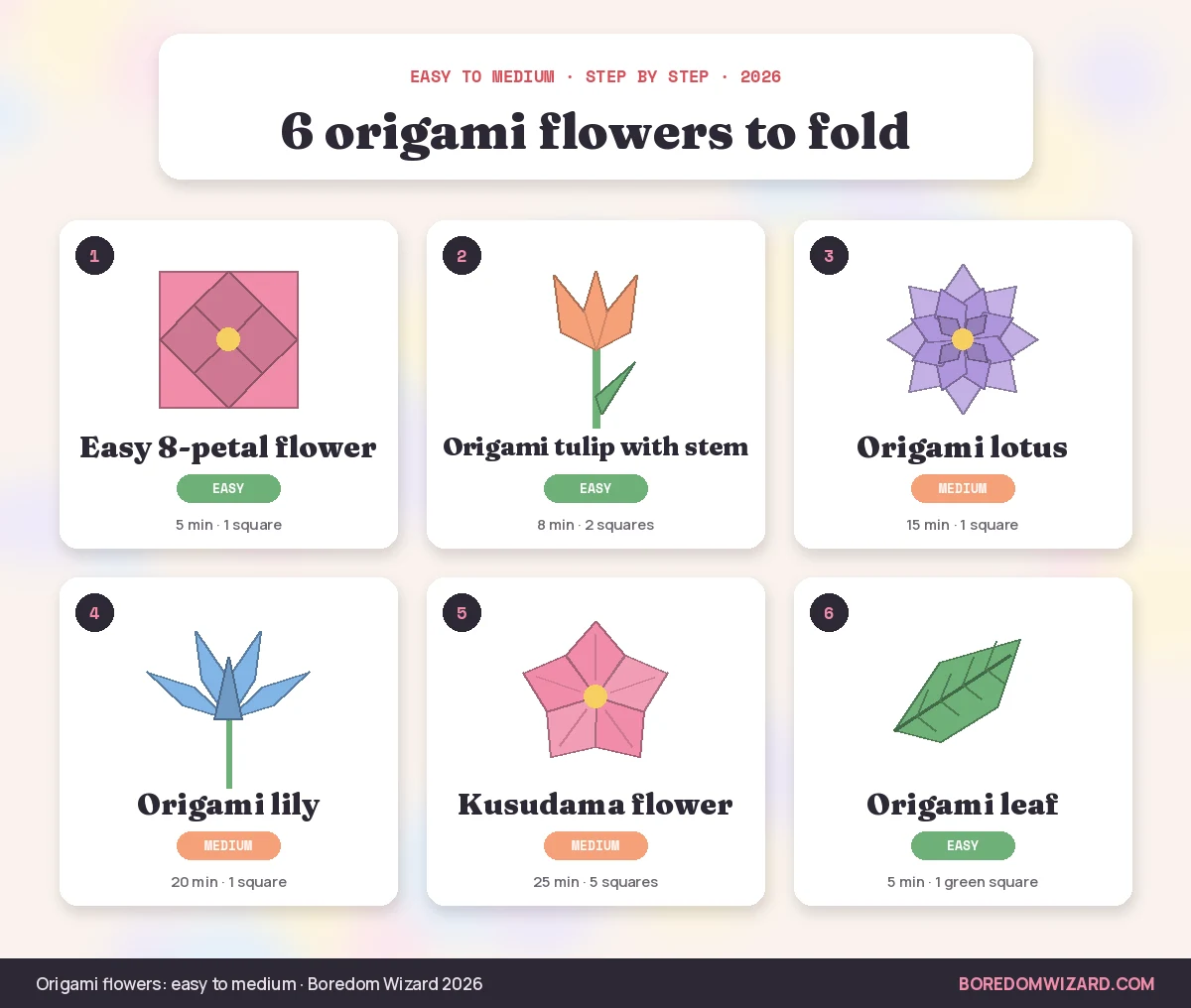
This guide teaches six origami flowers in order of difficulty, from a flat 8-petal flower and a tulip with a stem to a lotus, a lily and a five-petal kusudama flower, plus a leaf to finish your bouquet. Each one adds a single new folding skill, and every flower has an origami flower step by step diagram, so by the end you can fold flowers most beginners think are out of reach.
Quick answer: To make an easy origami flower, fold a square in half both ways and corner to corner, fold all four corners to the center, turn it over and fold the corners to the center again, then turn it back and fold the four center points out as petals. For a classic flower origami with a stem, fold a tulip from two squares. Once you are comfortable, try the lotus, the lily and the kusudama flower.
Best paper for origami flowers
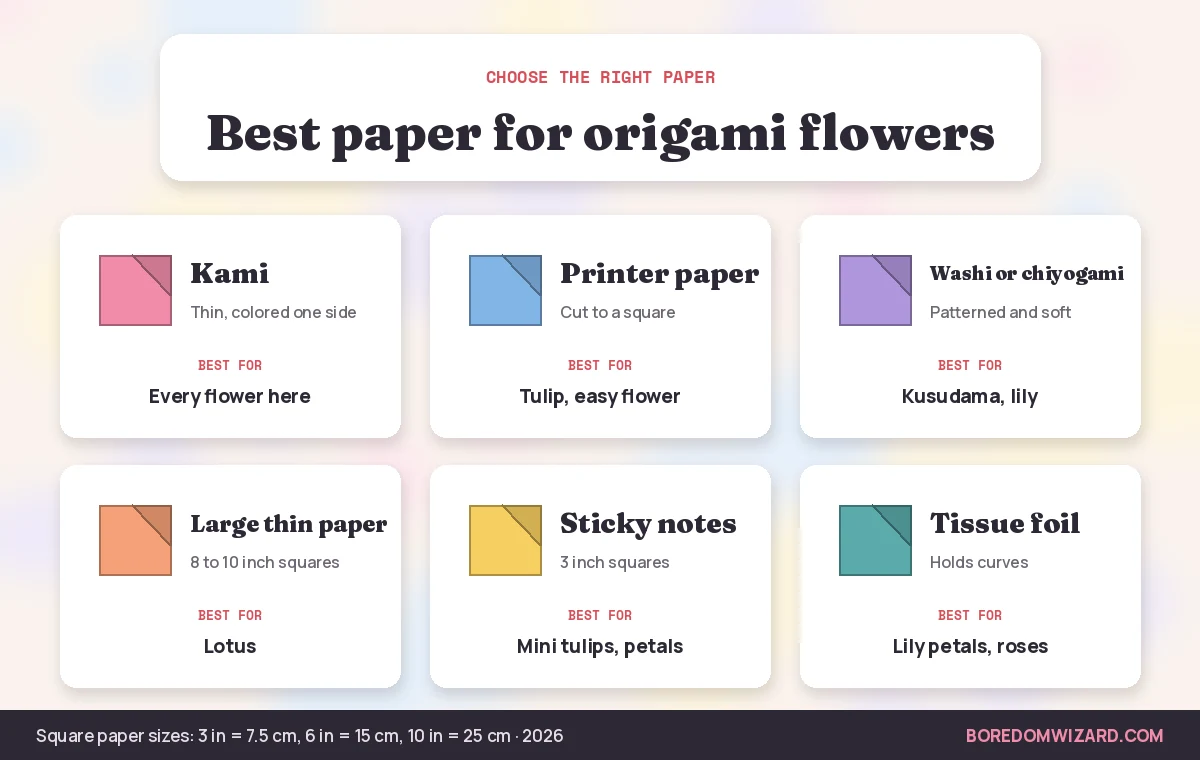
Standard origami paper, called kami, is thin, square and colored on one side, and it works for every flower here. A 6 inch (15 cm) square is the best size to learn on. You can also cut printer paper into squares, use patterned washi for kusudama flowers, or grab a pad of sticky notes for mini flowers; see our sticky note origami guide for desk-sized folds.
| Flower | Paper size | Level | Time |
|---|---|---|---|
| Easy 8-petal flower | 1 square, 6 in (15 cm) | Easy | 5 min |
| Origami tulip with stem | 2 squares, 6 in (15 cm): one flower color, one green | Easy | 8 min |
| Origami lotus | 1 square, 8 to 10 in (20 to 25 cm) | Medium | 15 min |
| Origami lily | 1 square, 6 in (15 cm) | Medium | 20 min |
| Kusudama flower | 5 squares, 3 in (7.5 cm), plus glue | Medium | 25 min |
| Origami leaf | 1 green square, 3 to 6 in | Easy | 5 min |
1. Easy 8-petal flower
This flat flower is the best easy origami flower to start with. It teaches the blintz fold, folding all four corners to the center, which you will use again in the lotus.
Level: Easy. Time: 5 min. Paper: 1 square, 6 in (15 cm). New skill: the blintz fold.
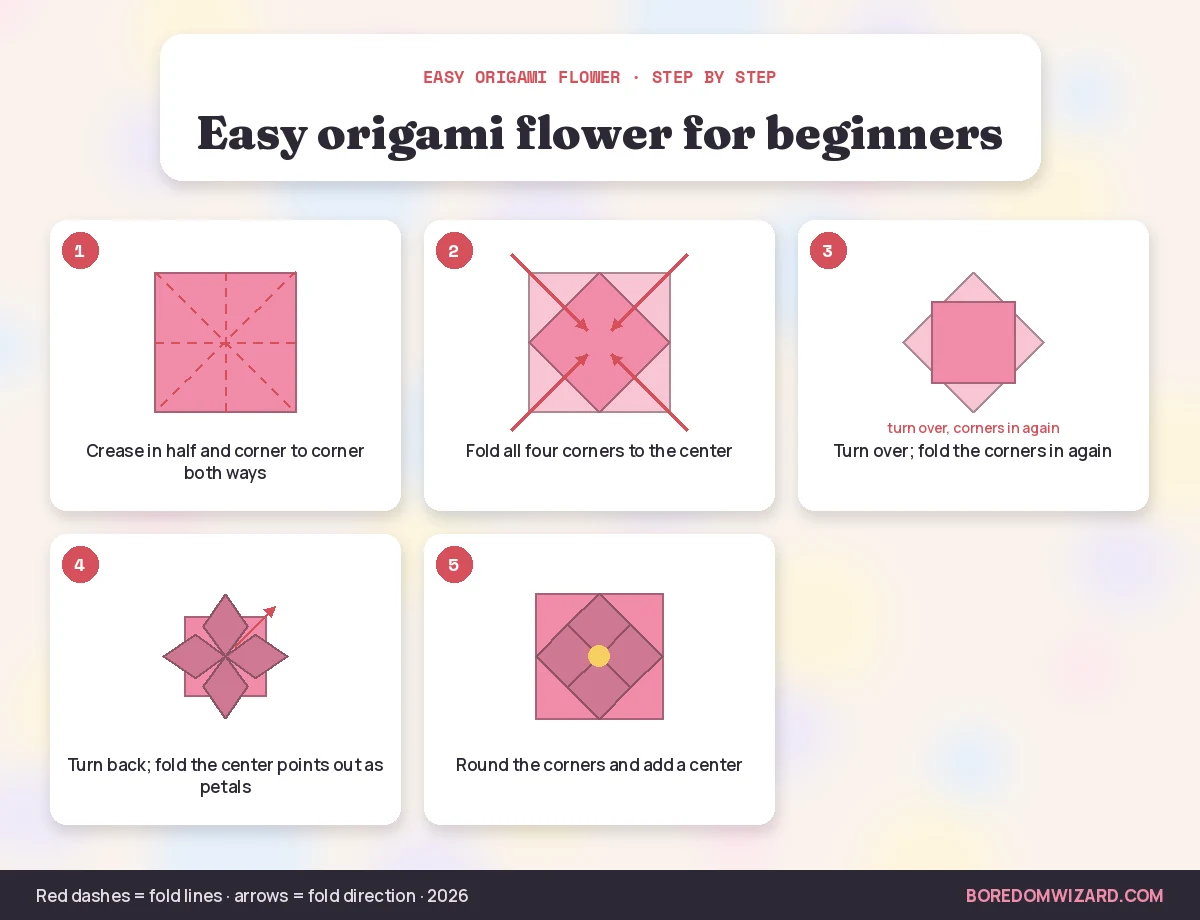
- Fold the square in half both ways and corner to corner both ways, then unfold. You now have eight creases meeting in the center.
- Fold all four corners in to the center point.
- Turn it over and fold all four new corners in to the center again.
- Turn it back over. Fold each of the four center points out to the middle of its outer edge so they open like petals.
- Fold the tips of the outer corners behind to round the flower, and draw or stick a dot in the middle.
Tip: This is the best first origami flower for kids, and it lies flat for cards and scrapbooks.
2. Origami tulip with stem
The origami tulip is the classic flower for kids and the quickest way to make a stem with a leaf.
Level: Easy. Time: 8 min. Paper: 2 squares, 6 in (15 cm): one flower color, one green. New skill: the kite fold for stems.
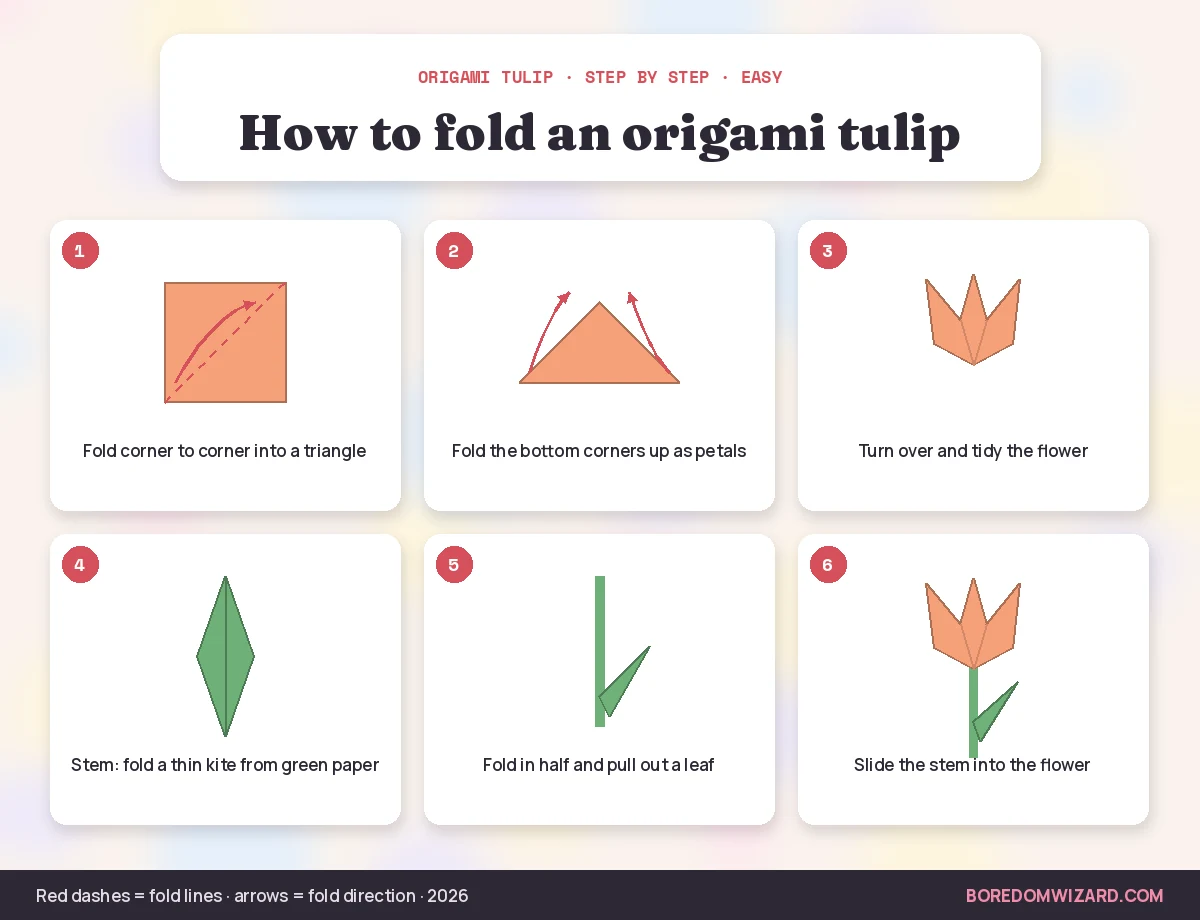
- Flower: fold one square in half corner to corner into a triangle, point up.
- Fold the left and right bottom corners up at an angle so their tips rise above the top point. These are the outer petals.
- Turn it over and fold the side corners and bottom point back to neaten the shape.
- Stem: turn the green square into a diamond and fold both lower edges to the center crease to make a kite, then fold the same edges in again to make it thinner. Repeat at the top.
- Fold the stem in half lengthwise, then fold the bottom half up and out at an angle to make a leaf.
- Slide the top of the stem into the bottom of the flower.
Tip: A group of tulips in a paper vase is the quickest origami flower bouquet.
3. Origami lotus
The origami lotus, sometimes called a water lily, looks complex but is just the blintz fold repeated, then opened from behind.
Level: Medium. Time: 15 min. Paper: 1 square, 8 to 10 in (20 to 25 cm). New skill: stacked blintz folds and pulling petals.
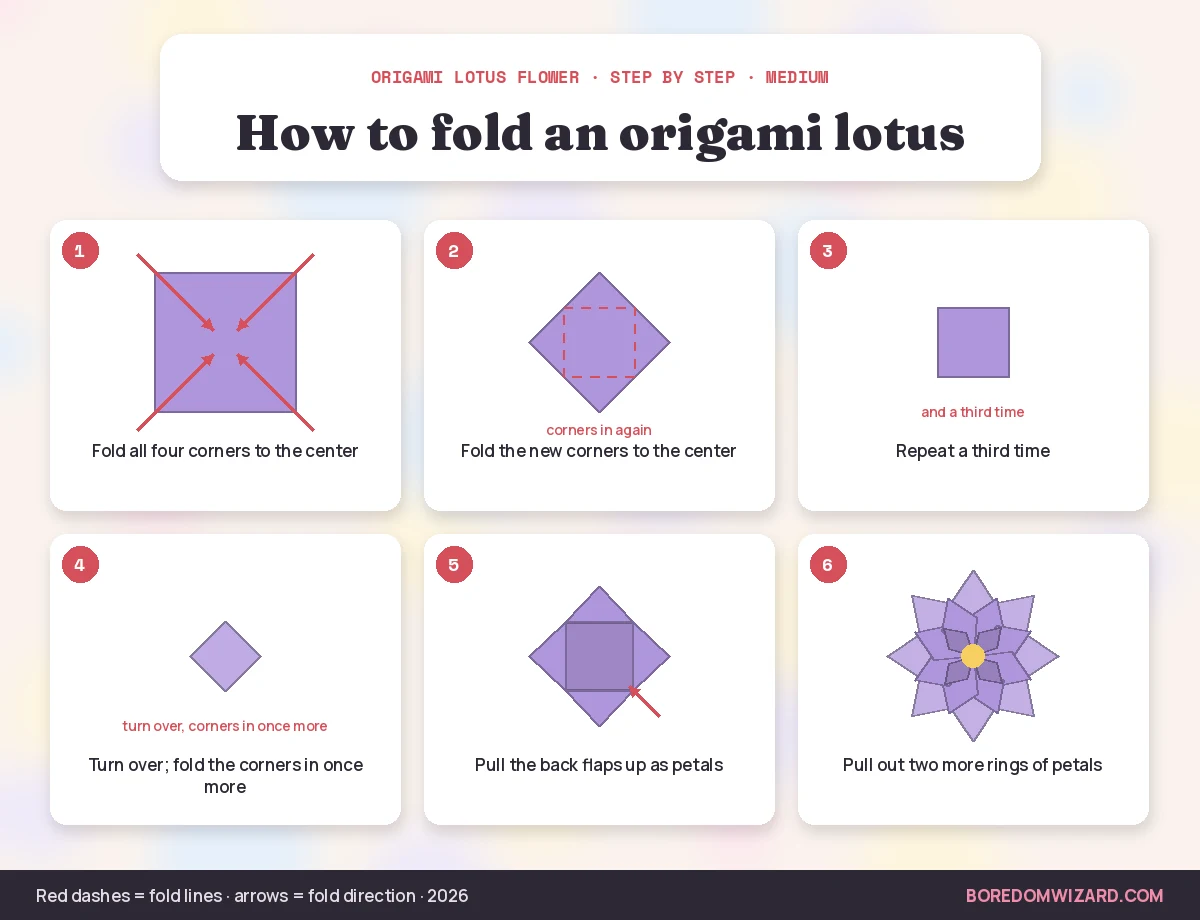
- Fold all four corners of the square in to the center.
- Fold the four new corners in to the center again.
- Repeat once more, so you have folded the corners in three times.
- Turn it over and fold the four corners in to the center one last time.
- Hold the center firmly. From the back, pull each corner flap gently forward and up, around the edge, to form the first ring of petals.
- Turn it over and pull out the next two layers of flaps the same way for the second and third rings of petals.
Tip: Use thin, large paper. Thick paper tears when you pull the last ring of petals.
4. Origami lily
The origami lily is the traditional Japanese flower and the first model that uses squash folds and petal folds, the same moves behind the paper crane.
Level: Medium. Time: 20 min. Paper: 1 square, 6 in (15 cm). New skill: the square base, squash fold and petal fold.
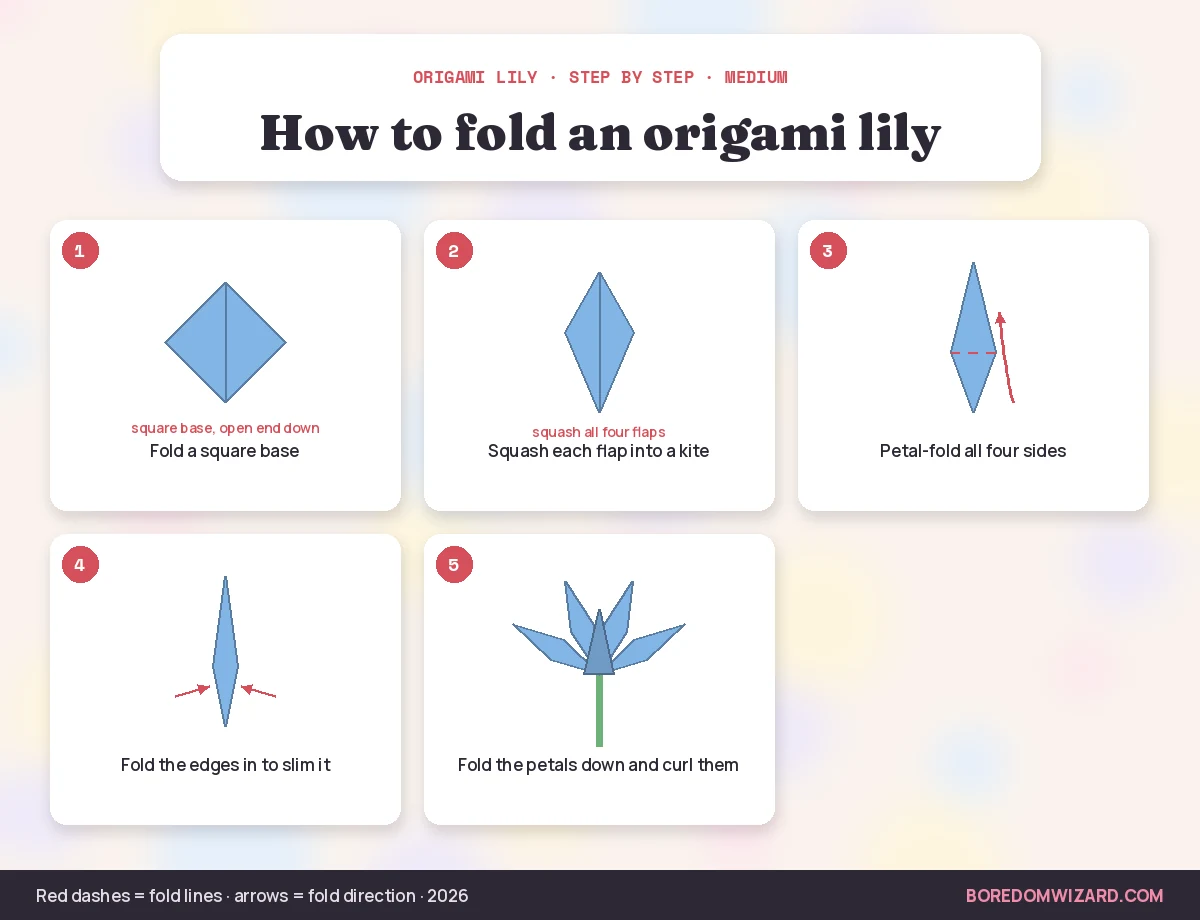
- Make a square base: fold corner to corner both ways, turn over, fold edge to edge both ways, then collapse it into a small square with the open end down.
- Lift one flap upright, open its pocket and squash it flat into a kite. Repeat on all four flaps.
- Petal-fold each side: fold the lower edges of the top layer to the center line, fold the top triangle down and unfold, then lift the bottom point up along the creases into a long diamond. Repeat on all four sides.
- Turn the layers so a smooth face shows. Fold the lower edges to the center line to slim it, and repeat on all four faces.
- Fold the four top points down as petals and curl each one around a pencil.
Tip: The lily uses the same petal fold as the paper crane, so it is a great step toward harder models.
5. Kusudama flower
Kusudama means medicine ball in Japanese. Each petal is a small module, and five petals glued together make one flower; twelve flowers make a whole ball.
Level: Medium. Time: 25 min. Paper: 5 squares, 3 in (7.5 cm), plus glue. New skill: modular folding with glue.
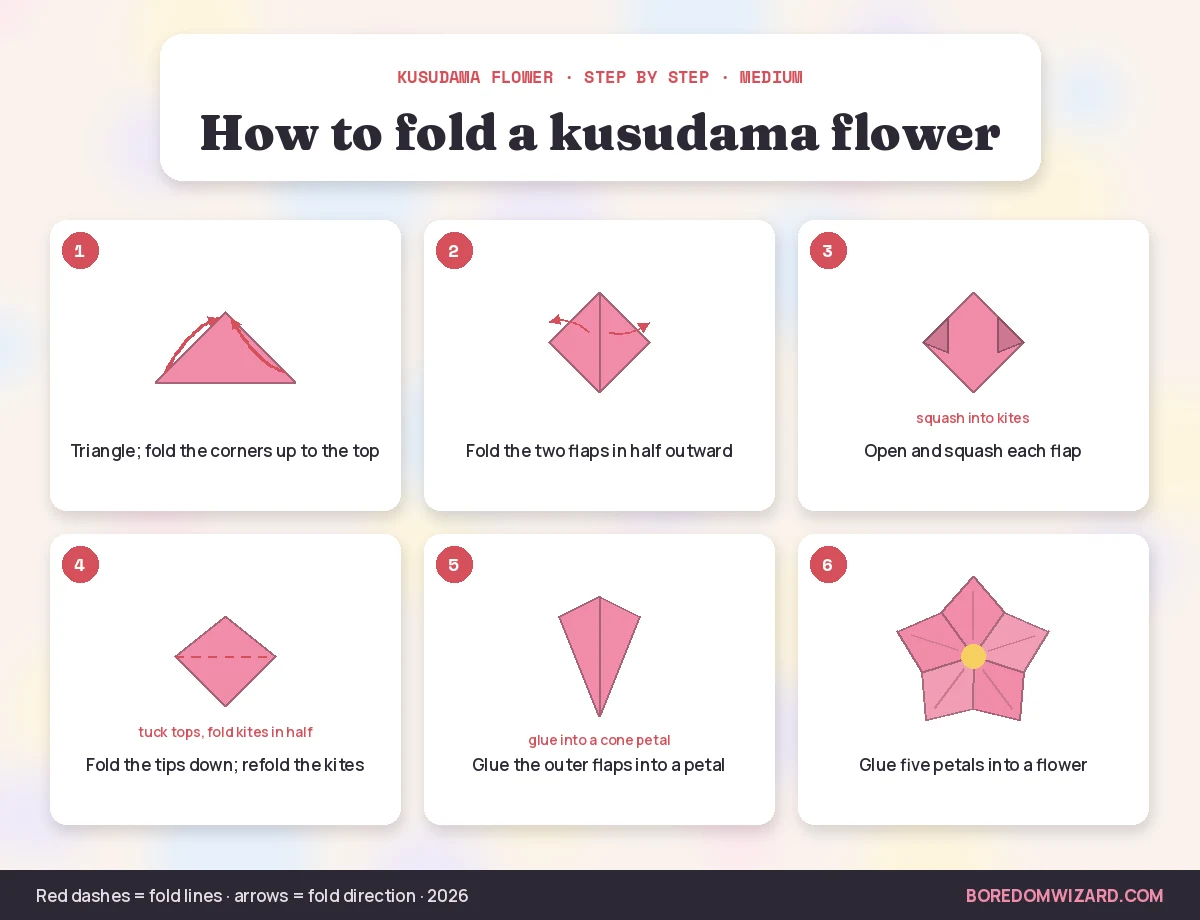
- Petal: fold a square in half corner to corner into a triangle, point up.
- Fold both bottom corners up to the top point to make a diamond.
- Fold each of the two front flaps in half outward, so their inner edges meet the outer edges of the diamond.
- Open each of those flaps and squash it flat into a small kite.
- Fold the small triangles that stick out above the diamond down behind the flaps.
- Fold the kites in half again along their center creases, then glue the two outer flaps together so the petal curls into a cone.
- Make five petals and glue them side by side into a flower.
Tip: Make 12 flowers and glue them together into a full kusudama ball.
6. Origami leaf
Every bouquet looks better with greenery. This pleated origami leaf takes five minutes and pairs with any flower above.
Level: Easy. Time: 5 min. Paper: 1 green square, 3 to 6 in. New skill: accordion pleats.
- Fold the square in half corner to corner into a triangle and unfold it.
- Starting at one side corner, accordion-fold the whole square in narrow pleats parallel to that crease.
- Fold the pleated strip in half at the middle.
- Glue or hold the two inside halves together and spread the outer edges into a veined leaf.
Tip: Add two or three leaves to any bouquet to make it look full.
How to make an origami flower bouquet
An origami flower bouquet makes a gift that lasts forever, perfect for Mother’s Day, teachers, birthdays and paper anniversaries.
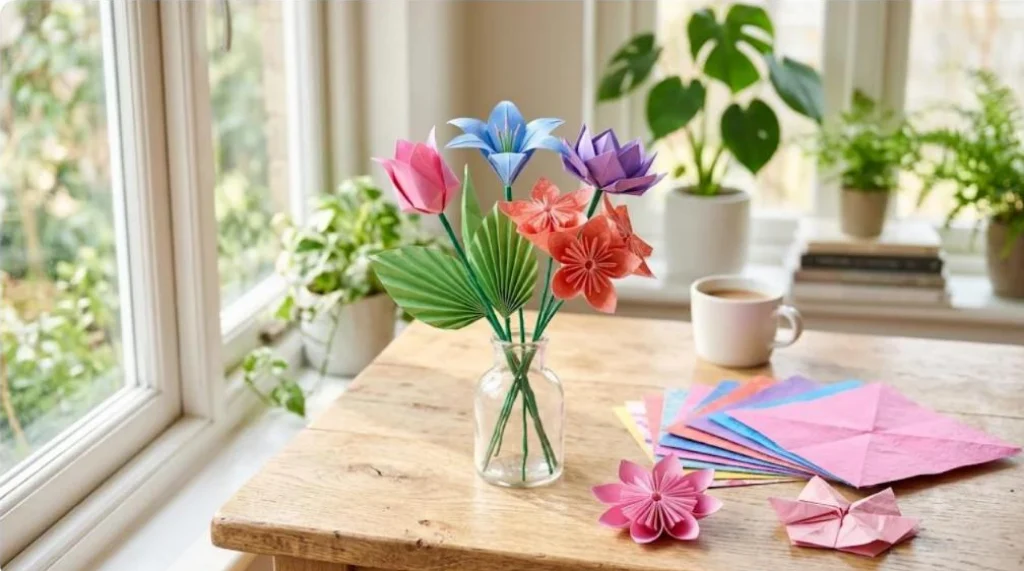
- Fold a mix: three tulips, two lilies, two kusudama flowers and four leaves make a full bouquet of about a dozen stems.
- Add stems: push green floral wire, a bamboo skewer or a green pipe cleaner up through the base of each flower and secure it with a dot of glue.
- Arrange: place the tallest flowers in the center, shorter ones around them, and tuck leaves between.
- Finish: tie the stems with ribbon, or stand them in a small vase filled with dried beans to hold them upright.
Prefer flowers with no folding? Try our pipe cleaner flowers or pressed flower ideas. You can also sell finished bouquets; see our crafts to make and sell.
What about an origami rose?
The famous origami rose, designed by Japanese mathematician Toshikazu Kawasaki, is an advanced model with a twist fold at its center. It is a great goal once the lily feels easy, and a video helps because the final twist is hard to show in diagrams.
For an easy rose today, make a paper spiral rose instead. It uses scissors, so it is a paper flower rather than pure origami: cut a circle about 6 inches across, cut it into a spiral, roll it tightly from the outside end inward, then let it loosen and glue the center circle to the base.
Love roses and flowers on paper? See our rose drawing and flower drawing ideas.
Why folding flowers is a perfect cure for boredom
Origami is one of the best screen-free hobbies when you are bored. It keeps your hands and attention on one task, rewards patience with a finished object, and gives you something to give away. A 2024 University of Toronto study found that switching between videos made people more bored, while staying with one thing felt more satisfying, and a flower that takes 15 minutes is the right size for that.
Folding also builds on itself: the techniques you learn here lead straight to cranes, boxes and animals. For more, try money origami, things to make with paper and our list of analog hobbies.
Origami in 2026: paper flower bouquets are a growing alternative to cut flowers for weddings and gifts, folders share speed-fold and bouquet videos on social media, and more people are turning to tactile, low-cost hobbies to unwind from screens.
Fold a flat 8-petal origami flower from one square of paper in five steps and about 5 minutes.
Total Time: 5 minutes
Crease the square
Fold the square in half both ways and corner to corner both ways, then unfold.
Fold the corners in
Fold all four corners in to the center point.
Repeat on the back
Turn it over and fold the four new corners in to the center again.
Open the petals
Turn it back over and fold each of the four center points out to the middle of its outer edge.
Finish the flower
Fold the tips of the outer corners behind to round the flower and add a center dot.
Natty’s take: Fold each new flower three times in a row. The first one teaches you the steps, the second one is neat, and by the third you will be folding without the diagram.
Origami flowers FAQ
What is the easiest origami flower?
The easiest origami flower is the flat 8-petal flower made with blintz folds, followed by the origami tulip. Both take about five minutes and use one square of paper.
How do you make an origami flower step by step?
Fold a square in half both ways and corner to corner, fold all four corners to the center, turn it over and fold the corners in again, then turn it back and fold the four center points out to form petals. Round the corners and add a center.
What paper is best for origami flowers?
Thin origami paper called kami, in 6 inch (15 cm) squares, is best for most origami flowers. Use larger, thin paper for a lotus and patterned washi or chiyogami for kusudama flowers.
How do you make an origami lotus?
Fold all four corners of a square to the center three times, turn it over and fold the corners in once more, then hold the center and pull the flaps from the back forward to form three rings of petals.
How do you make an origami flower bouquet?
Fold about a dozen flowers such as tulips, lilies and kusudama flowers, add stems with floral wire, skewers or pipe cleaners, arrange them with folded leaves and tie them with ribbon or stand them in a vase.
Is the origami rose hard to make?
Yes. The classic Kawasaki rose is an advanced model with a twist fold. Learn the lily first, then try the rose with a video. For an easy option, make a spiral paper rose with scissors.
How long does it take to make origami flowers?
Easy origami flowers like the 8-petal flower and tulip take about 5 to 8 minutes. A lotus takes about 15 minutes, a lily about 20 minutes and a five-petal kusudama flower about 25 minutes.
Can kids make origami flowers?
Yes. Kids around age 6 and up can fold the easy 8-petal flower, the tulip and the leaf. The lotus, lily and kusudama flower suit older kids and adults.
Updated November 2026. Supervise young children with scissors, glue and wire stems.