Things to Paint: 60 Easy, Cool and Fun Ideas for Every Skill Level (2026)
You have paint, you have a brush, and you have absolutely no idea what to put on the canvas. The blank surface stares back. You scroll Pinterest for 20 minutes, see 400 options, feel more overwhelmed than when you started, and close the app.
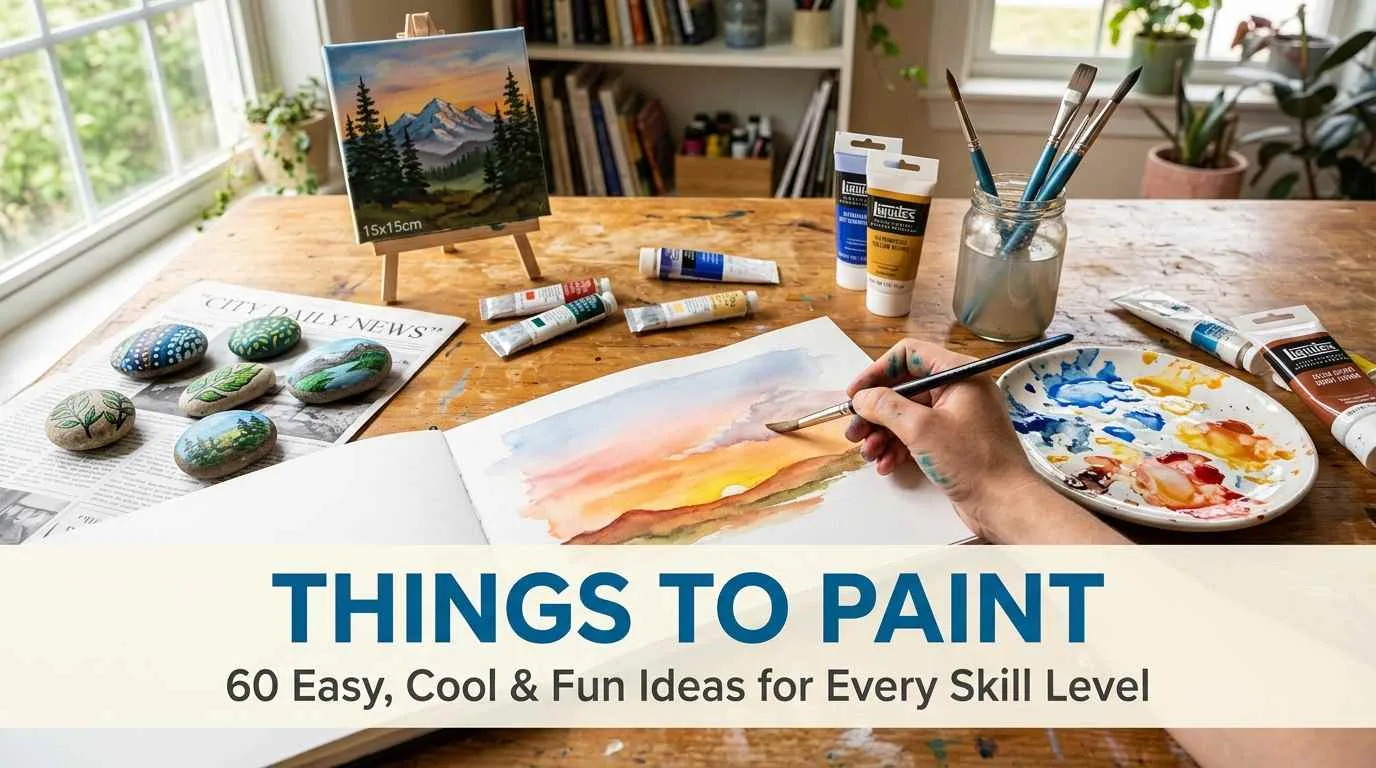
This guide fixes the decision problem. 60 things to paint sorted by difficulty and mood, with the recommended medium for each one (acrylic, watercolour, or gouache) so you know what works before you start. Every idea tells you what to paint, why it works, and the one technique that makes it look good even if you have never held a brush. No tutorials — just the idea, the spark, and the confidence to start.
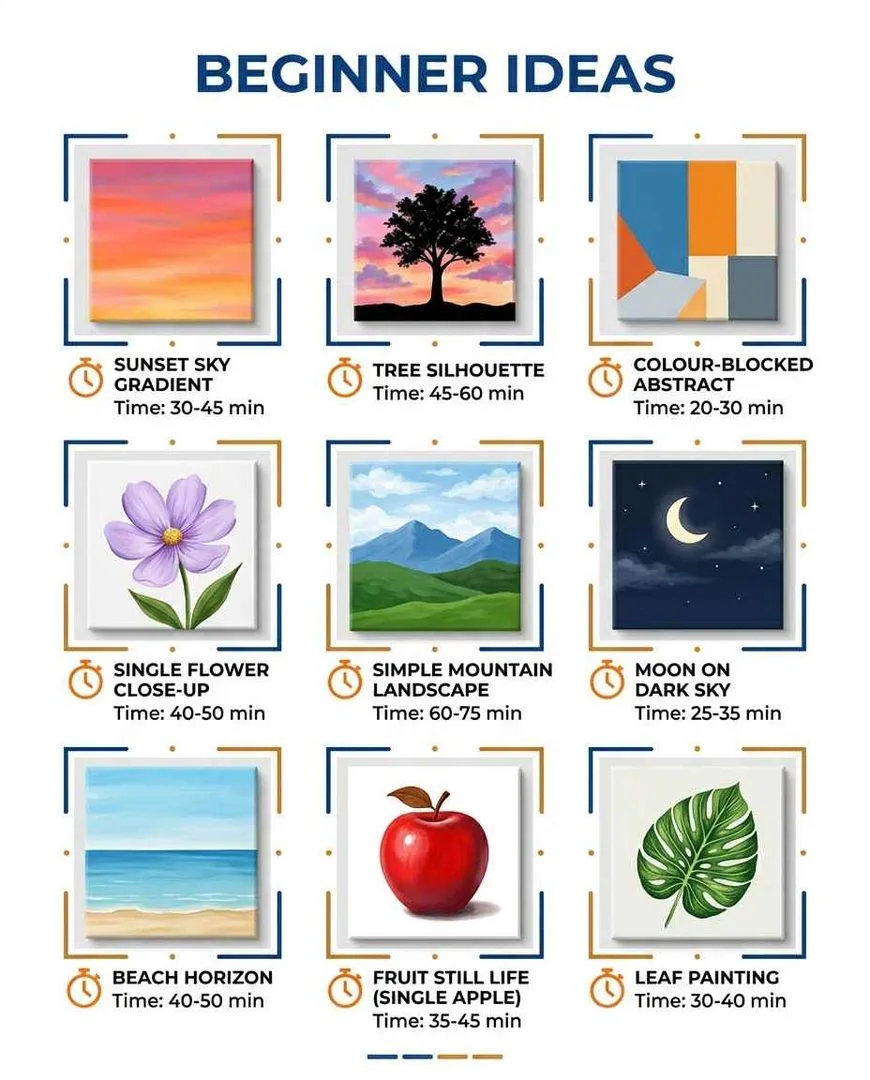
The best things to paint for beginners are a sunset sky (two colours blended on wet paper), an abstract colour-block canvas (tape off sections and fill each with a different colour), a silhouette landscape (paint a colourful sky first, then paint a black treeline over it), a single flower close-up (one bloom fills the whole canvas), and painted rocks (small surface, fast result, no canvas needed). All five take under 30 minutes and produce a result worth keeping.
What paint to use — the 30-second guide
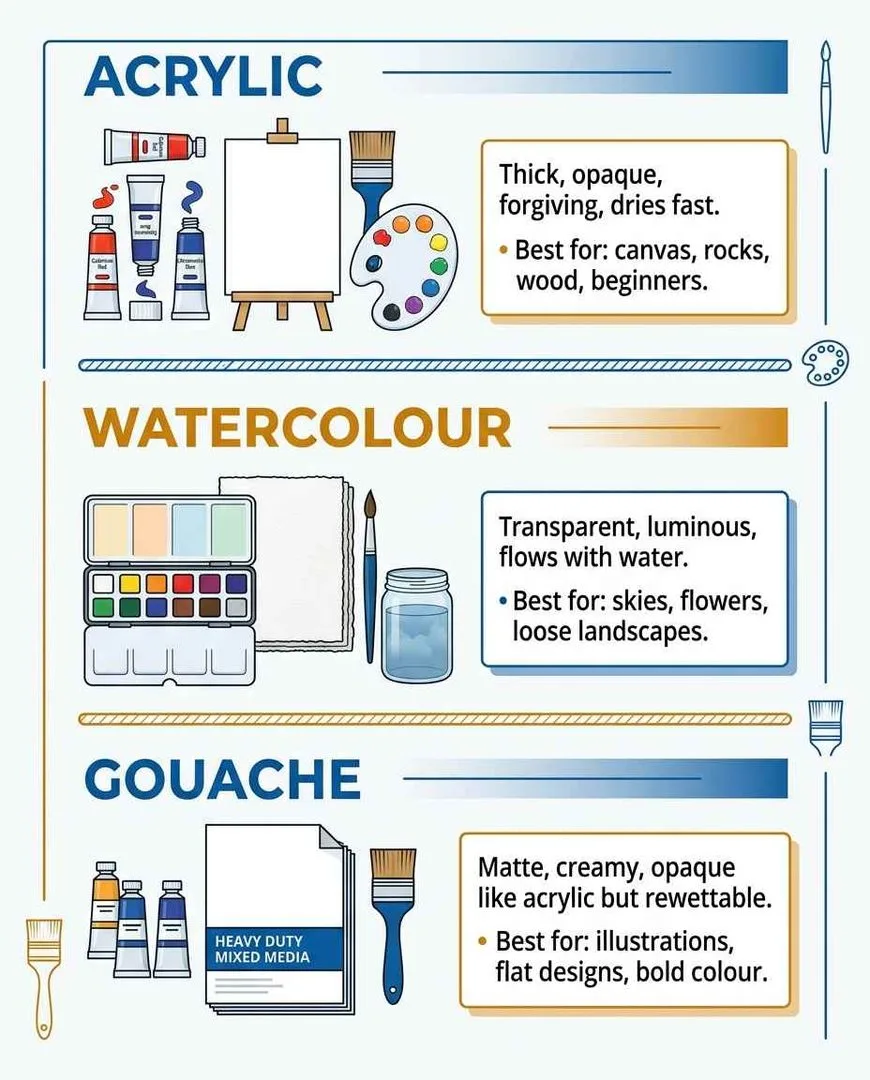
🎨 ACRYLIC — The beginner default. Thick, opaque, forgiving. Paint over mistakes while wet. Dries in minutes. Works on canvas, paper, wood, rocks, fabric and almost any surface. A 12-tube set costs $8–15 and covers every project on this page.
🎨 WATERCOLOUR — Transparent and luminous. Flows with water for dreamy, soft effects. Harder to control than acrylic but more atmospheric. Best on watercolour paper (regular paper buckles). A pan set costs $10–20.
🎨 GOUACHE — Matte, creamy, opaque. Like acrylic but rewettable (you can reactivate dried paint with water). Trending in 2026 for illustrations and flat-design art. A set costs $12–20.
Each idea below includes a [medium] recommendation in italics. If a different medium works too, it is noted. Most ideas work with any paint — the recommendation is which medium produces the best result with the least effort.
Easy painting ideas for beginners
These ideas use simple shapes, limited colour palettes and forgiving techniques. If you have never painted before, start with idea 1 and work down.
1. Sunset sky gradient
Watercolour on wet paper or acrylic on canvas · 15 min · Beginner
The single best first painting. Wet your paper or canvas with clean water. Apply yellow at the horizon, orange above it, pink above that, and purple at the top. While wet, blend where the colours meet using horizontal strokes. The water does the blending for you. The technique: work fast while the surface is wet, and let gravity and water do the mixing. Even a rushed version looks like a real sunset.
2. Silhouette landscape
Acrylic on canvas · 25 min · Beginner
Paint a colourful sky first (the sunset gradient from idea 1 works perfectly). Let it dry completely. Then paint a treeline, mountain range, or city skyline in pure black over the dry sky. The contrast between the colourful sky and the black silhouette creates drama with zero detail work. The silhouette hides every mistake because it is a solid shape — no eyes, no features, no anatomy.
3. Colour-block abstract
Acrylic on canvas · 20 min · Beginner
Tape off geometric sections on a canvas with painter’s tape (rectangles, triangles, diagonal stripes). Paint each section a different colour. Peel the tape while the paint is still slightly wet for crisp edges. No drawing skill, no subject, no composition decisions — the tape does the design work and the colours do the rest. Choose a palette (warm earth tones, cool ocean blues, neon brights) and commit to it.
4. Single flower close-up [Acrylic or gouache · 30 min] — Fill the entire canvas with one flower — a sunflower, a rose, a daisy — zoomed in so close the petals touch the edges. The large scale makes detail optional and the composition automatic.
5. Simple mountain landscape [Watercolour or acrylic · 20 min] — Three overlapping mountain ridges in graduating shades of one colour (darkest in front, lightest in back). A pale sky behind. The atmospheric perspective is the technique: darker = closer, lighter = farther.
6. Moon on a dark sky [Acrylic on dark paper or canvas · 15 min] — A dark blue or black background with a single circle moon (use a round object as a stencil). Add tiny white dots for stars. The simplest night scene possible and it looks genuinely atmospheric.
7. Beach horizon [Watercolour on wet paper · 15 min] — A horizontal line dividing the canvas into sky (top two-thirds) and water (bottom third). Blend blue into white for the sky. Blend darker blue into lighter blue for the water. Add a thin white line at the horizon where water meets sky.
8. Single fruit still life [Acrylic or oil · 30–45 min] — One apple, one lemon, one pear — a single fruit on a simple background. The limited subject forces you to focus on light, shadow and colour rather than composition. Paint what you actually see, not what you think a fruit looks like.
9. Leaf painting [Watercolour or gouache · 25 min] — A single large leaf (monstera, oak, maple) filling the canvas. Paint the veins, the colour gradients, and the slight translucency where light passes through. A botanical illustration simplified to its most satisfying element.
10. Clouds on blue sky [Acrylic on canvas · 20 min] — A blue background with white clouds built by dabbing (not stroking) white paint with a dry brush. The dabbing technique creates the fluffy, soft-edged texture that makes clouds look like clouds. This teaches you the most important beginner lesson: sometimes the brush technique matters more than the colour.
11. Geometric gradient [Acrylic or gouache · 30 min] — A grid of squares, each slightly different in shade from its neighbours, progressing from one colour to another across the canvas. A colour-mixing exercise disguised as a finished artwork.
12. Rainy window [Acrylic on canvas · 25 min] — A grey-blue background with white and clear drip lines running vertically. Blurred warm lights (yellow-orange circles) showing through the rain. Abstract enough that imprecision reads as atmosphere.
Cute and aesthetic things to paint
The paintings that look beautiful on a wall, in an Instagram post, or on a sketchbook page. Soft colours, charming subjects, Pinterest energy.
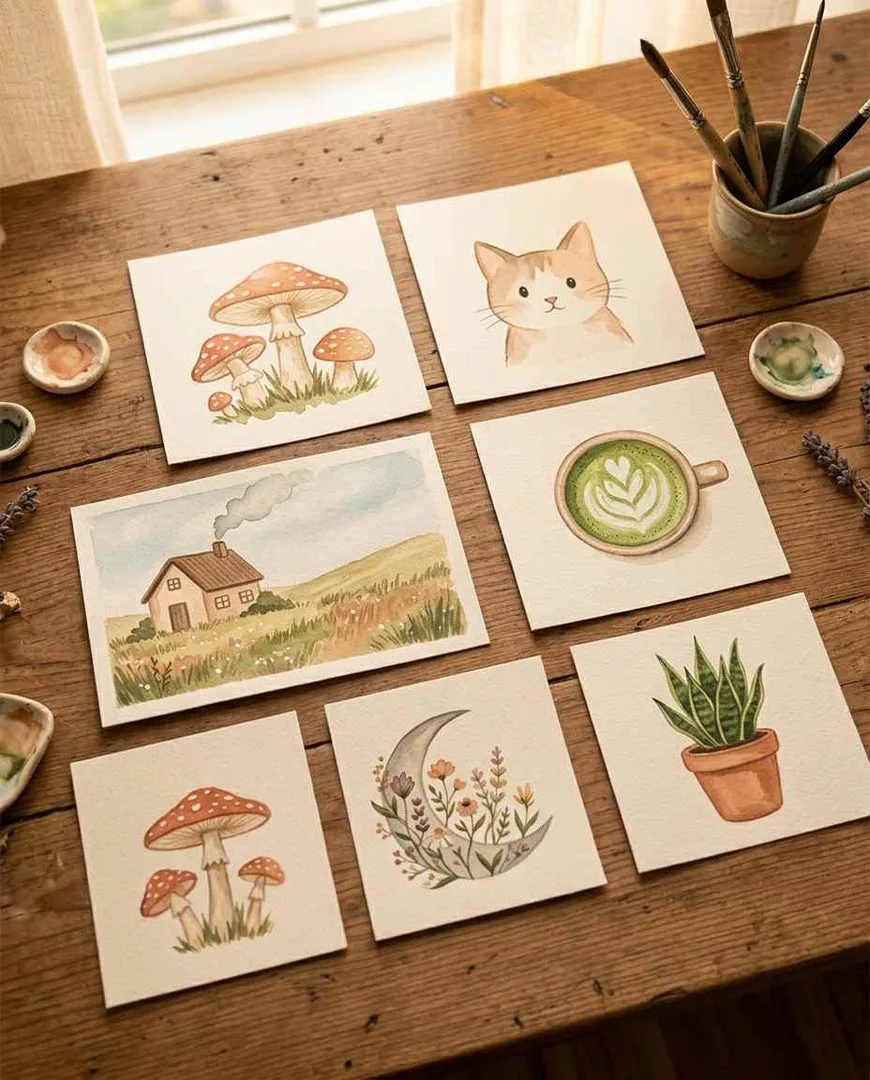
13. Mushroom cluster [Watercolour or gouache · 20 min] — Three to five mushrooms in warm earth tones with tiny grass blades at the base. The cap-and-stem shape is forgiving and the variety between mushrooms adds visual interest. Add tiny spots on the caps for a fairy-tale feel.
14. Cat portrait (simplified) [Gouache or acrylic · 25 min] — A cat face with two triangle ears, two large eyes with a highlight dot, a tiny nose and whiskers. Fill the outline with the cat’s colour (orange tabby, black, grey) and add minimal shading. The kawaii style works: big eyes, small features, maximum charm.
15. Cozy cottage [Watercolour or gouache · 30 min] — A small house with a peaked roof, a chimney with curling smoke, a round door, and flower boxes under the windows. Warm light glowing from the windows on a blue-grey evening background. Cottagecore in one painting.
16. Matcha latte from above [Gouache · 20 min] — A birds-eye view of a cup showing the green matcha surface with a white latte-art swirl. The circular composition is satisfying and the colour palette (green, cream, white) is inherently aesthetic.
17. Crescent moon with flowers [Watercolour with fine pen details · 30 min] — A crescent moon shape filled with tiny flowers, vines and leaves growing across its surface. The moon-as-garden concept is one of the most popular aesthetic painting subjects on Pinterest.
18. Small potted plant [Acrylic or gouache · 20 min] — A terracotta pot with a monstera, succulent or trailing pothos. The pot is a simple shape, the plant provides all the visual complexity, and the subject fits any size from a postcard to a large canvas.
19. Starry jar [Acrylic on dark paper · 25 min] — A mason jar filled with stars and galaxies, glowing from within. Paint the jar outline, then fill the interior with deep blue, purple and white star dots. The contrast between the ordinary jar and the cosmic interior is the concept.
20. Floral initial [Gouache or watercolour · 35 min] — A large letter (your initial) outlined on the canvas, filled with painted flowers, leaves and vines. The letter provides structure; the florals provide beauty. A personalised art piece.
21. Row of tiny houses [Gouache on toned paper · 30 min] — Five to seven small houses in a row, each a different colour and slightly different shape. The row creates a miniature street scene. Warm window lights on a dusk background.
22. Cup of tea with steam [Watercolour · 15 min] — A simple mug viewed from the side with curling steam lines rising from the surface. The steam teaches you to paint translucent shapes (thin, pale, wispy) against a background.
Cool things to paint that impress people
The paintings that make someone stop and look. These require a bit more time and technique, but the results earn wall space.
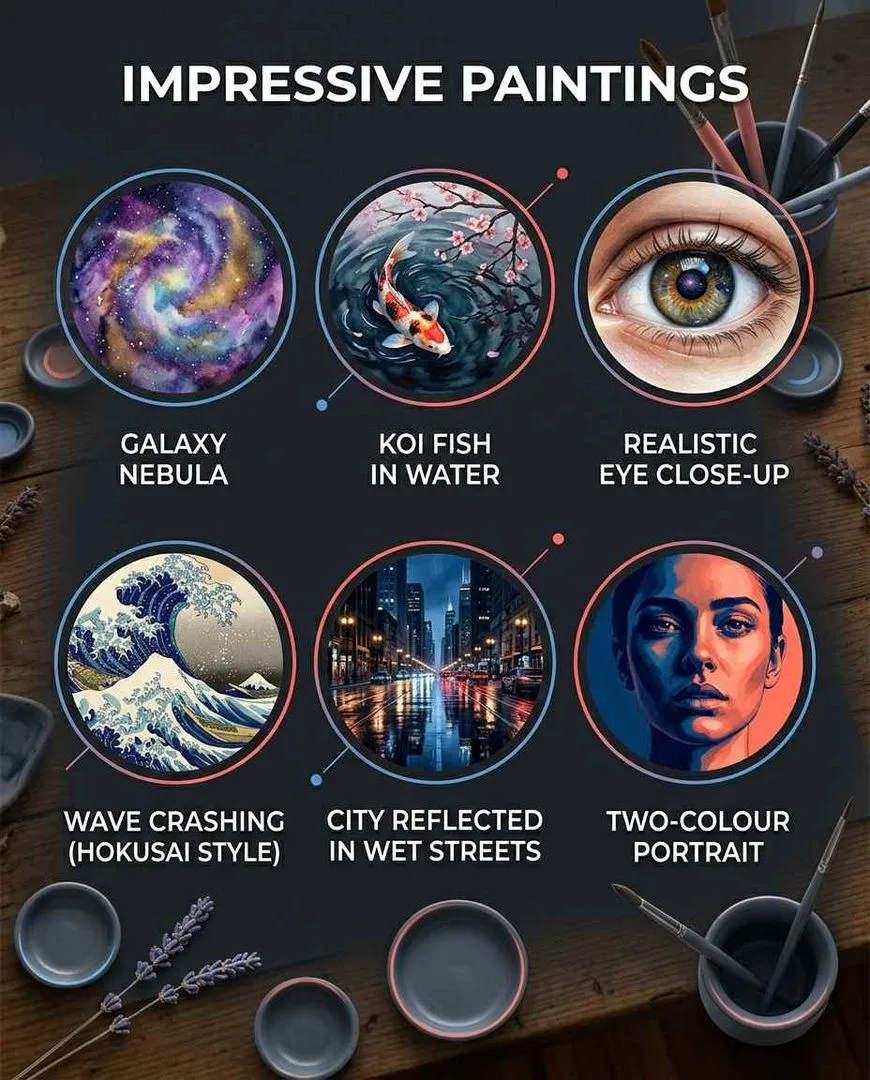
23. Galaxy nebula
Acrylic on black canvas or dark paper · 45 min · Intermediate
A deep-space scene. Start with a black background, then build layers: dark blue clouds, purple nebula wisps, bright white star clusters. Splatter white paint with a toothbrush for small stars. Dab concentrated white dots for larger stars. The layering technique is what creates depth — each layer of colour should be applied after the previous one is partly dry, leaving some dark space visible between.
24. Koi fish in water [Watercolour on cold-pressed paper · 40 min] — One or two koi fish viewed from above through water. The fish are solid and detailed; the water is loose, transparent washes of blue-green with ripple distortions. The contrast between the precise fish and the loose water is the technique.
25. Realistic eye close-up [Acrylic or oil · 45–60 min] — A single eye filling the entire canvas. The iris gets the most detail (colour, texture, reflected light), the pupil is pure black with a white highlight dot, and the skin around the eye is minimal. An eye study is the fastest way to a “wow, you painted that?” reaction.
26. Great wave [Acrylic on canvas · 45 min] — A stylised wave inspired by Hokusai’s woodblock print. The foam curls at the top, the body is deep blue-green, and tiny white details represent spray. You do not need to replicate Hokusai exactly — the wave shape itself is dramatic in any style.
27. City reflected in wet streets at night [Acrylic on canvas · 40 min] — A dark cityscape with neon lights reflected in rain-wet pavement. Paint the buildings as simple dark blocks, the lights as bright colour spots, and the reflections as vertical smears of the same colours on the lower half. The reflections are just blurred copies of the lights above.
28. Two-colour portrait [Acrylic or gouache · 45–60 min] — A portrait painted using only two colours (blue and orange, red and black, purple and gold) plus white. The limited palette forces dramatic contrast and the result looks like a professional art print. Work from a reference photo.
29. Underwater scene [Acrylic on canvas · 35 min] — A gradient from light turquoise at the surface to deep navy at the bottom, with light rays angling down through the water. Add silhouettes of fish, jellyfish, coral or a whale in dark shapes against the lighter water. The light rays are the technique: thin, angled white lines fading as they descend.
30. Glass of water with light [Acrylic or oil · 60 min] — A transparent glass of water showing refraction, surface tension and light passing through. This is a technical study that teaches you everything about painting transparency and reflection. Use a real glass as reference.
31. Fire and smoke [Acrylic on dark paper or canvas · 30 min] — A campfire, a candle flame, or a bonfire. The flames are built from yellow at the base through orange to red at the tips, with dark smoke above. The glow on the surrounding objects (a face, a log, a wall) is the detail that sells the light.
32. Stormy ocean horizon [Acrylic on canvas · 35 min] — A dramatic sea with dark churning water and heavy grey clouds, with one break in the clouds letting golden light through. The single light break on an otherwise dark scene creates instant drama with minimal detail work.
Things to paint on a canvas
Canvas-specific ideas designed for wall display. These compositions are sized and framed for a rectangular canvas, not a sketchbook page.
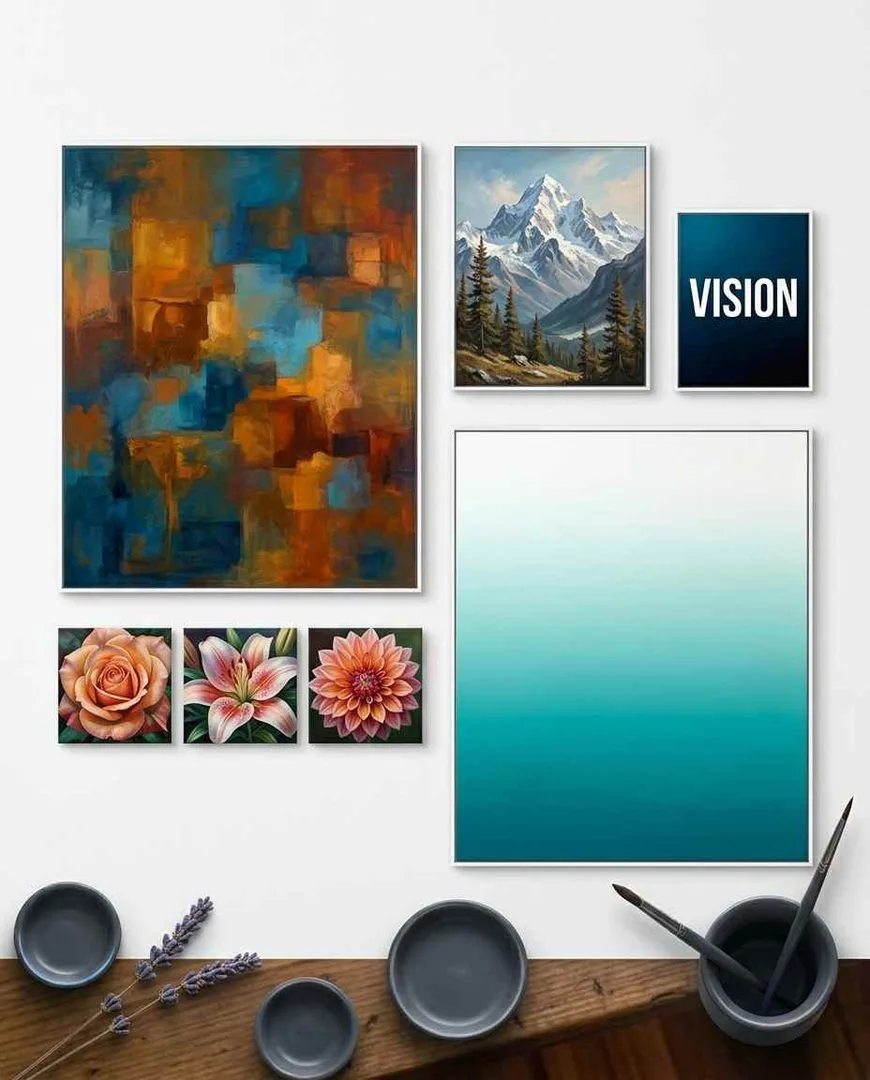
33. Abstract palette knife [Thick acrylic with palette knife · 20 min] — Load a palette knife with thick acrylic and scrape it across the canvas in broad strokes. Layer colours on top of each other while wet. The palette knife creates textures impossible to achieve with a brush. No planning, no sketch, just colour and movement.
34. Ombre gradient canvas [Acrylic on large canvas · 15 min] — One colour blended from dark at the bottom to white at the top. A single-colour gradient is the most elegant minimal art piece and it teaches you blending better than any other exercise. Use a large flat brush and work horizontally.
35. Bold single word [Acrylic on canvas · 20 min] — Paint a single meaningful word (BREATHE, HOME, CREATE, ENOUGH) in bold lettering on a white or coloured canvas. Use painter’s tape to create clean letter edges or paint freehand for a handmade feel.
36. Floral triptych [Acrylic on three small canvases · 45 min] — Three small canvases, each showing one flower from the same arrangement, hung side by side. The triptych format turns three simple paintings into a cohesive gallery installation.
37. Pour painting [Acrylic pouring medium on canvas · 15 min + drying] — Mix acrylic paint with pouring medium, layer colours in a cup, flip the cup onto the canvas and let the paint flow. Tilt the canvas to spread. Pour painting produces organic, cell-like patterns impossible to plan and impossible to replicate.
38. Textured white-on-white [Heavy body white acrylic on canvas · 20 min] — Apply thick white acrylic to a white canvas using a palette knife to create raised texture patterns: swirls, ridges, geometric lines. The texture catches light and shadow, creating a minimalist art piece that changes with the room’s lighting.
39. Vintage map or globe [Acrylic on pre-stained canvas · 40 min] — Paint a simplified world map or a single continent on an aged-looking canvas (tea-stain the canvas first for a vintage base). The accuracy does not matter — the cartographic aesthetic is the art.
40. Colourfield painting (Rothko style) [Acrylic on large canvas · 25 min] — Two or three large rectangles of colour floating on a toned background, edges slightly soft and blurred. The emotional impact of a Rothko is in the scale, the colour relationships and the soft edges. Your version at any size captures the same meditative quality.
Things to paint on rocks
Rock painting is the fastest path from idea to finished piece. The small surface forces simplicity, the 3D shape adds charm, and the finished rock sits on a shelf, in a garden, or gets hidden in a park for someone to find.
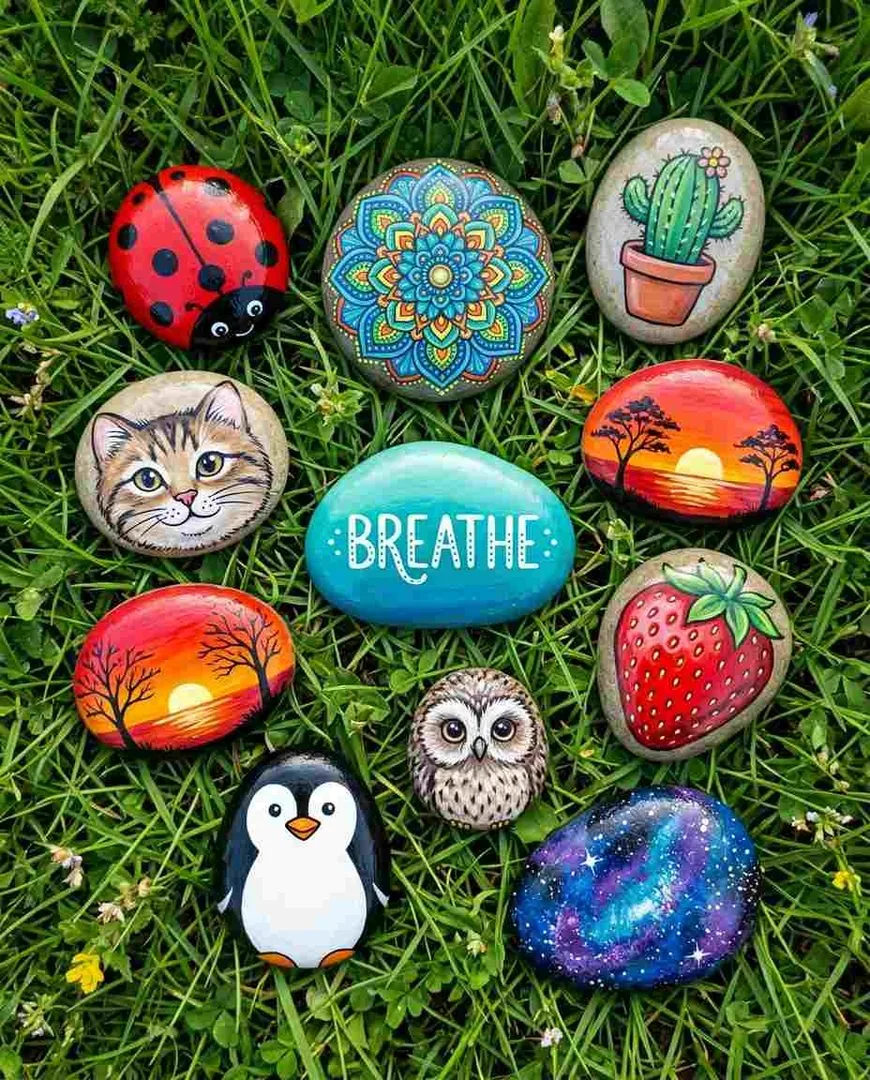
41. Ladybird [Acrylic + sealant · 10 min] — Red body, black spots, a black line down the centre, two tiny antennae. The most classic painted rock and the one most people start with.
42. Mandala pattern [Acrylic with dotting tool · 20–30 min] — Dot mandala: apply dots of paint using the end of a brush handle or a dotting tool in concentric circles from the centre outward. The dots build up into an intricate mandala pattern with zero freehand drawing. Mesmerising to make and to look at.
43. Cactus garden [Acrylic + sealant · 15 min] — Paint the rock green with cactus features (ridges, spines, a small flower) and sit it in a tiny terracotta pot. A plant that never dies.
44. Kindness rock [Acrylic paint pen + outdoor sealant · 5 min] — Paint a smooth rock with an encouraging word (SMILE, HOPE, YOU GOT THIS, BE KIND) and leave it in a public place for a stranger to find. The Kindness Rocks Project has turned this into a global movement.
45. Galaxy rock [Acrylic · 15 min] — Black base coat, sponge-dab blue and purple nebula clouds, splatter white stars. The same galaxy technique as the canvas version, miniaturised onto a rock. The small scale makes the galaxy feel concentrated.
Seasonal things to paint
These ideas match the time of year and make timely content for holiday decorating, gifts and seasonal displays.
Things to paint on pumpkins
No-carve pumpkin decorating is the fastest-growing seasonal painting trend. White or pale pumpkins are the best canvas — the pale surface shows colour more vibrantly than traditional orange.
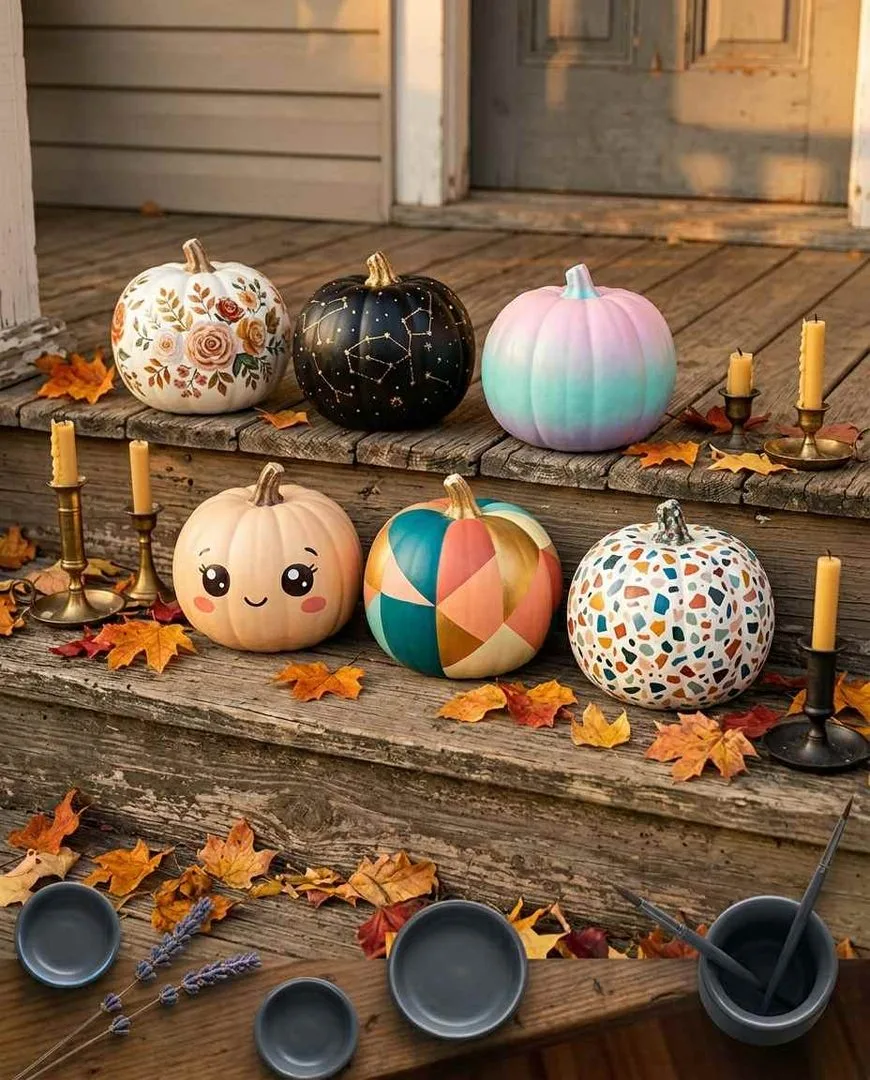
46. Floral pumpkin [Acrylic on white pumpkin · 30 min] — Paint flowers (roses, daisies, wildflowers) directly onto a white pumpkin. The pumpkin’s curved surface gives the florals natural dimension. The #1 trending no-carve pumpkin design.
47. Galaxy pumpkin [Acrylic · 20 min] — A black base coat with blue-purple nebula sponging and white star splatters. The cosmic-on-pumpkin contrast is striking.
48. Terrazzo pumpkin [Acrylic · 15 min] — Neutral-toned base with scattered geometric shapes (triangles, circles, rectangles) in muted colours. The terrazzo pattern is trending in interior design and translates beautifully to a pumpkin.
49. Kawaii face pumpkin [Acrylic · 10 min] — A simple kawaii face on a pastel-painted pumpkin: two dot eyes, a tiny curved mouth, circle blush cheeks. Cute, fast, no artistic skill required.
Other seasonal ideas
50. Christmas ornament painting [Acrylic on wood blanks · 15 min each] — Flat wooden ornament blanks painted with snowflakes, trees, reindeer, or names. Seal and hang on the tree. A personalised ornament tradition.
51. Valentine watercolour hearts [Watercolour · 15 min] — Loose, flowing watercolour hearts in reds, pinks and purples, layered wet-on-wet for bleeding, dreamy edges. Frame and gift.
52. Spring cherry blossom branch [Watercolour or acrylic · 20 min] — A dark branch painted with a liner brush, then pink-white blossoms dabbed along it with a cotton bud or a dry brush. The technique is dab, not stroke — the dabbing creates petal clusters.
53. Summer seashell painting [Acrylic + sealant on shells · 10 min per shell] — Paint real seashells with metallic gold, pastel colours or galaxy patterns. Display in a bowl. A beach-holiday craft that lasts longer than the tan.
What to paint by medium — acrylic, watercolour and gouache
If you already own one type of paint and want ideas matched to that specific medium:
Best things to paint with acrylic
Canvas landscapes, pour paintings, rock painting, palette-knife abstracts, silhouette scenes, bold graphic designs, pumpkins, anything on non-paper surfaces. Acrylic’s opacity means you can paint light over dark (a moon on a night sky, white clouds on blue) which watercolour cannot do.
Best things to paint with watercolour
Sunsets, skies, flowers, loose landscapes, botanical illustrations, dreamy washes, rainy scenes and anything where transparent, flowing colour creates atmosphere. Watercolour shines when the painting feels light, airy and slightly unpredictable.
Best things to paint with gouache
Illustrations, flat-design art, food illustrations, kawaii characters, bold colour-blocked scenes, typography and anything where you want matte, opaque colour with sharp edges. Gouache is the trending medium of 2025–2026, especially for illustrators and sketchbook artists.
For deeper painting tutorials and technique guides, visit our sister site Paintrove — dedicated entirely to painting for every skill level.
Things to paint: FAQ
What can I paint when I’m bored?
A sunset gradient (15 minutes, two colours, beginner-proof), a silhouette landscape (paint a sky then add a black treeline), a colour-block abstract (tape off sections and fill each with a colour), painted rocks (small, fast, satisfying), or a pour painting (mix acrylic with pouring medium and let gravity create the art). All five take under 30 minutes and require no drawing skill.
What should I paint today?
Match the painting to your mood. Feeling calm? A sunset, a cup of tea, a rainy window. Feeling creative? A galaxy, a koi fish, a pour painting. Feeling minimal? An ombre gradient, a single word, a white-on-white texture piece. Feeling festive? A painted pumpkin, a Christmas ornament, a valentine heart. Pick the mood first, then the subject.
What are easy things to paint on a canvas?
A sunset sky gradient, a colour-block abstract with painter’s tape, a silhouette landscape, an ombre single-colour gradient, a pour painting, a palette-knife abstract, a single bold word, or a floral close-up. All eight work on canvas, take under 30 minutes, and produce a result worth hanging on a wall.
What are the best things to paint for beginners?
Sunset gradients, silhouette landscapes, colour-block abstracts, simple flowers, painted rocks, and cloud studies. These subjects are forgiving because imprecision reads as style rather than mistake. Start with acrylic paint on canvas or thick paper — acrylic is the most beginner-friendly medium because mistakes can be painted over immediately.
What can I paint on besides canvas?
Rocks, pumpkins, wood slices, terracotta pots, tote bags, t-shirts (with fabric paint), seashells, glass jars, ceramic tiles, old books, vinyl records, shoes, and furniture. Acrylic paint adheres to most surfaces. Seal outdoor items with a clear coat for weather resistance.
What paint is best for beginners?
Acrylic. It is cheap, available everywhere, dries fast, works on almost any surface, and allows you to paint over mistakes while the paint is still wet. A 12-tube set of student-grade acrylic costs $8–15 and covers every project on this page. Upgrade to artist-grade when you are confident enough to notice the pigment difference.
How do I start painting with no experience?
Buy a 12-tube acrylic set, a few brushes (one flat, one round), a canvas or thick paper, and a cup of water. Open this page, pick idea 1 (sunset gradient), and follow the description. No courses, no YouTube tutorials, no preparation beyond opening the paint. The first brushstroke is the only instruction that matters — everything after that is adjustment.
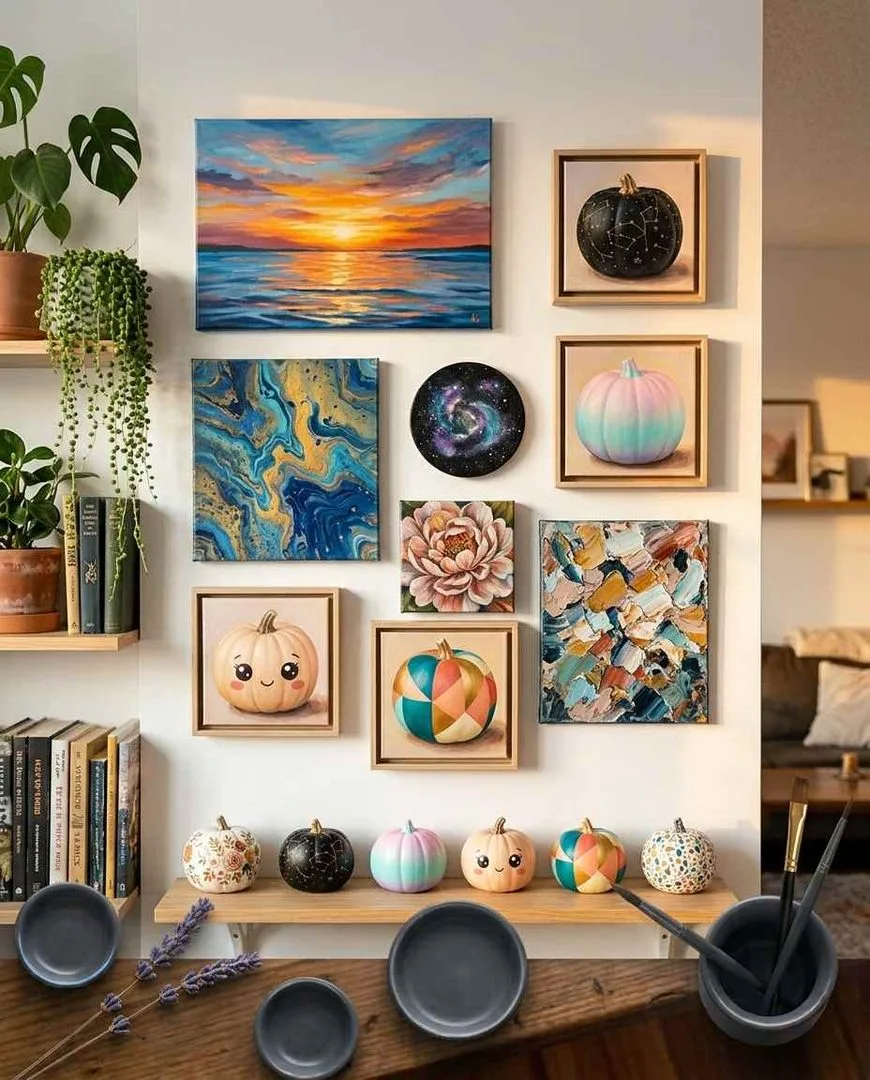
Pick a colour, pick a surface, and make the first mark
The sunset gradient takes 15 minutes and teaches you blending. The silhouette takes 25 minutes and teaches you layering. The colour-block abstract takes 20 minutes and teaches you nothing except that you just made something worth putting on a wall, which is the only lesson that matters for a first painting. Start with any of those three and the rest of this list will still be here when you are ready for the next one.
For more creative ideas, things to draw when bored has 100 drawing prompts sorted by mood, easy things to draw covers beginner-friendly sketching, air dry clay ideas has 50 sculpting projects, tie dye patterns has 30 step-by-step designs, and things to do when bored is the master list. For deeper painting tutorials, visit Paintrove.