Is Shopping a Hobby? (Yes — With One Big Catch)
Half the internet insists shopping is a legitimate leisure activity. The other half — including a surprisingly fierce essay from a Catholic parish — argues shopping shouldn’t be a hobby at all, pointing at fast fashion, compulsive spending, and closets full of clothes with nothing to wear. Both sides hold a real piece of the truth. This article puts shopping through the same four-question test we’ve applied to working out, traveling, and sleeping — and gives you the honest verdict, the six versions of shopping that genuinely count, and the warning signs that yours has quietly stopped being a hobby.
Quick Answer: Is Shopping a Hobby or Not?
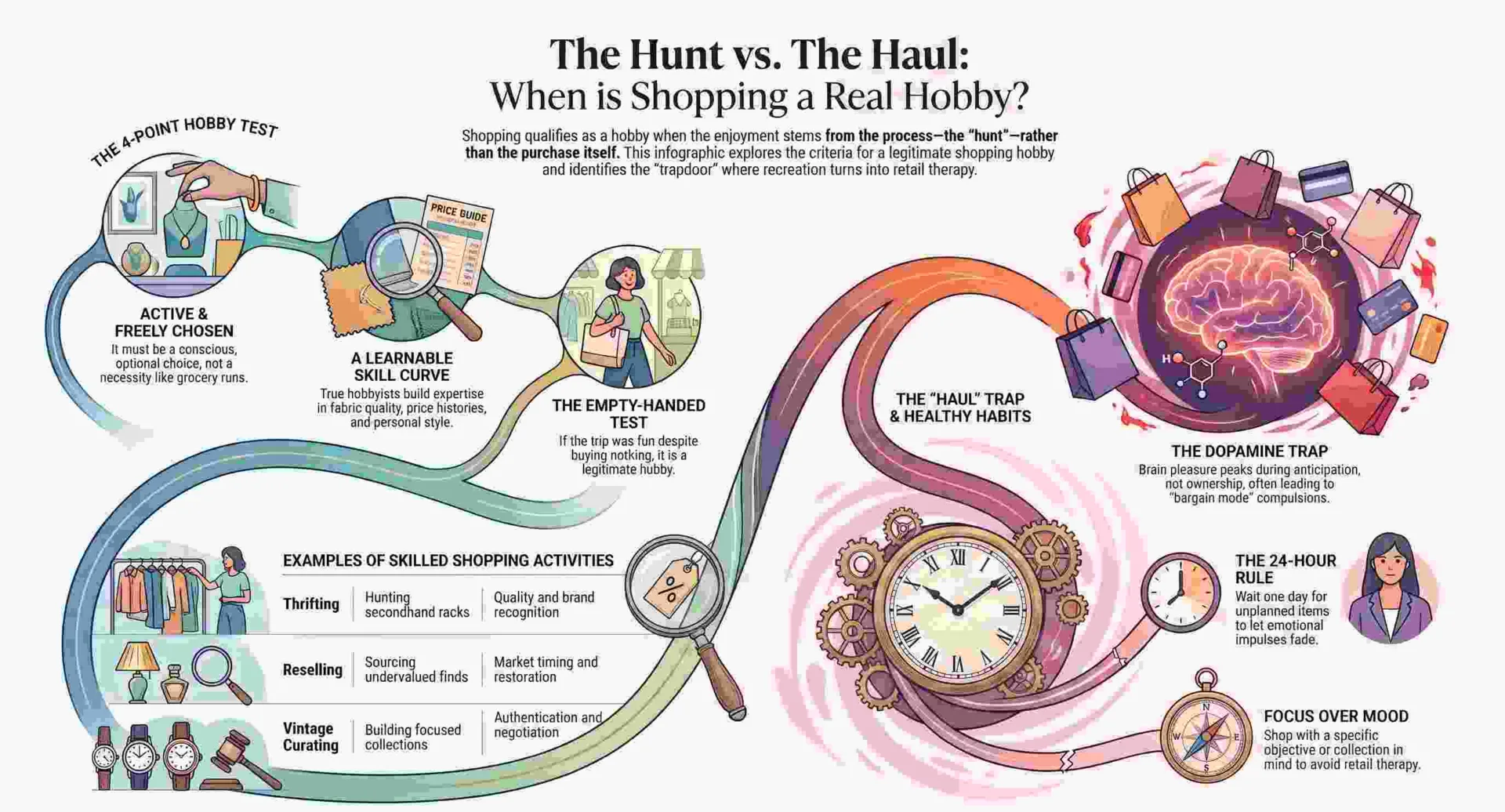
Yes, shopping is considered a hobby when it is done recreationally, for the pleasure of the process — browsing, comparing, discovering, curating — rather than as emotional relief or necessity. A hobby is an activity you choose freely and do for enjoyment in your leisure time. Recreational shopping clears that bar easily: it’s chosen, it’s active, and skills like spotting quality, knowing prices, and defining personal style genuinely improve with practice.
The catch: shopping is the only hobby on our list with a built-in trapdoor. The same dopamine that makes browsing fun makes buying compulsive, and the line between “shopping as a hobby” and retail therapy is crossed quietly — usually mid-checkout. The rest of this article is about staying on the right side of that line.
What Makes Something a Hobby in the First Place?
Same criteria we use across the whole hobbies series. A genuine hobby has four ingredients:
- It is chosen freely. Nobody’s forcing you to browse the flea market at 8 a.m.
- It is an activity. You participate consciously — searching, comparing, deciding.
- It can be practiced and improved. There’s a skill curve you can climb.
- It is done for pleasure in leisure time. Enjoyment is the point, not survival.
Grocery runs and emergency sock replacement fail the first test — that’s errand shopping, a necessity. But recreational shopping is a different animal, and it scores far better than most people expect.
The Hobby Test: How Shopping Actually Scores
| The Question | What a Hobby Needs | How Shopping Scores |
|---|---|---|
| 1. Chosen freely? | Fully optional | YES — recreational shopping is pure choice (errand shopping is not) |
| 2. An activity? | Conscious participation | YES — hunting, comparing, and curating are fully engaged activities |
| 3. Practice & improve? | A learnable skill | YES — spotting quality, knowing price histories, and defining personal style are real skills |
| 4. Pleasure in leisure? | Enjoyment is the point | YES* — the asterisk: only if the pleasure is the process, not the purchase |
Final score: 3.5 out of 4. Shopping passes the hobby test — far better than sleep’s 1.5, roughly on par with travel. Everything now rides on that asterisk, so let’s deal with it directly.
The One Question That Decides It: The Hunt or the Haul?
Ask yourself: if you came home empty-handed, was the trip still fun? If yes — you love the hunt. Browsing without buying, comparing price histories, antique booth diving, trying styles on a whim, leaving with nothing but ideas. That is a hobbyist. The activity itself feeds you; a purchase is a bonus, not the point.
If coming home empty-handed feels like failure — if the only satisfying ending is the transaction — you don’t love shopping. You love buying. And buying is not an activity you practice; it’s a button you press. That’s the version the critics are right about: instant gratification wearing a hobby’s clothes. One writer for a parish publication put it memorably — retail therapy caresses “like a silk Hermès scarf,” from the siren call of the Target home goods aisle to the quiet beckoning of an abandoned Amazon cart. The comfort is real. It just isn’t a hobby.
When Shopping IS a Real Hobby: 6 Versions That Count
Each of these passes the full test — chosen, active, skill-building, and enjoyable even on a $0 day. If “shopping” is your honest answer to the hobby question, one of these is probably what you actually mean.
| Shopping Hobby | What You Actually Do | Budget Needed | Skill You Build |
|---|---|---|---|
| Thrifting & preloved treasure hunting | Hunt secondhand racks and discount bins for quality pieces others missed | $5–20 per trip | Fabric knowledge, brand recognition, a ruthless critical eye |
| Vintage curating & collecting | Build a focused collection — cameras, vinyl, artisan ceramics, 90s denim | Set by you | Authentication, dating pieces, negotiation |
| Reselling for profit | Source undervalued finds, restore or style them, flip them online | $50 to start | Pricing, photography, market timing — a hobby that pays you |
| Browsing without buying | Window shopping, virtual cart curation, styling outfits you never purchase | $0 | Taste. You learn what you love before money is involved |
| Market & boutique scouting | Explore flea markets, estate sales, and niche boutiques as urban adventures | $0–20 | Local knowledge, haggling, the joy of the find |
| Sustainable fashion sourcing | Build a capsule wardrobe from ethical brands and secondhand only | Replaces spending | Mindful consumerism — style with a conscience |
Natty’s take: The healthiest shoppers I know are the ones with the narrowest focus. A client of mine collects one thing — vintage Pyrex, specific patterns only. She can walk through an entire mall untempted, then drive forty minutes for an estate sale. That’s not deprivation; that’s what a real shopping hobby looks like. The focus is the pleasure. If your shopping has no focus, the store chooses for you — and stores always choose more.
When Shopping Stops Being a Hobby: Retail Therapy and the Dopamine Trap
Here’s the psychology in one line: shopping releases dopamine — and the release peaks at anticipation, not ownership. As Psychology Today notes, that feel-good spike is exactly why shopping lifts a bad mood — and exactly why the lift never lasts. Bad week at work? You deserve that dress. Stressed? Those shoes will help. Bored? See what’s new at the mall. When purchases become a psychological remedy for an emotional state, you’re no longer practicing a hobby; you’re medicating with a credit card.
The warning signs are consistent: buying things because they’re on sale rather than because you want them (“it’s basically free!”), Black Friday remorse, a closet full of clothes and nothing to wear, hiding purchases from people who share your finances, and the tell-tale one — unnecessary spending that has become habitual, running on autopilot. Stores engineer this deliberately: sale tactics and bargain mode switch off the analytical brain and switch on the scavenger. If several of these feel familiar, a shopping detox — thirty days of browsing without buying — is the kindest experiment you can run on yourself. Compulsive shopping is also a recognized behavioral pattern worth discussing with a professional; no listicle should be your only support.

The Ethical Catch Every Shopping Hobbyist Should Know
There’s one more reason the “shopping shouldn’t be a hobby” camp exists, and it deserves a fair hearing: fast fashion. Journalist Elizabeth Cline, author of Overdressed, observed that we now buy clothes the way we buy coffee — casually, disposably. The consequences stack up fast: clothing made cheaply in third-world factories, toxic chemical runoff from garment dyeing, polyester shedding plastic particles into oceans and marine life, and billions of pounds of textiles landing in landfills every year. H&M and Forever21 hauls are cheap at the register and expensive everywhere else.
Here’s the reframe: the hobbyist version of shopping is the solution to this, not the cause. Thrifting, vintage curating, and sustainable sourcing are the most ethical ways to shop that exist — they extend the life of existing goods, reward quality over disposability, and train exactly the critical eye that sale tactics are designed to bypass. Mindful consumerism isn’t the end of shopping as a hobby. It’s the graduate level.
Is Shopping at Hobby Lobby a Hobby? (Yes, People Genuinely Ask)
No — shopping at Hobby Lobby is not itself a hobby, but it’s the funniest version of the question, because it’s the one store where the shopping is literally named after the hobby. Hobby Lobby sells the supplies — yarn, canvas, beads, model kits. Buying them is provisioning a hobby; the hobby is what happens when you get home and actually use them. Crafters even have a joke for the gap between the two: a stash “acquired beyond life expectancy.” If your Hobby Lobby hauls pile up unopened, you’ve developed a shopping habit wearing a crafting costume. The fix is pleasant: pick one project, finish it, and let the finishing — not the buying — become the thing you chase. If you need help choosing, our guide to finding a hobby you’ll actually enjoy was built for exactly this.
How to Keep Shopping a Healthy Hobby: 5 Rules
- Shop with a focus, not a mood. Collectors and curators thrive; browsers-of-everything get harvested by sale tactics.
- Use the 24-hour rule. Anything unplanned waits a day in the cart. The dopamine fades; your actual taste votes.
- Set a hobby budget. Budgeted retail therapy is honest recreation. Unbudgeted retail therapy is a leak.
- Practice browsing without buying. One $0 trip per month. If it isn’t fun, you’ve learned something important.
- Define your personal style first. A one-page style definition kills more impulse buys than any willpower ever will.
FAQs: Every Version of This Question, Answered
Is shopping a hobby or an addiction?
It can be either, and the dividing line is control. A hobby is something you direct: you choose when, set a budget, and enjoy the process. An addiction directs you: spending to escape feelings, hiding purchases, buying past your means, and feeling withdrawal-like restlessness when you can’t. If reading those made your stomach drop, take it seriously — compulsive shopping responds well to help, and asking for it is the strong move.
Is online shopping a hobby?
Same rules, higher difficulty. Hunting digital deals, comparing price histories, and virtual cart curation can be genuine hobby behavior — but online, the buy button is always one thumb away, and algorithms study your weaknesses in real time. Hobbyists browse online with a focus; the trapdoor opens for those who browse with a mood.
Is window shopping a hobby?
The purest version there is. Window shopping is all hunt and zero haul — pure aesthetic recreation, free, and skill-building. If you can spend a happy Saturday browsing boutiques and come home with nothing but opinions, congratulations: you’ve already passed the test most shoppers fail.
Is grocery shopping a hobby?
For most people, no — it’s a necessity, which fails the “chosen freely” test. The exception is the enthusiast tier: farmers-market scouting, hunting specialty ingredients, building a spice collection. When the grocery run becomes an expedition you’d take even with a full pantry, it’s crossed into hobby territory.
Should I say shopping is my hobby in an interview?
Name the skilled version instead. “I resell vintage finds online” signals initiative and market sense. “I’m building a capsule wardrobe from secondhand only” signals discipline and values. “I like shopping” signals a credit card. Same activity — the framing is the difference. If none of the skilled versions fit, browse 50 hobbies worth trying or the modern hobbies list for 2026 and pick one that does.
The Verdict, By Situation
| Your Situation | The Honest Verdict |
|---|---|
| You thrift, curate, collect, or resell with focus | A real hobby — skilled, chosen, and enjoyable at $0 |
| You love browsing and often leave empty-handed | A real hobby — the hunt is the whole point |
| You shop to fix a bad day | Retail therapy — a coping mechanism, not a hobby |
| You buy things mainly because they’re on sale | Bargain mode — the store is playing you, not the reverse |
| Your Hobby Lobby stash outpaces your projects | A shopping habit in a crafting costume — finish one project first |
| You hide purchases or spend past your means | A warning sign — worth real support, not a listicle |
| You errand-shop for groceries and socks | Not a hobby — just life admin, and that’s fine |
Final Thoughts: Love the Hunt, Own the Haul
So, is shopping a hobby? Yes — when it’s the hunt you love, the skill you’re building, and the focus you’ve chosen. No — when it’s the haul you need, the mood you’re medicating, and the sale sticker doing your deciding. Shopping is the rare hobby that comes with its own trapdoor, which means it’s also the rare hobby that teaches self-knowledge every single time you practice it.
Natty’s take: After 26 years of coaching, here’s my one-line test for any client who tells me shopping is their hobby: tell me about your favorite thing you didn’t buy. Real hobbyists light up — the one that got away, the piece they admired and walked past, the discipline that felt like power. If the question lands as nonsense — if every good story ends in a purchase — the hobby isn’t shopping. It’s spending. And the person deserves a hobby that gives more than it takes.