25 Analog Hobbies to Reclaim Your Brain in 2026
Analog hobbies to reclaim your brain— the tactile, screen-free kind your grandparents took for granted — are having the loudest comeback of 2026, with search interest more than doubling in six months. That’s not nostalgia. That’s millions of people noticing the same thing at once: the attention economy is winning, and their hands are tired of touching nothing but glass.
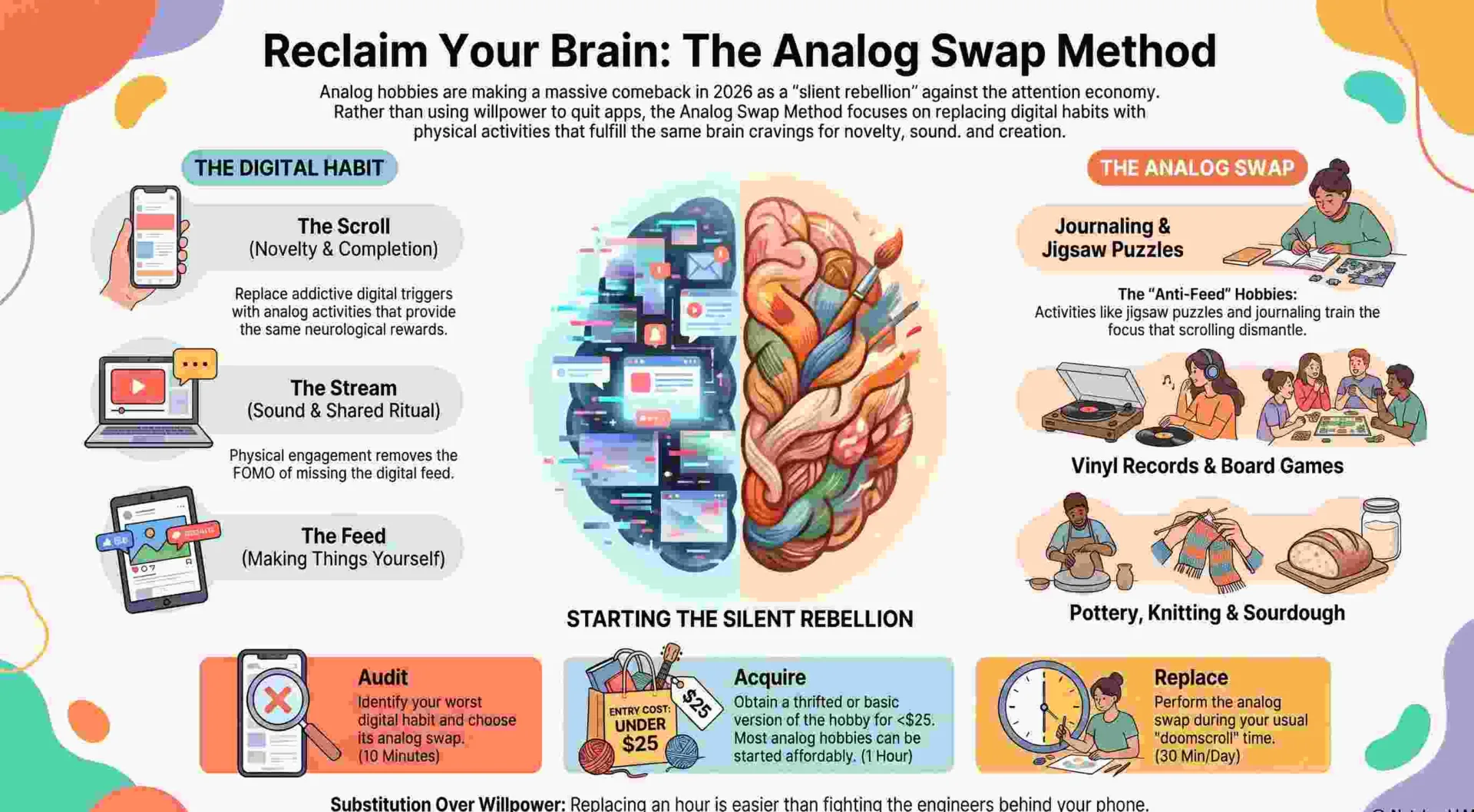
Artist and writer Jenny Odell named the problem in How to Do Nothing: Resisting the Attention Economy — big companies profit from every minute of your attention, and the apps are engineered to never let it go. Her answer wasn’t a productivity system. It was birds. Watching them, for no metric at all. That’s the spirit of this list: 25 analog activities as a silent rebellion — but organized in a way no other list uses. Every hobby below is a direct swap for a specific digital habit, because willpower doesn’t beat an addictive app. A better trade does.
Quick Answer: What Are Analog Hobbies?
Analog hobbies are leisure activities done entirely offline with physical materials — vinyl records, film photography, journaling by hand, pottery, board games, birdwatching — chosen deliberately as an alternative to screen time. The best way to start isn’t quitting your phone cold turkey; it’s swapping one digital habit for its analog counterpart. Replace the autoplay queue with a turntable ritual, the camera roll with 36 frames of film, the scroll with a fountain pen — and the screen time falls without a fight.
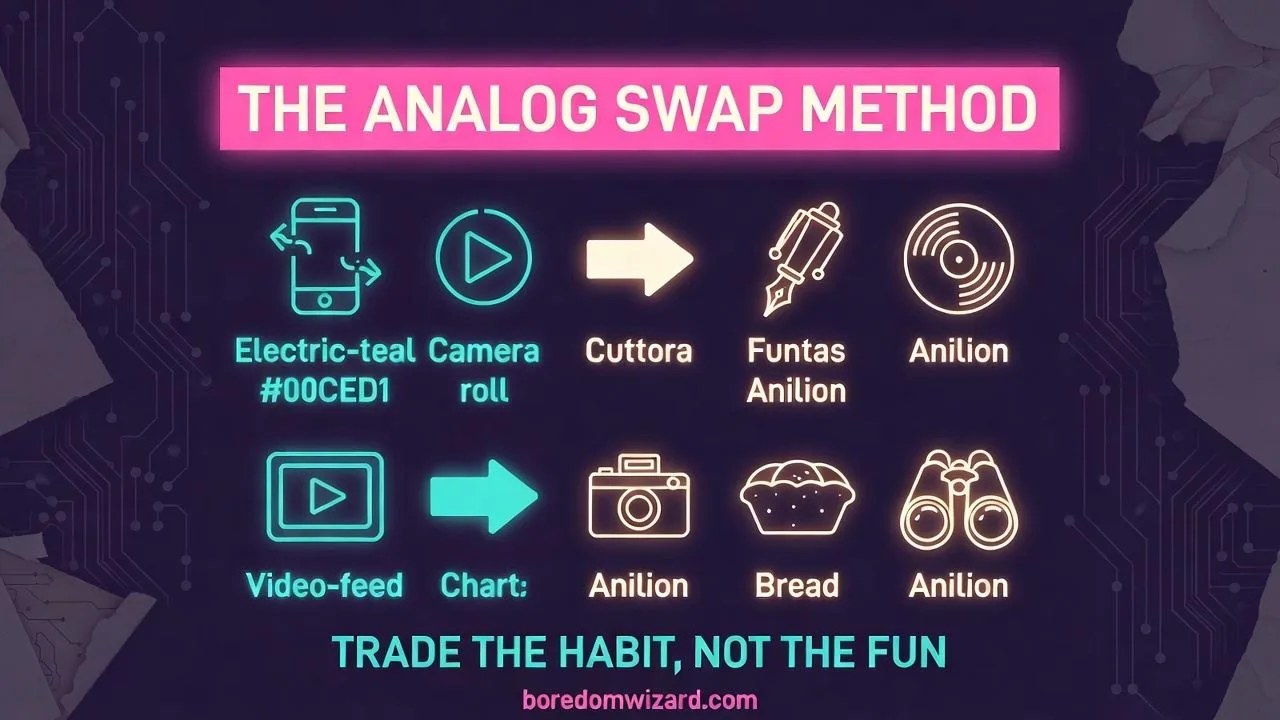
The Analog Swap Method: Trade the Habit, Not the Fun
Every doomscroll session is your brain looking for something — novelty, sound, images, making, or awe. Digital apps deliver cheap versions of all five. These swaps deliver the real ones:
| Digital Habit You’re Escaping | What Your Brain Actually Wants | The Analog Swap (Hobbies) |
|---|---|---|
| The Scroll (social feeds) | Novelty + tiny completions | Journaling, letters with wax seals, jigsaw puzzles, coloring, paper marbling (1–5) |
| The Stream (autoplay music & TV) | Sound + shared ritual | Vinyl collecting, an instrument, board games & chess, ham radio, mixtapes (6–10) |
| The Camera Roll (infinite photos) | Seeing, actually | Film photography, pinhole cameras, instant film, urban sketching, darkroom printing (11–15) |
| The Feed of Other People Making Things | Making things yourself | Pottery, sourdough, knitting, woodworking, calligraphy & bookbinding (16–20) |
| The Optimization Apps | Slowness + awe | Birdwatching, stargazing, gardening & natural dyes, mechanical tinkering, map-and-compass walks (21–25) |
Swap 1: Kill the Scroll — Paper Hobbies
1. Journaling by Hand
A notebook and a decent pen replace the urge to narrate your life to strangers. Morning pages, one-line-a-day, or a rant nobody reads — handwriting is slower than typing, and the slowness is the feature. It’s the single cheapest analog hobby and the one most likely to stick.
2. Letter Writing (With Wax Seals, Obviously)
Write one real letter a month to someone who’d never expect it. Wax seal embossing kits cost about $15 and turn correspondence into a small ceremony. You will never get a text as good as the reply you’ll get.
3. Jigsaw Puzzles
A 1,000-piece puzzle is the anti-feed: one image, revealed slowly, no algorithm deciding what’s next. Puzzle solving quietly trains the same focus the scroll dismantles.
4. Adult Coloring and Paper Marbling
Coloring books are the entry point; paper marbling patterns — swirling pigments on water, lifting the print onto paper — are the rabbit hole. Both are meditative, both end with something you can hold, and neither has a comments section.
5. Reading Physical Books (Aloud Counts Double)
A paper book has no notifications layered over page 200. Reading aloud with a partner or kids is the oldest analog activity on this list and still one of the best — our books to read when bored list is the starting shelf.
Swap 2: Kill the Autoplay — Sound & Table Hobbies
6. Vinyl Record Collecting
A turntable setup makes listening an event again: choose the record, drop the needle, flip at side B. Crate-digging for used pressings is the treasure-hunt half of the hobby; cleaning and caring for them is the ritual half. Start used — a decent secondhand turntable runs $60–100.
7. Learning an Instrument
Twenty minutes a day on a $40 used guitar or a $25 harmonica outperforms two hours of passive listening for mood, memory, and the specific joy of getting better at something. Pick the instrument whose music you already love — motivation is pre-installed.
8. Board Games and Chess
A chess board or a shelf of board games converts screen-night into face-night. Chess is the deepest free game ever designed; modern board games are the social version. Either way, the entertainment looks back at you when it laughs.
9. Ham Radio
The original social network: license, radio, and conversations bouncing off the atmosphere with strangers three time zones away. The entry license is a weekend of study, and the community is famously welcoming to newcomers. Analog audio at its most gloriously nerdy.
10. Cassette Mixtapes
Yes, really — tapes are back. A mixtape is a playlist with stakes: 45 minutes a side, no reordering, recorded in real time. Making one for someone is the analog love language your streaming account can’t speak.
Swap 3: Kill the Camera Roll — Slow Image Hobbies
11. Film Photography
Thirty-six frames per roll changes everything: you stop capturing and start seeing. Used film cameras cost $30–80, and film’s delay — days between shutter and print — is the exact opposite of the instant feedback loop your phone trained into you.
12. Pinhole Camera Building
Build a working camera from a tin, tape, and photo paper — pinhole camera building is half physics experiment, half magic trick. The first ghostly image you develop from a box you made will beat any photo on your phone.
13. Instant Film
Polaroid-style instant photos are the social version of slow photography: one physical print, handed to the person in it. Parties remember the wall of instant photos long after everyone’s stories expire.
14. Urban Sketching
A pocket sketchbook and one pen. Sit somewhere, draw what’s in front of you, badly at first. Sketching forces ten straight minutes of looking at one thing — a superpower in 2026 — and hand-bound sketch journals become the souvenir shelf of your life.
15. Darkroom Printing
The final boss of analog photography: darkroom tray development under red light, watching a blank sheet become a silver gelatin print in the chemistry. Community darkrooms rent by the hour in most cities — no basement conversion required.
Swap 4: Kill the Watching — Maker Hobbies
You’ve watched a thousand hours of other people making things. These five give your hands the job back — and they’re the heart of the whole analog hobbies resurgence.
16. Pottery
Clay is the most honest material there is: it responds only to your actual hands, in actual time. Studio taster sessions run $30–60, and the wobbly first bowl will outrank every mug you own.
17. Sourdough Bread
Flour, water, salt, and a starter with a name. Sourdough is analog fermentation theater — slow, tactile, forgiving, and it ends in warm bread. The pandemic made it a cliché; the cliché was right.
18. Knitting and Crochet
The original fidget hobby: hands busy, mind free, TV optional. Knitting patterns scale from dishcloth to heirloom blanket, yarn starts at $5, and the finished-object high is real. Bonus: it’s the most portable maker hobby on the list.
19. Woodworking With Hand Tools
Skip the power tools; hand-tool woodworking — saw, chisel, plane — is quieter, safer, cheaper, and more meditative. A cutting board is the classic first project. Sawdust is aromatherapy for a screen-fried brain.
20. Calligraphy and Bookbinding
Start with calligraphy for beginners (a $10 pen and drills that feel like meditation), graduate to leather bookbinding techniques and vintage fountain pen restoration. This corner of the analog world — inks, nibs, papers, stitches — is deep enough to hold a decade of curiosity.

Swap 5: Kill the Optimization — Slow World Hobbies
21. Birdwatching
Jenny Odell’s own antidote, and the fastest-growing hobby among people under 35. Binoculars, a paper field guide, and a park bench — bird-watching rewires you to notice a world that was always there. The life list becomes a diary of places and mornings.
22. Stargazing
Start with your eyes, add a star map (paper, obviously), and graduate to a secondhand telescope — polishing a brass telescope is a hobby inside the hobby. Awe is the emotion the feed can’t manufacture; the sky does it for free every clear night.
23. Gardening and Natural Dyes
Soil under fingernails is the opposite of glass under fingertips. Grow herbs and tomatoes on a balcony, then push into natural dye extraction — onion skins, marigolds, avocado pits — coloring fabric with things you grew. Slow living, literally.
24. Mechanical Tinkering
Mechanical watches, model building, wooden ship model rigging, basic car maintenance — the tinkering family. Understanding and repairing a physical mechanism scratches the itch the optimization apps only pretend to. Start with a $20 mechanical watch and a screwdriver set.
25. Map-and-Compass Walks
Leave the GPS home. A paper map, a compass, and a route you plotted yourself turn an ordinary nature walk into low-stakes adventure — map reading is a dying skill precisely because it’s a satisfying one. Camping is this hobby’s graduation ceremony.
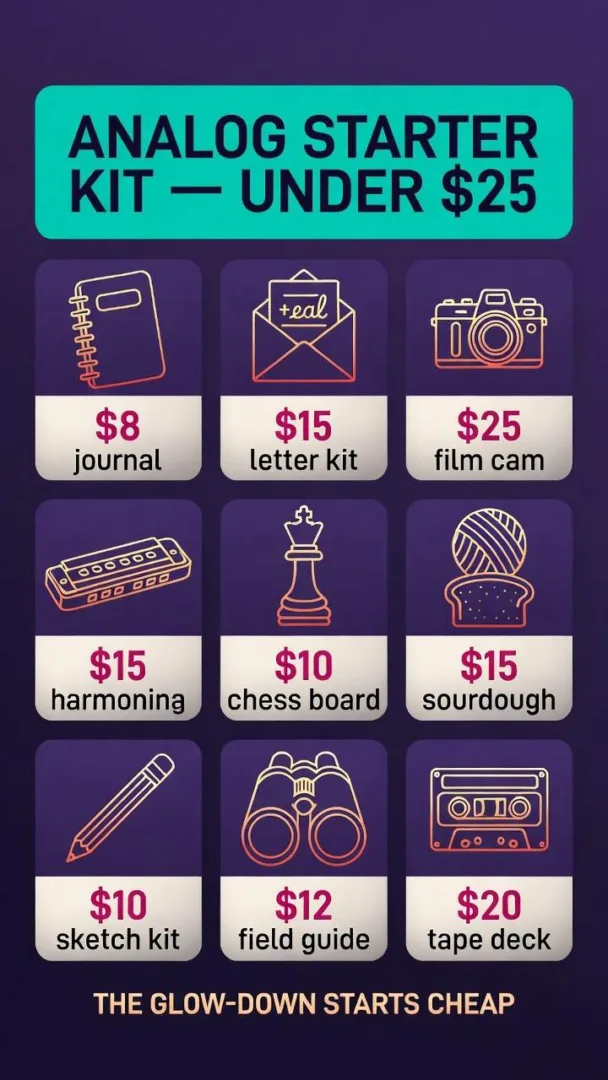
The Under-$25 Analog Starter Kit
The analog world has a gatekeeping problem — $400 turntables, $900 cameras. Ignore it. Every swap above has an entry under $25:
| Analog Hobby | Your First $25 or Less | First Session |
|---|---|---|
| Journaling | Any notebook + a pen that feels good ($8) | Tonight, 10 minutes |
| Letter writing | Stationery + wax seal kit ($15) | One letter, this week |
| Film photography | Thrifted point-and-shoot + 1 roll ($25) | One roll, one walk |
| Instrument | Used harmonica ($15) or borrowed guitar | 20 minutes, badly, gloriously |
| Chess | Secondhand board ($10) | One game, phone in a drawer |
| Knitting | Needles + one skein ($12) | A very honest dishcloth |
| Sourdough | Flour + a jar (starter is free to make) | Day 1 of feeding your new pet |
| Sketching | Pocket sketchbook + fineliner ($10) | Draw your coffee cup |
| Birdwatching | Free app alternative: a paper field guide ($12) | One park bench, one hour |
| Mixtapes | Thrifted cassette player + blank tapes ($20) | Side A for someone you like |
The 7-Day Analog Reset (How to Actually Start)
Don’t buy anything yet. Run this one-week experiment first — it pairs perfectly with our 30-day digital detox challenge if you want the full version:
| Day | The Move | Time |
|---|---|---|
| Day 1 | Pick your worst digital habit (screen-time report doesn’t lie) | 5 min |
| Day 2 | Choose its swap from the table above — one hobby, not three | 5 min |
| Day 3 | Acquire the under-$25 version. Thrift stores first | 1 hour |
| Day 4–6 | Do the analog swap at your usual scroll time. Phone in another room | 30 min/day |
| Day 7 | Check your screen-time report again. Keep the swap if it dropped | 5 min |
Natty’s take: I’ve watched dozens of clients try to fight their phones with willpower, and the phone wins every time — it has a thousand engineers on its side and you have a Tuesday evening. The only strategy I’ve seen work is substitution: the hour must go somewhere, so give it somewhere better to go. And notice what the FOMO actually was: not fear of missing the feed — fear of sitting with empty hands. Fill the hands, and the feed loses its leverage. That’s the whole trick, and it costs less than a month of streaming.
FAQs: Quick Answers
What counts as an analog hobby vs a digital one?
If the core activity happens in physical material — paper, clay, vinyl, soil, wood, film — it’s analog, even if you occasionally look up a tutorial online. A hobby isn’t disqualified by a YouTube lesson; it’s disqualified when the screen IS the hobby.
Are analog hobbies expensive?
The internet’s version is — vintage cameras and audiophile turntable setups get pricey fast. The actual hobbies aren’t: everything on this list starts under $25 (see the starter kit table), and thrift stores are the analog hobbyist’s supply chain.
Which Analog Hobbies to Reclaim Your Brain help most with anxiety and doomscrolling?
Repetitive-motion hobbies — knitting, kneading, coloring, puzzles — calm the nervous system fastest, which is why therapists keep recommending them. If doomscrolling is the specific problem, start with Swap 1 and read our things to do instead of doomscrolling guide tonight instead of the feed.
Aren’t these just grandma hobbies?
Partly, and say it with respect — grandma was right. The “grandma hobbies” wave on social media is this same movement wearing a funnier name: cross-stitch, crochet, bread, and jigsaw puzzles trending with people under 30. The generation raised on infinite scroll is the one buying yarn. That’s not regression; that’s course correction.
Can analog hobbies make money?
Several can — pottery, knitting, film photography, sourdough, woodworking, and calligraphy all appear in our hobbies that make money guide with real numbers. One caution: monetize the second analog hobby, not the first. The first one’s job is protecting your attention, and it should stay off the clock.
Final Thoughts: The Rebellion Is Quiet
Nobody announces an analog hobby. There’s no app to join, no streak to protect, no audience to update. You just… start noticing birds, or your hands smell like bread, or there’s a letter in your mailbox that someone sealed with wax. Twenty-five doors are listed above. The whole silent rebellion is opening one of them — and leaving the phone on the other side. Not sure which door is yours? The hobby-finder guide narrows it to one in five questions.