How to Juggle 3 Balls: Easy Step-by-Step Guide for Beginners (2026)
Juggling is one of the best boredom cures there is. It costs almost nothing, you can practice it in a living room, and it pulls your attention fully into the moment, the opposite of doomscrolling. The good news: juggling three balls is far easier than it looks once you learn it in the right order.
This guide teaches you how to juggle 3 balls with the same three-step method juggling teachers use: one ball, then the two-ball exchange, then the cascade. You also get a slow-motion juggling trainer you can watch at 15 percent speed, a 7-day practice plan, a way to make juggling balls from rice and balloons, the beginner mistakes that cause most drops, and the tricks to learn next.
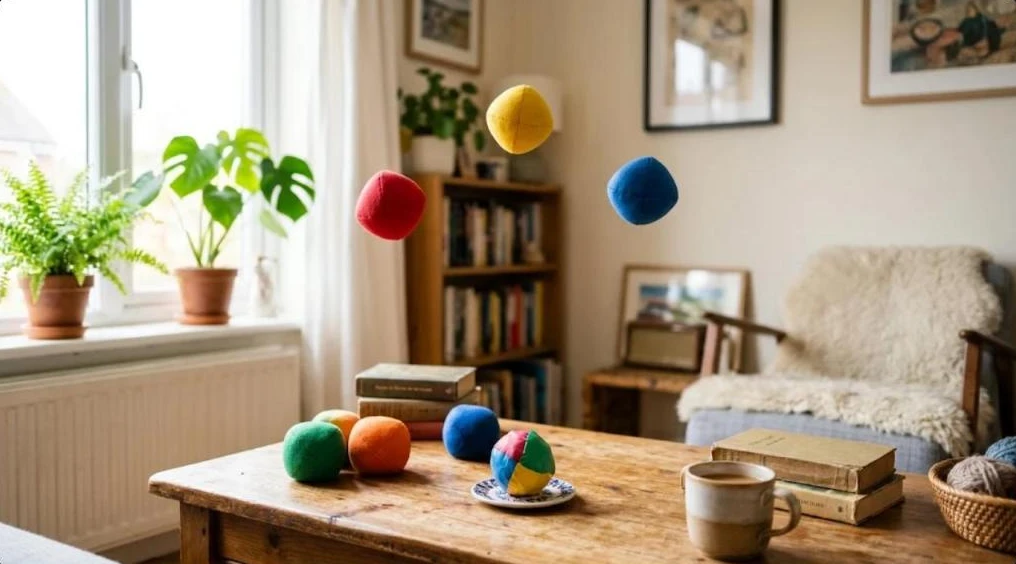
How do you juggle 3 balls? Start with one ball, tossing it from hand to hand in an arc that peaks at eye level. Next, learn the exchange: throw one ball, and when it peaks, throw a second ball underneath it from the other hand. For three balls, hold two in your first hand and keep repeating the exchange, alternating hands, so the next ball goes up every time one peaks.
Time to first success: a few short sessions | Cost: free to $15 | Ages: about 7+ (scarves for younger kids)
What you need to start juggling
- Three beanbag juggling balls. Soft balls filled with seeds or pellets, about 2.5 inches (6 to 7 cm) wide, are the easiest to learn with because they land in your hand and do not bounce away. Tennis balls work, but they roll under the sofa every time you drop one.
- Or make your own. Rice and balloons make great free juggling balls. Instructions are below.
- A bed, sofa or table in front of you. Stand facing it so dropped balls land at waist height instead of on the floor. It saves your back and lets you practice twice as long.
- Ten minutes. Short daily sessions beat one long weekend session. Stop while you are still having fun.
How to juggle 3 balls, step by step
Stand with your feet shoulder width apart, elbows bent at about 90 degrees and tucked near your hips, palms up. Your throws come from your forearms, not your shoulders, and every throw should peak at about eye level.
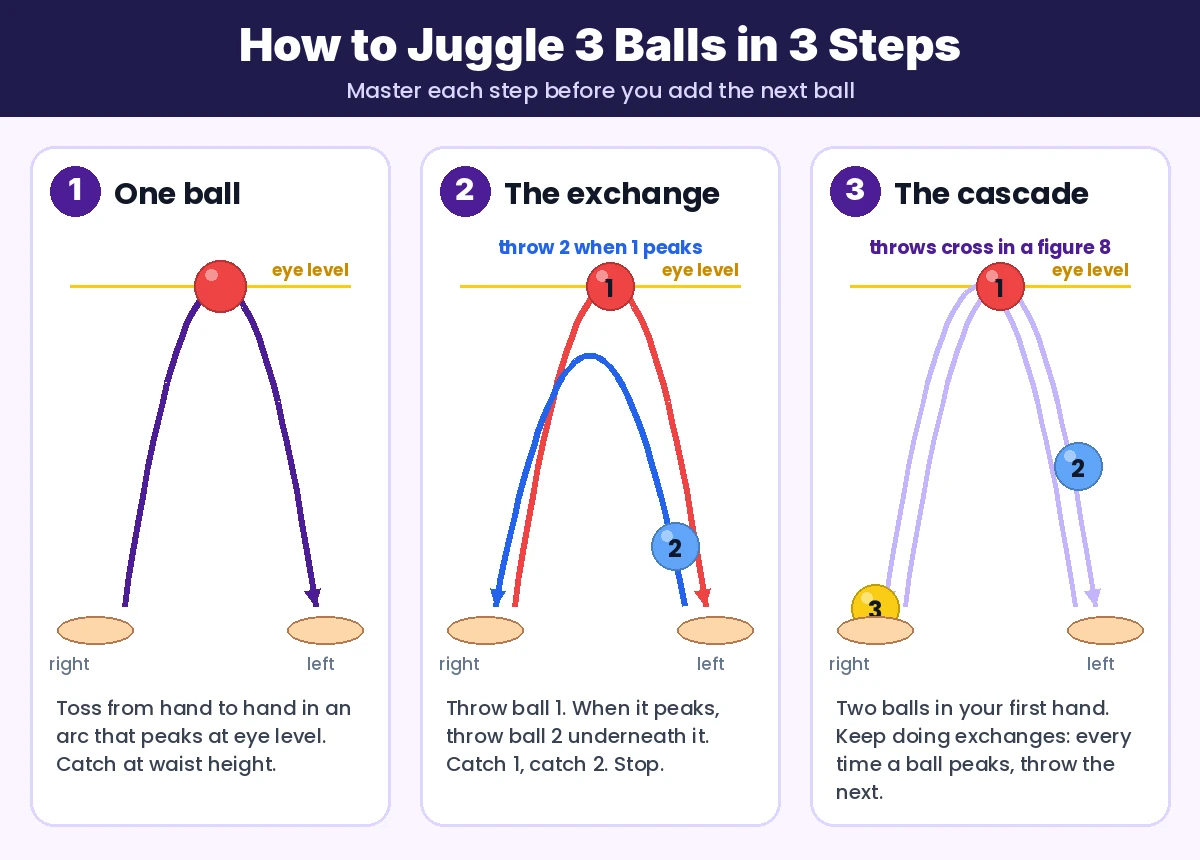
Learn to juggle three balls (the 3-ball cascade) in three progressive steps.
Total time: 15 minutes
Throw one ball
Toss one ball from your right hand to your left in a gentle arc that peaks at eye level, then back again. Let the ball drop into your waiting palm at waist height instead of reaching up for it. Do this until every throw lands in the same spot without moving your hand.
Do the exchange with two balls
Hold one ball in each hand. Throw the right-hand ball. When it reaches the top of its arc, throw the left-hand ball underneath it toward your right hand. Catch the first ball in your left hand, then the second in your right. Stop. Practice starting with each hand.
Hold three balls
Put two balls in your dominant hand: one held by your thumb, index and middle finger, the other tucked under your ring and little fingers. Put the third ball in your other hand.
Flash three throws
Throw ball 1 from the hand with two balls. When it peaks, throw ball 2 from the other hand. When ball 2 peaks, throw ball 3. Catch all three and stop. This is called a flash, and it is the moment you can say you have juggled.
Keep the cascade going
Instead of stopping after three throws, keep going: every time a ball peaks, throw the ball in the hand it is falling toward. Count your catches out loud and add one more each time.
The one rule that makes it click: you never throw because a ball is in your hand. You throw because a ball has reached the top of its arc. Say “throw, throw” out loud at each peak and your timing sorts itself out.
Slow-motion juggling trainer: watch every step
Reading about juggling only gets you so far. Use our free juggling trainer below to watch each step in slow motion. Start with Step 1: One ball at 15 to 35 percent speed, copy the hand movements with real balls, then move to the exchange and the cascade. When you are ready, try the tricks or type in any siteswap pattern.
🤹 Slow-Motion Juggling Trainer
Watch each step in slow motion, then speed it up. Pick a step, follow the counts and copy the hands.
What is siteswap? Jugglers write patterns as numbers. Each number is how high a ball is thrown in beats: 3 is a normal cascade throw, 4 is higher and comes back to the same hand, 5 is higher still and crosses, 1 is a quick pass across, 2 is holding a ball and 0 is an empty hand. So “3” is the cascade, “441” is a popular first trick, and “5” is the five-ball cascade.
7-day juggling practice plan for beginners
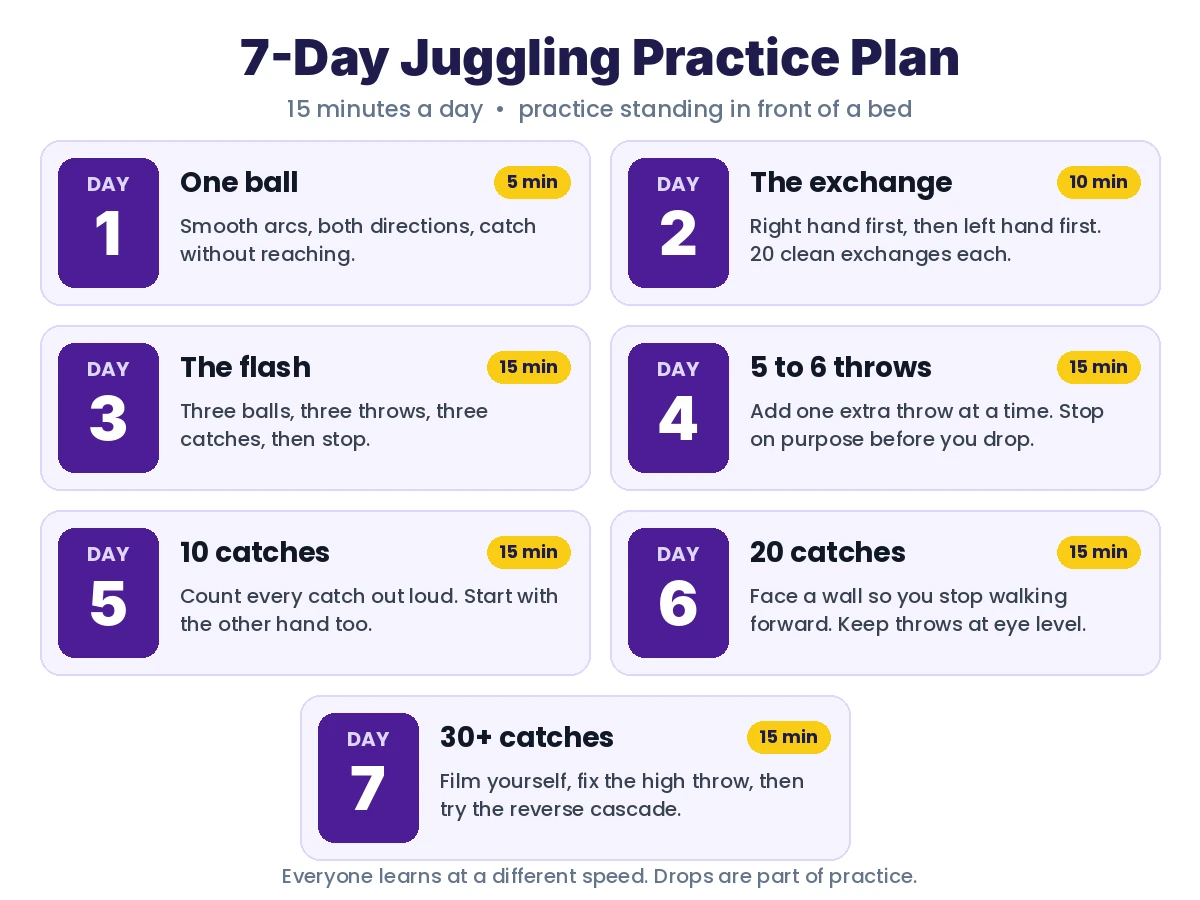
| Day | Goal | Practice |
|---|---|---|
| 1 | One ball, both directions | 5 minutes |
| 2 | Exchange from each hand, 20 clean reps | 10 minutes |
| 3 | The flash: 3 throws, 3 catches | 15 minutes |
| 4 | 5 to 6 throws in a row | 15 minutes |
| 5 | 10 catches, start with either hand | 15 minutes |
| 6 | 20 catches facing a wall | 15 minutes |
| 7 | 30+ catches, then try the reverse cascade | 15 minutes |
Everyone learns at a different pace, so treat the days as levels, not deadlines. If day 3 takes you a week, that is completely normal. Juggling also makes a great exercise to do when you are bored: you will be surprised how warm your arms get after ten minutes of picking up drops.
5 beginner juggling mistakes (and how to fix them)
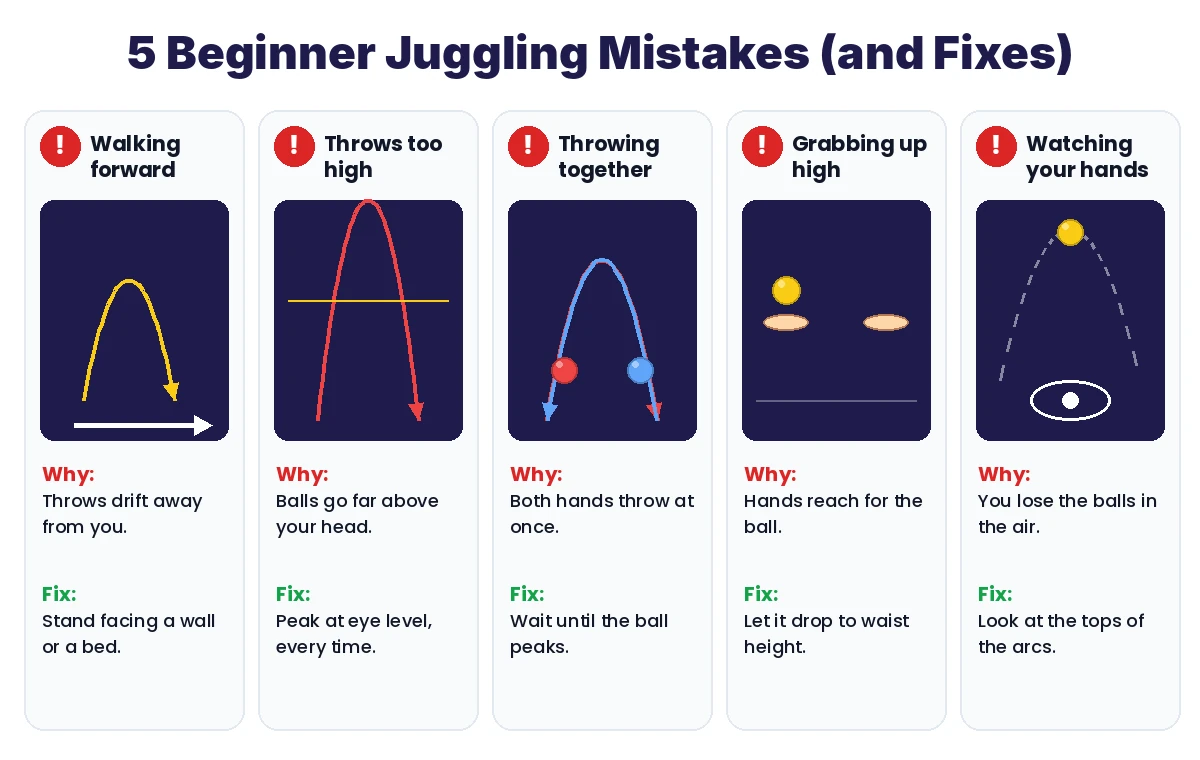
- Walking forward. Your throws drift away from your body, so you chase them. Practice facing a wall or a bed so you cannot step forward, and aim each throw slightly back toward yourself.
- Throwing too high (or too low). High throws come down fast and hard to catch; low throws leave no time. Imagine a window frame in front of you and make every ball peak at its top corners, around eye level.
- Throwing both balls at once. This is the most common exchange mistake. Wait until the first ball peaks before you throw the second.
- Reaching up to grab. Let the ball fall into your hand at waist height. Reaching up shortens the time you have for the next throw.
- Watching your hands. Look at the tops of the arcs, not your hands. Your hands know where to go once the throws are consistent.
How to make DIY juggling balls (rice and balloons)
No juggling balls? Make a set in 15 minutes. Homemade rice juggling balls are soft, squishy and do not roll away, and making them is a fun little thing to do when bored at home on its own.
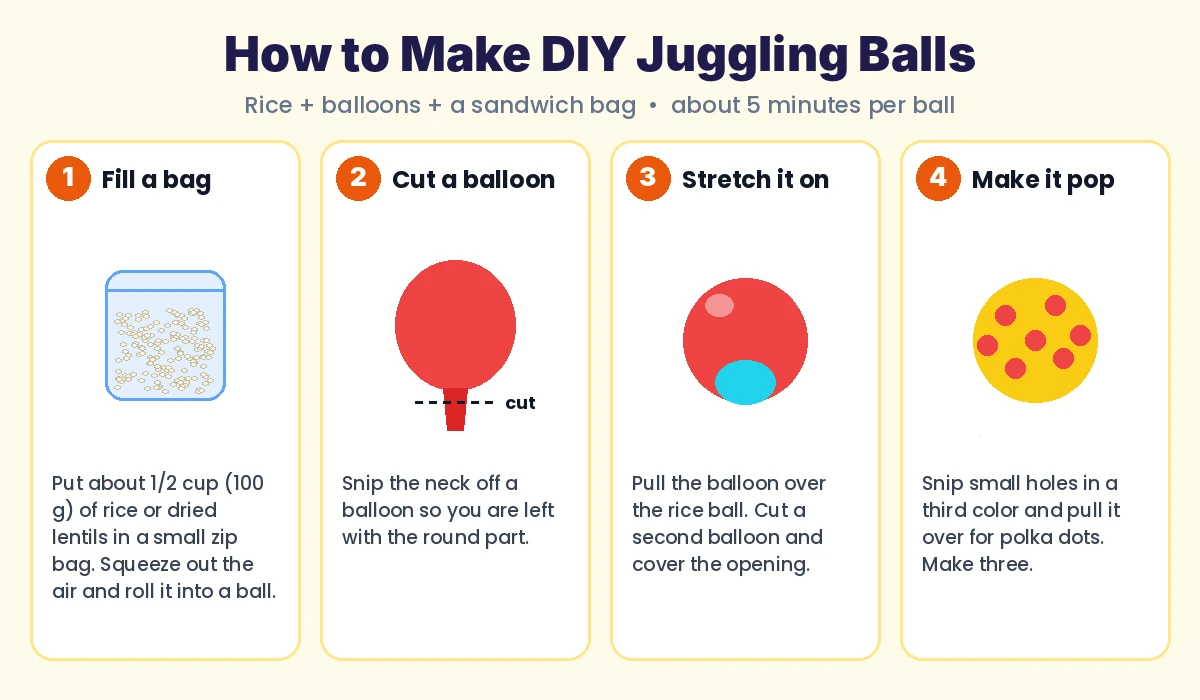
- Fill a bag. Put about 1/2 cup (around 100 g) of uncooked rice, millet or dried lentils into a small zip-top sandwich bag. Squeeze out the air, seal it and wrap any extra plastic around the filling to make a ball.
- Cut the balloons. Use regular 9 to 12 inch party balloons. Cut the neck off two balloons, just where it widens.
- Cover the ball. Stretch the first balloon over the rice ball. Stretch the second balloon over from the other side to cover the opening.
- Decorate. Snip small holes in a third balloon of another color and stretch it on for polka dots. Make three balls of slightly different colors so you can follow each one.
Keep the balls the same weight by measuring the filling. Avoid using these around very young children, since loose rice and balloon pieces are choking hazards.
Juggling scarves: the easiest way for kids to start
Juggling scarves are thin, light nylon squares that float down slowly, giving beginners about three times longer to react. They are perfect for kids from about five years old, and for adults who want to learn the cascade pattern before switching to balls. You throw scarves from the hand by pulling them up from the middle, then catch them with a downward clawing motion. The pattern is exactly the same as the ball cascade. For more screen-free ideas, see our things to do when bored for kids.
Juggling tricks to learn after the cascade
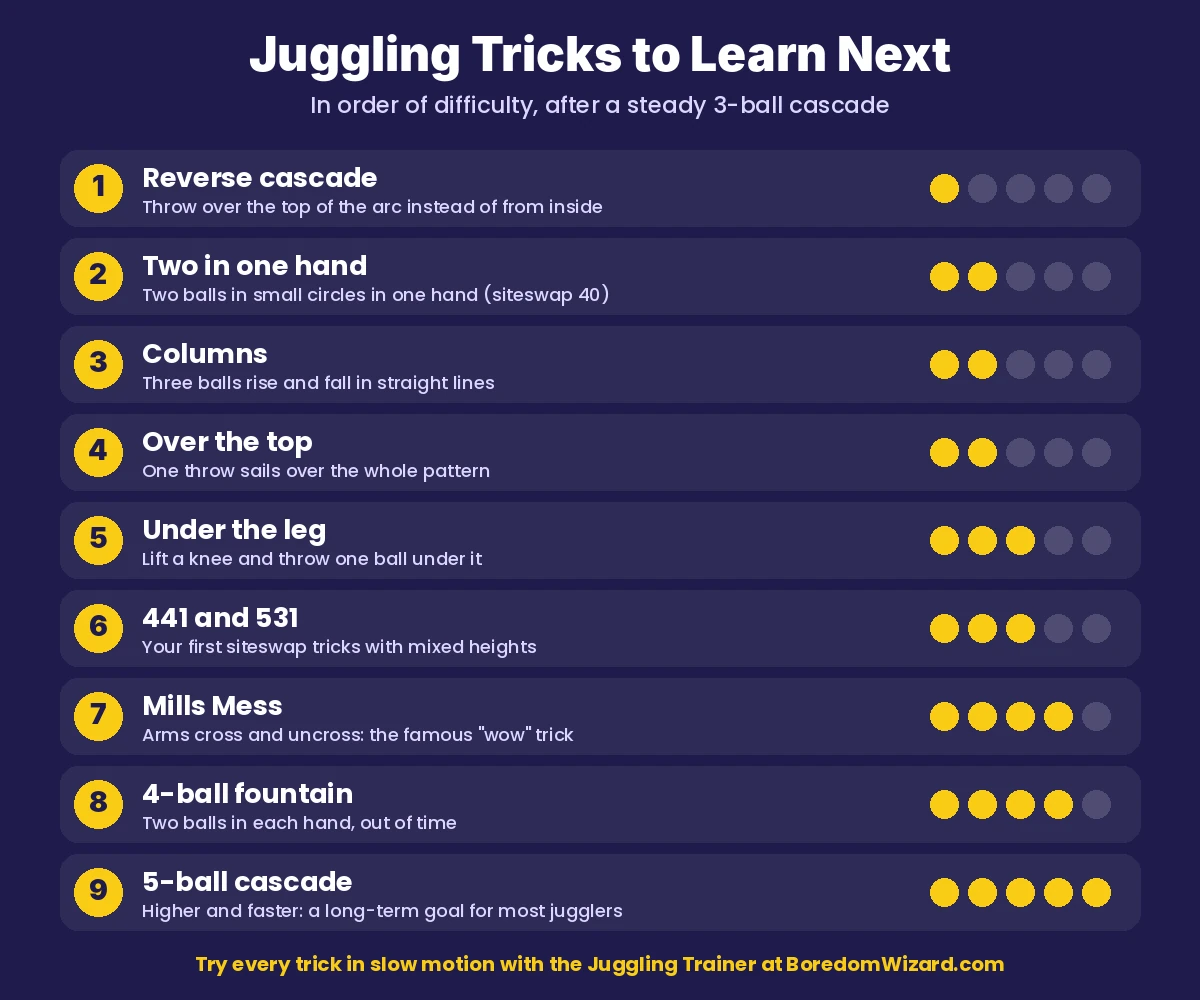
- Reverse cascade: the same pattern, but every ball is thrown over the top of the arc from the outside.
- Two in one hand: two balls in small circles in one hand. Learn both hands, and you are halfway to four balls.
- Columns: three balls rise and fall in straight lines; one hand moves between two columns.
- Over the top: one ball in the cascade is thrown high over the whole pattern instead of through it.
- Under the leg: lift your knee and throw one ball under it, then carry on the cascade.
- 441 and 531: your first siteswap tricks. Watch them in the trainer above before you try them.
- Mills Mess: the famous trick where your arms cross and uncross as you throw. Hard, but it looks amazing.
- 4-ball fountain: two balls in each hand, juggled out of time with each other.
- 5-ball cascade: the big milestone for most hobby jugglers.
Love skills you can show off? Pair juggling with a few easy card tricks, learn to solve a cube with our Rubik’s Cube algorithms, or take it outside with some skateboard tricks.
How to juggle a soccer ball (keepy-uppy)
“Juggling” also means keeping a soccer ball in the air with your feet, thighs and head. It is a separate skill, but the learning method is similar: start small and add one touch at a time.
- Drop and catch. Drop the ball onto your laces (the top of your foot), kick it gently back up and catch it.
- Add one bounce. Let the ball bounce once on the ground between each kick. Keep your ankle locked and toes pointed slightly up.
- Two touches. Kick, kick, catch. Then three, then four.
- Switch feet and add thighs. Alternate feet, and use your thigh to cushion high balls back to your feet.
Is juggling good for your brain?
Juggling is one of the best-studied hobbies in brain science. In a 2004 study published in Nature, adults who learned the 3-ball cascade over three months showed a temporary increase in gray matter in brain areas that process visual motion, and the change shrank again after they stopped practicing. A 2008 follow-up found similar changes in adults around 60. Oxford researchers later reported changes in white matter after six weeks of juggling practice, as summarized by ScienceDaily.
In plain terms, learning any new physical skill keeps your brain adapting, and juggling is a cheap, fun way to do it at any age. It is also a lovely analog hobby to fill short breaks, and a great pick from our list of hobbies for retirees to stay active. Still looking for your thing? Take our hobby quiz or browse unique hobbies to try.
Juggling FAQ
How long does it take to learn to juggle 3 balls?
Most beginners manage their first flash (three throws and three catches) within a few short practice sessions. Keeping a steady cascade going for 20 or more catches usually takes one to a few weeks of 10 to 15 minutes of daily practice.
What is the easiest way to learn to juggle?
Learn in order: one ball first, then the two-ball exchange, then three balls. Practice standing in front of a bed so drops are easy to pick up, and use soft beanbag balls or scarves.
What are the best juggling balls for beginners?
Soft beanbag balls about 2.5 inches (6 to 7 cm) across and around 100 to 130 grams are easiest, because they sit in your hand and do not bounce or roll away. Homemade rice and balloon balls work almost as well.
Why do I keep walking forward when I juggle?
Your throws are drifting away from your body. Practice facing a wall or a bed and aim each throw slightly back toward yourself.
How do you juggle 2 balls in one hand?
Hold two balls in one hand. Throw one up from the inside of your hand, and when it peaks throw the second one, then catch the first. Keep the balls moving in small circles or straight columns.
Can kids learn to juggle?
Yes. Children from about five can learn the pattern with juggling scarves, and most kids from about seven or eight can learn with balls.
Is juggling good for your brain?
Studies have found that learning to juggle is linked with changes in gray and white matter in brain areas involved in vision and movement, in both younger and older adults. It is also a fun way to take a screen break.
How do you juggle a soccer ball?
Drop the ball onto your laces, kick it gently back up and catch it. Then let it bounce once between kicks, and build up from two touches to three and four before switching feet and adding your thighs.