Macrame for Beginners: 8 Knots, a DIY Plant Hanger + 16 Easy Projects (2026)
Macrame looks complicated, but it is really just a handful of knots repeated in patterns. No needles, no machine, no pattern-reading skills: just cotton cord, your fingers and a dowel or ring to tie onto. That is why it has become one of the most relaxing hobbies to pick up when you are bored and want something beautiful to show for your time.
This macrame for beginners guide is set up like a two-day workshop. On Saturday you will choose your cord and learn the 8 basic macrame knots. On Sunday you will make a DIY macrame plant hanger from start to finish. After that, pick from 16 easy macrame projects, use the free cord calculator so you never cut too short, and see the macrame trends for 2026 and 2027.
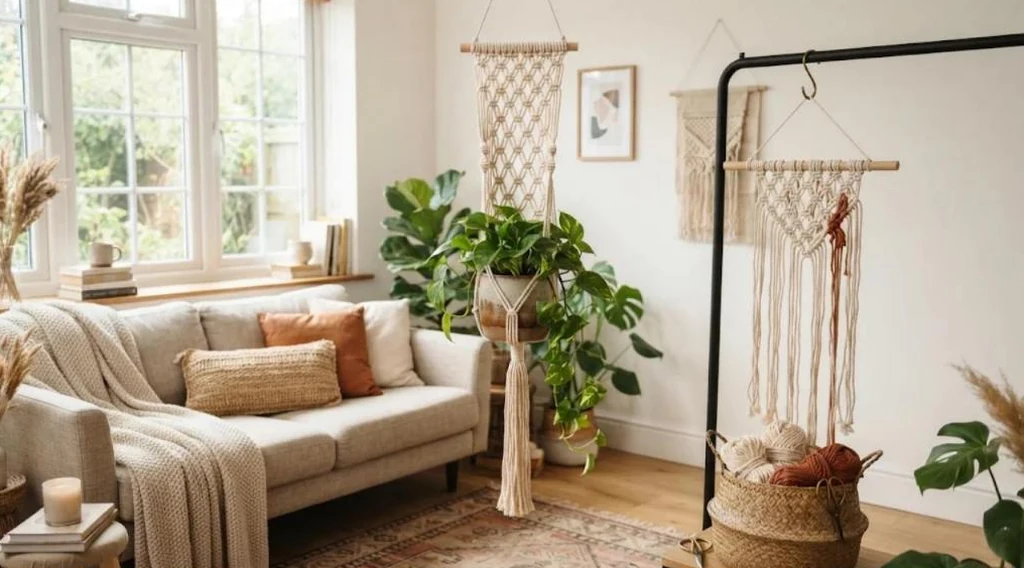
What is macrame? Macrame is a craft that uses knots instead of weaving or knitting to make patterns in cord. Most designs use just two knots, the square knot and the half hitch, attached to a dowel or ring with a lark’s head knot.
How to start macrame: Buy 3-4 mm cotton cord and a wooden dowel or ring. Practice the lark’s head, square knot and double half hitch on 4 short cords, then make a simple project like a keychain or a plant hanger.
Time to learn: one weekend | Cost: one roll of cord plus a dowel or ring | Best first project: a macrame plant hanger
Your 2-day macrame plan
| When | What you do | You finish with |
|---|---|---|
| Saturday morning | Pick your cord and set up a hanging workspace | Cord cut and ready |
| Saturday afternoon | Practice the 8 basic macrame knots | A knot sampler on a dowel |
| Sunday morning | Make the DIY macrame plant hanger | Your first finished piece |
| Sunday afternoon | Try a quick project from the list below | A keychain, bookmark or feather to gift |
Saturday morning: macrame supplies
You only need a few things to start. Skip big kits until you know which projects you enjoy.
- Cotton macrame cord, 3-4 mm: soft on the hands and forgiving. Single strand or 3-ply are best for learning.
- A wooden dowel or ring: a 12 in (30 cm) dowel for samplers and wall hangings, a 2 in (5 cm) ring for plant hangers.
- Sharp fabric scissors and a tape measure: dull scissors fray the ends.
- Something to hang your work on: a clothes rack with S-hooks, a coat hook or a strip of painter’s tape on a door.
- A comb or pet brush: for fluffy fringes on single-strand cord.
- Optional: wooden beads, a macrame board with pins for bracelets, and a few clips to hold cords out of the way.
How much macrame cord do you need?
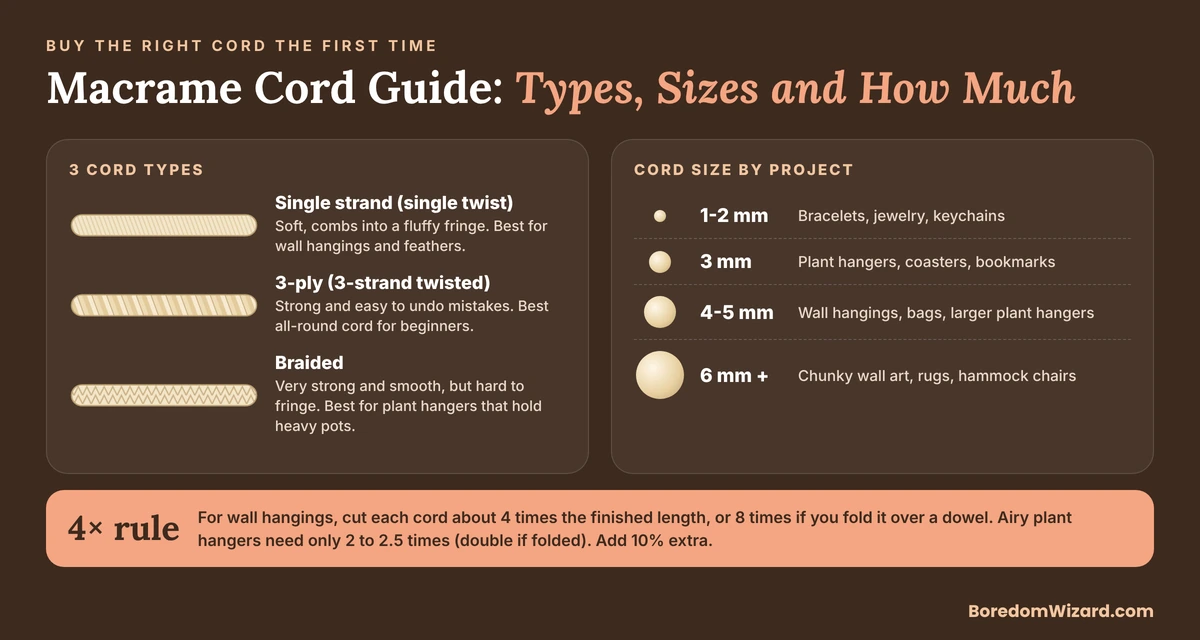
Running out of cord halfway through is the most common beginner mistake, and you cannot add length to a cord without a visible join. Use the calculator below before you cut. It is set up for the plant hanger you will make on Sunday.
🧶 Macrame Cord Calculator
Pick a project or enter your own numbers to see how long to cut each cord and how much to buy.
Project
Knot density
Cords folded over a dowel or ring?
Units
Saturday afternoon: 8 basic macrame knots
Learning how to macrame really comes down to these eight knots. Cut 4 cords about 3 ft (1 m) long, attach them to a short dowel and practice each knot until you can tie it without looking at the steps. This little sampler becomes your reference for every future project.
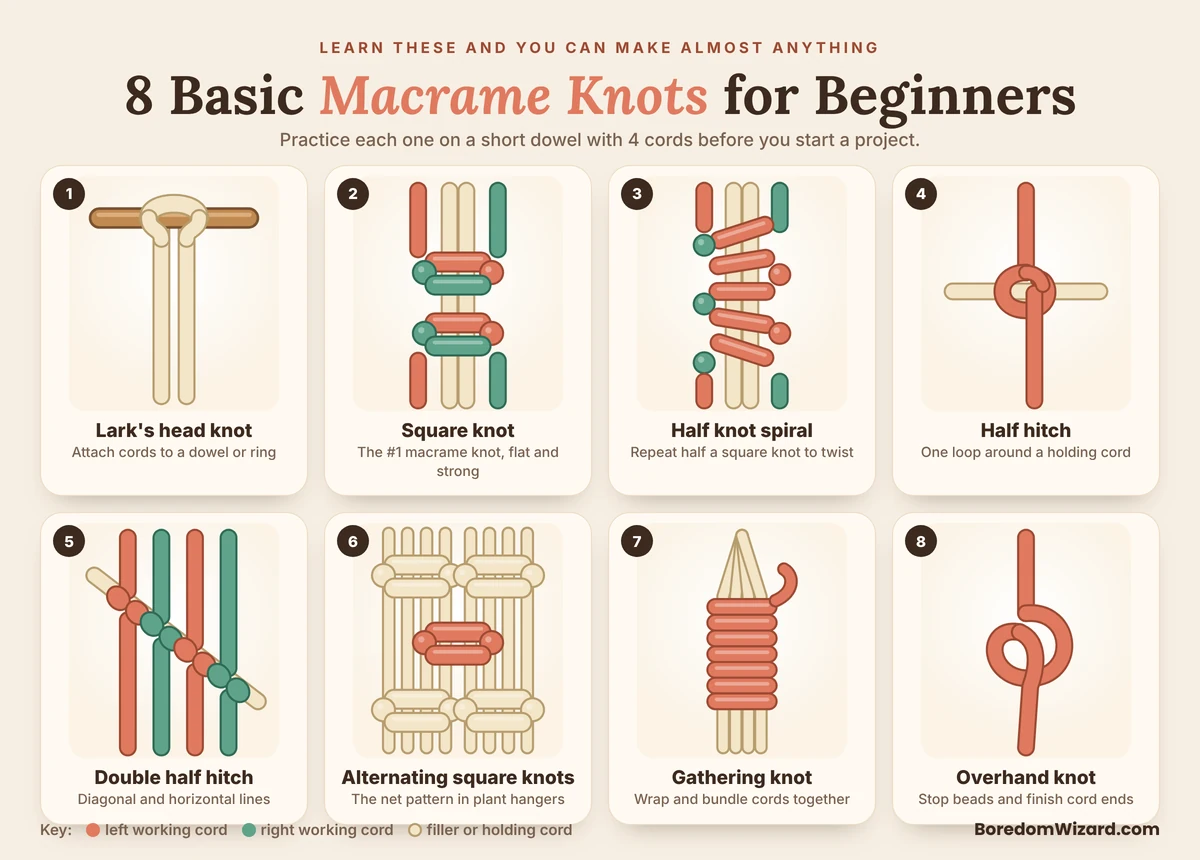
- Lark’s head knot: fold a cord in half, lay the loop over the dowel from the front, bring it down behind and pull both ends through the loop. This is how almost every macrame project begins.
- Square knot: use 4 cords. Take the left cord over the 2 middle fillers and under the right cord. Take the right cord under the fillers and up through the loop on the left. Pull tight, then repeat in mirror image, starting with the right cord. This is the most-used macrame knot.
- Half knot spiral: tie only the first half of the square knot over and over. After 4 or 5 knots the cords start to twist into a spiral. Let it turn naturally.
- Half hitch: hold one cord tight as the holding cord. Wrap the working cord over it, around the back and out through its own loop.
- Double half hitch: tie two half hitches in a row on the same holding cord. Angle the holding cord to make diagonal lines, or keep it level for horizontal bars.
- Alternating square knots: after a row of square knots, skip 2 cords and tie the next row using 2 cords from each neighboring knot. Repeat to build the classic net or diamond pattern.
- Gathering knot (wrapping knot): lay a short extra cord along a bundle with a loop pointing down, wrap the long end tightly around the bundle from top to bottom, thread it through the loop and pull the top tail until the loop hides under the wraps. Trim both ends.
- Overhand knot: make a loop and pass the end through it. Use it to stop beads from sliding or to finish fringe ends.
Sunday: DIY macrame plant hanger step by step
A macrame plant hanger is the perfect first real project: it only uses three knots, it is forgiving if your tension is uneven, and it looks great the moment you hang it. This pattern makes a hanger about 3 ft (90 cm) long that fits a 4 to 6 in pot.
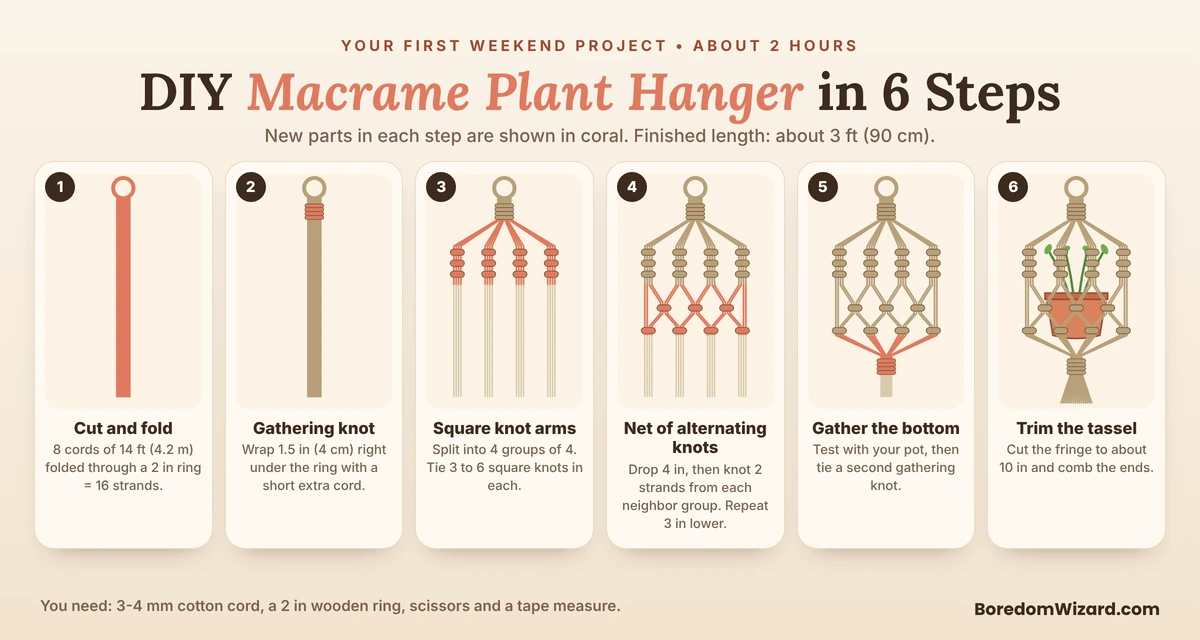
How to make an easy DIY macrame plant hanger with square knots and a net of alternating square knots.
Total time: 120 minutes
Cut and fold the cords
Cut 8 cords of 14 ft (4.2 m) from 3-4 mm cord, plus two 3 ft (1 m) wrapping cords. Thread the long cords through a 2 in (5 cm) wooden ring and line up the ends so each cord is folded exactly in half. You now have 16 strands.
Tie a gathering knot
Just under the ring, use one wrapping cord to tie a gathering knot about 1.5 in (4 cm) long. This holds all the strands together.
Make 4 square knot arms
Split the strands into 4 groups of 4. About 4 in (10 cm) below the gathering knot, tie 3 to 6 square knots in each group. Keep the starting point the same height in every group.
Knot the net
Measure about 4 in (10 cm) down. Take the 2 right strands of one group and the 2 left strands of the next group and tie a square knot. Repeat all the way around, including the first and last groups, so the hanger forms a ring. Tie a second round of alternating square knots about 3 in (8 cm) lower.
Gather the bottom
Set your pot inside the net to check the height, then remove it and tie a second gathering knot about 4 in (10 cm) below the last knots with the other wrapping cord.
Trim the tassel
Cut the fringe to about 10 in (25 cm). Unravel the ends with your fingers or a comb for a fluffy tassel, or keep them neat for a modern look.
Weight tip: cotton cord stretches a little, so hang your plant for a day before deciding on the final height. For a heavy ceramic pot, use braided cord and screw the hook into a ceiling joist, not just drywall.
16 easy macrame projects to try next
Once you can tie a square knot and a double half hitch, you can make every project below. They are ordered from quickest to most ambitious. Almost every free macrame pattern you find online is a mix of the same knots, so these projects are great practice for reading macrame patterns later.
Beginner macrame projects (1-8)
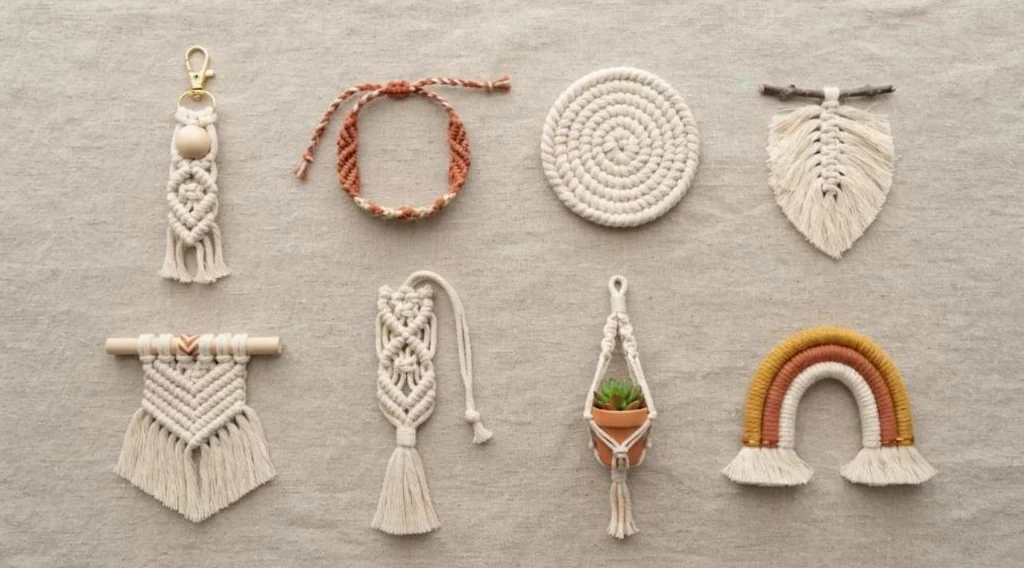
| # | Project | Main knots | Cord | Time |
|---|---|---|---|---|
| 1 | Macrame keychain with a wooden bead | Lark’s head, square knot, gathering knot | 3 mm | 20 min |
| 2 | Square knot bracelet | Square knot | 1-2 mm | 30 min |
| 3 | Round coaster | Lark’s head on a ring, square knot, double half hitch | 3 mm | 45 min |
| 4 | Macrame feather | Lark’s head on a center spine, then brush and trim | 3-5 mm single strand | 30 min |
| 5 | Mini wall hanging | Lark’s head, square knot, double half hitch | 3 mm | 1 hour |
| 6 | Bookmark with a tassel | Square knot, gathering knot | 2-3 mm | 30 min |
| 7 | Mini plant hanger for succulents | Square knot, alternating square knots | 3 mm | 45 min |
| 8 | Macrame rainbow | Wrapping cord around a thick rope core | 3 mm + 5 mm core | 1 hour |
Small pieces like keychains, feathers and bookmarks make great handmade gifts. If you like these, try our friendship bracelet patterns and pony bead patterns too.
Macrame ideas for the home (9-16)
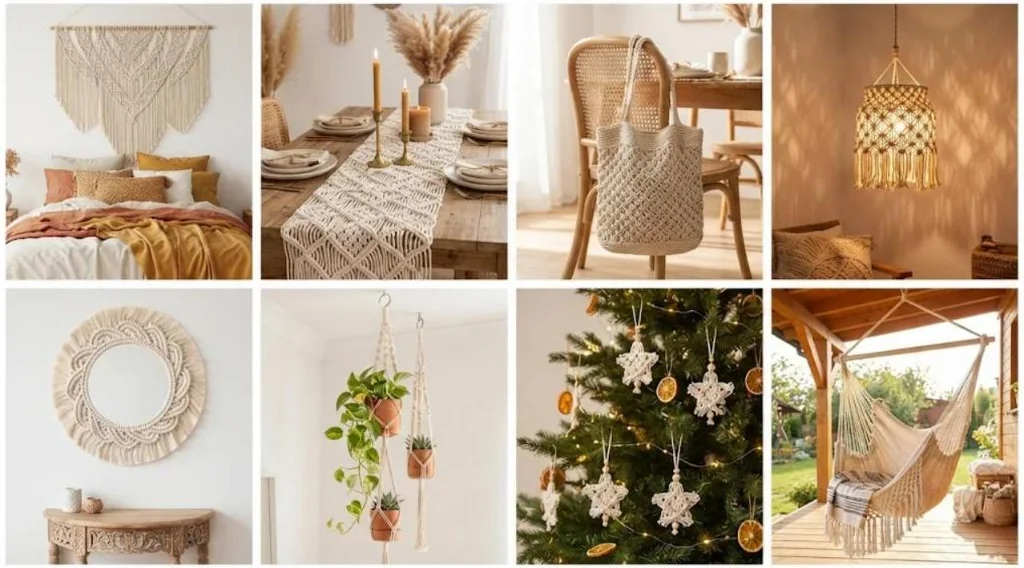
| # | Project | Main knots | Cord | Time |
|---|---|---|---|---|
| 9 | Large wall hanging | Double half hitch, alternating square knots | 5 mm single strand | 1-2 weekends |
| 10 | Table runner | Alternating square knots, double half hitch | 4-5 mm | 1 weekend |
| 11 | Market tote bag | Alternating square knots | 4 mm 3-ply | 4-6 hours |
| 12 | Pendant lampshade | Lark’s head on metal rings, square knot | 4-5 mm | 4-6 hours |
| 13 | Mirror frame | Double half hitch around a round mirror | 3-4 mm | 3-4 hours |
| 14 | Double plant hanger | Square knot, alternating square knots, gathering knot | 4 mm braided | 3 hours |
| 15 | Star Christmas ornaments | Lark’s head and double half hitch on a star frame | 2-3 mm | 30 min each |
| 16 | Hammock chair | Alternating square knots | 5-6 mm braided | Several weekends |
Safety notes: use only LED bulbs inside a macrame lampshade, and hang a hammock chair from hardware and a beam rated for the weight it will hold. For more home projects, see our home decor ideas and terrarium ideas, which pair perfectly with a plant hanger.
Macrame troubleshooting: 7 quick fixes
| Problem | Why it happens | Fix |
|---|---|---|
| Square knots twist into a spiral | You keep starting with the same side | Alternate: start the first half from the left, the second half from the right |
| Ran out of cord | Cords cut too short | Use the 4x rule or the calculator above, and cut a test cord first |
| Knots look uneven | Tension changes as you go | Hang your work at eye level and pull each knot with the same force |
| Diagonal lines are wavy | Holding cord not kept tight | Hold the holding cord firmly at the angle you want while you tie |
| Plant hanger hangs crooked | Groups started at different heights | Measure each group’s first knot from the gathering knot |
| Fringe looks frizzy | Wrong cord for a smooth fringe | Single strand brushes fluffy. Use 3-ply and leave it twisted for a neat fringe |
| Cord ends fray | Dull scissors or loose ends | Cut with sharp scissors and wrap the ends with tape until you finish |
Macrame trends 2026 (and what is next in 2027)
Macrame first boomed in the 1970s, came back with boho decor in the late 2010s and is now settling in as a modern, mindful craft. Here is what makers are tying now and where it is heading next:
- Mini and micro macrame: keychains, earrings, phone straps and bag charms in 1-2 mm cord. Quick, cheap and very giftable.
- Color blocking and dip-dye: terracotta, sage, mustard and soft blush instead of all-natural cream, often dyed at home.
- Functional pieces: plant hangers, market bags, lampshades and storage baskets that do a job, not just decorate a wall.
- Recycled cord: more makers choose cord spun from recycled cotton and reuse offcuts for fringes and keychains.
- Mixed fiber art: macrame combined with weaving, wooden beads and dried flowers in one piece.
- Into 2027: expect chunky 6 mm+ statement pieces, macrame lighting and more makers selling their own patterns and kits. It also fits the rise of screen-free, analog hobbies that calm a busy mind.
Is macrame a good hobby?
Yes, especially if you want a creative hobby you can learn fast. The repetitive knotting is calming, you see progress in minutes, a single roll of cord goes a long way and finished pieces make useful decor and gifts. Many people also sell keychains, plant hangers and wall hangings at craft fairs and online, which is why macrame appears in our list of crafts to make and sell.
If you enjoy working with your hands, try crochet for beginners or our guide on how to knit a scarf next. For more ideas, browse easy crafts for adults, creative hobbies and cheap hobbies.
A little history for your next craft night: macrame is thought to have started with 13th-century Arab weavers who knotted the loose ends of fabric into decorative fringes, and sailors later spread it around the world by knotting on long voyages (Wikipedia: Macrame).
Macrame FAQ
What is macrame?
Macrame is a craft that uses knots, instead of weaving or knitting, to create patterns in cord. Popular macrame projects include plant hangers, wall hangings, keychains, bags and bracelets.
Is macrame easy for beginners?
Yes. Most macrame projects use just a few knots, mainly the lark’s head, square knot and double half hitch. Most beginners can learn them in an afternoon and finish a simple plant hanger in about two hours.
What are the basic macrame knots?
The basic macrame knots are the lark’s head knot, square knot, half knot spiral, half hitch, double half hitch, alternating square knots, gathering knot and overhand knot.
What size macrame cord should a beginner use?
Use 3-4 mm cotton cord. It is easy to hold, shows the knots clearly and works for plant hangers, coasters and small wall hangings. Use 1-2 mm for jewelry and 5 mm or more for large wall hangings.
How much cord do I need for a macrame plant hanger?
For a plant hanger about 3 ft (90 cm) long, cut 8 cords of about 14 ft (4.2 m) and fold them in half through a ring. That gives 16 strands, plus two short cords for the gathering knots.
How do you make a macrame plant hanger?
Fold 8 long cords through a ring, tie a gathering knot, split the strands into 4 groups and tie square knots in each, join neighboring groups with alternating square knots to form a net, tie a gathering knot at the bottom and trim the tassel.
What is the difference between single strand, 3-ply and braided macrame cord?
Single strand cord is soft and brushes into a fluffy fringe. 3-ply cord is made of three twisted strands, is strong and easy to undo. Braided cord is the strongest and smoothest but is hard to fringe, so it suits heavy plant hangers.
Is macrame still in style in 2026?
Yes. Macrame has moved beyond the classic boho wall hanging into mini accessories, color-blocked pieces, functional items like bags and lampshades, and mixed fiber art.