27 Things to Do When Bored Alone (Worth Your Time) in 2026

Boredom alone is not the same thing as loneliness. I want to be clear about that before we go any further. Boredom alone is your brain scanning the room, checking your hands, and asking: what are we doing next? That question deserves a real answer — not another scroll session.
The 27 best things to do when bored alone include cooking an elaborate meal from scratch, starting a journaling practice, going for a mindful solo walk, learning a language on Duolingo, organizing one room, trying mindfulness meditation, taking an online course on Skillshare or Coursera, becoming a tourist in your own city, and 19 more ideas that range from 10 minutes to a full afternoon — all free or under $20.
I’ve coached executives, athletes, and business owners and I’ve raised 4 kids who have all been spectacularly bored at different stages. What I know for certain is this: the right solo activity does not just fill time. It shifts your state. These 27 things to do when bored alone were chosen because they leave you feeling more like yourself when you’re done — not less.
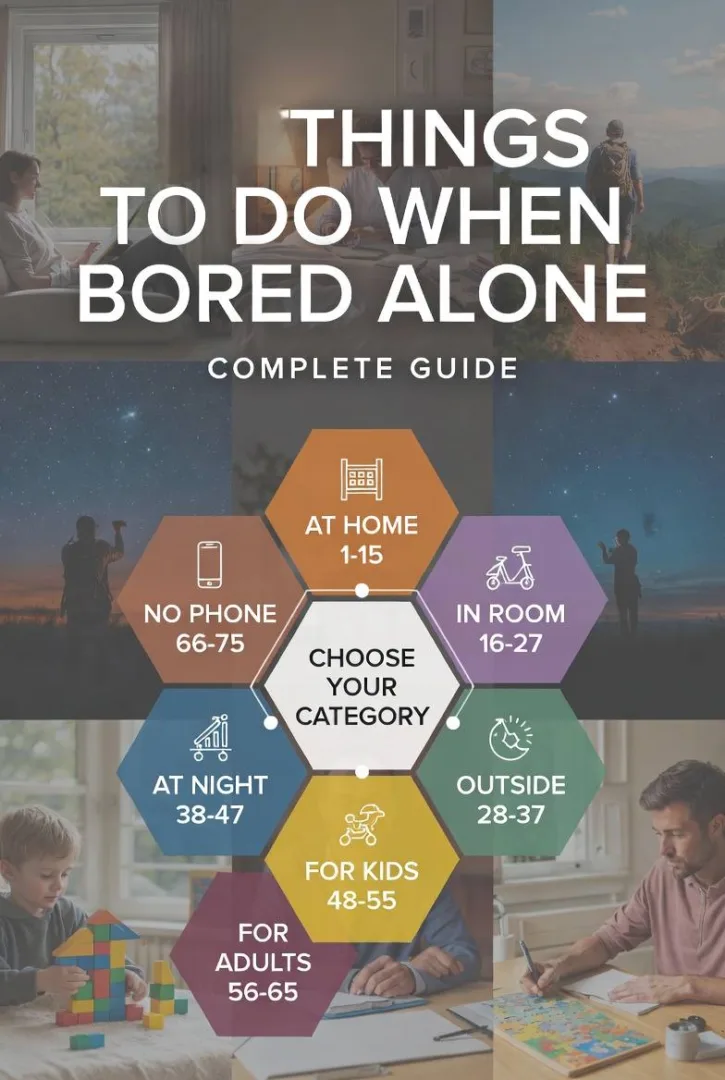
1. Cook an Elaborate Meal From Scratch — Turn Boredom Into Dinner
Cooking an elaborate meal alone transforms aimless time into a 90-minute creative project that ends with something you can actually eat.
Pick a recipe that intimidates you slightly. Not a recipe you’ve made 40 times — one that requires a technique or ingredient you have never used. Ina Garten’s beef bourguignon. A Thai curry paste from whole spices. Homemade pasta with nothing but flour, eggs, and a rolling pin. The kind of cooking that takes attention is the kind that displaces boredom entirely.
This works because cooking demands sequencing, fine motor control, timing, and sensory engagement all at once. Your brain cannot be bored and sautéing garlic at the same time. I’ve recommended this to dozens of clients who say they have nothing to do on a Sunday afternoon — every single one reported that the focus required changed their mood within 20 minutes.
You do not need a professional kitchen. A single pot, a cutting board, and a sharp knife handle 90% of recipes. If money is tight, reverse engineer a favorite restaurant dish using pantry staples. The process matters more than the presentation.
| Detail | Info |
| Time Required | 60–120 minutes |
| Cost | Under $15 (groceries) |
| Energy Level | Medium |
| Best For | Solo adults, teens who can use a stove |
| Indoor or Outdoor | Indoor |
| What You Need | Kitchen basics, one recipe, grocery list |
Natty’s take:
I’ve done this at 9 PM on a Tuesday when my brain was completely fried. I picked a recipe from Pinterest that I had been saving for months and just started. By the time the kitchen smelled like roasted garlic and thyme, I forgot I was tired. Cooking alone is not about the food. It’s about what the focus does to your head.
2. Start a Journaling Practice — The 10-Minute Reset
Journaling for 10 minutes redirects the scattered energy of boredom into self-awareness, and it costs nothing but a pen and paper.
You do not need a fancy journal. A piece of notebook paper works. Open to a blank page and write one of these prompts at the top: What am I avoiding right now? What would make today feel like a win? What do I actually want to do this week? Then write without stopping for 10 minutes. Do not edit. Do not reread. Just move the pen.
Journaling works because it externalizes the noise in your head. When you are bored alone, your brain is cycling through options without committing to any of them. Writing forces a decision. Research published in BMJ Open has connected regular journaling to reduced anxiety and improved emotional regulation — and those benefits start on day one.
This is one of the best things to do when bored alone at home because it needs zero preparation. No app download. No equipment. No leaving the couch. Just a pen, paper, and honesty.
| Detail | Info |
| Time Required | 10–20 minutes |
| Cost | Free |
| Energy Level | Low |
| Best For | Solo — all ages, introverts especially |
| Indoor or Outdoor | Indoor |
| What You Need | Pen and paper |
3. Go for a Mindful Solo Walk or Run — Move Your Body, Shift Your Mind
A 30-minute solo walk or mindful run with no headphones resets your nervous system and breaks the mental loop of boredom faster than any indoor activity.
Leave your phone in your pocket or at home. Walk or run at whatever pace feels natural. Pay attention to what you see, hear, and smell — not what you need to do later. This is not exercise for fitness. This is movement as a state change.
Mindful running and walking work because physical movement increases blood flow to the prefrontal cortex, the part of your brain responsible for decision-making and focus. A study from Harvard found that even 20 minutes of moderate walking improved mood and reduced feelings of stagnation. When you add the mindfulness layer — noticing without judging — the effect compounds.
If you live near a park like Central Park or Prospect Park, walk there. If you live in a suburb, pick a route you have never taken. The novelty of a new path keeps your brain engaged. This is one of the best solo activities for introverts because it requires zero social energy and delivers a significant mood lift.
| Detail | Info |
| Time Required | 20–45 minutes |
| Cost | Free |
| Energy Level | Low to Medium |
| Best For | Solo — all ages, especially introverts |
| Indoor or Outdoor | Outdoor |
| What You Need | Comfortable shoes |
Natty’s take:
I go for a walk alone at least 3 times a week. No podcast. No music. Just me and whatever street I’m on. My best business ideas have come from these walks — not from sitting at my desk. If you are bored alone outside and don’t know what to do, start walking. Direction optional.
4. Learn a Language on Duolingo — Because Your Brain Is Literally Asking for Input
Spending 15 minutes on Duolingo turns dead time into measurable progress on a skill that compounds every single day you practice.
Download the app if you do not have it. Pick a language you have always been curious about. Complete one lesson. That is it. One lesson takes 5 to 8 minutes, and the gamification system makes it satisfying enough that most people do 2 or 3 before they realize how much time has passed.
Language learning works against boredom because it activates pattern recognition, memory recall, and auditory processing simultaneously. Your brain shifts from scanning for something to do into actively solving problems. After 10 sessions, you will be able to construct basic sentences — and that kind of visible progress changes how you feel about your free time.
This is one of the totally free options that is genuinely productive. If you want to go deeper, Coursera and Skillshare offer full language courses with cultural context and conversation practice. But Duolingo is where you start when you are bored alone and want to use the time.
| Detail | Info |
| Time Required | 10–20 minutes per session |
| Cost | Free (premium optional) |
| Energy Level | Low |
| Best For | Solo — teens, adults, language nerds |
| Indoor or Outdoor | Indoor |
| What You Need | Smartphone or laptop |
5. Organize One Room Top to Bottom — Small Change, Outsized Impact
Organizing one room — just one — gives your brain the sense of control and completion that boredom strips away.
Pick the room that bothers you most. Not the whole house. One room. Set a timer for 60 minutes and work through it in this order: remove everything that does not belong, clean surfaces, reorganize what stays, catalog any hardware inventory or supplies you have been ignoring. Bag donations. Throw away trash. Wipe everything down.
Organizing works against boredom because it creates a visible before-and-after that your brain registers as an accomplishment. I’ve seen this shift moods in clients who were stuck for weeks. One afternoon of organizing a home office or a closet gave them enough momentum to tackle the project they had been avoiding.
If you want a smaller version, reorganize your physical bookshelf, optimize your browser bookmark folders, or catalog items in one drawer. The principle is the same: take something messy, make it ordered, and let the visual result do the emotional work.
| Detail | Info |
| Time Required | 45–90 minutes |
| Cost | Free |
| Energy Level | Medium |
| Best For | Solo — adults, productive types |
| Indoor or Outdoor | Indoor |
| What You Need | Trash bags, cleaning spray, timer |
Natty’s take:
I reorganize something in my house every time I feel stuck on a problem. Not because I’m avoiding the problem — because the physical act of creating order gives my brain permission to think clearly. If you are bored alone at home and want to be productive, start with the room that stresses you out. You will feel different by the time you’re done.
6. Read a Book That Has Been Sitting on Your Shelf — The Original Boredom Cure
Reading a physical book for 30 uninterrupted minutes is the single most effective low-energy activity for replacing boredom with genuine engagement.
Go to your shelf. Pick the book you bought, borrowed, or were gifted and never finished. Sit somewhere comfortable. Read for 30 minutes without checking your phone. If you do not own a physical book, use a Kindle, download Audible, or check your local library’s digital catalog.
Reading works because it demands sustained attention, which is the exact opposite of the scattered mental state boredom creates. A novel immerses you in someone else’s world. A nonfiction book like Eat, Pray, Love or a memoir gives you a lens on a life different from yours. Both types pull you out of the boredom loop.
Build a reading list on Goodreads so you always have a next book ready. The moment between finishing one book and starting another is where boredom creeps back in. Eliminate that gap.
| Detail | Info |
| Time Required | 30–60 minutes |
| Cost | Free (library) to $15 |
| Energy Level | Low |
| Best For | Solo — all ages, introverts |
| Indoor or Outdoor | Indoor |
| What You Need | One book |
7. Try Mindfulness Meditation — 10 Minutes That Change Your Next 3 Hours
A 10-minute mindfulness meditation session reduces the restlessness that boredom creates and sharpens your ability to choose what to do next.
Sit somewhere quiet. Close your eyes. Breathe normally. Focus on the sensation of air entering and leaving your nose. When your mind wanders — and it will — bring it back. That is the entire practice. If you want guided help, Headspace offers free beginner sessions that walk you through each step.
Meditation directly addresses the cognitive conditions that make boredom feel unbearable. Research from Harvard has linked regular meditation practice to reduced anxiety, lower blood pressure, and even a slower progression of Alzheimer’s disease markers. But the immediate benefit is simpler: after 10 minutes of meditation, your brain stops spinning and starts choosing.
This is one of the best things to do when bored alone without a phone. No screen. No app required. Just you, a chair, and 10 minutes. If you are bored alone at night and your brain will not stop, meditation is the off switch.
| Detail | Info |
| Time Required | 10–20 minutes |
| Cost | Free |
| Energy Level | Low |
| Best For | Solo — all ages, anyone with anxiety or restlessness |
| Indoor or Outdoor | Indoor |
| What You Need | Quiet space, optional cushion |
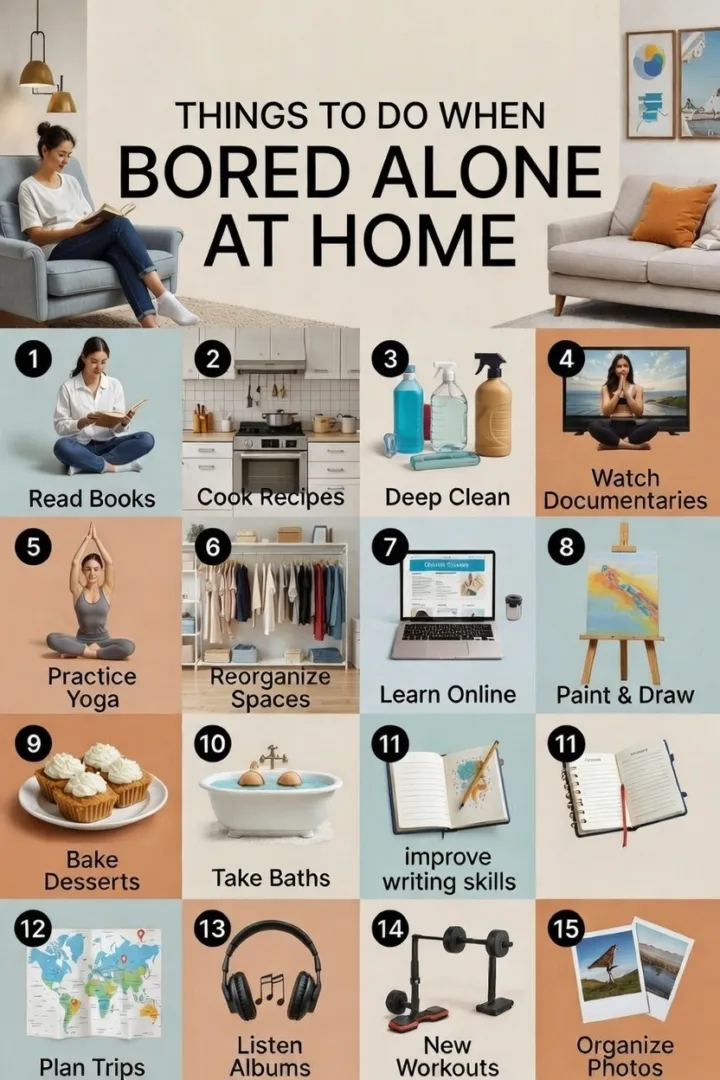
8. Take an Online Course — Turn Boredom Into a New Skill
Completing one module of an online course on Skillshare or Coursera converts 30 minutes of boredom into permanent personal development.
Go to Skillshare, Coursera, or YouTube and search for something you have been curious about. Watercolor painting. Data analysis. Photography composition. Music production. Pick a course. Watch the first lesson. Take notes. That is your afternoon.
Online courses work against boredom because they give your brain structured input with clear milestones. You are not just watching a video — you are progressing through something. The difference between scrolling YouTube randomly and following a course on YouTube is the difference between killing time and building a skill.
If money is a factor, YouTube has full university-level courses for free. SUNY Buffalo offers open courseware. Coursera has audit options on most classes. The barrier is not money. The barrier is choosing.
| Detail | Info |
| Time Required | 30–60 minutes per session |
| Cost | Free to $15/month |
| Energy Level | Low to Medium |
| Best For | Solo — adults, teens, lifelong learners |
| Indoor or Outdoor | Indoor |
| What You Need | Laptop or tablet, internet connection |
9. Be a Tourist in Your Own City — Solo Outings That Change Your Perspective
Treating your own city like a travel destination gives you the novelty hit your bored brain is craving without spending money on a plane ticket.
Pick a neighborhood you rarely visit. Walk there. Look at the architecture. Stop at a café you have never entered. Visit a museum — the Guggenheim, a local gallery, a historical society. Window shop in SoHo or whatever your version of that neighborhood is. Eat lunch at a place you have walked past a hundred times. Take photos like a tourist would.
This works because boredom is often a familiarity problem. You are not bored because there is nothing to do. You are bored because everything you usually do has stopped surprising you. Becoming a tourist in your own city forces your brain into novelty-seeking mode, and that mode is the opposite of bored.
If you live in NYC, walk through a park in a borough you never visit. If you live in a small town, drive 30 minutes in any direction and explore. Hotel Tonight can help you find last-minute stays if you want to turn it into an overnight solo trip. This is one of the best solo outings for introverts because you control the pace, the route, and the length.
| Detail | Info |
| Time Required | 2–4 hours |
| Cost | Free to $30 (transit, coffee, admission) |
| Energy Level | Medium |
| Best For | Solo — adults, teens with transit access |
| Indoor or Outdoor | Outdoor |
| What You Need | Comfortable shoes, phone for photos, small cash |
10. Start Drawing or Painting — Creative Hobbies You Can Begin Today
Picking up a pencil and sketching for 20 minutes activates the creative network in your brain that boredom has been trying to wake up.
You do not need to be good at this. You need a pencil and a piece of paper. Sketch what is in front of you: a mug, a shoe, your hand. If you want direction, search Pinterest for “drawing prompts” and pick one. If you prefer paint, grab a basic watercolor set for under $10 and follow a beginner tutorial on YouTube.
Creative hobbies work against boredom because they require a specific kind of attention that screens do not provide. Drawing demands observation — you have to look at something closely in order to reproduce it. That close looking displaces the mental restlessness that makes boredom feel uncomfortable. You do not have to produce art. You just have to focus.
If you want a specific challenge, sketch local architectural details — a doorframe, a window pattern, a staircase railing. Architectural sketching trains your eye to see structure in ordinary things, and that shift in perception outlasts the drawing session.
| Detail | Info |
| Time Required | 20–60 minutes |
| Cost | Free to $10 (basic supplies) |
| Energy Level | Low to Medium |
| Best For | Solo — all ages, creative types, beginners welcome |
| Indoor or Outdoor | Indoor or Outdoor |
| What You Need | Pencil, paper, optional watercolors |
Natty’s take:
I am not an artist. I draw badly and I do it anyway. The value is not in the drawing. The value is in the 30 minutes where my brain stops planning, stops problem-solving, and just observes. If you think you need talent to draw, you do not. You need a pencil and 20 minutes of honesty about what you see.
11. Have a Full Self-Care Day — Intentional, Not Indulgent
A planned self-care day alone replaces boredom with restoration — and it works best when you treat it like an appointment, not an afterthought.
Block 3 to 5 hours. Write a schedule for yourself: morning skin care, a long bath or shower, a meal you prepare slowly, an hour of reading, a walk, and one thing that makes you feel genuinely good — not just distracted. This is the Golden Age of self-care for a reason: people are realizing that rest is not laziness. Rest is maintenance.
Self-care routines work against boredom because they give structure to unstructured time. The boredom you feel alone at home on a Saturday is often the absence of a plan, not the absence of options. A self-care day gives you both — a plan and options that actually replenish you.
If you think self-care is face masks and candles, broaden the definition. Self-care is also meal prepping for the week, scheduling a doctor’s appointment you have been avoiding, or spending 30 minutes on a wellness check-in with yourself. The version of self-care that matters is the one that leaves you functioning better tomorrow.
| Detail | Info |
| Time Required | 3–5 hours |
| Cost | Free to $30 |
| Energy Level | Low |
| Best For | Solo — adults, teens, anyone feeling depleted |
| Indoor or Outdoor | Indoor |
| What You Need | Whatever makes you feel human — bath supplies, a book, a recipe |
12. People Watch at a Café or Park — Free Entertainment That Sharpens Your Observation
Sitting alone in a public place and watching people for 30 minutes is one of the most underrated solo activities for breaking the boredom cycle.
Find a bench, a café window, or a park. Sit down. Watch. Notice the couple arguing quietly. The dad chasing a toddler. The person reading on a bench who looks exactly like you feel right now. People watching alone is not creepy — it is one of the oldest forms of entertainment and one of the best ways to get out of your own head.
This works because observation shifts your attention outward. Boredom is an inward spiral — you are thinking about yourself, your lack of plans, your restlessness. People watching reverses that. You become curious about others instead of frustrated with yourself.
If you live near a park like Prospect Park or a busy downtown area, go there. Grab an Auntie Anne’s pretzel or a coffee. Give yourself 30 minutes with no phone. You will leave feeling lighter than you arrived.
| Detail | Info |
| Time Required | 30–60 minutes |
| Cost | Free to $5 (coffee) |
| Energy Level | Low |
| Best For | Solo — all ages, introverts and extroverts |
| Indoor or Outdoor | Outdoor or Indoor (café) |
| What You Need | Nothing — just show up |
13. Volunteer Through VolunteerMatch — Give Time, Get Perspective
Volunteering for 2 hours through VolunteerMatch or a local organization converts boredom into contribution and gives you a sense of purpose that solo activities cannot always match.
Go to Volunteer Match and enter your zip code. Filter by cause, time commitment, and whether you want in-person or virtual opportunities. Shelters, food banks, literacy programs, and community gardens all need help. Pick one and sign up for a single shift. No long-term commitment required for your first time.
Volunteering works against boredom because it connects your energy to someone else’s need. That connection is one of the fastest mood shifters I have seen in 26 years of coaching. When you feel purposeless and bored, helping someone else gives you a purpose that requires zero planning. Someone already planned the work. You just show up.
| Detail | Info |
| Time Required | 2–4 hours |
| Cost | Free |
| Energy Level | Medium |
| Best For | Solo — adults, teens 16+ |
| Indoor or Outdoor | Outdoor or Indoor |
| What You Need | Transportation, comfortable clothes |
14. Curate Your Digital Photo Archives — Organize 3,000 Memories in One Afternoon
Spending an hour sorting, deleting, and organizing your phone’s photo library turns digital clutter into a curated archive and gives boredom a satisfying purpose.
Open your camera roll. Delete the duplicates, the blurry shots, the accidental screenshots. Create albums by year, trip, or person. Back up the ones that matter to a cloud service. This project takes 45 to 90 minutes depending on how many photos you have ignored, and the result is a phone that feels lighter and a photo library that actually tells your story.
Curating digital photo archives works against boredom because it combines nostalgia with organization — two things your brain enjoys. You will stop on photos you forgot you took and remember moments that make you smile. That emotional engagement is the opposite of boredom.
| Detail | Info |
| Time Required | 45–90 minutes |
| Cost | Free |
| Energy Level | Low |
| Best For | Solo — adults, teens |
| Indoor or Outdoor | Indoor |
| What You Need | Phone or laptop |

15. Compose Micro Fiction Pieces — Write a Complete Story in 100 Words
Writing a 100-word story exercises your creativity, your editing instincts, and your ability to think in complete arcs — all in under 15 minutes.
Pick a prompt: a stranger on a train, a letter that arrives 10 years late, the last person in a building. Write the story in exactly 100 words. Not 99. Not 101. The constraint is the point. It forces you to choose every word deliberately, and that level of focus is the antidote to boredom’s mental fog.
Micro fiction works because it is short enough to finish in one sitting and challenging enough to keep your brain engaged. You will rewrite, cut, and rearrange more in 15 minutes than most people do in a month. This is one of the best things to do when bored alone with pen and paper — no technology required.
| Detail | Info |
| Time Required | 10–20 minutes per story |
| Cost | Free |
| Energy Level | Low to Medium |
| Best For | Solo — adults, teens, writers and non-writers |
| Indoor or Outdoor | Indoor |
| What You Need | Pen and paper or laptop |
Natty’s take:
I started doing this when my kids were little and I had 15-minute windows of free time. I would write a 100-word story while waiting in the car. They were terrible at first. Then they got better. The point was never publication. The point was using my brain for something that required care. If you are bored and alone in your room, try it. One story. See what happens.
16. Window Shop a Neighborhood You Never Visit — Solo Outing, Zero Spending Required
Walking through a new neighborhood and window shopping without buying anything gives you novelty, movement, and visual inspiration for free.
Pick a neighborhood with shops, galleries, or boutiques you have never entered. Walk slowly. Look at window displays. Go inside stores that catch your eye. Touch fabrics, browse shelves, try on a hat. You are not shopping. You are exploring. The financial pressure is gone, and what is left is pure curiosity.
Window shopping works because it gives your brain the novelty of a new environment without the cost of travel. Retail spaces are designed to be visually stimulating — colors, textures, arrangements — and that stimulation is exactly what your bored brain is missing. Walk a neighborhood like SoHo, a local arts district, or even a good thrift store strip.
| Detail | Info |
| Time Required | 1–2 hours |
| Cost | Free |
| Energy Level | Low to Medium |
| Best For | Solo — adults, teens |
| Indoor or Outdoor | Outdoor |
| What You Need | Comfortable shoes |
17. Listen to a Podcast and Deconstruct It — Turn Passive Listening Into Active Learning
Listening to one podcast episode with a notebook open transforms passive entertainment into a 30-minute personal development session.
Pick a podcast on a topic you care about — business, psychology, history, wellness, true crime, personal growth. Play one episode. Pause when something strikes you. Write it down. Ask yourself: do I agree? Why? What would I do differently? This is not listening. This is deconstructing complex podcast episodes, and the difference is enormous.
Active listening works because it engages your analytical brain. Passive listening lets boredom return within minutes. Active listening forces you to process, evaluate, and respond — even if the response is just a note in a margin. Spotify, Audible, and every podcast app have free content that can fill this role.
| Detail | Info |
| Time Required | 30–60 minutes |
| Cost | Free |
| Energy Level | Low |
| Best For | Solo — adults, teens |
| Indoor or Outdoor | Indoor or Outdoor |
| What You Need | Phone, headphones, notebook |
18. Rearrange Your Furniture — Prototype a New Room Layout in 45 Minutes
Moving your furniture into a new arrangement changes how a room feels and gives your brain a spatial problem to solve that is satisfying in a way screens never are.
Pick one room. Stand in the doorway and imagine the furniture in different positions. Then move it. Try the bed against a different wall. Rotate the couch. Shift the desk to face a window. Prototype modular desk arrangements until one clicks. You do not need to buy anything. You are working with what you have.
This works because spatial rearrangement activates the same brain regions as puzzle-solving. It also creates a sense of newness in a familiar space — and that newness combats the familiarity that breeds boredom. I have clients who rearrange their office every quarter and credit it with keeping their energy fresh.
| Detail | Info |
| Time Required | 30–60 minutes |
| Cost | Free |
| Energy Level | Medium to High |
| Best For | Solo — adults, physically able |
| Indoor or Outdoor | Indoor |
| What You Need | Just your furniture |
19. Reverse Engineer a Favorite Restaurant Dish — Kitchen Detective Work
Attempting to recreate a restaurant dish you love using taste memory and online clues is a 90-minute puzzle that trains your palate and your problem-solving skills.
Think about the last restaurant meal that made you pause and say something out loud. Now try to make it. Search for copycat recipes. Watch YouTube videos. Taste as you go. Adjust. The goal is not a perfect replica. The goal is getting close enough that you learn something about how flavors work together.
Reverse engineering favorite recipes works because it combines research, creativity, and physical execution. Your brain is fully occupied: remembering, comparing, adjusting, tasting. There is no room for boredom in that process.
| Detail | Info |
| Time Required | 60–90 minutes |
| Cost | Under $15 |
| Energy Level | Medium |
| Best For | Solo — adults, adventurous teens |
| Indoor or Outdoor | Indoor |
| What You Need | Kitchen, ingredients, a reference recipe |
20. Build a Solo Fitness Routine — No Gym, No Partner, No Excuses
Creating and completing a 30-minute bodyweight workout at home gives you an endorphin rush, a sense of accomplishment, and a physical outlet for boredom’s restless energy.
Search YouTube for “30-minute bodyweight workout” or “beginner home exercise routine.” Pick one. Do it. Pushups, squats, lunges, planks, mountain climbers — no equipment. No gym membership. No group fitness class required. Just you, a floor, and a timer.
Exercise works against boredom because it floods your brain with endorphins and gives your body something physical to process. The mental fog of boredom is often a physical stagnation problem disguised as an emotional one. Move your body for 30 minutes and watch how different your brain feels afterward.
| Detail | Info |
| Time Required | 20–40 minutes |
| Cost | Free |
| Energy Level | Medium to High |
| Best For | Solo — all fitness levels, all ages |
| Indoor or Outdoor | Indoor or Outdoor |
| What You Need | Floor space, water bottle |
21. Map Your Ancestral Migration Paths — Turn Curiosity Into a Research Project
Spending an afternoon researching your family history and mapping ancestral migration paths turns boredom into a personal investigation that can last weeks.
Start with what you know: names, birth years, countries of origin. Call a relative — maybe an Aunt Marcia or an uncle who remembers the stories. Search free genealogy databases. Plot locations on a map. Transcribe handwritten family letters if you have them. Each new detail connects to another, and the project grows organically.
Genealogy research works against boredom because it is open-ended and personal. You are not learning abstract facts. You are learning about people whose decisions led directly to you being alive. That emotional connection keeps the research compelling long after the initial curiosity fades.
| Detail | Info |
| Time Required | 1–3 hours per session |
| Cost | Free (online databases) to $20/month (Ancestry.com) |
| Energy Level | Low to Medium |
| Best For | Solo — adults, history lovers, family-oriented people |
| Indoor or Outdoor | Indoor |
| What You Need | Laptop, family contacts, old documents |
22. Deep Clean One Space — A Targeted 60-Minute Project
Deep cleaning one specific space — a bathroom, a kitchen, a car interior — produces a visible result in 60 minutes and gives boredom a physical, satisfying outlet.
Choose one space. Not the whole house. The bathroom. The refrigerator. The inside of your car. Set a timer for 60 minutes and clean it thoroughly: scrub grout, wipe shelves, vacuum crevices, document household maintenance logs if you are the type who tracks that. The key is the specificity. One space, done well, beats four rooms done halfway.
Deep cleaning works because it is physical, repetitive, and produces an immediate visible reward. Your brain gets the satisfaction of a completed project, and your space gets noticeably better. This is one of the most productive things to do when bored alone at home for free.
| Detail | Info |
| Time Required | 45–75 minutes |
| Cost | Free (cleaning supplies you already own) |
| Energy Level | Medium |
| Best For | Solo — adults, teens (with motivation) |
| Indoor or Outdoor | Indoor |
| What You Need | Cleaning supplies, trash bags, timer |
23. Build a Reading List on Goodreads — Curate Your Next 12 Books
Spending 30 minutes on Goodreads building a targeted reading list gives you a plan for every future moment of boredom and eliminates the decision fatigue that keeps you stuck.
Create a Goodreads account or open the one you already have. Search by genre, author, or recommendation list. Read reviews. Add books to your “Want to Read” shelf. Aim for 12 books — one per month. The goal is not to read them all right now. The goal is to never again be bored and not know what to read.
Curating a reading list works against boredom because it replaces the open question of “what should I do?” with a concrete answer. Decision fatigue is one of the biggest reasons boredom persists. A list removes the decision. The next book is already chosen.
| Detail | Info |
| Time Required | 20–40 minutes |
| Cost | Free |
| Energy Level | Low |
| Best For | Solo — all ages |
| Indoor or Outdoor | Indoor |
| What You Need | Phone or laptop |
24. Analyze Your Monthly Spending Patterns — 20 Minutes of Clarity
Reviewing your last month of spending with a calculator and a notebook turns boredom into a financial awareness session that can save you real money.
Open your bank app or credit card statement. Categorize every charge: housing, food, subscriptions, entertainment, random purchases. Calculate the percentages. Simulate hypothetical budget scenarios: what if you cut dining out by 50%? What if you cancelled 3 subscriptions? Analyze your monthly spending patterns with honesty, not judgment.
Financial review works against boredom because it gives you a sense of control over something that most people avoid until it becomes a crisis. Spending 20 minutes with your money once a month prevents the anxiety that builds when you ignore it. This is one of the most productive solo tasks you can do at home.
| Detail | Info |
| Time Required | 20–40 minutes |
| Cost | Free |
| Energy Level | Low |
| Best For | Solo — adults |
| Indoor or Outdoor | Indoor |
| What You Need | Bank app or statement, calculator, notebook |
25. Take a Solo Day Trip — 3 Hours Away, A Full Reset
Driving or taking a train 1 to 3 hours from home for a solo day trip gives you the novelty of travel without the cost or planning of a full vacation.
Pick a town, a trail, a beach, or a landmark within 3 hours of where you live. Leave in the morning. Explore without an itinerary. Eat at a local restaurant. Walk around. Take photos. Come home by dinner. If you are in the tristate area, Sarah Stiefvater from PureWow has written about solo outings that are perfect for this kind of spontaneous trip.
Solo travel — even a day trip — works because it removes you from the environment where boredom lives. Your apartment, your neighborhood, your routine — those are the contexts your brain has labeled as “boring.” Leave them, and the label falls off. Hotel Tonight can help if you decide to extend into an overnight.
This is one of the best ways to become more independent with your free time. You do not need a travel partner. You need a full tank of gas or a train ticket and the willingness to go.
| Detail | Info |
| Time Required | 4–8 hours |
| Cost | $20–$80 (gas, food, admission) |
| Energy Level | Medium |
| Best For | Solo — adults, older teens with a car |
| Indoor or Outdoor | Outdoor |
| What You Need | Car or transit pass, phone, snacks, comfortable shoes |
26. Sketch Local Architectural Details — See Your Neighborhood With New Eyes
Sitting outside with a pencil and sketching one architectural detail — a doorframe, a window, a cornice — trains your observation and gives you 30 minutes of focused, calm engagement.
You do not need to sketch a whole building. Pick one detail: the ironwork on a railing, the pattern of bricks above a doorway, the shape of a rooftop water tower. Sit where you can see it. Draw it slowly. Pay attention to proportions, shadows, and textures. The sketch does not need to be good. It needs to be honest.
Architectural sketching works because it forces the slow, deliberate observation that boredom makes impossible. You cannot rush a sketch and you cannot fake attention. This is one of the best things to do when bored alone outside because it gives you a reason to be somewhere, looking at something, with purpose.
| Detail | Info |
| Time Required | 20–45 minutes |
| Cost | Free |
| Energy Level | Low |
| Best For | Solo — all ages, especially visual thinkers |
| Indoor or Outdoor | Outdoor |
| What You Need | Pencil, small sketchbook or paper |
27. Audit Your Personal Subscription Ecosystem — Save Money in 15 Minutes
Reviewing every active subscription on your accounts takes 15 minutes and typically uncovers $20 to $100 per month in services you forgot you were paying for.
Open your email and search “subscription confirmation” or “payment receipt.” List every service: Netflix, Spotify, Headspace, gym memberships, news sites, cloud storage, meal kits, apps. Write down the monthly cost of each. Decide for each one: do I use this weekly? If the answer is no, cancel it. Refine your personal productivity workflows by keeping only the tools that earn their cost.
Subscription auditing works against boredom because it gives you a quick, concrete task with a measurable result. You will find money you did not know you were spending, and that discovery feels like a win. This is one of the best things to do when bored at home alone with no money — because the outcome might give you some back.
| Detail | Info |
| Time Required | 15–25 minutes |
| Cost | Free (and likely saves money) |
| Energy Level | Low |
| Best For | Solo — adults |
| Indoor or Outdoor | Indoor |
| What You Need | Phone or laptop, email access |
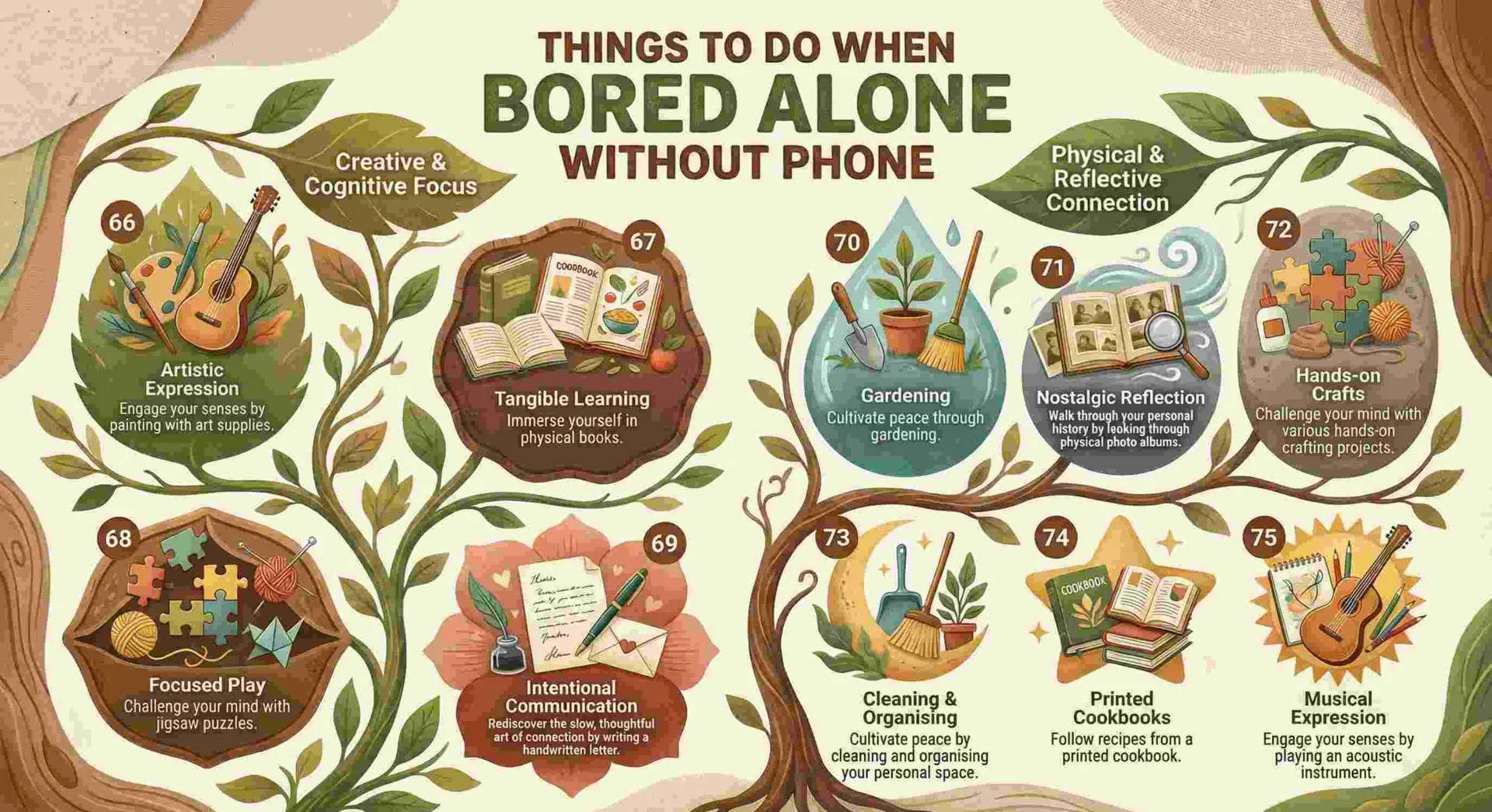
Best Things to Do When Bored Alone by Situation
Use this table to match your current situation to the right activity. Scan the column that describes where you are or how you feel.
| Situation | Best Activities | Time Needed | Cost |
| Bored alone at home | Journaling, Organize One Room, Cook a Meal | 10 min – 2 hrs | Free – $15 |
| Bored alone at night | Meditation, Read a Book, Micro Fiction | 10 – 60 min | Free |
| Bored alone outside | Mindful Walk, Sketch Architecture, Tourist in Your City | 20 min – 4 hrs | Free – $30 |
| Bored and lonely | Volunteer, People Watch, Call a Relative | 30 min – 4 hrs | Free |
| Bored and broke | Journaling, Walking, Organize, Deep Clean | 10 – 75 min | Free |
| Bored and want to be productive | Online Course, Spending Analysis, Subscription Audit | 15 – 60 min | Free |
| Bored on a weekend | Solo Day Trip, Cook Elaborate Meal, Self-Care Day | 2 – 8 hrs | Free – $80 |
| Bored with pen and paper | Micro Fiction, Journaling, Sketch Architecture | 10 – 45 min | Free |
| Bored without a phone | Read, Meditation, Draw, Rearrange Furniture | 10 – 60 min | Free |
| Bored in your room | Journaling, Drawing, Online Course, Rearrange Room | 10 – 60 min | Free |
| Bored on a rainy day | Cook, Read, Photo Archive, Family History | 30 min – 3 hrs | Free – $15 |
| Bored as a teen at home | Duolingo, Drawing, Micro Fiction, Deep Clean | 10 – 75 min | Free |
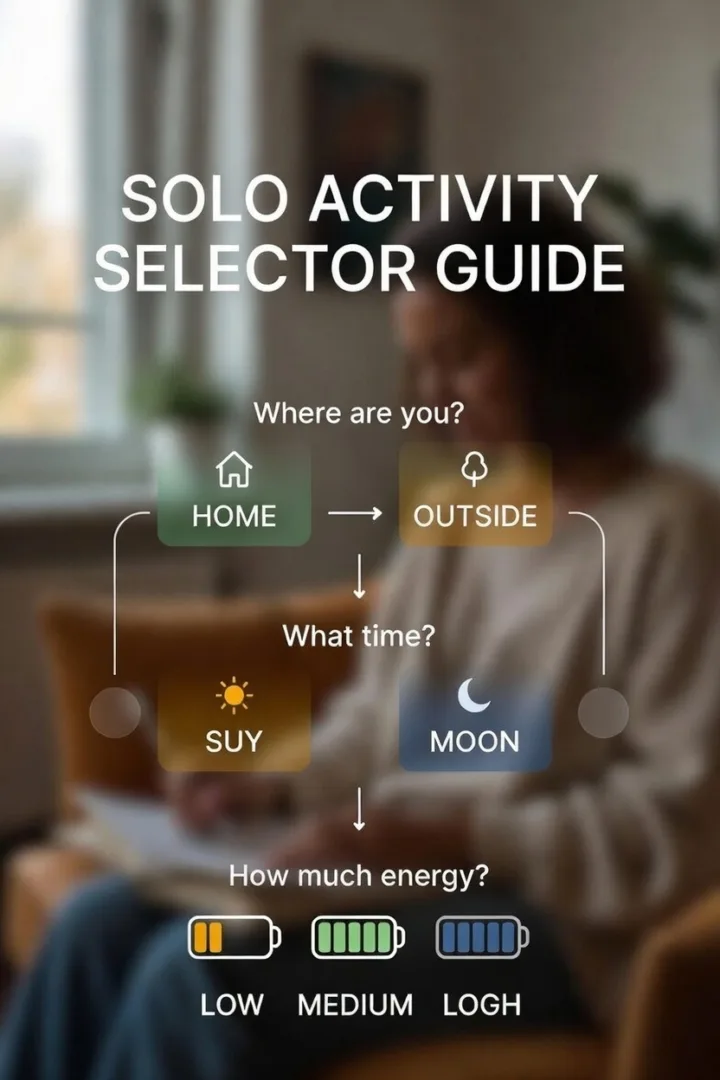
How to Choose the Right Activity When You’re Bored Alone
Not every activity on this list is right for every moment. The trick is matching your current state to the activity type. Here are 6 questions I give my clients to help them decide quickly.
1. How much energy do you have right now?
If the answer is “almost none,” start with reading, journaling, or meditation. If the answer is “too much and I do not know what to do with it,” go for a walk, deep clean, or rearrange furniture. Match your energy, do not fight it.
2. Do you want to be inside or outside?
This one question eliminates half the list immediately. If you need fresh air, pick walking, sketching, window shopping, or a solo day trip. If you want to stay in, pick cooking, organizing, or an online course. Let the environment narrow your options.
3. Do you want to produce something or consume something?
Producing means journaling, drawing, cooking, writing micro fiction, or organizing. Consuming means reading, listening to podcasts, or taking an online course. Both are valid. Know which one your brain is asking for right now.
4. How much time do you actually have?
If you have 15 minutes, audit subscriptions or write one micro fiction piece. If you have 3 hours, take a solo trip or have a self-care day. Be honest about the time available and pick an activity that fits inside it, not one that requires more than you have.
5. Are you bored or are you avoiding something?
This is the question most people skip. If you are avoiding a task, no boredom-busting activity will fix the underlying tension. Do the thing you are avoiding first — even for 15 minutes — then reward yourself with something from this list.
6. When is the last time you tried something new?
If it has been more than 2 weeks since you did something for the first time, pick an activity from this list that you have never done. Novelty is the fastest antidote to boredom, and the unfamiliar options on this list are here for exactly that reason.
Final Thoughts
You have these fabolous things to do when bored alone. Some take 10 minutes. Some take a full afternoon. Some cost nothing. Some require a car and a free weekend. The list is not the point. The point is this: boredom is not a problem with your life. It is a prompt. Your brain is ready for something, and all you need to do is give it a direction.
I have been bored as a mother at 10 PM when the house is finally quiet. I have been bored between projects when my business felt stale. I have been bored on solo trips when the excitement wore off and the afternoon stretched out in front of me with no plan. Every time, the solution was the same: pick one thing. Do it for 20 minutes. See how I feel.
You do not have to be excited about the thing you pick. You do not have to feel ready. You just have to start. That is the wizard move — not having the perfect idea but doing something with the one you have. Pick one. Go.
Other ideas to explore
By Who You Are: [Things to Do When Bored for Adults] · [Things to Do When Bored for Teens] · [Things to Do When Bored for Kids] · [Things to Do When Bored: College Student Edition] · [Things to Do When Bored: Stay-at-Home Mom Edition] · [Things to Do When Bored After Retirement]
By Situation: [Things to Do When Bored by Yourself] · [Things to Do When Bored with Friends] · [Things to Do at a Sleepover] · [37 Things to Do When Tired and Bored] · [49 Things to Do When Feeling Depressed and Bored] · [49 Things to Do Instead of Doomscrolling] · [29 Things to Do When Feeling Narcoleptic and Bored] · [37 Exercises to Do When Bored] · [53 Home Decor Ideas to Explore When Bored].[Books to read when bored].[Things to do cook when bored].[Fun things to do when bored].[Tattoo ideas to explore when feeling bored and doomscrolling]. [Upcoming Car Models to explore when feeling bored].[Things to do when bored with no money]. [Things to do when bored with ADHD].[Things to do when bored after breakup]. [Things to do when bored working from home].[Things to do when bored on phone]. [Things to do when bored and anxious]. [How to build a Dopamine Menu When Bored].[Build a 30-day Digital Detox Challenge].