35 Things to Do When Bored and Anxious [Grounding Activities That Calm and Engage Simultaneously 2026]
Quick Answer: Things to do when bored and anxious
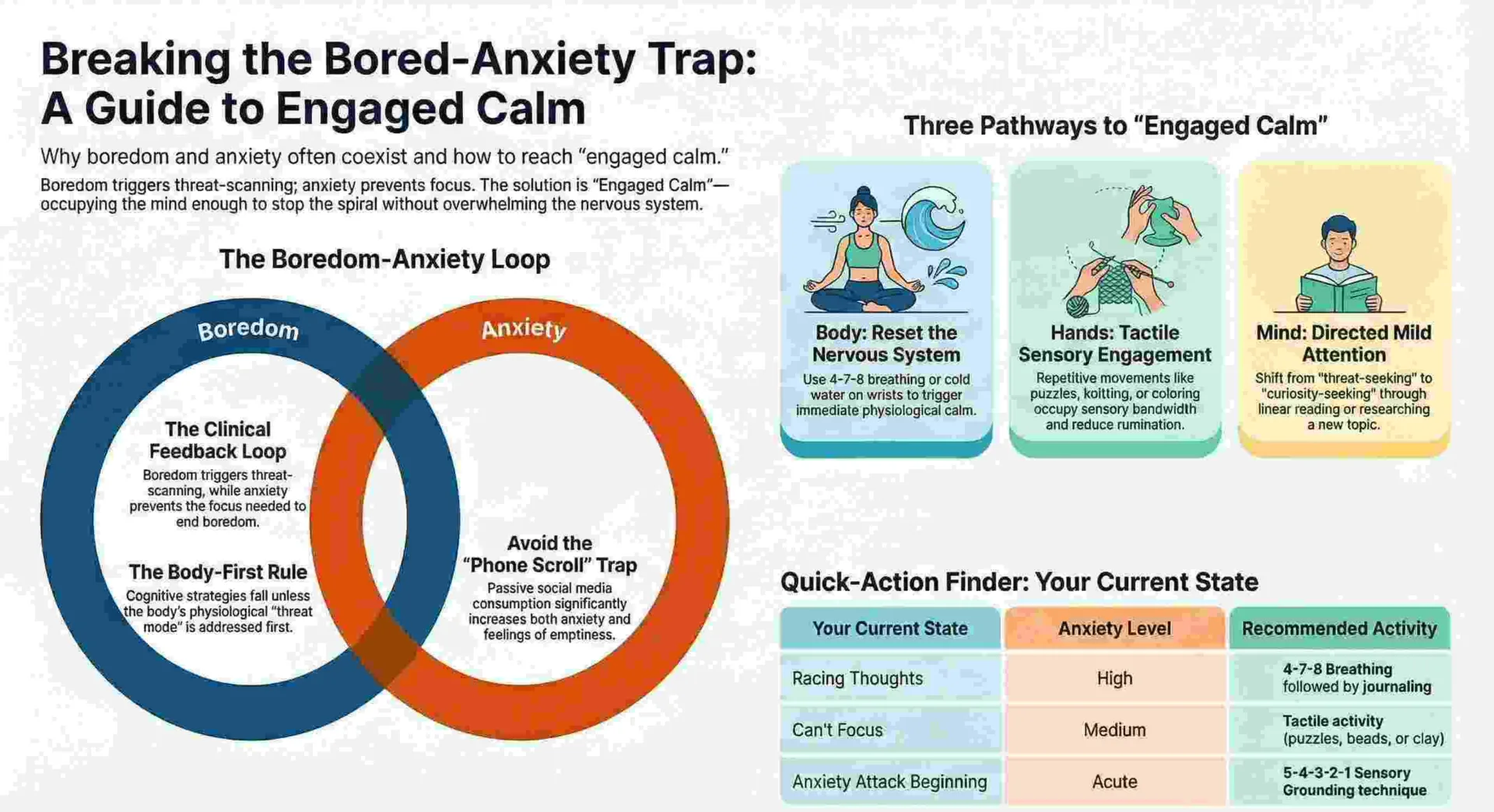
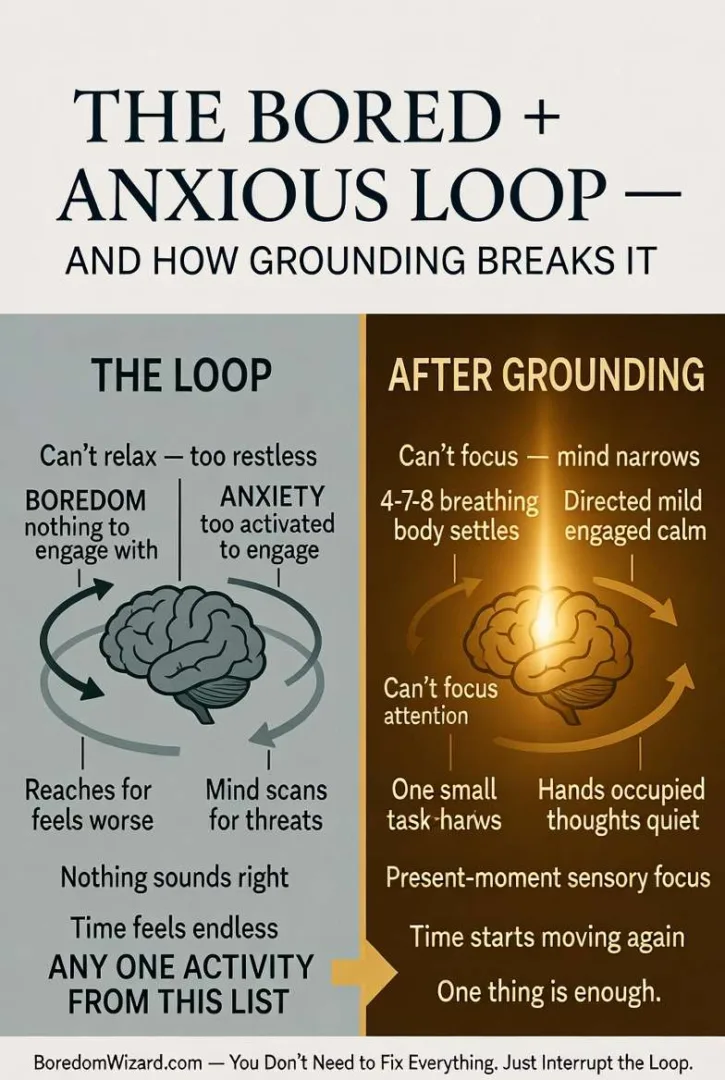
Nobody talks about this specific combination — but it is one of the most common and most misunderstood mental states adults experience. Being bored and anxious simultaneously is not a contradiction. It is a trap. Boredom and anxiety feed each other in a clinically documented loop: anxiety makes it impossible to engage with activities (because the nervous system is in threat-detection mode, not engagement mode), and boredom intensifies anxiety (because an unoccupied mind defaults to threat-scanning). You cannot relax because you are too restless. You cannot engage because you are too wound up. Standard advice for both states fails because it addresses only one at a time — “just relax” doesn’t work for boredom, and “just find something to do” doesn’t work for anxiety.
The activities in this list were chosen for one specific reason: they activate the mind enough to end boredom while simultaneously calming the nervous system. This is the concept of “engaged calm” — a neurological state where the brain is gently occupied but not overstimulated, attentive but not vigilant. Think of it as the cognitive equivalent of a walk in quiet nature — enough input to keep the mind from spiraling, not enough to exhaust a system that is already overloaded.
Three things to know before you start:
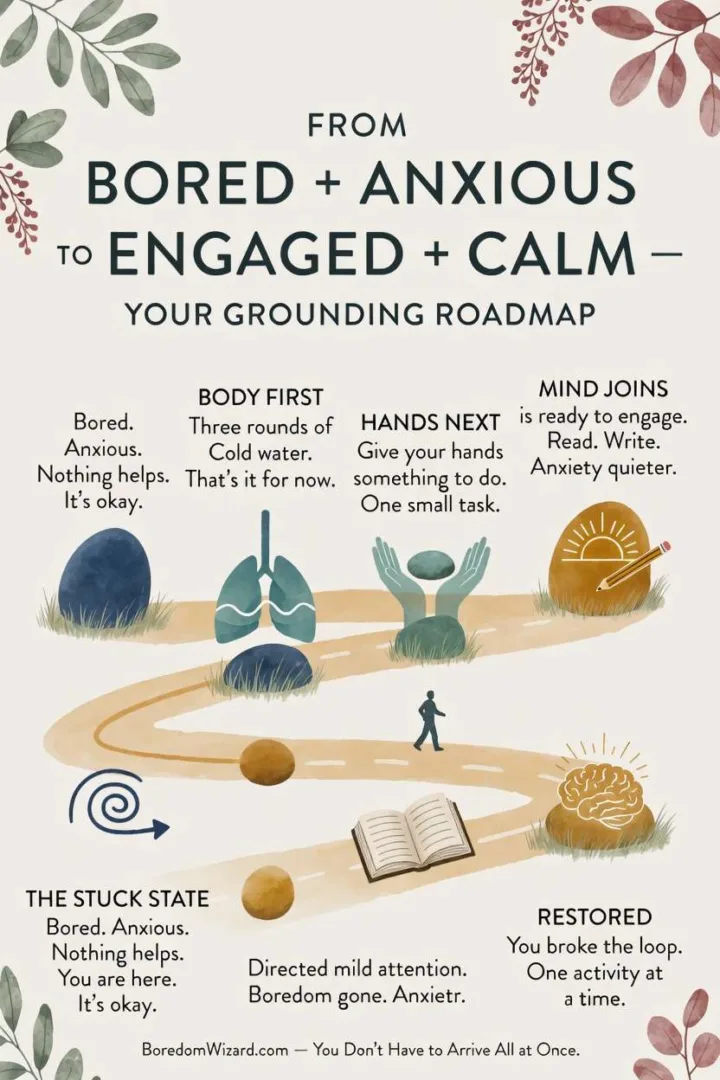
First — how to reduce anxiety immediately starts with the body, not the mind. Every cognitive strategy fails if the physiological component is not addressed first. Breathe first, think second.
Second — boredom and anxiety both shrink when you narrow your focus. The anxious-bored state feels like everything is too much and nothing is enough simultaneously — the antidote is one specific thing, small enough to complete, engaging enough to hold attention.
Third — the worst thing you can do when bored and anxious is reach for your phone and scroll. Research from the University of Pennsylvania found that passive social media consumption significantly increases both anxiety and the sense of emptiness — the exact two things you are already experiencing. Every activity on this list is an intentional alternative to that loop.
📊 Bored + Anxious Activity Finder — Your Exact State, Your Exact Activity
| 😶 Your State Right Now | ⚡ Anxiety Level | 🎯 Best Activity | ⏱ Time | 💊 What It Does |
| Bored + mildly anxious | 🟡 Low-medium | Slow drawing or hand lettering | 20 min | Narrows focus, calms hands |
| Bored + racing thoughts | 🔴 High | 4-7-8 breathing → then journaling | 15 min | Body first, mind second |
| Bored + anxious at home | 🟡 Medium | Cold water + gentle reorganizing | 20 min | Sensory reset + physical agency |
| Bored + anxious at night | 🔴 High | Progressive muscle relaxation | 15 min | Full body discharge |
| Bored + anxious + restless | 🔴 High | Brisk outdoor walk + voice memo | 25 min | Movement + verbal processing |
| Bored + anxious + alone | 🟡 Medium | Guided meditation + one warm drink | 30 min | Co-regulation substitute |
| Bored + anxious + can’t focus | 🟡 Medium | Tactile activity (puzzle, beads, clay) | 30 min | Hands engage, mind settles |
| Anxiety attack beginning | 🔴 Acute | 5-4-3-2-1 grounding immediately | 5 min | Sensory anchoring |
| Bored + anxious after bad news | 🔴 High | Physical movement + one honest call | 1 hour | Body + social regulation |
| Low-level chronic boredom-anxiety | 🟡 Ongoing | Daily micro-ritual system | 10 min/day | Pattern interruption |
Why Grounding Activities Work for Both Boredom and Anxiety Together
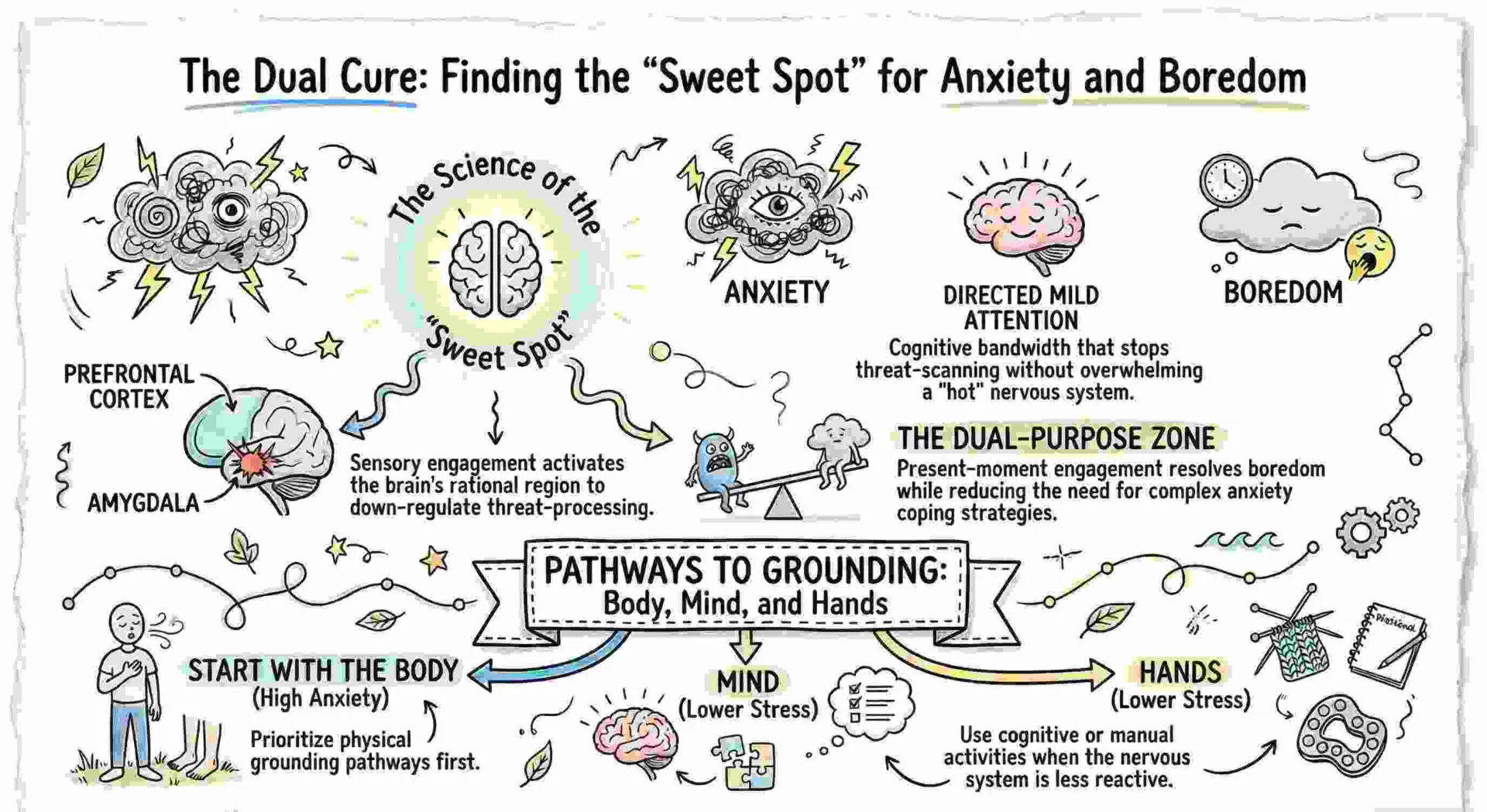
Grounding activities occupy a very specific cognitive bandwidth — enough to prevent the mind from spiraling into threat-scanning (which is what how to stop anxiety thoughts requires), but not so much that they overwhelm a nervous system already running hot. This bandwidth is called directed mild attention by psychologists — and it is the exact sweet spot that both boredom and anxiety simultaneously need.
Dr. Jon Kabat-Zinn’s foundational research on mindfulness-based stress reduction at the University of Massachusetts Medical School showed that activities requiring present-moment sensory engagement reduce anxiety coping strategy requirements by activating the prefrontal cortex — the brain’s rational, calm-executive region — which directly down-regulates the amygdala’s threat-processing. Boredom, meanwhile, is resolved by the same engagement. The activities below live precisely in that dual-purpose zone.
They are organized into three sections — Body, Mind, and Hands — because grounding works through whichever pathway is most accessible to you right now. When anxiety is high, start with Body. When it is lower, Mind and Hands work equally well.
Body Grounding — Calm the Nervous System First
These activities address the physiological component of anxiety before asking the mind to engage. How to reduce anxiety immediately always starts here — the body leads, the mind follows.
1. The 4-7-8 Breathing Technique — Four Full Rounds, Right Now Inhale for 4 counts, hold for 7, exhale for 8. The extended exhale is the mechanism — it activates the parasympathetic nervous system directly, and this is one of the 5 ways to deal with anxiety that has the fastest measurable physiological effect. Four complete rounds. Start before you read anything else on this list.
2. Run Cold Water Over Your Wrists and Forearms for 30 Seconds Cold water on the wrists activates the mammalian dive reflex, which immediately lowers heart rate and interrupts the acute physiological symptoms of anxiety. This is one of the fastest ways to calm an anxiety attack that requires no equipment, no training, and no particular mental state to initiate — you just need a tap.
3. Do a Full 5-4-3-2-1 Sensory Grounding Name five things you can see right now. Four things you can physically touch. Three things you can hear. Two things you can smell. One thing you can taste. How to deal with anxiety attacks in the moment often begins here — this technique forces present-moment sensory attention that interrupts the future-catastrophizing loop that anxiety and boredom together produce.
4. Progressive Muscle Relaxation — Toes to Jaw, Ten Minutes Systematically tense each muscle group for five seconds, then release completely, moving from toes upward. Lie flat, close your eyes. This is one of the most evidence-backed anxiety coping strategies available — it physically discharges the muscular tension that anxiety accumulates in the body and leaves behind a genuine physiological calm that cognitive strategies alone cannot produce.
5. Take a Walk at Moderate Pace for Exactly 20 Minutes Not fast enough to be exercise, not slow enough to let your mind wander unchecked. A moderate 20-minute walk is one of the most reliable how to relieve stress interventions available — it reduces cortisol, increases serotonin, and provides enough environmental input to quiet the boredom component simultaneously.
6. Splash Cold Water on Your Face Five Times Five separate splashes of genuinely cold water. The shock activates the vagus nerve, which directly lowers heart rate and resets the nervous system within sixty seconds. This is how to calm an anxiety attack when you need something that works faster than breathing and requires nothing more than a bathroom sink.
7. Eat Something That Specifically Helps Anxiety Foods that reduce anxiety fast include dark chocolate (magnesium + theobromine), bananas (B6 + potassium), cashews (highest plant-based magnesium), chamomile tea (L-theanine + apigenin), and oats (steady blood glucose prevents cortisol spikes). What helps with anxiety at the physiological level is often simply not being in a state of nutritional deficit — low blood sugar amplifies anxiety consistently and is the most commonly overlooked factor.
8. Do a Body Scan Starting From the Top of Your Head Sit or lie quietly and move your attention slowly from the crown of your head to your toes, noticing every physical sensation without trying to change it. This is one of the most portable anxiety coping strategies available — it requires nothing external, works in any location, and provides enough directed mental engagement to address the boredom component simultaneously.
9. Stretch Every Major Muscle Group in Sequence A full-body stretch sequence takes fifteen minutes and releases the physical tension that anxiety stores in muscles — shoulders, jaw, hip flexors, chest, and neck are the primary sites. How to relax physically when anxious and bored is often answered simply by stretching the exact places where anxiety lives in the body.
10. Take a Warm Shower or Bath — Not Functional, Deliberate Warm water immersion lowers cortisol and is one of the most consistently effective how to reduce anxiety immediately at home interventions available at zero cost. The key distinction: approach it as a deliberate calming practice, not a hygiene task. Stay longer than you think you need to.
11. Do 10 Minutes of Gentle Yoga from a Free YouTube Video Yin yoga, restorative yoga, or a beginner flow — any movement-based practice that combines physical activity with breath instruction. The dual-channel engagement of body movement and breathing guidance is one of the most complete grounding activities for the bored-and-anxious state because it occupies both the physical restlessness and the mental racing simultaneously.
12. Lie Flat on the Floor — Not the Bed, the Floor The firm, cool, grounding physical sensation of a hard floor beneath the entire length of your body is one of the most immediately calming postures available. Known in yoga as savasana and in nervous system work as “earthing,” the simple act of lying flat on a solid surface activates proprioceptive feedback that signals physical safety to the nervous system. Stay for five minutes minimum.
Mind Grounding — Occupy the Brain Without Overwhelming It
Once the body has settled even slightly, these activities redirect mental energy from threat-scanning into gentle, absorbing tasks. They are chosen specifically to be engaging enough to stop boredom but calming enough not to spike anxiety further.
13. Write a Stream-of-Consciousness Page — Dump Everything Out Set a timer for ten minutes and write every thought currently in your head without stopping, editing, or judging. How to stop anxiety thoughts is often not about stopping them at all — it is about externalizing them. Once a thought is on paper it stops needing to be held in active mental processing, which reduces cognitive load and anxiety simultaneously.
14. Read One Full Chapter of a Physical Book Not your phone. A real book, or a Kindle at full size, held in both hands. Extended linear reading is one of the most reliable how to relieve stress activities because it requires the kind of sustained directed attention that interrupts both the unfocused spiral of boredom and the hypervigilant scanning of anxiety.
15. Listen to a Complete Album From Start to Finish — No Skipping Choose an album you know and love, lie down, close your eyes, and listen to it completely from track one to the last track without skipping anything. The constraint of listening in sequence is important — it creates a mild structure that anxiety-bored brains need, while the familiar music provides the emotional regulation that both states require.
16. Do a Jigsaw Puzzle — Any Size, Any Image Jigsaw puzzles occupy precisely the right cognitive bandwidth for the bored-anxious state — they require enough pattern recognition to end boredom but not enough executive function to overwhelm anxiety. Tactile handling of pieces, spatial problem solving, and incremental visible progress combine into one of the most complete grounding activities available for any age.
17. Watch a Nature Documentary With Full Attention — No Second Screen Nature content at high visual quality — oceans, forests, wildlife — reduces anxiety coping strategy load measurably. Research from the University of Exeter found that people who watched nature documentaries experienced significant reductions in anxiety and reported greater feelings of calm and connectedness. The key: full attention, no phone, no multitasking.
18. Research Something You Are Genuinely Curious About for 20 Minutes Not news, not social media — a specific topic of genuine personal curiosity approached through Wikipedia, a book, or a documentary. Directing curiosity outward at something interesting is one of the most consistent how to calm anxiety activities because it occupies the mind with something expansive rather than contracted.
19. Plan Something You Are Looking Forward to in Specific Detail A trip, a meal, a project, an experience — plan it in specific, exciting detail without pressure to act on it immediately. Future-positive orientation is one of the most reliable grounding activities for the bored-anxious state because it redirects the brain’s forward-scanning from threat-seeking to possibility-seeking — the same mechanism, different target.
20. Learn Five Interesting Facts About a Historical Period You Know Nothing About Open Wikipedia on a historical era or event completely outside your knowledge — Ancient Carthage, the Meiji Restoration, the history of jazz. Genuine historical curiosity activates the brain’s interest system through novelty and narrative, which provides stimulation for the boredom component while the structured reading calms the anxiety component.
21. Write Three Gratitude Entries in Specific Sensory Detail Not “I am grateful for my family.” Specific sensory detail: “I am grateful for the exact feeling of my coffee this morning — the warmth of the mug, the first sip when it was still too hot.” Specific gratitude writing activates the brain’s reward circuitry through memory and sensory re-experiencing, which is one of the most research-backed destress practices available at zero cost.
22. Listen to a Long Podcast Episode on a Topic You Know Nothing About A genuine deep-dive podcast on an unfamiliar topic — history, science, philosophy, craft — provides continuous low-demand auditory stimulation that keeps the bored mind occupied while the narrative structure and pace provide a calming container for the anxious mind.
23. Do a Free Duolingo Lesson in a Language You Have Never Studied Language learning occupies a very specific cognitive bandwidth — enough novelty and challenge to engage a bored brain, structured and rule-bound enough to calm an anxious one. A single Duolingo lesson in a completely new language is one of the most effective five-minute grounding activities for the bored-anxious state.
24. Write the Story of Your Day in Third Person Write today’s events as if describing a character in a novel — not “I did” but “she did” or “he did.” Psychological distancing through third-person narrative is a clinically validated technique for reducing anxiety about events — it creates cognitive space between you and your experience that first-person narration cannot.
Hands Grounding — Give Your Body Something to Do
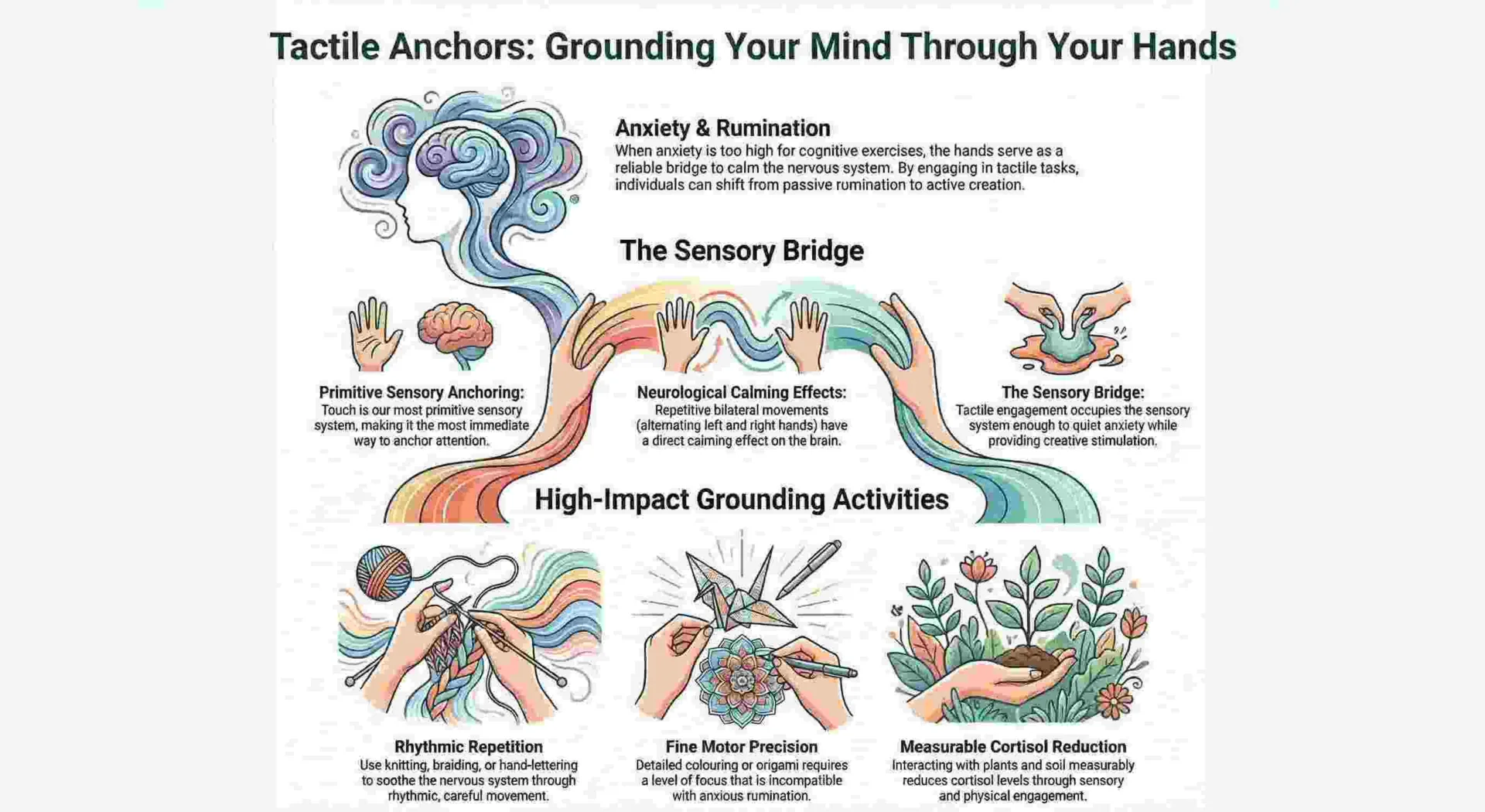
When anxiety is too high for cognitive activities and the body has already been addressed, the hands are the most reliable bridge. Tactile engagement occupies the sensory system enough to quiet anxiety while providing enough creative stimulation to end boredom — simultaneously.
25. Hold a Smooth Stone or Any Textured Object and Examine It Fully Pick up any small object with texture — a stone, a wooden block, a coin, a piece of fabric — and spend three minutes examining it through touch alone. Tactile focus is one of the most portable and immediate how to deal with anxiety when alone techniques because it anchors attention to present sensory reality through the most primitive sensory system available.
26. Draw or Doodle With Zero Artistic Intention A pen, any paper, no goal. Shapes, lines, patterns, spirals — whatever the hand wants to make. Research consistently shows that freehand doodling reduces anxiety and improves mood even in people who do not consider themselves artistic — the mechanism is tactile engagement combined with the mild creative reward of making visible marks.
27. Do Hand Lettering Practice — Copy a Phrase You Love Choose one sentence — a quote, a song lyric, a line from a book — and practice writing it in a deliberate, careful hand-lettering style repeatedly across a page. The repetitive careful movement of hand lettering is deeply grounding — it requires just enough attention to keep boredom at bay while its rhythmic nature soothes an overactivated nervous system.
28. Knit, Crochet, Braid, or Do Any Repetitive Tactile Movement If you know how, pick it up. If you don’t, a beginner scarf pattern can be learned from YouTube in twenty minutes. Repetitive bilateral hand movements — movements that alternate between left and right hands in a rhythm — are used in EMDR trauma therapy for their direct neurological calming effect. The same mechanism works for everyday anxiety.
29. Do a Detailed Adult Coloring Page Coloring within defined areas with a specific focus on staying precise is one of the most complete grounding activities for the bored-anxious combination — tactile engagement through the hand, visual engagement through color choice and precision, and meditative rhythm through the repetitive motion. A clinically reviewed study in the Art Therapy journal found significant anxiety reduction from adult coloring compared to free drawing.
30. Cook or Bake Something That Requires Full Attention A recipe you have never made before, requiring genuine focus on technique. The combination of physical movement, sensory engagement (smell, touch, taste), sequential task completion, and the tangible reward of a finished product makes cooking one of the most neurologically complete grounding activities for anxiety and boredom simultaneously.
31. Do a Slow, Detailed Craft With Your Hands — Paper Folding, Weaving, Beading Origami, finger weaving, friendship bracelet patterns, threading beads — any craft that requires sequential fine motor movements toward a visible completion point. The combination of hands-on focus, stepwise progress, and visible results is one of the most complete ways to calm anxiety attack that does not require any special equipment or prior skill.
32. Write a Letter by Hand to Someone You Care About — in Your Best Handwriting Not a text. A handwritten letter, in your most careful and deliberate script, to a specific person. The act of forming each letter carefully requires the kind of present-moment fine motor attention that is incompatible with anxious rumination — which makes it one of the most effective how to stop anxiety thoughts activities disguised as a simple act of correspondence.
33. Garden, Tend to a Plant, or Repot Something If you have plants, spend thirty minutes with them — repot, water carefully, remove dead leaves, observe growth. Interaction with living plants reduces cortisol measurably in multiple peer-reviewed studies and the combination of soil texture, gentle repetitive movement, and care for something living makes gardening one of the most complete grounding activities for the bored-anxious state.
34. Organize One Small Space With Complete Deliberateness Not a whole house clean. One drawer, one surface — sorted, cleaned, and reorganized with full attention to each object. The combination of physical movement, decision-making about small objects, and the visible before-and-after result provides exactly the right cognitive load for the bored-anxious brain — enough to engage, not enough to overwhelm.
35. Make Something — Anything — With Your Hands That Did Not Exist Before A drawing, a paper crane, a braided cord, a hand-written poem, a playlist, a small structure from objects around you. The specific act of making something that did not exist before you sat down is one of the most psychologically complete grounding activities available for any state — because it transforms passive experience into active creation, which is the fundamental shift that both boredom and anxiety need most.
❓ Frequently Asked Questions
Q: How to reduce anxiety immediately when you are also bored? A: How to reduce anxiety immediately starts with the body — not the mind. Do four rounds of 4-7-8 breathing first, followed by cold water on your wrists or face. These two actions address the physiological component of anxiety within five minutes, which then makes the boredom component accessible. Trying to cure boredom while anxiety is still physiologically active does not work.
Q: What are the best grounding activities for anxiety and boredom together? A: The most effective grounding activities for the bored-anxious state are those with directed mild attention — jigsaw puzzles, hand lettering, cooking a new recipe, drawing without a goal, and progressive muscle relaxation followed by reading. These occupy the mind enough to end boredom while calming the nervous system enough to reduce anxiety — simultaneously.
Q: How to deal with anxiety when alone and bored? A: How to deal with anxiety when alone follows a specific sequence: body first (breathing, cold water, movement), then hands (tactile activity), then mind (reading, writing, research). The social isolation that amplifies both boredom and anxiety is best addressed by calling one person — even briefly — which activates the social safety system of the nervous system directly.
Q: What are ways to calm an anxiety attack when bored at the same time? A: Ways to calm an anxiety attack that also address boredom include the 5-4-3-2-1 grounding technique (sensory engagement that absorbs full attention), cold water face splash followed by deliberate coloring or doodling, and progressive muscle relaxation followed by a tactile hands activity. The sequence matters — anxiety attack first, then boredom. So also try to explore first this things to do when bored.
Q: What are 5 ways to deal with anxiety that also help boredom? A: The five ways to deal with anxiety that simultaneously address boredom are: (1) 4-7-8 breathing into deliberate journaling, (2) a grounding body scan into reading, (3) a brisk walk with a podcast, (4) progressive muscle relaxation into a puzzle or craft, (5) cold water reset into cooking something new. Each pairs a physiological anxiety intervention with a mental engagement activity.
Q: What foods that reduce anxiety fast can I eat right now? A: Foods that reduce anxiety fast include dark chocolate (magnesium), bananas (B6 and potassium), cashews (highest plant magnesium source), chamomile tea (apigenin), oats (blood glucose stability), and blueberries (antioxidants that reduce cortisol-related oxidative stress). What helps with anxiety nutritionally is primarily avoiding the foods that spike cortisol — high sugar, high caffeine, and alcohol — especially when already anxious.
Q: How to stop anxiety thoughts when you are also bored? A: How to stop anxiety thoughts is most effective through externalization — writing the thoughts down removes them from active mental processing — combined with redirection through tactile engagement. The specific sequence: write every anxious thought on paper (5 minutes), then immediately begin a hands activity that requires physical attention. The thoughts do not stop — they lose their urgency when the hands are occupied.
Q: Does anxiety cause chest pain and how do I know it is anxiety? A: Anxiety-related chest tightness is caused by hyperventilation, muscle tension, and the physiological stress response — and it can feel identical to cardiac symptoms. The distinguishing feature is usually that anxiety chest discomfort responds to breathing interventions (4-7-8 technique reduces it within minutes) and changes with posture and movement. However, if chest pain is severe, persistent, radiates to the arm or jaw, or is accompanied by shortness of breath, seeking immediate medical assessment is always the right choice — anxiety chest pain and cardiac events can coexist.
More BoredomWizard Guides for Every Mood, Season, and Situation
By Location: [Things to Do When Bored at Home: 50+ Creative Ideas That Actually Work] · [20 Things to Do When Bored in Your Room] · [20 Things to Do When Bored at Work] · [20 Things to Do When Bored at School] · [50 Things to Do When Bored in Class] · [20 Things to Do When Bored in a Waiting Room] · [25 Things to Do When Bored in a Car] · [30Things to Do When Bored on a Plane] · [30 Things to Do When Bored on Computer]
By Season: [50 Things to Do When Bored in Summer] · [50 Things to Do When Bored in Winter] · [30 Things to Do in Fall When Bored] · [20 Things to Do When Bored in Spring] · [50 Things to Do When Bored on a Rainy Day] · [52 Things to Do on a Snow Day When Bored] · [25 Things to Do When Bored During Holiday]
By Who You Are: [Things to Do When Bored for Adults] · [Things to Do When Bored for Teens] · [Things to Do When Bored for Kids] · [Things to Do When Bored: College Student Edition] · [Things to Do When Bored: Stay-at-Home Mom Edition] · [Things to Do When Bored After Retirement]
By Situation: [Things to Do When Bored by Yourself] · [Things to Do When Bored Alone] · [Things to Do When Bored with Friends] · [25 Things to Do at a Friend’s House] · [Things to Do at a Sleepover] · [50 Things to Do When Bored on Weekends] · [25 Things to Do When Bored at Night] · [37 Things to Do When Tired and Bored] · [20Productive Things to Do When Bored and Sick] · [49 Things to Do When Feeling Depressed and Bored] · [49 Things to Do Instead of Doomscrolling] · [29 Things to Do When Feeling Narcoleptic and Bored] · [37 Exercises to Do When Bored] · [53 Home Decor Ideas to Explore When Bored].[Books to read when bored].[Things to do cook when bored].[Fun things to do when bored].[Personal care products to explore when bored].[Tattoo ideas to explore when feeling bored and doomscrolling]. [Upcoming Car Models to explore when feeling bored].[Things to do when bored with no money]. [Things to do when bored with ADHD].[Things to do when bored after breakup]. [Things to do when bored working from home].[Things to do when bored on phone]. [How to build a dopamine menu]. [Build a 30-Days Digital Detox Challenge].
Written by Natty O Lewis, Mental Health & Wellness Coach.