How to Make a Christmas Wreath: Step-by-Step Guide + 30 DIY Christmas Wreath Ideas (2026)
There is a moment, about 20 minutes into your first wreath, when the bare wire frame disappears under the greenery and it suddenly looks like something you could buy for $80. That moment is why wreath making is one of the most satisfying holiday hobbies you can pick up. It costs a fraction of a store wreath, your house smells like a forest and the result is completely yours.
This guide shows you how to make a wreath the way florists and extension educators do: pick the right base, choose greens that actually last, build it with the bundle method and finish with a proper bow. Then it gives you 30 DIY Christmas wreath ideas, from a classic fresh fir wreath to ornament, ribbon and grapevine wreaths that need no greenery at all, plus a free Wreath Recipe Mixer that writes your shopping list.
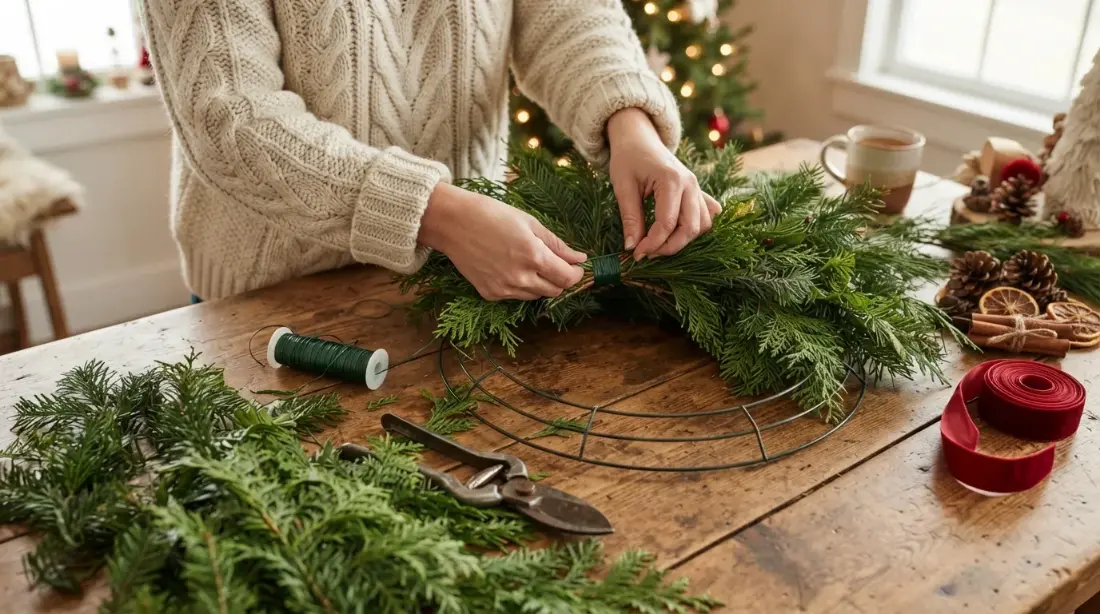
Quick answer: how do you make a Christmas wreath? Wire a paddle of 22 or 24 gauge florist wire to a 16-inch wire box frame. Cut evergreens into 4 to 8 inch sprigs, gather 3 or 4 into a bundle, lay it on the frame and wrap the wire tightly 2 or 3 times. Lay the next bundle over the stems of the last and keep going around the ring, tuck the final bundle under the first, then add a hanger, cones, fruit and a bow.
Time: about an hour for a fresh 16-inch wreath. Cost: about $15 to $30 if you buy greens, or less if you use your own trimmings.
Wreath Making Supplies and What Each One Does
You do not need a craft room to learn how to make a wreath. For a fresh wreath, this short list covers everything, starting with a simple wire wreath frame.
| Supply | What it does | Typical cost |
|---|---|---|
| Wire box wreath frame | The skeleton. Iowa State Extension notes frames run from 8 to 24 inches; 16 inches suits most doors. | $3 to $6 |
| Paddle florist wire | Holds the bundles. 22 or 24 gauge for most greens; heavier 18 or 20 gauge for thick branches. | $3 to $5 |
| Pruners and wire cutters | Clean cuts on stems, and a separate tool for wire so you do not dull your pruners. | Already own |
| Gloves | Spruce, juniper and holly are prickly, and sap is sticky. | $5 |
| Fresh greenery | Two or three types for a full, textured wreath. | $10 to $25, or free trimmings |
| Accents | Pine cones, dried oranges, berries, ornaments, bells. | $5 to $15 |
| Wired ribbon | For the bow. Wired edges hold their shape outdoors. | $5 to $10 |
Maker’s note: the Oregon State University Extension reminds wreath makers that a higher wire gauge number means a thinner wire. Keep a pumice hand cleaner nearby too; it lifts pine sap from fingers and tools.
Step 1: Pick Your Wreath Base
The base decides how everything attaches, so choose it before you buy anything else.
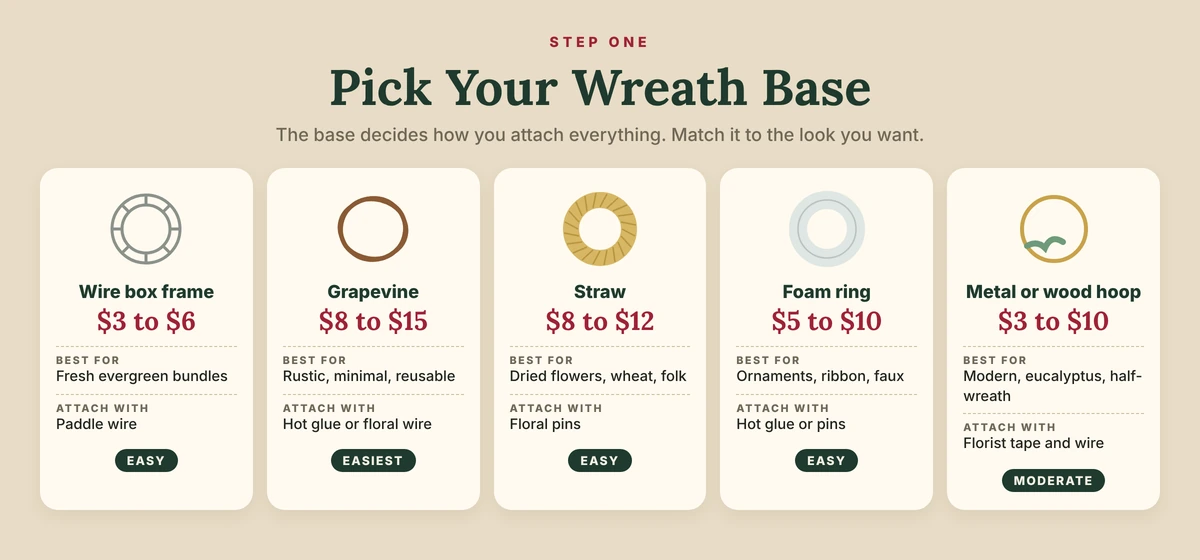
- Wire box frame: the only base for the classic fresh evergreen wreath. Greens are wired on in bundles.
- Grapevine: the easiest base of all. It already looks finished, so you just tuck in stems or glue on accents. It lasts for years.
- Straw: perfect for dried flowers, wheat and folk wreaths. Leave the plastic wrap on to keep it neat, and attach everything with floral pins.
- Foam ring: best for ornament wreaths, ribbon wreaths and anything glued. Wrap it in ribbon first so no white shows.
- Metal or wood hoop: the modern half-wreath look. Decorate one side only and let the empty ring do the rest.
Step 2: Choose Greens That Last
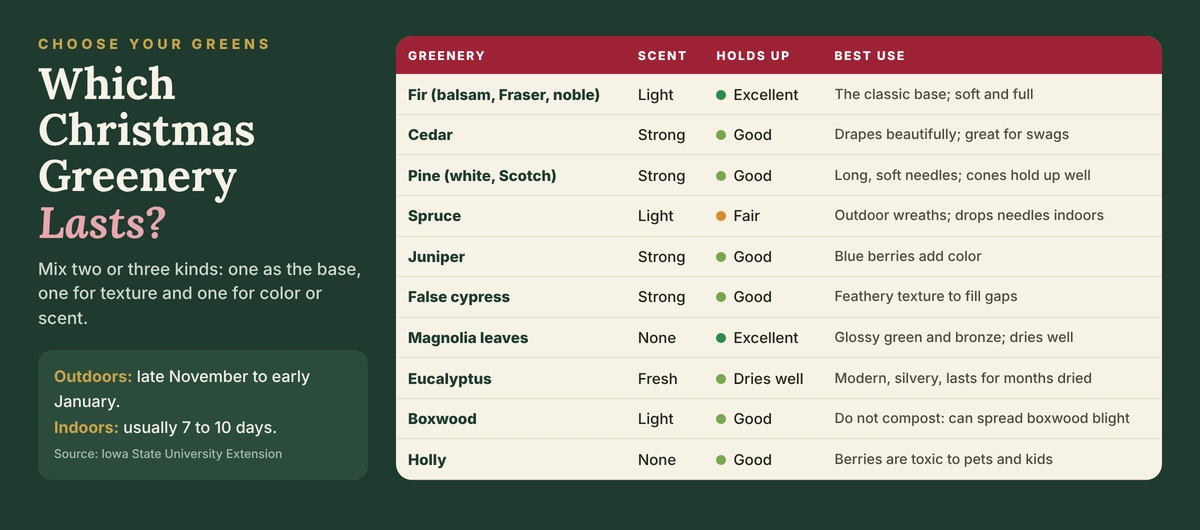
Iowa State Extension recommends fir, pine, juniper, spruce, false cypress, yew, boxwood and holly for wreaths, and notes that juniper, pine and false cypress have the strongest scent while spruce, fir and yew are lighter. The trick is mixing two or three types: one as the base, one for texture and one for color or scent.
- Use only fresh greens. Bend a needle: if it snaps or the branch drops needles when you shake it, it is too old.
- Prune from the back. Your own shrubs and the bottom branches of your Christmas tree are perfect. Oregon State Extension advises thinning branches from full areas, since conifers do not regrow from bare wood.
- Skip invasive Oriental bittersweet. Iowa State Extension suggests native American bittersweet instead if you want orange berries.
- Never compost boxwood. Boxwood blight can spread from old wreaths to healthy garden plants, so bag it for the trash.
Step 3: How to Make a Christmas Wreath With Fresh Greenery
This is the bundle method, the same technique Iowa State Extension teaches. Cover your table with paper or cardboard first; it gets messy.
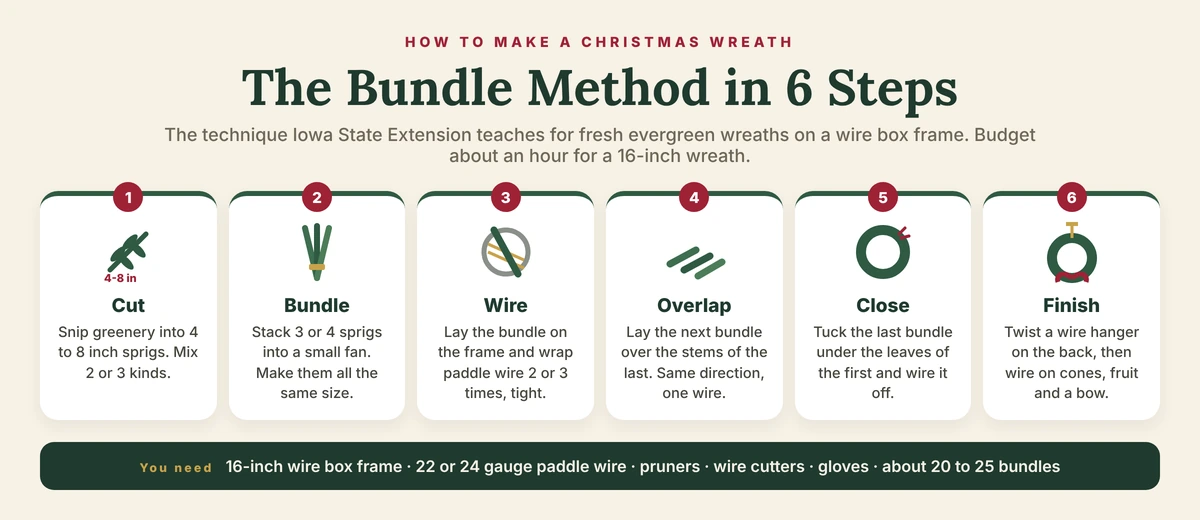
- Anchor the wire. Wrap the loose end of the paddle wire around the outer ring of the frame a few times and twist it tight. Do not cut it; you will use one continuous wire for the whole wreath.
- Cut your greens. Snip branches into 4 to 8 inch sprigs. Longer sprigs make a fuller, wilder wreath; shorter ones make a neat, tailored one.
- Make a template bundle. Fan 3 or 4 sprigs together, mixing types. Keep this first bundle aside as your size guide so every bundle matches.
- Wire the first bundle. Lay it on the frame with the stems pointing in the direction you will travel, and wrap the wire tightly 2 or 3 times around the stems and frame.
- Overlap and repeat. Lay the next bundle so its leaves cover the stems of the last one, wire it on and keep going around the ring in the same direction. Close bundles give a lush wreath; wider spacing gives a flatter, lighter one.
- Close the circle. Lift the leaves of the very first bundle and tuck the stems of the last bundle underneath. Wire it, then cut the wire and twist the end into the back of the frame.
- Add a hanger. Twist a 6-inch loop of wire onto the back at the top. Iowa State Extension suggests wrapping a little wire around your door hook too, so the wreath cannot blow off.
- Decorate. Wire each cone, fruit slice or ornament on separately, then add the bow. Fill any thin spots with an extra sprig or a cone.
That is really all there is to how to make a wreath with fresh greens. How many bundles? Roughly 20 to 25 for a 16-inch frame, depending on how tightly you overlap. Not sure what to buy for your size and style? Let the mixer work it out:
Wreath Recipe Mixer
Choose a base, a style, where it will hang and a size. Get a full shopping list, quantities and the right care plan.
How to Make a Bow for a Wreath
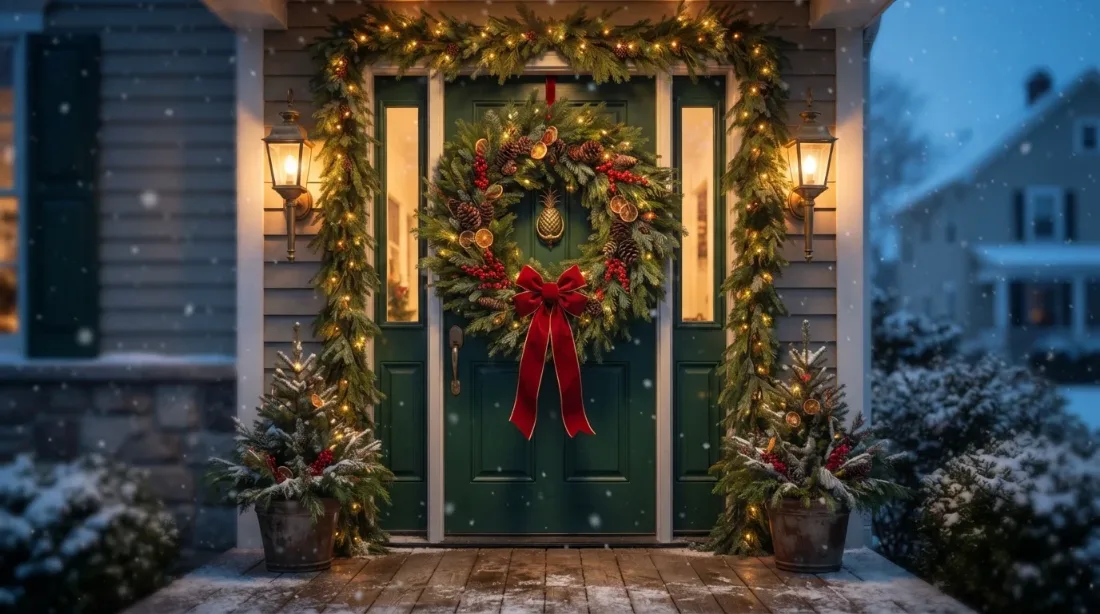
A full, florist-style bow is what makes a homemade wreath look professional. Use wired ribbon about 2.5 inches wide; the wire lets you shape the loops and keeps them from drooping in rain.
- Measure. About 3 yards of ribbon makes a full bow with tails on a 16 to 24 inch wreath.
- Make the center loop. Leaving a tail of about 12 inches, wrap the ribbon once around your thumb to form a small loop, pretty side out.
- Twist and loop. Pinch the ribbon at the center, give it a half twist so the pretty side faces out again, and make a loop on one side. Twist again and make a matching loop on the other side.
- Build it up. Repeat until you have 3 or 4 loops on each side, making each pair slightly larger than the last.
- Secure it. Push a 12-inch piece of floral wire or a pipe cleaner through the center loop, wrap it around the pinched center and twist tight at the back. Use those wire ends to attach the bow to the wreath.
- Shape and trim. Fluff each loop into place. For a dovetail tail, fold the end in half lengthwise and cut diagonally toward the fold.
30 DIY Christmas Wreath Ideas
Once you know the basics, every wreath below is a variation. They are grouped by base, so you can pick by what you already have at home.

Fresh and Foraged Wreaths (1-6)
1. Classic Fir and Cedar
Base: wire frame · You need: fir, cedar, pine cones, red velvet ribbon · Time: 1 hour
The traditional wreath, and the one to learn on. Use fir as the base and add cedar for its soft, drooping texture. Wire pine cones in groups of three and finish with a big red bow.
2. Backyard Trimmings Wreath
Base: wire frame · You need: whatever evergreens your yard has · Time: 1 hour
Holly, juniper, arborvitae and the lower branches of your Christmas tree make a free wreath that looks completely unique. Mixing four or five types gives it a natural, wild look.
3. Magnolia Wreath
Base: wire frame · You need: about 60 magnolia leaves · Time: 1 hour
The Southern classic. Wire leaves in small bundles, alternating the glossy green tops and the velvety bronze undersides. A magnolia wreath dries beautifully and can last the whole season.
4. Eucalyptus Wreath
Base: wire frame or hoop · You need: silver dollar or seeded eucalyptus · Time: 45 minutes
Silvery, fragrant and modern. Eucalyptus dries in place, so a eucalyptus wreath made in November still looks good in February.
5. Juniper and Berry Wreath
Base: wire frame · You need: juniper, fir, red berry picks · Time: 1 hour
Juniper brings dusty blue berries and a strong scent. Add faux red berries for color, since many real berries, like holly, are toxic to pets and kids.
6. Swag Instead of a Wreath
Base: none · You need: long cedar and pine branches, wire · Time: 20 minutes
Layer branches from longest to shortest, wire the stems together and cover the binding with a bow. It is the fastest fresh project here and suits narrow doors.
Grapevine and Dried Wreaths (7-12)
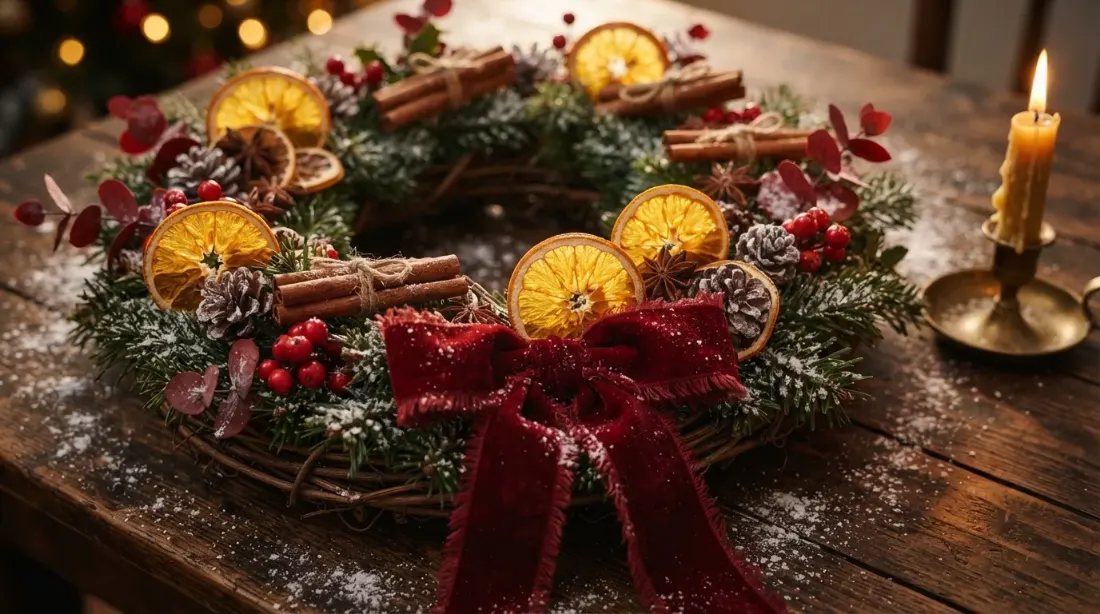
7. Dried Orange and Cinnamon Wreath
Base: grapevine · You need: dried orange slices, cinnamon sticks, berries · Time: 45 minutes
The signature of the Victoriana trend. Dry thin orange slices on a rack at your oven’s lowest setting, around 200°F, for 2 to 3 hours, flipping every 30 minutes, then glue or wire them onto the vine with bundles of cinnamon sticks.
8. Minimal Grapevine With One Sprig
Base: grapevine · You need: one bundle of evergreens, ribbon · Time: 15 minutes
Tuck a single generous bundle of greenery into the bottom left of the ring and tie a ribbon. The bare vine does the rest.
9. Make Your Own Grapevine Wreath
Base: wild grapevine · You need: long fresh vines, twine · Time: 30 minutes
Fresh or soaked vines bend easily. Coil a long vine into a circle, then wrap more vines around it until it is as thick as you like. It dries into a sturdy grapevine wreath you can use for years.
10. Pine Cone Wreath
Base: straw, foam or cardboard ring · You need: about 40 to 60 pine cones, hot glue · Time: 1 hour
Glue cones close together with their tips facing out, mixing sizes. Iowa State Extension notes pine cones hold up better than spruce or fir cones. Leave it natural or dust the tips with white paint for a snowy look.
11. Dried Flower and Wheat Wreath
Base: straw · You need: wheat, dried hydrangea, strawflowers · Time: 45 minutes
A folk-style wreath that works long after Christmas. Pin small bundles of wheat and dried flowers around the ring, overlapping like the bundle method.
12. Cinnamon Stick Wreath
Base: foam ring or cardboard · You need: about 100 cinnamon sticks · Time: 1 hour
Glue cinnamon sticks side by side around a ring for a wreath that smells like baking all season.
Modern Hoop and Minimal Wreaths (13-17)
13. Brass Hoop Half-Wreath
Base: metal hoop · You need: eucalyptus, florist tape, linen ribbon · Time: 20 minutes
Tape a few stems of eucalyptus onto one side of a brass hoop, overlapping them so the tape is hidden, and tie a long linen ribbon at the top.
14. Embroidery Hoop Wreath
Base: wooden embroidery hoop · You need: cedar sprigs, mini ornaments · Time: 20 minutes
A cheap, charming version of the hoop trend. Use a set of hoops in three sizes for a window or a wall.
15. Olive Branch Wreath
Base: metal hoop or wire frame · You need: faux or fresh olive stems · Time: 30 minutes
Gray-green and quietly elegant. It suits a modern home and works well beyond Christmas.
16. Monochrome White Wreath
Base: foam ring · You need: white flocked sprigs, white ornaments, white ribbon · Time: 45 minutes
A snowy, all-white wreath that looks especially striking on a black or deep green door.
17. Moss Wreath
Base: straw or foam ring · You need: sheet moss, floral pins · Time: 30 minutes
Pin sheet moss all over a ring for a soft, velvety wreath. Add a single brass bell or a tiny bird.
No-Greenery Wreaths: Ornament, Ribbon and More (18-25)
18. Ornament Wreath
Base: foam ring or wire hanger · You need: a few dozen shatterproof ornaments in mixed sizes, hot glue · Time: 1 hour
The showstopper. Glue the ornament caps in place first so they cannot pop off, then glue the largest ornaments on, filling gaps with smaller ones. An ornament wreath works in any color scheme; retro shades are perfect for the Kitschmas trend. Have leftover ornaments from our DIY Christmas ornaments? This is where they go.
19. Ribbon Wreath
Base: wire frame · You need: several ribbons cut into 8-inch strips · Time: 1 hour
Tie strips of ribbon onto the rungs of a wire frame, pushing them close together. Mixing three or four patterns makes a cheerful, textured ribbon wreath.
20. Rag Wreath
Base: wire frame · You need: fabric scraps or an old flannel shirt · Time: 1 hour
The same technique as the ribbon wreath, using torn fabric strips. Plaid flannel gives you the heritage look for almost nothing.
21. Deco Mesh Wreath
Base: wire work frame · You need: deco mesh roll, pipe cleaners · Time: 30 minutes
Gather the mesh into puffs and twist pipe cleaners around them to attach to the frame. It is fast, bright and weatherproof.
22. Sweater Wreath
Base: foam ring · You need: an old knit sweater, pins · Time: 30 minutes
Wrap a ring in the sleeve or body of a cozy sweater, pin it at the back and add a few felt leaves or a small bow.
23. Felt Ball Wreath
Base: foam ring · You need: about 100 felt balls, hot glue · Time: 1 hour
Soft, colorful and child-friendly. It suits the whimsical trend and looks lovely in a kids’ room.
24. Book Page Wreath
Base: cardboard ring · You need: pages from an old paperback, glue · Time: 1 hour
Roll pages into cones and glue them in layers around the ring. It is perfect for readers and costs nothing.
25. Jingle Bell Wreath
Base: wire hanger or wire ring · You need: about 100 jingle bells · Time: 45 minutes
Thread bells onto a straightened wire hanger, bend it back into a circle and tie on a bow. It rings every time the door opens.
Budget and Kid-Friendly Wreaths (26-30)
26. Dollar Tree Christmas Wreath
Base: dollar store wire frame · You need: dollar store garland, ornaments and ribbon · Time: 30 minutes
Wrap two or three dollar store garlands around a frame, then add ornaments and a bow for a full wreath that costs about $10. Find more cheap ideas in our Dollar Tree crafts.
27. Paper Plate Wreath
Base: paper plate · You need: green paint or tissue paper, pom poms · Time: 30 minutes
Cut out the center of a paper plate and let kids paint it or glue on scrunched tissue paper. Our Christmas crafts for kids have more ideas like this.
28. Handprint Wreath
Base: paper plate or cardboard ring · You need: green paper, scissors, glue · Time: 45 minutes
Trace and cut out the whole family’s handprints and glue them around the ring. Write the year on the back; it becomes a keepsake.
29. Salt Dough Wreath
Base: salt dough · You need: flour, salt, water, paint · Time: 2 hours including baking
Shape a ring of salt dough, press in leaves and berries, bake and paint. Our salt dough ornaments recipe works perfectly. Keep it indoors; salt dough softens in damp air.
30. Pipe Cleaner Mini Wreaths
Base: pipe cleaners · You need: green pipe cleaners, red beads · Time: 10 minutes each
Twist two pipe cleaners together, bend into a circle and thread on red beads as berries. Make a dozen as tree ornaments or gift toppers. See more in our pipe cleaner crafts.
Christmas Wreath Ideas for 2026 Trends
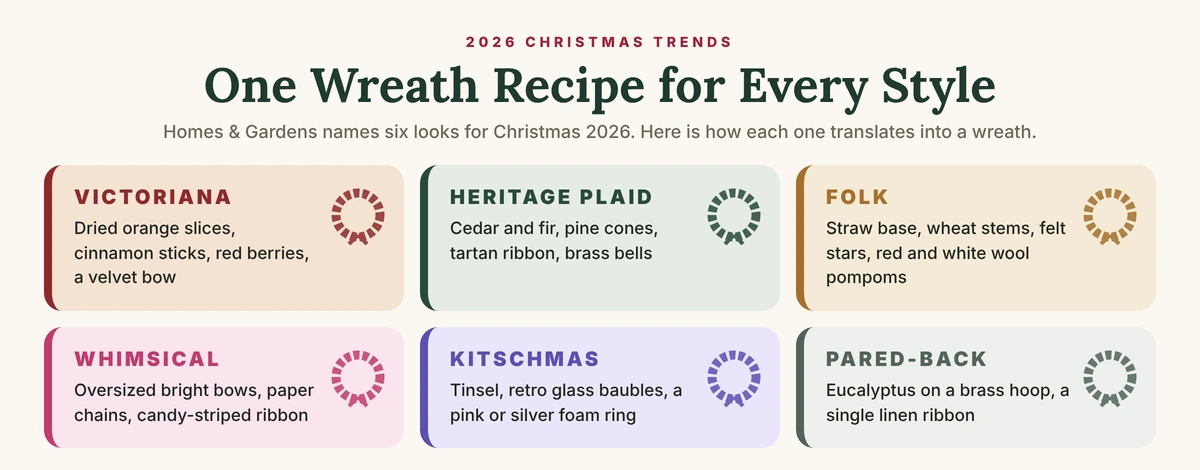
Homes & Gardens names six looks for Christmas 2026: Victoriana, a Ralph Lauren style heritage look, whimsical nostalgia, folk, “Kitschmas” and pared-back minimalism. Each translates neatly into a wreath recipe.
Looking ahead to 2027: expect more natural, compostable wreaths (dried citrus, foraged stems and grapevine instead of plastic), more hoop and half-wreath designs, and more reusable bases that you redecorate each year. Wreath-making workshops at garden centers and florists are a popular way to learn, and a sign that people want to make, not just buy.
How Long Does a Fresh Wreath Last?
According to Iowa State Extension, a fresh wreath outdoors in a cold climate usually lasts from late November to early January, while indoors it lasts about 7 to 10 days. “The ideal conditions for a fresh-cut wreath are cool and moist.”
- Hang it out of the wind. Moving air dries greens fast.
- Use an anti-desiccant spray in dry or sunny climates. Apply it a few hours before handling the wreath.
- Indoors, keep it cool. Hang it away from heat vents, fireplaces and direct sun, and mist it regularly. Take it down once it dries out; dry greens are a fire risk near candles and fireplaces.
- Make it last longer indoors. Iowa State Extension suggests storing it in a plastic bag somewhere cool, like a garage, between special occasions.
- Reuse the frame. After the holidays, cut the wire at the back, compost the greens (except boxwood) and save the frame, ribbon and decorations for next year.
Decorating the rest of the house? Pair your wreath with our Christmas porch decor ideas (including how big your door wreath should be) and our mantel decor ideas. For more cozy winter projects, try paper snowflakes, gingerbread house ideas or our winter bucket list. If wreath making hooks you, our candle making ideas and hobbies to do at home are the natural next step.
What do you need to make a Christmas wreath?
For a fresh wreath you need a wire box frame (16 inches suits most doors), 22 or 24 gauge paddle florist wire, pruners, wire cutters, gloves, two or three kinds of evergreen greenery, accents like pine cones or dried oranges, and wired ribbon for a bow.
How do you make a wreath as a beginner?
Start with a grapevine base, the easiest option. Tuck one bundle of greenery into the vine, add a few pine cones with hot glue and tie on a bow. For a fresh wreath, use the bundle method on a wire frame, which takes about an hour.
What greenery lasts longest in a wreath?
Fir (balsam, Fraser and noble) and magnolia hold up best, followed by cedar, pine, juniper and false cypress. Spruce drops needles faster indoors. Eucalyptus and magnolia dry well and can last for months.
How many bundles do I need for a wreath?
Roughly 20 to 25 bundles of 3 or 4 sprigs for a 16-inch frame, depending on how closely you overlap them. A 24-inch frame needs about 30 to 35.
How much ribbon do I need for a wreath bow?
About 3 yards of 2.5-inch wired ribbon makes a full bow with tails for a 16 to 24 inch wreath.
How do you keep a fresh wreath from drying out?
Keep it cool and moist: hang it out of wind and direct sun, mist it every few days, use an anti-desiccant spray in dry climates, and keep indoor wreaths away from heat vents and fireplaces.
Is it cheaper to make your own Christmas wreath?
Usually, yes. A homemade fresh wreath costs about $15 to $30 in supplies, less with your own trimmings, while a store-bought fresh wreath of the same size often costs $40 to $100. The frame, ribbon and decorations can be reused every year.