36 Fairy Garden Ideas: Magical Miniature Gardens for Pots, Yards & Jars (2026)
A fairy garden is a stage set built for an audience of one: the person kneeling down to look at it. The best ones make you forget the scale for a second. You see the door, the worn little path leading up to it and the moss lawn, and your brain fills in the rest. The worst ones look like a toy bin tipped into a flowerpot.
The difference is almost never money. It is three decisions that most fairy garden ideas lists skip: where your garden lives (the stage), how big its world is (the scale) and what tiny story it tells. This guide makes those three choices easy, then gives you 36 fairy garden ideas sorted by stage, from a broken pot on the patio to a Christmas village on the porch, plus the plants that stay small and a free planner that builds your garden for you.
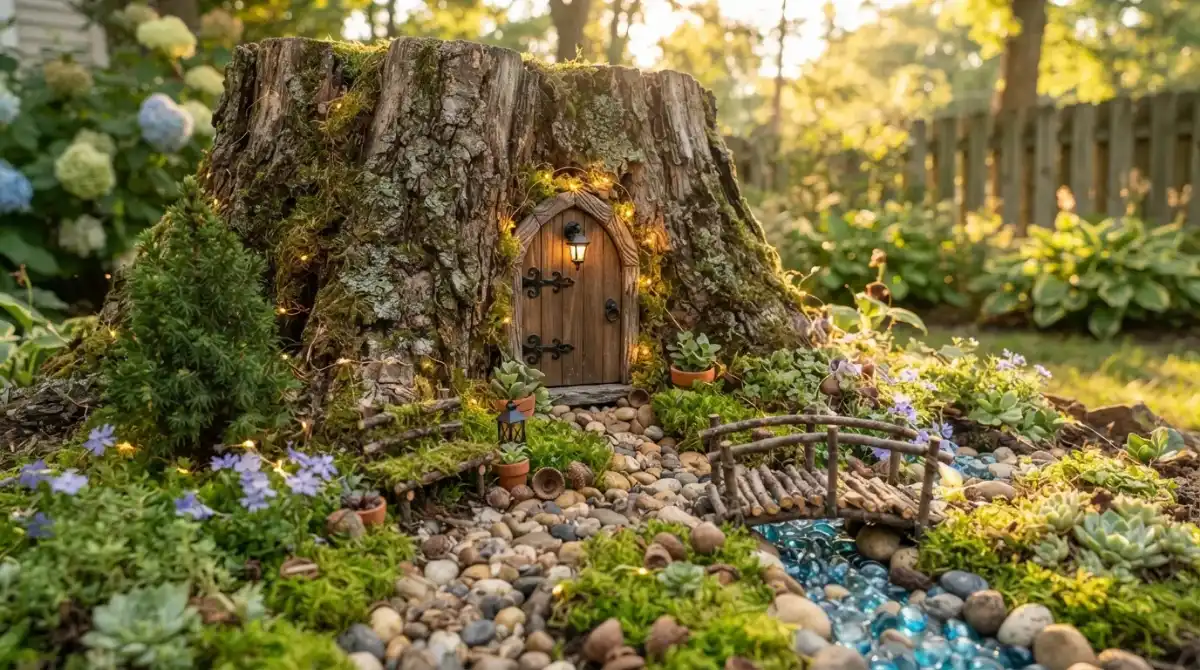
Quick answer: how do you make a fairy garden? Pick a spot or a container with a drainage hole, fill it with fresh potting mix, plant one small “tree” at the back and low ground covers in front, lay a pebble path that leads to a fairy house, then add two or three props in the same scale. Water gently and add one new story detail each week.
Best beginner plants: Irish moss, Elfin thyme, hens and chicks, dwarf mondo grass and a dwarf conifer outdoors; fittonia, baby tears and a jade plant indoors.
Typical cost: about $15 for a dollar store tray, about $50 for a planted pot and around $150 for a large tub village.
What Is a Fairy Garden?
A fairy garden is a miniature garden with tiny houses, paths and props that suggest someone very small lives there. It can be planted in the ground, at the base of a tree or in any container from a teacup to a wheelbarrow. The U.S. Botanic Garden describes building one in layers: good soil first, then ground covers, then paths, bridges and dwellings, then furniture and finally the plants that bring it to life.
It is part gardening, part dollhouse, part storytelling, which is why it works as a calm weekend hobby for adults and a gentle first garden for kids. If you like building tiny worlds, you will also enjoy our terrarium ideas.
Before You Start: Stage, Scale and Story
Think like a set designer. Every great fairy garden answers three questions before anything is bought.
- Stage: where will it live? A pot, a patch of yard, a tree base or indoors under glass. The stage decides your plants, because it decides your light and your weather.
- Scale: how big is its world? Fairy houses, fences and figurines come in different sizes. Pick one scale and keep every prop in it.
- Story: what is happening here? A cottage with laundry on the line, a fishing dock at the edge of a pond, a winter village waiting for Santa. One clear story makes 10 small props feel like a place.
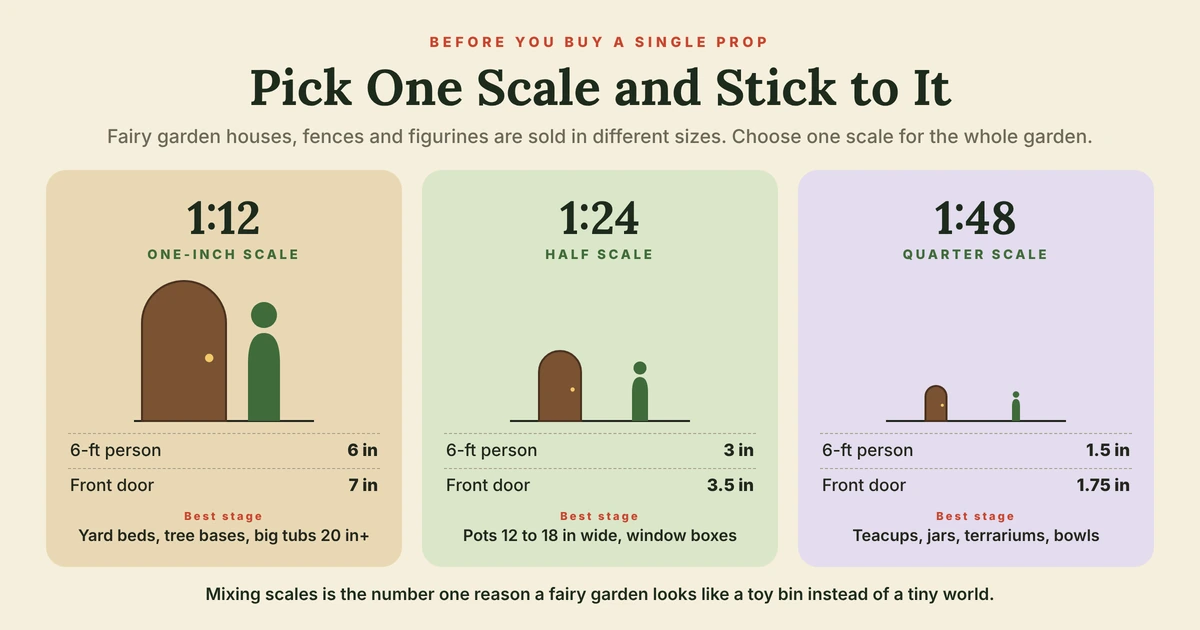
The scale rule in practice: at 1:12, a 6-foot person is 6 inches tall and a front door is about 7 inches, which suits yard beds and big tubs. At 1:24 everything halves, which suits pots 12 to 18 inches wide. At 1:48 a door is under 2 inches, perfect for teacups, jars and terrariums. Your plants follow the same logic: a dwarf conifer reads as a tall pine at 1:12, while a single sprig of thyme can be a tree at 1:48.
Not sure which stage and story suit you? Answer four questions and the planner below builds a garden for your light and budget.
Fairy Garden Story Builder
Answer four questions and get a fairy garden plan: the theme, scale, plants that suit your light, props for your budget and a first-weekend build list.
Now for the ideas. They are grouped by stage so you can jump straight to the space you have.
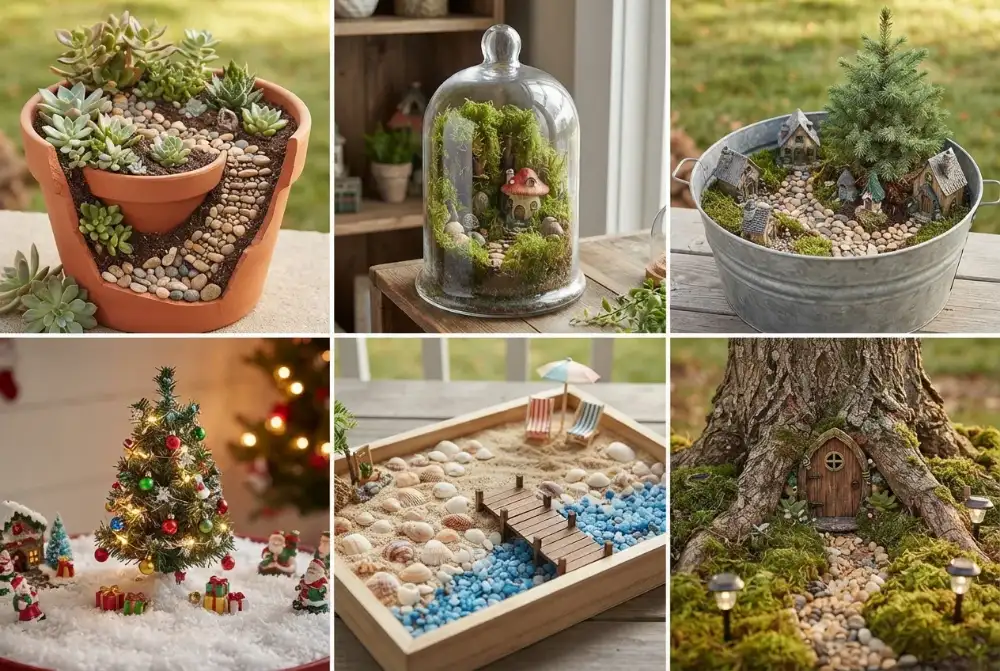
Fairy Garden Ideas for Pots and Planters (1-6)
A container is the easiest way to start: it is portable, it can come indoors for winter and it gives you a natural frame. Always choose a pot with a drainage hole.
1. Broken Pot Terraces
Stage: patio or porch · Scale: 1:24 · About $25 · Full sun
Break a chunk out of the rim of a large terracotta pot, then stand the broken shards inside as terraces. Fill the levels with cactus mix and succulents, add tiny stairs up the shards and put a cottage on the top terrace. It looks like a hillside village built into a ruined wall.
Set tip: wrap the pot in an old towel and tap gently with a hammer, or nibble the rim with tile nippers for more control. Wear safety glasses.
2. Strawberry Pot Tower
Stage: patio · Scale: 1:24 · About $35 · Sun to part shade
A strawberry pot already has little pockets down its sides. Plant each pocket with thyme or sedum and give one pocket a balcony: a tiny chair, a window box or a ladder leading up to a house on top. It is a whole apartment block in one pot.
3. Galvanized Tub Village
Stage: patio or deck · Scale: 1:12 or 1:24 · About $60 to $150 · Sun to part shade
A wide galvanized tub gives you room for a real street: two houses, a pebble lane, a well and a dwarf conifer as the village tree. Drill several drainage holes in the base before planting. This is the classic “heirloom” fairy garden that can last for years.
4. Window Box Main Street
Stage: windowsill or railing · Scale: 1:24 · About $30 · Matches your window
Line up three or four tiny shopfronts along a window box: a bakery, a bookshop, a florist. Plant a low ground cover in front as the sidewalk and trailing plants spilling over the edge. Seen from inside the house, it becomes a view for the fairies and for you.
5. Teacup Cottage
Stage: shelf or table · Scale: 1:48 · About $10 · Bright indoor light
An old teacup and saucer make a charming micro garden. Plant one small sedum or echeveria, add a pebble path across the saucer and a quarter-scale mushroom house. Because most teacups have no drainage, water sparingly with a spoon or use the cup as a cover pot around a small nursery pot.
6. Hanging Basket Floating Island
Stage: porch or pergola · Scale: 1:48 · About $25 · Part shade
Line a wire hanging basket with sheet moss, plant trailing plants around the sides as “cliffs” and set a tiny house and a rope bridge on top. Hung at eye level, it looks like an island drifting in the air. Glue props down so wind cannot steal them.
Backyard Fairy Garden Ideas for Large Outdoor Spaces (7-12)
In the yard you can work at 1:12 and let real landscape features do the heavy lifting. Roots become cliffs, rocks become mountains and a birdbath becomes a lake. These large outdoor fairy garden ideas also make lovely landscaping details along paths and borders.
7. Tree Root Fairy Village
Stage: base of a mature tree · Scale: 1:12 · About $40 · Part shade
The gaps between big surface roots are natural rooms. Set a fairy door against the trunk, lay a pebble path between two roots and plant moss or Corsican mint in the shady pockets. Do not pile soil against the trunk or dig deeply around roots; build on top with thin layers of mix.
Set tip: attach a fairy door with outdoor-safe adhesive putty or a stake rather than nails into a living tree.
8. Tree Stump Hideaway
Stage: old stump · Scale: 1:12 · About $50 · Sun to part shade
An old stump is the best free prop in any yard. Fix an arched door and a window to the side, add a ladder or spiral of stepping stones, and plant thyme and hens and chicks in the crevices. Solar micro lights wrapped loosely around the top make it glow at dusk, as in the photo above.
9. Rock Garden Mountain Pass
Stage: sunny slope or rockery · Scale: 1:12 · About $45 · Full sun
Stack flat stones into a slope and tuck Elfin thyme, sedum and hens and chicks between them as alpine meadows. A slate path switchbacks up to a stone cottage at the top. This is one of the toughest fairy gardens you can build, because rock garden plants love heat and fast drainage.
10. Border Hamlet
Stage: edge of an existing flower bed · Scale: 1:12 · About $30 · Matches the bed
You do not need a dedicated spot. Pick a 2 by 2 foot corner at the front of a border, clear it, plant a low ground cover and set a cottage so it peeks out from under the bigger plants behind it. Visitors discover it by surprise, which is half the magic.
11. Pond Edge Fishing Village
Stage: beside a pond, fountain or birdbath · Scale: 1:12 · About $60 · Sun to part shade
Real water changes everything. Build a little dock from craft sticks sealed with outdoor varnish, add a rowboat, a fishing rod and a pebble beach, and plant blue star creeper along the edge. Keep resin pieces out of standing water so they last.
12. Raised Bed Fairy Allotment
Stage: corner of a vegetable bed · Scale: 1:12 · About $20 · Full sun
Give the fairies a 1 by 1 foot corner of your raised bed and plant tiny rows of thyme, chives and alyssum like a miniature vegetable plot, with a scarecrow and a wheelbarrow. It is a lovely way to get kids into the real garden too. Planning a bed for spring? See our raised garden bed ideas.
Indoor Fairy Garden and Fairy Garden Terrarium Ideas (13-18)
Indoors you work small, usually at 1:48, and light becomes your main limit. One rule matters more than any other: closed glass is for moisture lovers like moss, fittonia and baby tears, and open dishes are for succulents, which rot in trapped humidity.
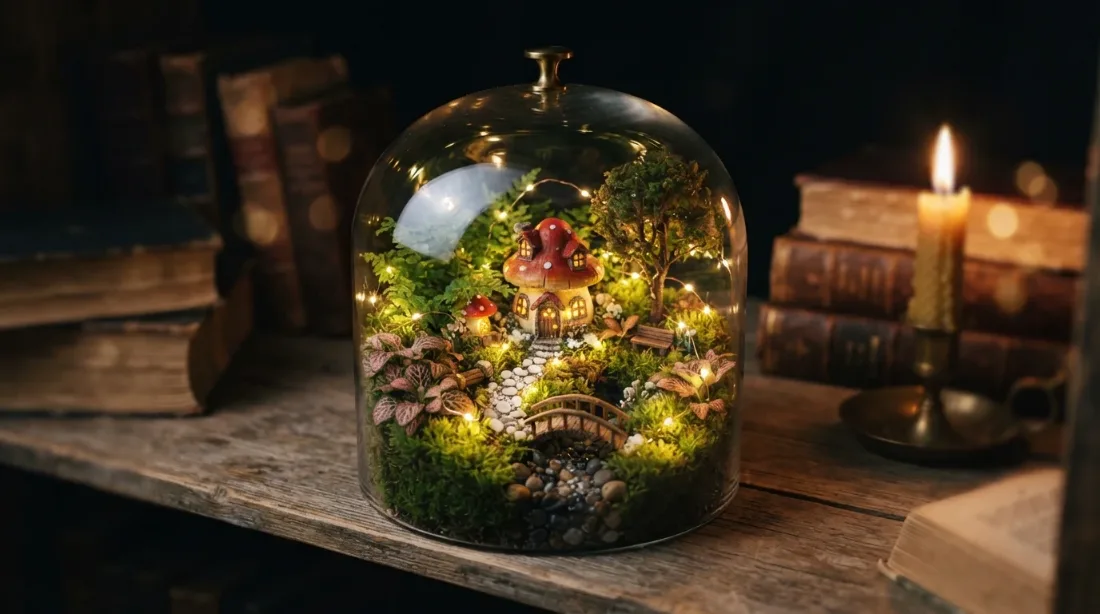
13. Cloche Moss Woodland
Stage: table or shelf · Scale: 1:48 · About $30 · Bright, indirect light
A glass cloche over a shallow tray creates a humid little forest. Plant cushion moss, a fittonia and a fern, then add a mushroom house and a stone path. Lift the cloche for an hour once a week to let fresh air in, and mist when the moss looks dull.
14. Apothecary Jar Mushroom Glade
Stage: shelf · Scale: 1:48 · About $25 · Bright, indirect light
Layer gravel, a thin layer of activated charcoal and potting mix in a tall jar, then build a glade of moss and baby tears with red-capped mushroom figures. Use long tweezers and a chopstick to place everything. Keep it out of direct sun, which cooks closed glass.
15. Open Succulent Dish
Stage: sunny windowsill · Scale: 1:48 · About $20 · Bright direct light
A wide, shallow dish of cactus mix with three or four small succulents becomes a desert outpost. Add a sand path, a tiny adobe house and a few pebbles as boulders. Water only when the mix is completely dry.
16. Bookshelf Fairy Library
Stage: bookshelf near a window · Scale: 1:48 · About $20 · Bright, indirect light
Set an open terrarium dish on a shelf between real books and give the fairies their own reading nook: a chair, a lamp and a stack of tiny books cut from card. Plant a moss lawn and one small jade plant as the shade tree.
17. Kitchen Herb Fairy Garden
Stage: sunny kitchen window · Scale: 1:24 · About $25 · Full sun
Plant thyme, chives and parsley in a long trough and tuck a cottage at one end, so the fairies live in your herb patch. Everything is edible, and you trim it every time you cook. For lighting and watering, use our indoor herb garden guide.
18. Shadow Box Wall Garden
Stage: any wall · Scale: 1:48 · About $25 · Any light
For a dark room, skip live plants entirely. Glue preserved moss, dried flowers and a tiny door inside a deep shadow box frame and hang it like art. It needs no water and is out of reach of pets and toddlers. Our pressed flower ideas show how to dry the flowers.
Dollar Tree Fairy Garden and Upcycled Ideas (19-24)
Some of the most charming fairy gardens cost almost nothing, because the container itself tells the story.
19. The $15 Dollar Store Tray
Stage: table or porch · Scale: 1:48 or 1:24 · About $15 · Matches your plant
Dollar Tree and other dollar stores sell fairy houses, figurines, mini fences, moss and decorative pebbles at around $1.25 each. Pair them with a tray or basket, a small bag of potting mix and one or two live plants from a garden center, and you have a complete garden for about $15. More ideas live in our Dollar Tree crafts guide.
Set tip: check every prop against your chosen scale in the store. Dollar store houses vary a lot in size.
20. Dresser Drawer Cottage Row
Stage: porch or patio · Scale: 1:24 · About $15 · Part shade
An old wooden drawer becomes a long planter for a row of cottages. Drill drainage holes, line it with landscape fabric and seal the outside with exterior varnish so it lasts more than one season.
21. Vintage Suitcase Picnic
Stage: covered porch or indoors · Scale: 1:24 · About $20 · Bright light
Prop open a thrifted suitcase, line the bottom half with plastic and fill it with mix and moss, then set a fairy picnic in the lid: blanket, basket and a tiny cake. Keep it under cover, because suitcases do not survive rain.
22. Birdbath Island
Stage: yard · Scale: 1:12 or 1:24 · About $25 · Full sun
A cracked or retired birdbath bowl makes a perfect round garden on a pedestal. Drill a drainage hole, plant hens and chicks and thyme around a central house, and edge it with shells or pebbles like a shoreline.
23. Wagon or Wheelbarrow Caravan
Stage: yard · Scale: 1:12 · About $30 · Sun to part shade
A rusty wheelbarrow or child’s wagon becomes a traveling fairy village you can roll into the sun or under cover. Drill holes in the base, fill with mix and plant a mounding ground cover, then park a cottage and a cart on top.
24. Watering Can Cottage
Stage: garden bed · Scale: 1:12 · About $10 · Any
Lay an old metal watering can on its side, half buried in a bed, and paint a door and windows on the bottom. The spout becomes a chimney. Plant moss or thyme around it so it looks like it has been there for years.
Themed Fairy Garden Ideas With a Story (25-30)
A theme gives every prop a reason to be there. Pick one and edit out anything that does not fit.
25. Beach Cove
Stage: shallow tray or sandy corner · Scale: 1:24 · About $20 · Full sun
Fill one half of a tray with play sand and the other with blue glass beads as the sea. Add a driftwood dock, shells, a striped umbrella and two deck chairs. Plant sea thrift (Armeria) or a sedum where the “dunes” meet the soil.
26. Cottagecore Tea Party
Stage: pot or tub · Scale: 1:12 · About $35 · Part shade
A thatched cottage, a table set for tea, bunting strung between two twigs and a lawn of Irish moss. Plant sweet alyssum for a honey scent and tiny flowers. This is the fairy garden equivalent of a lazy Sunday afternoon.
27. Gnome Woodland Workshop
Stage: shady bed or tree base · Scale: 1:12 · About $35 · Shade
Gnomes are woodworkers, so build them a workshop: a log pile from twigs, a sawhorse, a wheelbarrow and a mushroom-capped shed. Hostas like ‘Blue Mouse Ears’ and Labrador violet make perfect shady woodland plants.
28. Dragon’s Lair
Stage: sunny pot or rockery · Scale: 1:24 · About $30 · Full sun
Kids love this one. Build a cave from stacked rocks, scatter gold-painted pebbles as treasure and plant spiky succulents as a fierce landscape. A small dragon figure guarding the entrance completes the story.
29. Night Garden
Stage: patio or porch · Scale: 1:12 or 1:24 · About $40 · Sun to part shade
Design for after dark: white flowers like sweet alyssum, a silver ground cover, a pale cottage with lit windows and a ring of solar micro fairy lights. It glows when you sit outside in the evening.
30. Pollinator Fairy Meadow
Stage: sunny bed or wide pot · Scale: 1:12 · About $30 · Full sun
Plant a tiny meadow of flowering creeping thyme, alyssum and thrift that real bees and hoverflies visit, with a fairy beekeeper’s cottage and a mini hive. It is a fairy garden that feeds the actual garden.
Christmas Fairy Garden and Seasonal Ideas (31-36)
Changing the story with the seasons is what keeps a fairy garden fun for years. Swap props, not plants, and the garden stays alive while it feels brand new.

31. Christmas Fairy Village
Stage: porch pot or indoor tray · Scale: 1:24 · About $30 · Matches your plants
A dwarf Alberta spruce becomes the village Christmas tree. Wrap it in micro lights, add tiny wrapped presents, a sled and a wreath on the cottage door, and dust the ground with faux snow. Place the pot by the front door and it doubles as part of your Christmas porch decor.
32. Winter Wonderland Jar
Stage: mantel or table · Scale: 1:48 · About $15 · No live plants needed
Fill a large jar with fake snow, a bottlebrush tree or two, a tiny cabin and a fairy skating on a mirror “pond.” It is a no-water winter display that the kids can rearrange all season. Add it to your winter bucket list.
33. Autumn Harvest Market
Stage: pot or tray · Scale: 1:24 · About $20 · Any
Acorn caps become baskets, tiny gourds become pumpkins and a market stall from craft sticks sells the harvest. Plant a sedum that blushes red in fall for color.
34. Haunted Hollow
Stage: shady pot · Scale: 1:24 · About $20 · Part shade
A crooked house, a twig fence, a tiny graveyard of painted stones and dark-leaved bugleweed (Ajuga) or black mondo grass for a spooky mood. Swap it back to a woodland scene on November 1.
35. Spring Bulb Meadow
Stage: pot or bed · Scale: 1:12 · About $15 · Full sun
Plant small bulbs such as crocus or grape hyacinth (Muscari) in fall, then build the fairy garden on top. In spring the flowers push up through the moss like a meadow coming to life. If your ground has not frozen yet, there is still time this season.
36. Summer Firefly Campground
Stage: patio tub · Scale: 1:12 · About $30 · Full sun
A tiny tent, a campfire of orange glass beads circled with pebbles, a canoe on a bead lake and solar lights as fireflies. It turns a summer evening on the patio into an adventure.
How to Make a Fairy Garden in 7 Steps
Here is the build order that works for every DIY fairy garden, in a pot or in the ground. Work from the back to the front and from the bottom to the top, exactly like a stage crew.
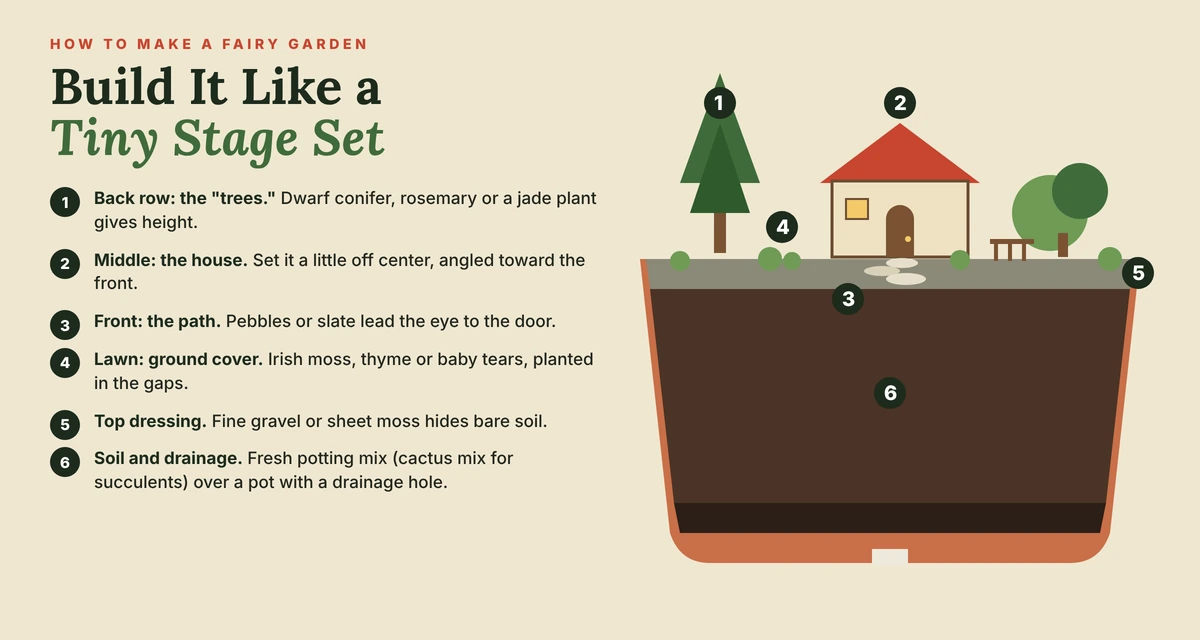
- Choose the stage and check the light. Note how many hours of direct sun the spot gets. Your plants depend on it.
- Prepare the container or ground. Use a pot with a drainage hole and fresh potting mix, or cactus mix for succulents. In the ground, loosen the top few inches and mix in compost.
- Plant the back row first. Your tallest plant, the “tree,” goes at the back or to one side so it frames the scene.
- Lay the path before the house. A path is what makes a garden feel lived in. Let it curve, and press pebbles or slate pieces firmly into the soil.
- Place the house where the path ends. Set it a little off center and angled toward the viewer.
- Plant ground covers into the gaps. Irish moss, thyme or baby tears fill in quickly and become the lawn.
- Add two or three props and stop. A bench, a mailbox, a lantern. Leave empty space; it is what makes the scene believable. Water gently to settle everything.
The eye-level test: when you think it is finished, crouch down so your eyes are level with the fairy door and take a photo with your phone. Anything that looks out of scale or cluttered in the photo should move or go.
Fairy Garden Plants That Stay Small
The right fairy garden plants grow slowly, stay low and have tiny leaves, so they read as full-size trees, lawns and flower beds at miniature scale. The U.S. Botanic Garden recommends ground covers such as blue star creeper, Irish moss and Corsican mint, flowers like Armeria ‘Nifty Thrifty’ and Hosta ‘Blue Mouse Ears’, and grasslike plants such as dwarf mondo grass. Ohio State Extension Master Gardeners add Elfin thyme, succulents and lavender for sunny gardens.
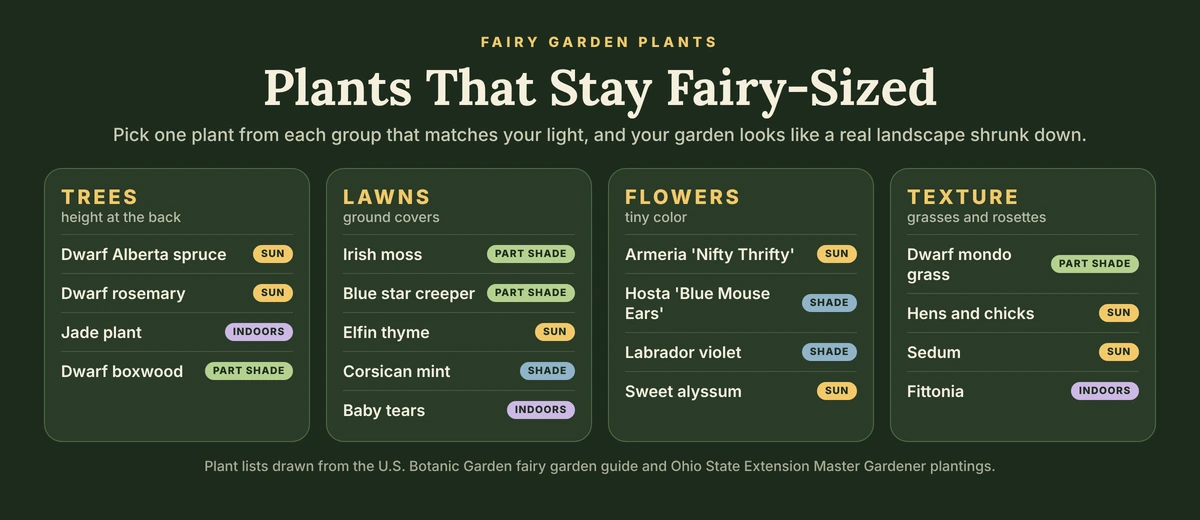
| Plant | Role in the scene | Light | Good to know |
|---|---|---|---|
| Dwarf Alberta spruce | Pine tree | Sun | Grows only a few inches a year; doubles as a Christmas tree |
| Dwarf rosemary | Shrub or tree | Sun | Likes to dry out between waterings; you can cook with the trimmings |
| Jade plant | Indoor tree | Bright indoors | Looks like a bonsai; toxic to cats and dogs |
| Irish moss | Lawn | Sun to part shade | Not a true moss; needs good drainage |
| Elfin thyme | Lawn | Sun | Forms a tight mat only an inch or so tall |
| Blue star creeper | Lawn with flowers | Sun to part shade | Tiny blue stars; can spread, so trim edges |
| Corsican mint | Mossy lawn | Part shade to shade | Tiny leaves with a mint scent; needs steady moisture |
| Baby tears | Lawn | Indoors or shade | Loves humidity; ideal for terrariums |
| Hens and chicks | Boulders and shrubs | Sun | Very cold hardy; never let it sit in wet soil |
| Dwarf mondo grass | Grass tufts | Part shade | Slow growing and evergreen |
| Fittonia | Colorful shrub | Indoors | Bright veined leaves; best under glass |
| Sweet alyssum | Flower bed | Sun | Honey-scented annual that attracts pollinators |
Trim to keep the illusion. Ohio State Extension volunteers note that occasional trimming keeps fairy garden plants small. Snip anything that starts to look bigger than the house, and pull out a ground cover that tries to swallow the path.
DIY Fairy Garden Accessories You Can Make (and Which Survive Outdoors)
Store-bought fairy garden accessories add up fast. Handmade props cost pennies, look more natural and are the best part of the project for kids. The column that matters most is the third one: plenty of craft materials melt, rot or fade in the first rainstorm.
| Prop | Make it from | Outdoors? | Good for kids? |
|---|---|---|---|
| Fence | Twigs tied with garden twine | Yes | Ages 4+ |
| Bridge | Craft sticks glued and sealed with outdoor varnish | Yes, if sealed | Ages 6+ |
| Stepping stones | Flat pebbles or salt dough discs | Pebbles yes, salt dough indoors only | Ages 3+ |
| Mushrooms | Painted rocks or wooden pegs | Yes, with sealer | Ages 4+ |
| Bowls and baskets | Acorn caps | Yes | Ages 3+ |
| Table and stools | Bottle caps and wine corks | Yes | Ages 5+ |
| Bunting | Pressed petals or fabric scraps on thread | Indoors only | Ages 5+ |
| Pond | A jar lid filled with blue glass beads | Yes | Ages 4+ |
| Cottage | Cardboard and air-dry clay | Indoors only | Ages 7+ |
Find step-by-step instructions in our guides to popsicle stick crafts, rock painting ideas and salt dough. Building with little ones? Our Christmas crafts for kids pair perfectly with a holiday fairy garden.
How Much Does a Fairy Garden Cost?
A fairy garden can cost almost anything, but three builds cover most people. The money is best spent on healthy plants and one good house; everything else can be handmade.
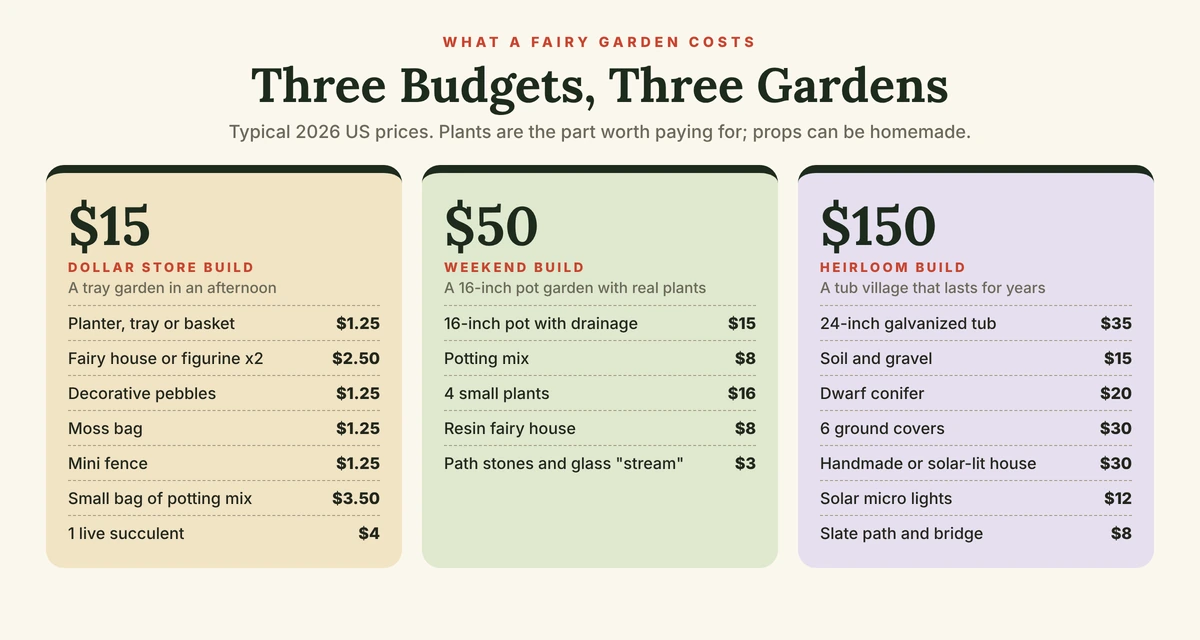
Fairy garden kits that bundle a container, soil, seeds and figurines are a good gift for kids and usually cost $20 to $40. They often skip live plants or use fast-growing seeds that outgrow the scale, so treat a kit as a starting point and swap in the slow plants from the list above.
Keep Your Fairy Garden Alive Through Rain, Winter and Curious Pets
- Water by plant, not by calendar. Succulents and thyme like to dry out; moss, Corsican mint and baby tears like steady moisture. Ohio State Extension volunteers warn that succulents are especially easy to overwater, so group plants with the same needs together.
- Pin props down. Wind, rain, squirrels and birds all move tiny things. Use a dab of outdoor adhesive to fix pieces to flat stones, or push a toothpick or skewer into the soil under each prop.
- Bring breakables in before the first hard freeze. Resin, ceramic and glass can crack when water trapped inside them freezes. Terracotta pots can also crack in freeze-thaw cycles, so move them somewhere sheltered or switch to frost-resistant containers.
- Winter the plants. Hardy plants like hens and chicks and dwarf conifers can stay out in many US regions. Tender succulents, fittonia and baby tears need to come indoors to a bright window.
- Keep tiny props away from toddlers. Small pieces are a choking hazard for children under 3. Glue them down or save the garden for older kids.
- Check plants against pets. Jade plant is toxic to cats and dogs. If you have pets, check any plant against the ASPCA toxic plant list before adding it.
- Refresh each season. Topdress with fresh gravel, divide crowded ground covers in spring and swap in new props for the next story.
Fairy Garden Trends for 2026 and 2027
Fairy gardens have been around for decades. Ann Arbor, Michigan, has had tiny fairy doors on its downtown storefronts since 2005. But the style keeps evolving. Here is where it is heading.
- Natural over plastic. More twig, stone, moss and clay props, fewer shiny resin figurines. The garden should look grown, not bought.
- Gardens that help wildlife. Pollinator meadows with flowering thyme and alyssum, tiny bee houses and fairy gardens built around a birdbath.
- Moss everything. Moss gardens and woodland terrariums keep growing in popularity, and fairy gardens are borrowing the look.
- Solar micro lighting. Small solar fairy lights and lanterns turn gardens into evening features without any wiring.
- Workshops and terrarium bars. Garden centers and craft studios increasingly host fairy garden and terrarium workshops, and we expect more of them through 2027.
- Seasonal rotations. Instead of one permanent scene, people keep the plants and change the story four times a year, from a spring meadow to a Christmas village.
Looking for more slow, hands-on projects? Browse our hobbies to do at home or set up some backyard games for the kids who just finished building the fairy village.
What do you put in a fairy garden?
A fairy garden needs small plants (a tiny “tree,” low ground covers and a few flowers), a path, a fairy house and two or three props such as a bench, a fence or a lantern. Keep everything in one scale, and leave some empty space so the scene feels real.
What are the best plants for a fairy garden?
Slow-growing plants with small leaves work best: Irish moss, Elfin thyme, blue star creeper, Corsican mint, hens and chicks, dwarf mondo grass and a dwarf conifer outdoors, and fittonia, baby tears and jade plant indoors.
How do you make a fairy garden in a pot?
Choose a pot at least 12 inches wide with a drainage hole, fill it with fresh potting mix, plant one taller plant at the back and ground covers in front, lay a pebble path to a fairy house and add a few props in the same scale.
Can a fairy garden stay outside in winter?
The hardy plants can, but bring resin, ceramic and glass props and terracotta pots indoors or under cover before hard freezes, because trapped water can crack them. Tender plants like succulents and fittonia should come inside.
How much does it cost to make a fairy garden?
About $15 for a simple dollar store tray garden, about $50 for a planted pot with a resin house, and around $150 for a large tub village with a dwarf conifer, several ground covers and solar lights.
What is the difference between a fairy garden and a terrarium?
A terrarium is a garden inside glass, open or closed. A fairy garden is any miniature garden with fairy houses and props. A fairy garden can be built inside a terrarium, but most are planted in pots or in the ground.
How do I keep fairy garden accessories from blowing away?
Glue props to flat stones with outdoor adhesive, push a toothpick or skewer into the soil beneath each piece, or bury the base of houses slightly in the soil.