Cybersigilism Tattoo: 80 Designs by Placement, Style and Meaning (2026)
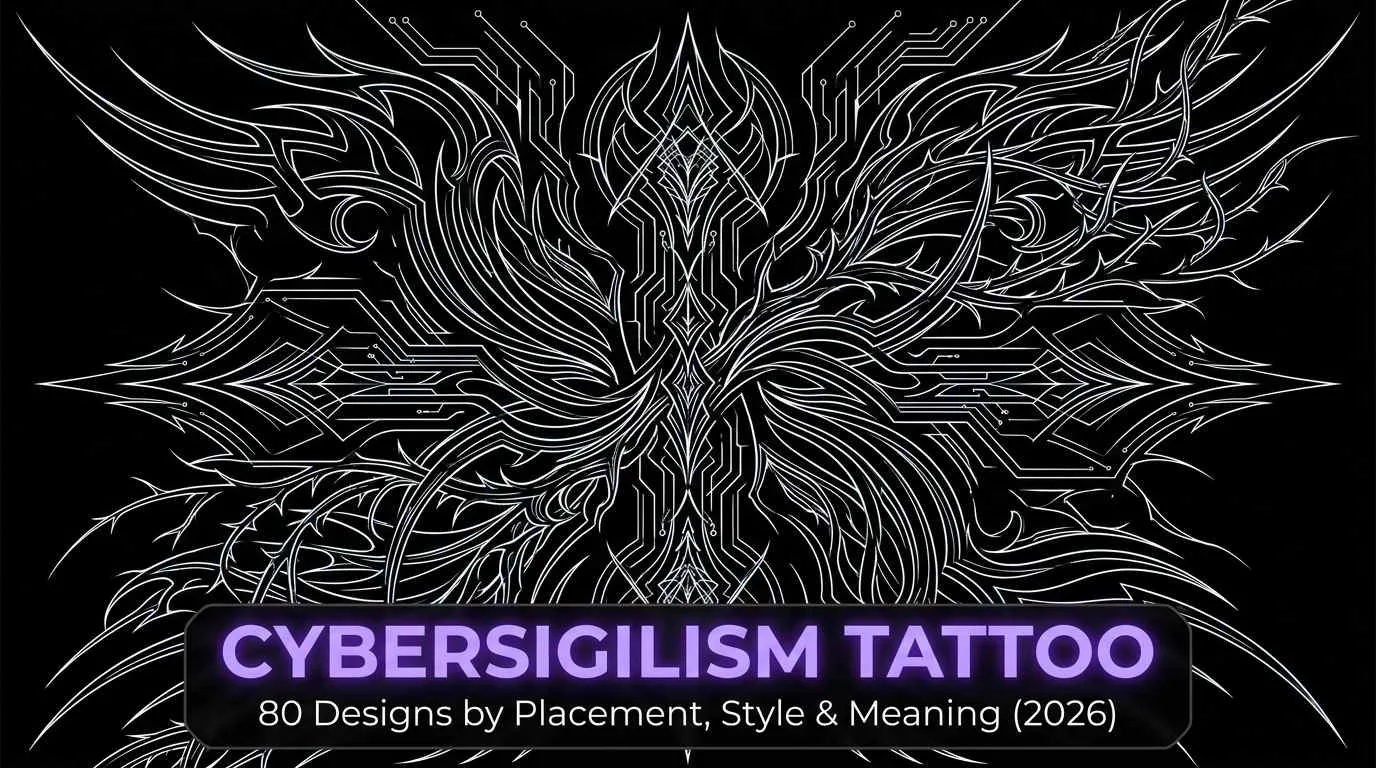
Cybersigilism is the tattoo style that looks like it was designed by an AI in a cathedral. Flowing neo-tribal curves meet circuit-board precision, sacred geometry collapses into organic thornwork, and the whole thing sits on the body like something between a sigil, a spell and a motherboard trace. It is the defining tattoo aesthetic of the 2020s, and searches for cybersigilism tattoo designs have exploded past 22,000 per month with no sign of slowing.
This guide has 80 cybersigilism tattoo designs organised by body placement — back, arm, hand, chest, spine, neck, leg and small/minimal — with the history, the design language explained, the meaning behind the style, and a section on how to draw cybersigilism yourself. Every design is described in enough detail to take to a tattoo artist as a reference.
Cybersigilism is a tattoo and digital art style that fuses neo-tribal line work with sacred geometry, circuit-board patterns, organic thornwork and occult sigil aesthetics. Originating from the underground digital art communities of the early 2020s and popularised by artists like Brody Polinsky and Gina Stancescu, the style is defined by sharp symmetrical curves, flowing angular lines, pointed terminals and a dark, futuristic visual language that references both ancient mysticism and digital technology. Common placements are the upper back, spine, hands and chest.
What is cybersigilism? History, meaning and origins
The word itself tells the story: cyber (digital, technological, futuristic) + sigil (a symbol believed to carry magical or spiritual power in occult traditions). Cybersigilism merges these two worlds — the precision of digital design and the mysticism of symbolic mark-making — into a visual language that feels simultaneously ancient and post-human.
The roots: tribal, sacred geometry and occult sigils
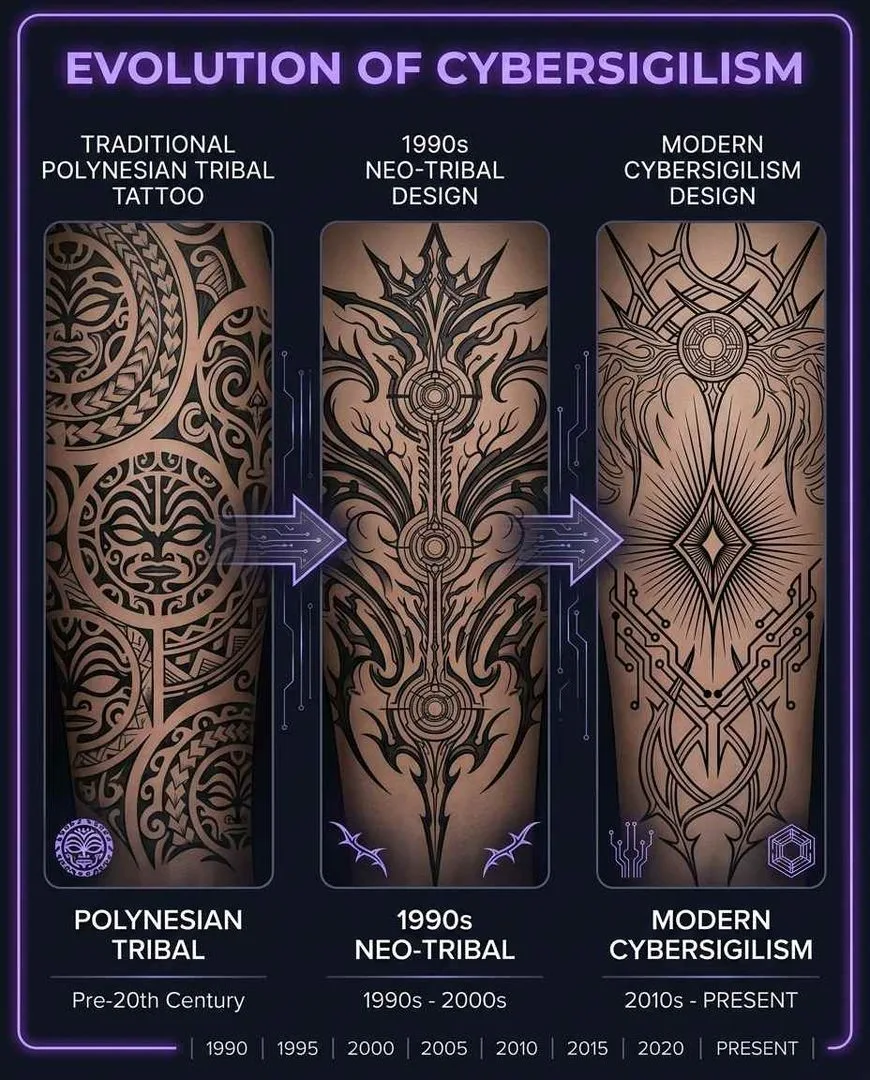
Cybersigilism draws from three historical design traditions. Tribal tattoos (Polynesian, Maori, Borneo) established the visual grammar of flowing black curves on skin. Sacred geometry (the Flower of Life, Metatron’s Cube, mandalas) contributed the mathematical precision and spiritual symbolism. Occult sigils (symbols created through magical intent, rooted in Chaos Magick and Renaissance hermeticism) gave the style its name and its sense that the design carries meaning beyond the visual.
The modern movement: 2020–2026
The modern cybersigilism aesthetic emerged from Tumblr, Instagram and digital art communities around 2020–2021. Artists like Brody Polinsky (@bfreetattoos), Gina Stancescu (@bloodyginatattoos), and Manas (@blackmanastattoo) defined the vocabulary: spine pieces with flowing symmetrical curves, hand tattoos with circuit-inspired line work, and back pieces that merge sacred geometry with organic forms. By 2024, cybersigilism had crossed from underground art circles into mainstream tattoo culture, and by 2026 it is one of the most-searched tattoo styles globally.
What does a cybersigilism tattoo mean?
Unlike traditional tattoo styles where each symbol has a fixed meaning (an anchor means stability, a rose means love), cybersigilism designs are intentionally abstract. The meaning is personal to the wearer. Some people treat the design as a literal sigil — a symbol charged with personal intention during its creation. Others choose it purely for the aesthetic. Both approaches are valid. The style’s power is that it looks like it means something profound even when the meaning is “I thought it looked cool,” and that ambiguity is part of the design philosophy.
The cybersigilism design language — what makes it cybersigilism
Not every black line tattoo with curves is cybersigilism. The style has specific visual characteristics that distinguish it:
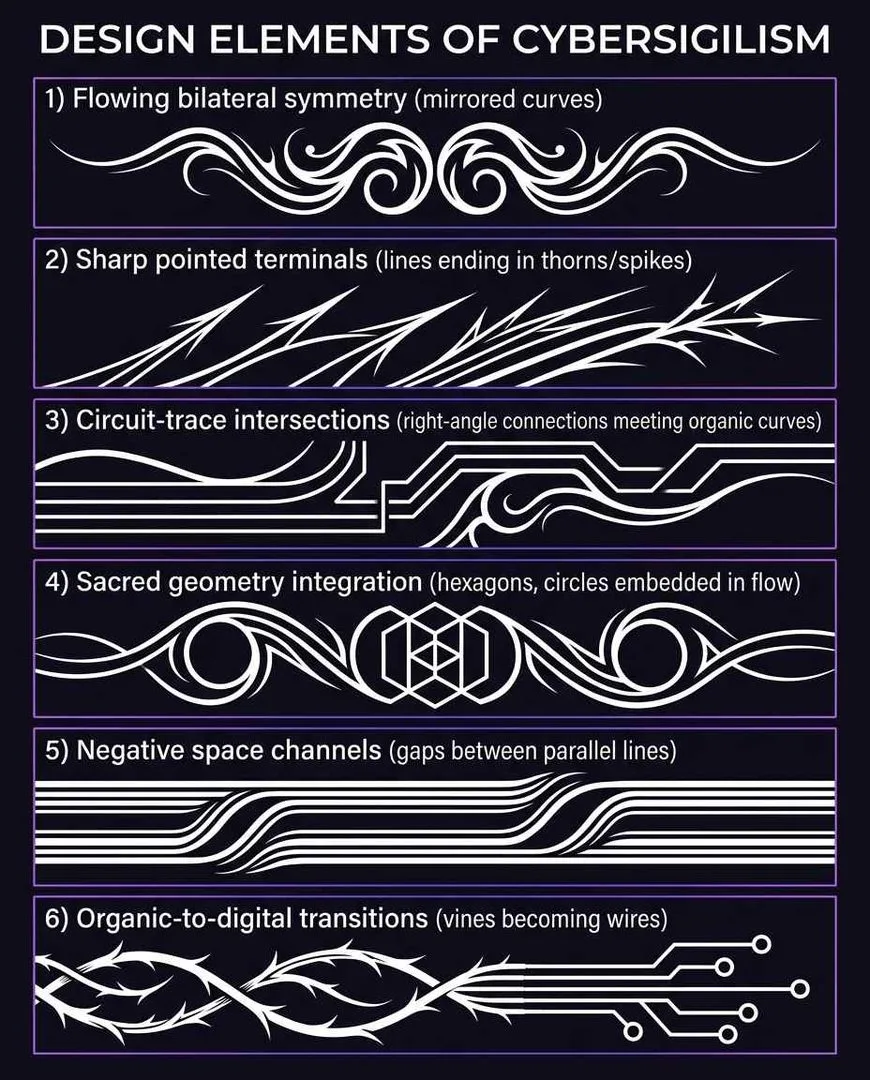
- Bilateral symmetry. Most cybersigilism designs mirror across a vertical axis, creating a perfectly balanced composition. The symmetry references sacred geometry and gives the design a meditative, ritualistic quality.
- Flowing curves with sharp terminals. Lines flow in smooth arcs but terminate in sharp points, thorns or spikes. The contrast between the smooth flow and the aggressive endpoints is the visual tension that defines the style.
- Circuit-trace intersections. Where two lines meet, they often connect at right angles or precise geometric junctions, reminiscent of circuit board traces. This is the “cyber” element.
- Sacred geometry integration. Circles, hexagons, diamonds and other geometric forms appear as nodes or focal points within the flowing line work, grounding the organic curves in mathematical precision.
- Negative space. Parallel lines separated by precise gaps create channels of skin that read as light between dark lines. The negative space is as designed as the positive.
- Black ink only. Traditional cybersigilism is pure black. The contrast against skin is the colour palette. Some contemporary artists add white ink highlights or subtle colour accents, but the canon is monochrome.
- Organic-to-digital transitions. Vines become wires. Thorns become antenna points. Roots become circuit paths. The seamless transition between natural and technological forms is the conceptual core of the style.
Cybersigilism back tattoo designs
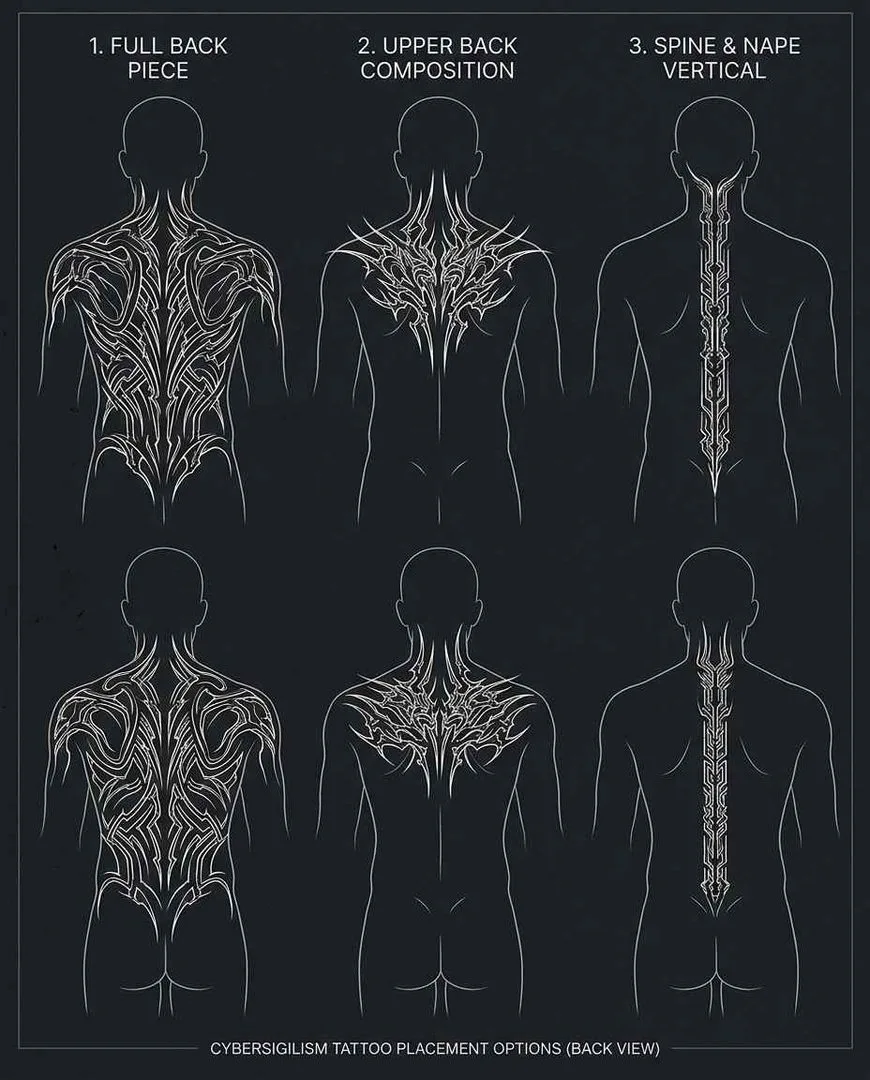
The back is the most popular cybersigilism placement because it offers the largest canvas for symmetrical, vertically-oriented compositions. The spine acts as the natural axis of symmetry, and the shoulder blades provide natural nodes for design elements to radiate from.
1. Full-back cathedral piece
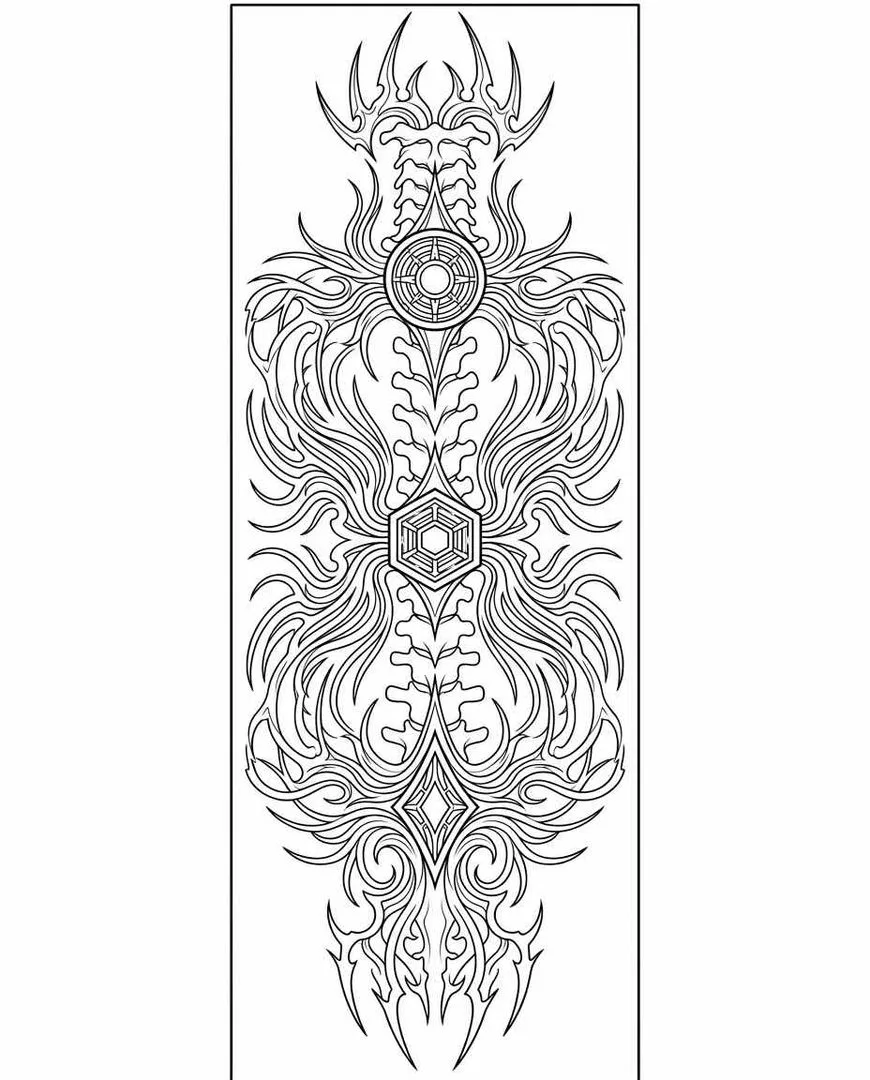
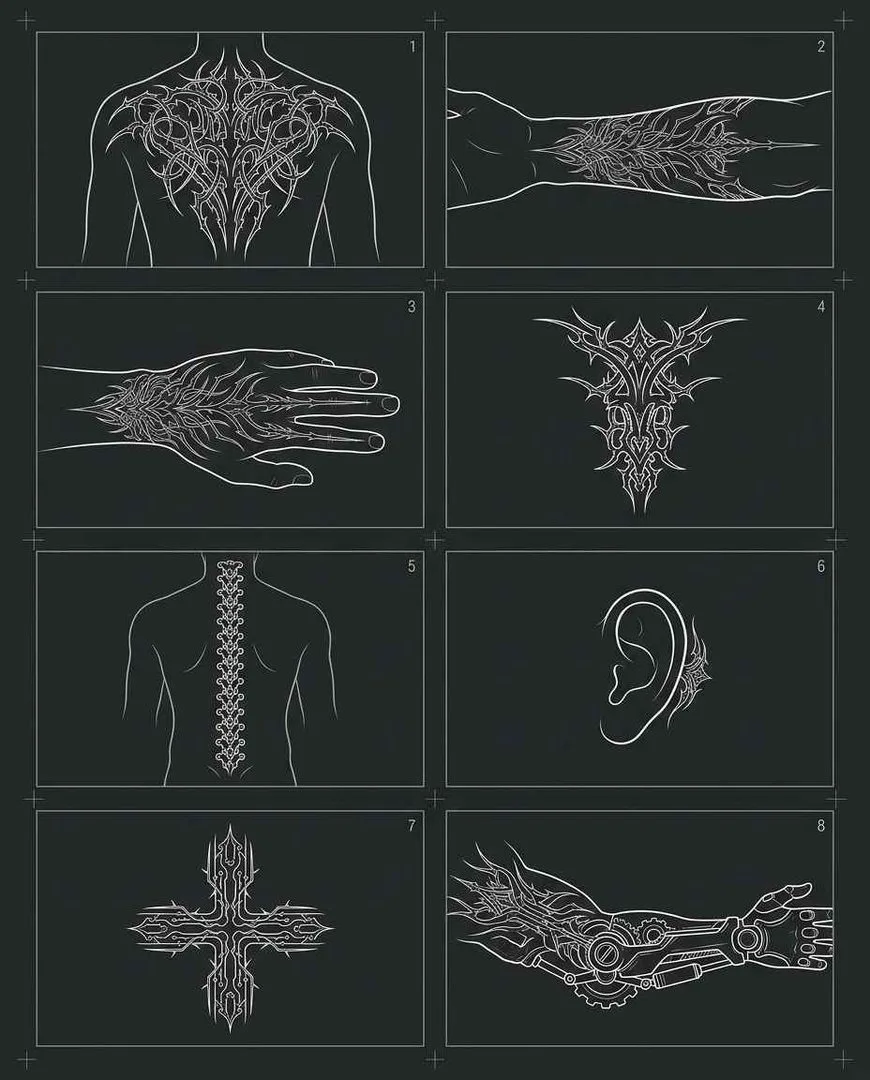
A design that spans the entire back, using the spine as the central axis. Flowing curves radiate outward from the spine like the ribs of a gothic cathedral, reaching the shoulder blades where they terminate in sharp points. The lower back section narrows to a pointed terminal at the tailbone. Sacred geometry circles at the shoulder blade nodes. This is the definitive cybersigilism statement piece — the one that defines the style’s visual power.
2. Upper-back wings
Symmetrical flowing forms that radiate from between the shoulder blades outward and upward, suggesting wings without being literal wings. The lines follow the shoulder blade contours and terminate in thorn points at the shoulders. The spine section is a narrow vertical sigil connecting the two sides.
3. Shoulder-to-shoulder yoke
A design that spans from shoulder to shoulder across the upper back and the base of the neck, like a yoke or collar. The design sits above the shoulder blades rather than on them, creating a crown-like effect when seen from behind. Works well with crew-neck and off-shoulder clothing that reveals the top edge.
4. Lower-back ascending piece
A design that starts narrow at the lower back and expands upward, with the densest, most complex elements at the top between the shoulder blades. The ascending composition draws the eye upward, reversing the typical flow of back tattoo designs.
5. Spinal column overlay
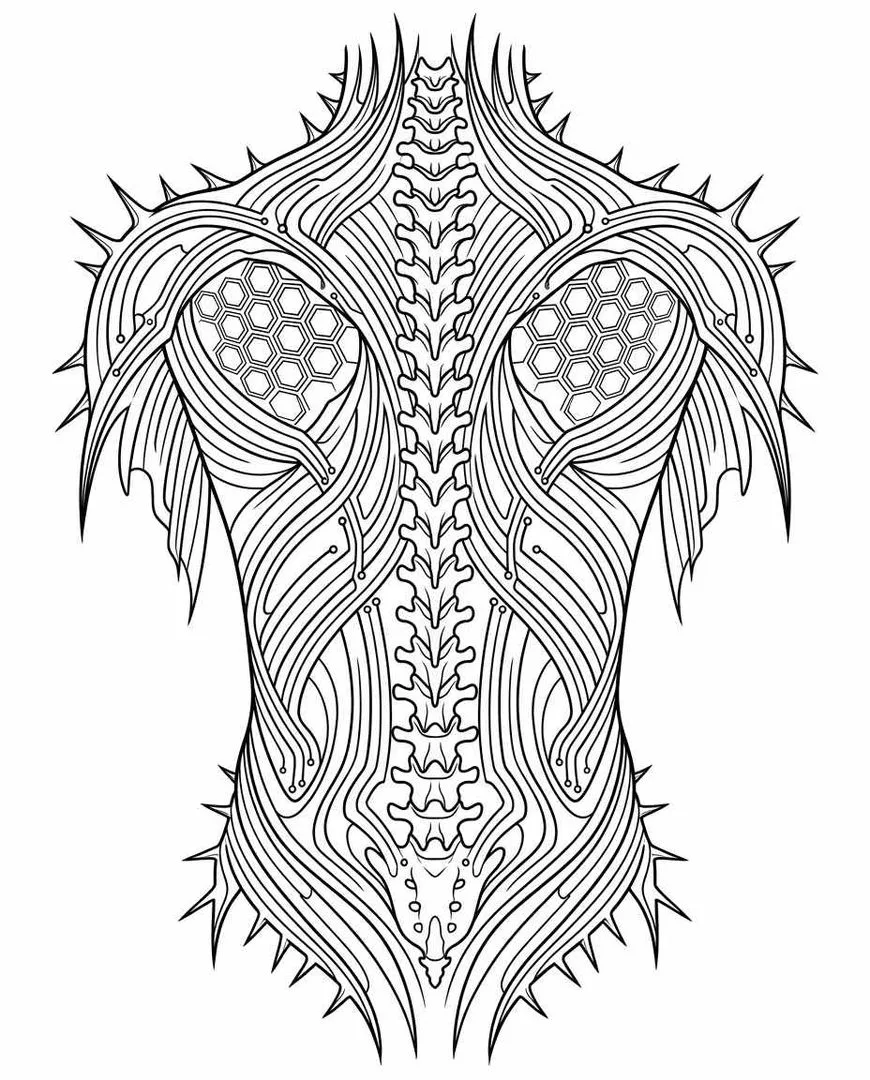
A design that follows the actual vertebral column, with each vertebra position marked by a geometric node (circle, diamond, hexagon) connected by flowing curves that arc outward briefly before returning to the spine. The result looks like a futuristic spinal implant rendered in ink.
6. Back piece with integrated cross
A symmetrical cross form embedded within the flowing cybersigilism line work, visible but abstracted. The horizontal bar aligns with the shoulder blades, the vertical bar follows the spine. The cross reads as both religious iconography and geometric structure.
7. Shoulder blade mandalas
Two mirrored mandala-style circular designs, one on each shoulder blade, connected by a horizontal sigil across the spine. Each mandala is rendered in cybersigilism vocabulary: flowing curves with sharp terminals rather than traditional mandala petal forms.
8. Asymmetric back flow
Breaking the bilateral convention: a single flowing design that starts at one shoulder, sweeps across the upper back diagonally, and terminates at the opposite hip. The asymmetry is rare in cybersigilism and creates a dynamic, motion-filled composition.
9. Negative-space spine channel
Parallel lines running down the spine with a precise gap of bare skin between them, creating a visible channel of negative space. The lines arc outward at intervals, creating ribcage-like extensions. The spine itself is the design — defined by what is NOT inked.
10. Upper back with neck extension
A back piece that extends upward past the collar line, sending a narrow sigil element up the back of the neck to the hairline. The neck extension is visible above any crew-neck collar, creating a reveal element.
Cybersigilism arm and forearm tattoo designs
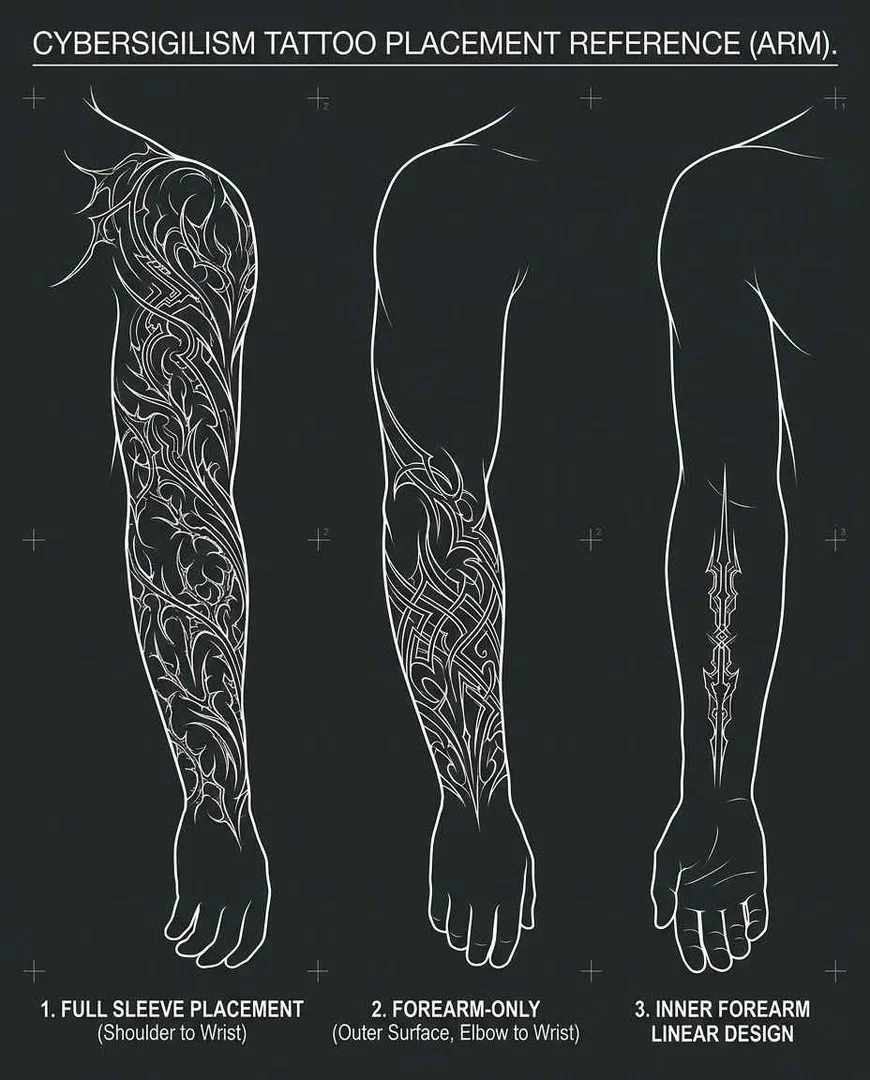
Arms and forearms are the second most popular placement. The cylindrical surface wraps the design around the limb, creating a different visual experience from the flat plane of the back. Designs can spiral, wrap, or run linearly along the arm’s length.
11. Full sleeve spiral
A continuous cybersigilism design that spirals from the shoulder to the wrist, wrapping around the arm like a vine made of circuit traces. The spiral creates visual movement and ensures the design is visible from every angle.
12. Forearm gauntlet
A design that covers the outer forearm from wrist to elbow, sitting on the forearm like armour plating. The wrist end terminates in sharp points that reach onto the back of the hand, and the elbow end fades into bare skin with tapered lines.
13. Inner forearm vertical sigil
A narrow, vertical design running along the inner forearm — the most visible and personal placement. The design is a single, contained sigil: bilaterally symmetrical, 15–20cm tall, with a clear beginning and end. This is the classic “first cybersigilism tattoo” placement.
14. Bicep band
A cybersigilism armband that wraps the upper arm, replacing the traditional solid-black armband with flowing curves and geometric nodes. The band can be narrow (3cm) or wide (8cm+), with the complexity scaling to the width.
15. Elbow web
A design centred on the elbow, with flowing lines radiating outward from the elbow point like a web or starburst. The elbow’s natural crease becomes a design feature rather than an obstacle. A bold, unusual placement.
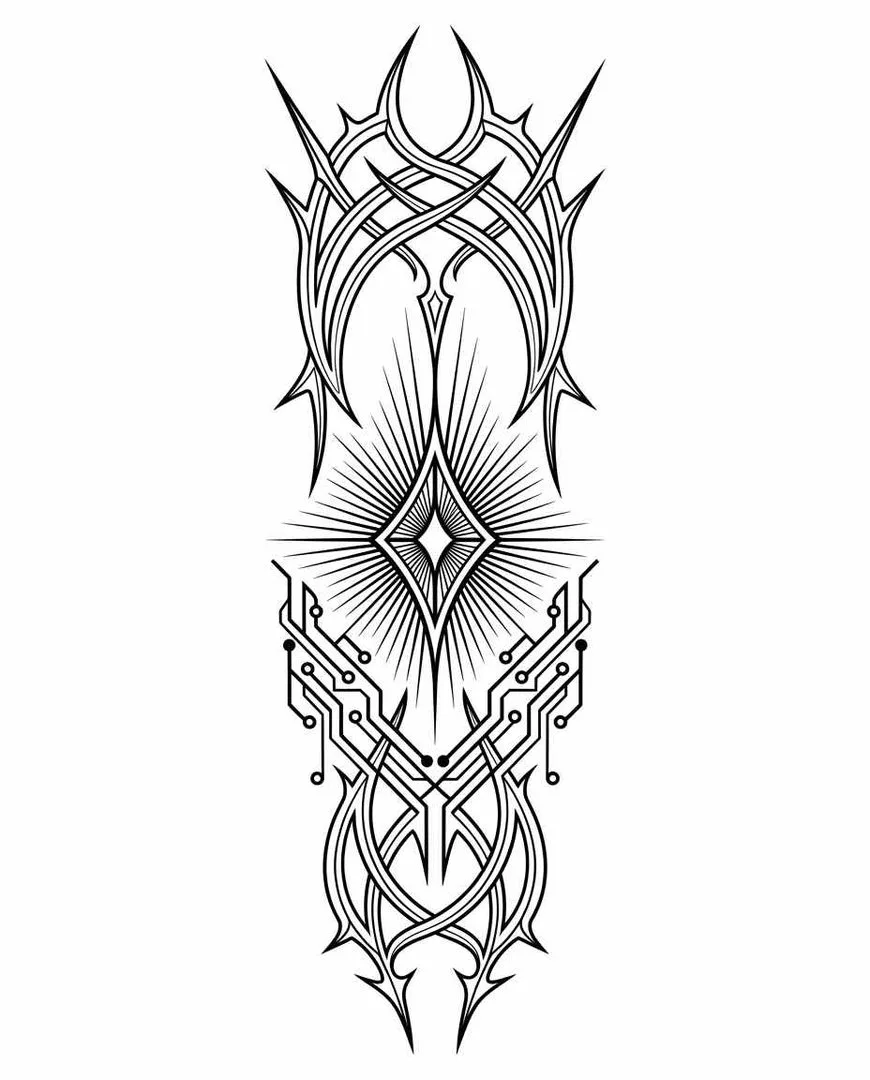
16. Forearm-to-hand flow
A continuous design that starts at the mid-forearm and flows unbroken onto the back of the hand and fingers. The transition from forearm to hand is seamless — no border, no break. The design treats the arm and hand as one surface.
17. Outer arm half-sleeve
A design covering only the outer surface of the arm from shoulder to elbow. The inner arm stays bare. This placement is visible when the arm hangs naturally but hidden when the arm is turned, creating a reveal-and-conceal dynamic.
18. Symmetrical double forearm
Matching but mirrored designs on both forearms — the left forearm is the mirror image of the right. When the forearms are placed side by side, the two designs connect into a single symmetrical composition.
19. Wrist cuff
A narrow cybersigilism design that wraps the wrist like a bracelet or cuff. 2–3cm wide. Delicate pointed terminals. The smallest and most concealable arm placement.
20. Shoulder cap extension
A design that wraps over the shoulder cap (deltoid), extending slightly onto the upper arm and upper back. The shoulder’s rounded surface creates a helmet-like or pauldron-like effect.
Cybersigilism hand tattoo designs
Hands are high-visibility, high-commitment placements. Cybersigilism’s fine line work suits the hand’s small, bony surface better than most tattoo styles. The bones, tendons and finger anatomy provide natural channels for the design to follow.
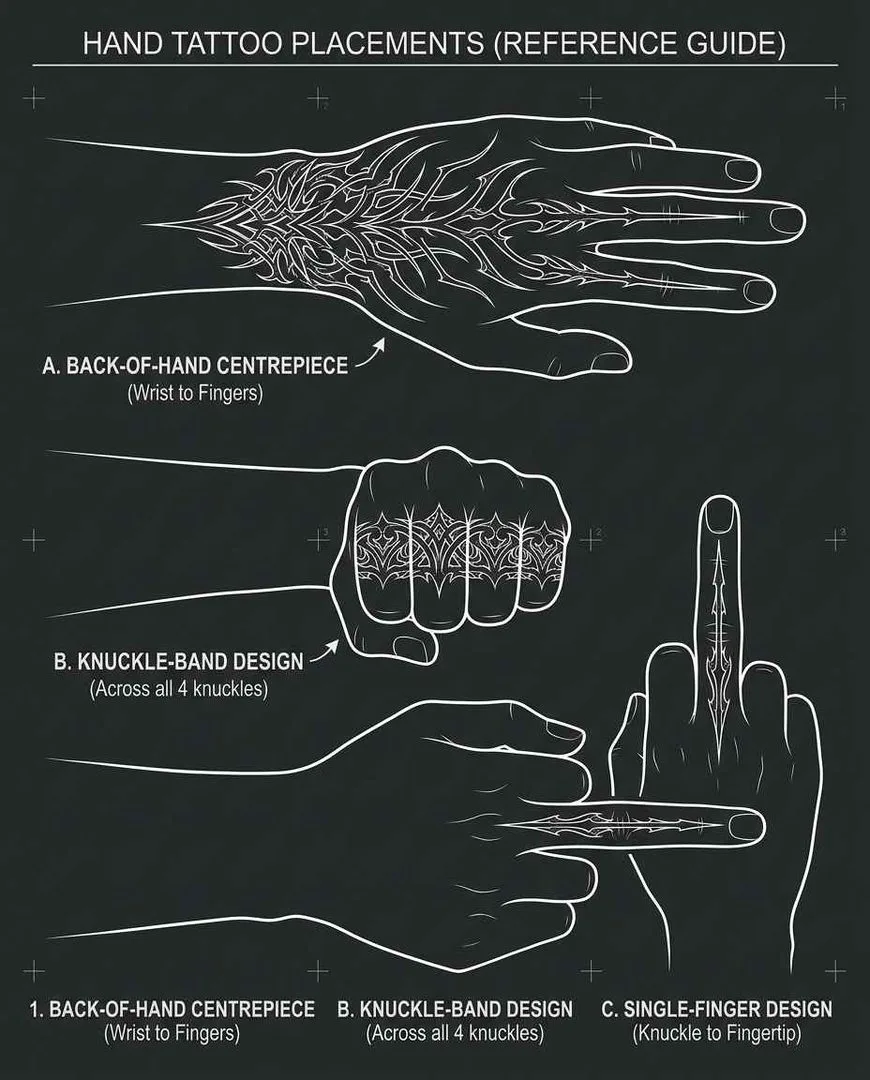
21. Back-of-hand centrepiece
A symmetrical design centred on the back of the hand, with the main sigil sitting between the knuckles and wrist and flowing extensions reaching onto two or three fingers. The hand’s tendons and bones create natural valleys for the lines to follow.
22. Finger-line extensions
Fine single lines running along the top of each finger from knuckle to tip, connecting to a larger sigil on the back of the hand. The finger lines are delicate — single strokes, no fill — and they make the hand look like a cybernetic implant.
23. Knuckle sigils
Four small, individual sigils — one on each finger’s middle phalanx (between the two knuckle creases). Each sigil is different but shares the cybersigilism vocabulary, creating a set that reads as a coded sequence.
24. Thumb web design
A small design in the web of skin between the thumb and index finger. The triangular space naturally frames a pointed cybersigilism element. One of the most subtle and concealable hand placements.
25. Wrist-to-finger flow
A design that starts at the wrist, flows across the back of the hand, and terminates on two fingers. The composition treats the hand as a continuation of the arm, not a separate canvas. Works as a standalone or as an extension of a forearm piece.
Cybersigilism chest tattoo designs
The chest offers a wide, relatively flat canvas with the sternum as a natural vertical axis. Cybersigilism chest pieces typically use the sternum as the spine of the design, with flowing elements radiating outward across the pectoral muscles.
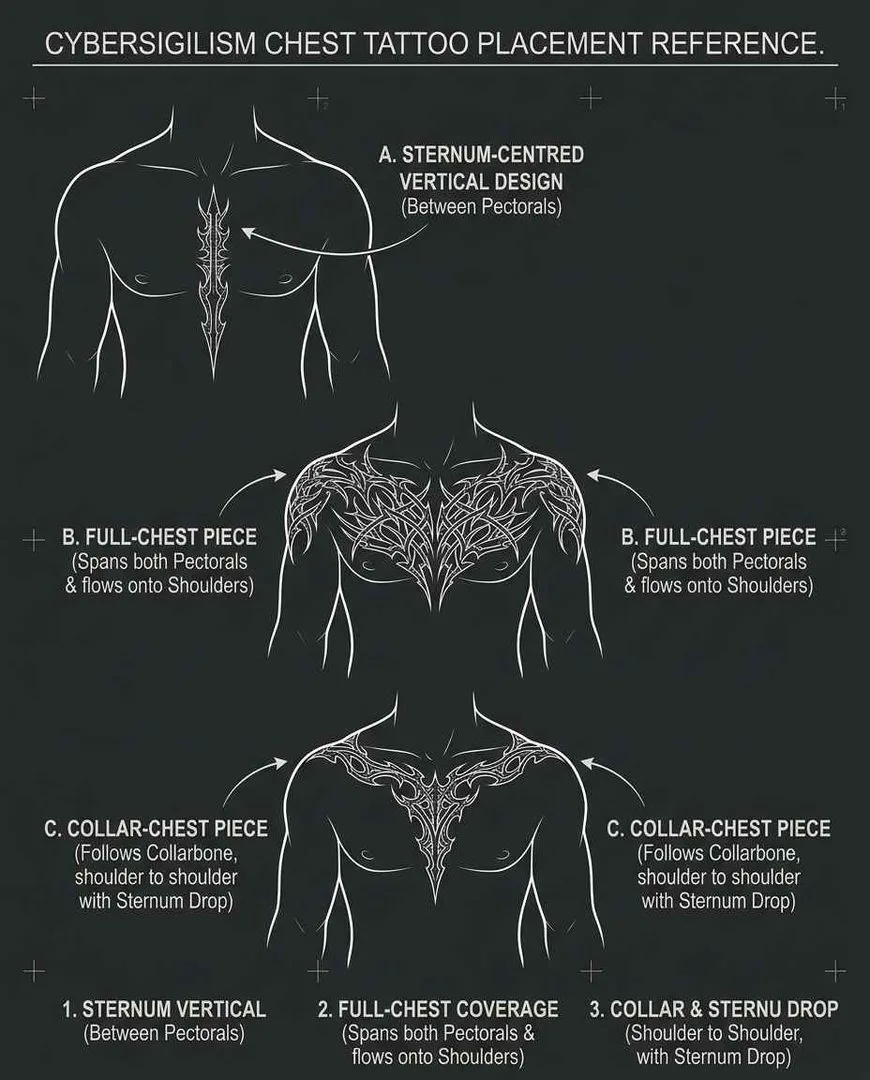
26. Sternum vertical sigil
A narrow, vertically oriented design running down the sternum from the collarbone notch to the solar plexus. The sternum’s natural ridge becomes the axis of symmetry. Flowing curves arc outward briefly before returning, staying within the narrow sternum corridor. This is the most popular female cybersigilism placement and one of the most visually striking minimal placements.
27. Full-chest canopy
A design spanning both pectoral muscles, using the sternum as the central axis and the collarbones as upper boundaries. Flowing curves reach toward the shoulders and terminate in thorn points at the deltoids. The full-chest piece is the front-body equivalent of the back cathedral.
28. Collarbone horizon
A horizontal design following the collarbone from shoulder to shoulder, with a central drop element at the sternum. The design sits at the neckline of a crew-neck shirt, visible when the collar shifts or in open-collar clothing. A sophisticated, concealable placement.
29. Under-pec curve
A design that follows the natural curve beneath the pectoral muscle, sitting in the crease where the chest meets the ribcage. The curved placement creates a crescent or arc composition that wraps with the body’s contour.
30. Chest-to-shoulder connection
A design that starts on one pectoral, crosses the shoulder, and extends onto the upper arm or upper back. The continuous flow across the shoulder joint is technically challenging for the tattoo artist but creates a seamless body-as-canvas effect.
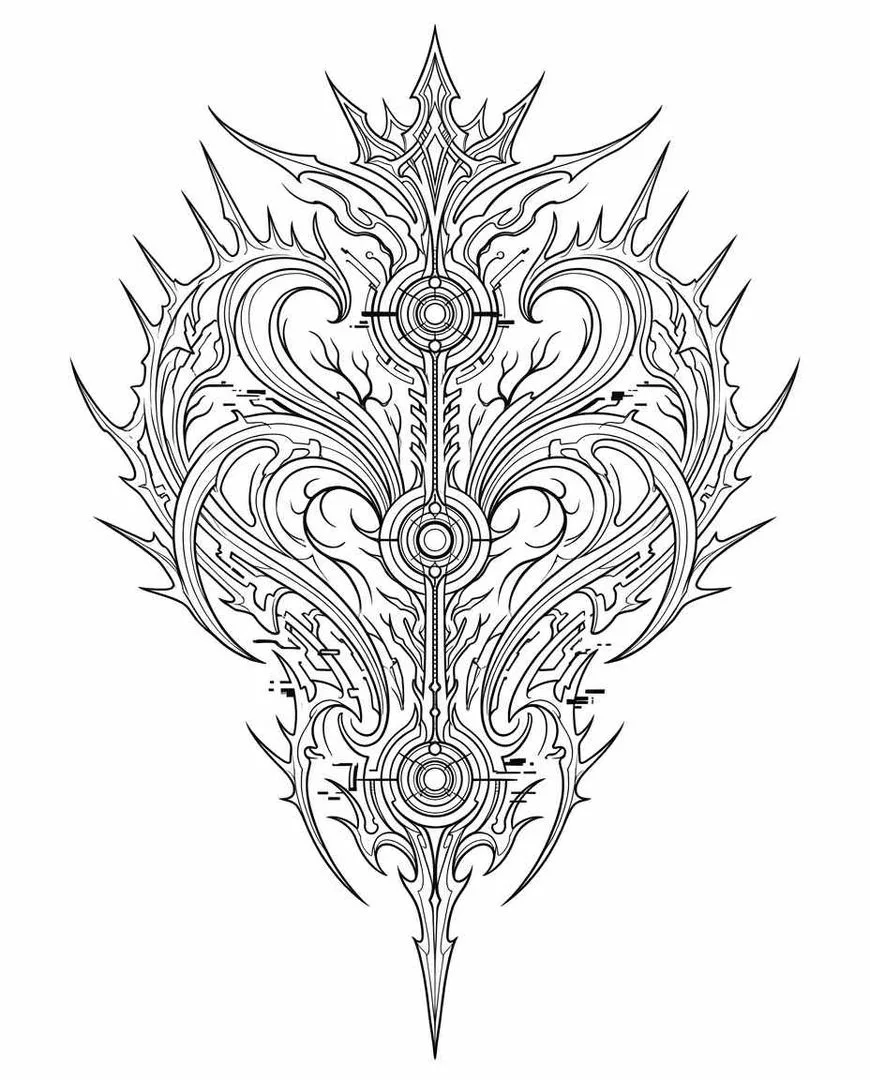
Cybersigilism spine and neck tattoo designs
The spine is the body’s natural axis of symmetry, which makes it the conceptually perfect placement for bilaterally symmetrical cybersigilism designs. The neck extends the spine’s vertical line into high-visibility territory.
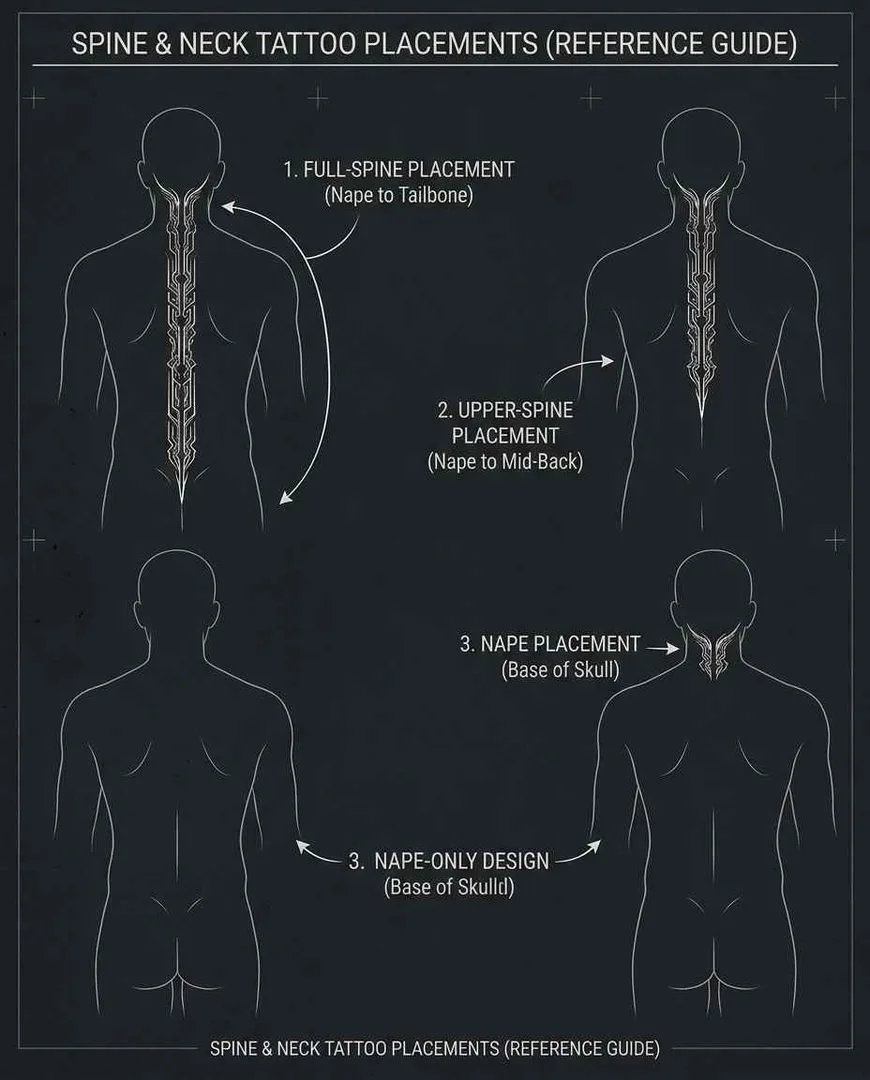
31. Full spine column
A continuous vertical design from the base of the skull to the tailbone. The design follows the spine’s natural curves (cervical, thoracic, lumbar), with geometric nodes at intervals marking each vertebral region. The longest possible single-axis cybersigilism piece.
32. Upper spine to nape
A concentrated design from the base of the skull to the mid-back (T6–T8 vertebra level). The nape section is visible above shirt collars, and the rest is concealed. The dual-visibility dynamic is part of the appeal.
33. Nape sigil
A single contained sigil at the nape of the neck, sitting in the space between the hairline and the collar. Small (8–12cm), symmetrical, and visible only with the hair up or from behind. A discreet, sophisticated placement.
34. Side-neck line
A single flowing cybersigilism line running down the side of the neck from behind the ear to the collarbone. The line follows the sternocleidomastoid muscle’s natural diagonal, creating a compositionally elegant single stroke.
35. Back-of-neck descending crown
A design at the base of the skull that descends onto the upper back, shaped like an inverted crown or a cascading sigil. The widest point is at the nape, narrowing as it descends. Visible when the hair is up, hidden when the hair is down.
Cybersigilism leg tattoo designs
36. Thigh panel
A large design on the front or outer thigh, using the flat quadriceps surface as a wide canvas. The thigh allows designs as large as a back piece, with the advantage of being easily concealed under standard clothing.
37. Shin vertical
A narrow vertical design running down the shin from knee to ankle. The tibia’s flat anterior surface provides a natural canvas for a linear sigil.
38. Calf flow
A design on the back of the calf, following the gastrocnemius muscle’s natural diamond shape. The calf’s curved surface adds dimensionality to flat designs.
39. Knee web
A radial design centred on the kneecap, with flowing lines extending onto the thigh above and shin below. The knee’s circular form becomes a focal node in the design.
40. Ankle band
A cybersigilism wrap around the ankle, 3–5cm wide, replacing a traditional ankle bracelet tattoo with flowing sharp-terminated curves. Delicate and architectural.
Small and minimal cybersigilism tattoo designs
Cybersigilism scales down surprisingly well. The style’s emphasis on clean line work means small designs retain clarity and impact. These are the entry-level placements for people who want the aesthetic without a large commitment.
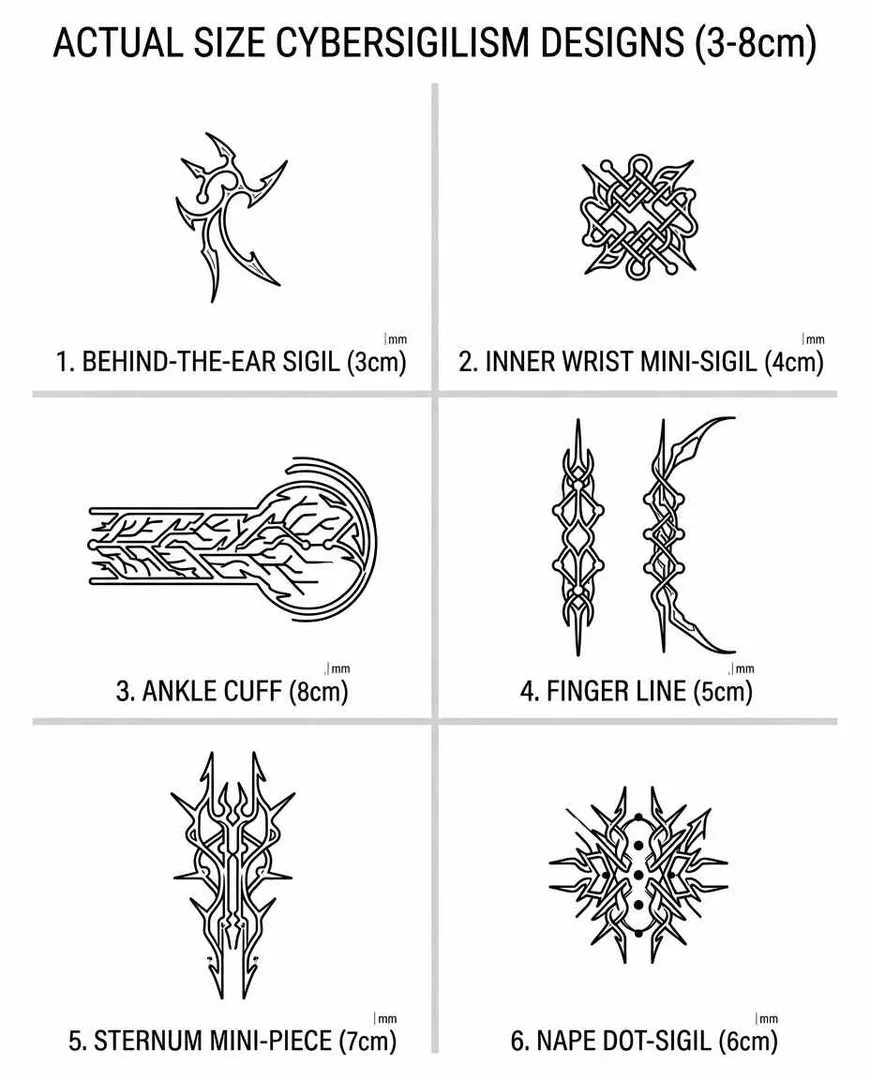
41. Behind-the-ear micro-sigil
A tiny symmetrical sigil (2–3cm) behind the ear. Visible only with hair up or from certain angles. The smallest possible cybersigilism tattoo that still reads as the style.
42. Inner wrist stamp
A small contained sigil on the inner wrist, 3–5cm. Visible in daily life, concealable with a watch or bracelet. The most common “first tattoo” placement for cybersigilism.
43. Finger spine line
A single fine line with geometric nodes running along the top of one finger from knuckle to tip. Minimal, architectural, and visible every time you look at your hand.
44. Collarbone point
A small design sitting on the collarbone, 4–6cm, like a brooch or pin rendered in ink. Visible in open-collar and off-shoulder clothing.
45. Rib single sigil
A vertical sigil on the ribcage, 8–12cm, following the line of one rib. A private placement visible only shirtless or in certain cuts of clothing.
Cybersigilism design variants and hybrid styles
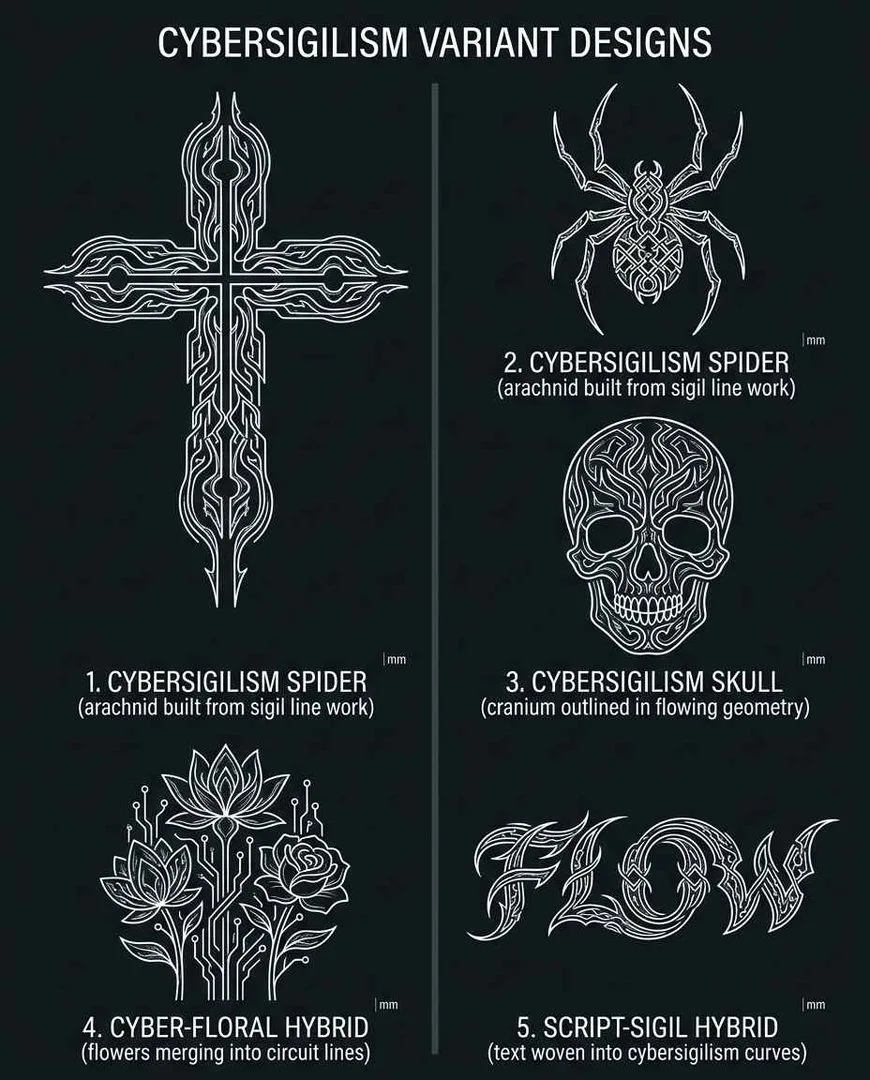
46. Cybersigilism cross
A cross form rendered entirely in cybersigilism vocabulary: the four arms of the cross are flowing curves with sharp terminals, the intersection is a geometric node, and the negative space between the arms is precisely defined. Religious iconography meets digital mysticism.
47. Cybersigilism spider
A spider form built from sigil line work: the body is a central geometric node, the eight legs are flowing curves with pointed terminals. The spider can be realistic in proportions or abstracted into near-unrecognisable geometry that reveals itself slowly.
48. Cyber-skull
A human skull rendered in cybersigilism lines: the cranium is a series of flowing arcs, the eye sockets are geometric voids, the jawline is a sharp angular construction. The skull is recognisable but transformed by the style into something post-human.
49. Cyber-floral hybrid
Flowers (roses, lotuses, chrysanthemums) with petals that transition into circuit-trace lines and thorns that become cybersigilism points. The organic-to-digital transition within a single botanical form.
50. Script-integrated sigil
Text (a word, a date, a name, coordinates) woven into a cybersigilism design so the letters are embedded within the flowing curves. The text is readable but camouflaged, requiring close inspection to identify.
51. Biomechanical cyber-fusion
Cybersigilism merged with biomechanical tattoo elements: the flowing lines transition into mechanical gears, pistons and structural components that appear to sit beneath the skin. The body-as-machine concept amplified by sigil aesthetics.
52. Cybersigilism-meets-Japanese
Flowing cybersigilism curves merging with Japanese irezumi elements: waves that become circuit traces, dragons whose scales transition into geometric nodes, wind bars that sharpen into cyber-thorns. A cultural hybrid that requires a skilled artist.
53. UV-reactive cyber-sigil
A standard black cybersigilism design with select elements inked in UV-reactive ink that glows under blacklight. The design transforms in club or festival lighting, revealing hidden elements invisible in daylight.
How to draw cybersigilism — the design process
You do not need to be a tattoo artist to design cybersigilism. The style’s vocabulary is learnable, and designing your own sigil — even if a professional tattoo artist refines it — makes the tattoo genuinely personal.
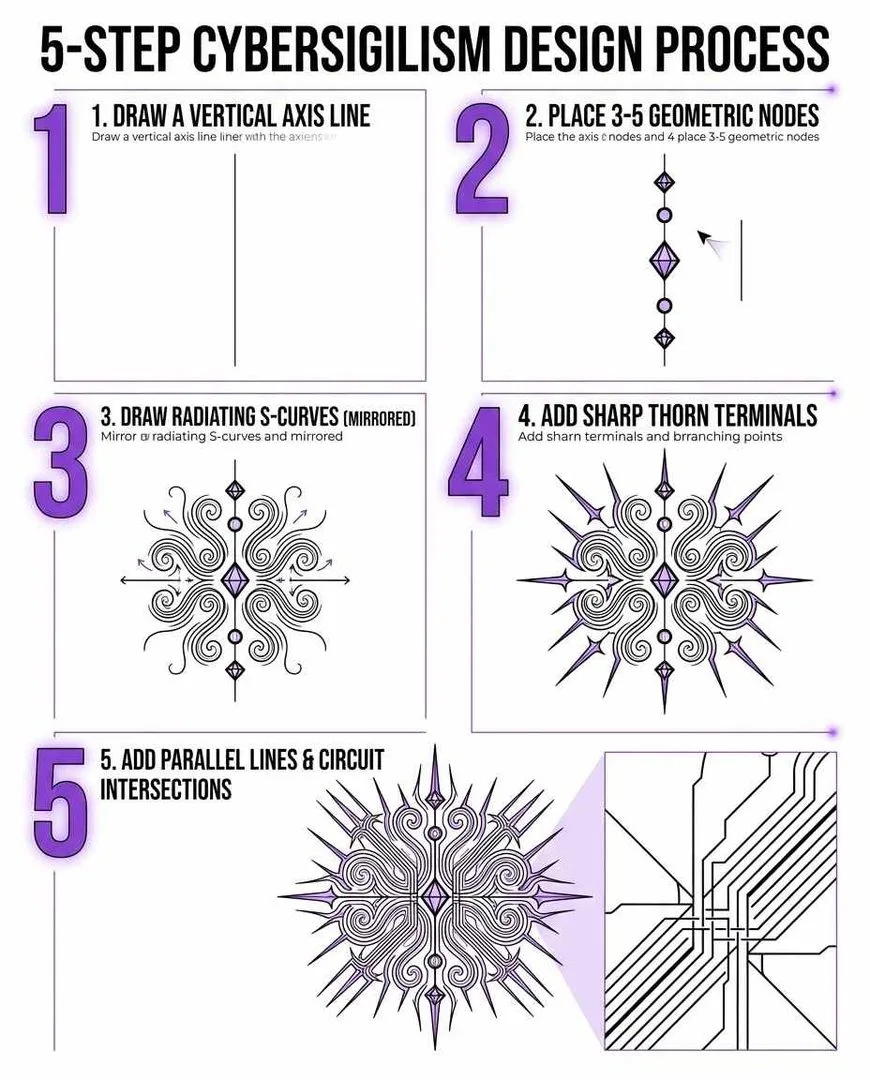
- Step 1: Draw the axis. A vertical line down the centre of your page. This is the spine of your design and the line of bilateral symmetry.
- Step 2: Place the nodes. Draw 3–5 geometric shapes (circles, diamonds, hexagons) along the axis at irregular intervals. These are the anchor points from which curves will radiate.
- Step 3: Draw the flowing curves. From each node, draw smooth S-curves that arc outward and then return toward the axis or terminate in space. Mirror every curve on both sides of the axis. Use a pencil and work lightly — the curves need adjustment.
- Step 4: Add sharp terminals. Every curve ends in a sharp point, a thorn, or a spike. The terminals should feel aggressive and precise, contrasting with the smooth flow of the curves.
- Step 5: Add complexity. Parallel lines alongside existing curves (negative-space channels). Circuit-trace right-angle junctions where lines cross. Smaller secondary curves branching from primary ones. Each pass adds density without losing readability.
- Step 6: Refine in digital. Scan or photograph your pencil sketch and refine in Procreate, Illustrator or any vector program. The clean, precise line work that defines cybersigilism is easiest to achieve digitally. This is also where you ensure perfect bilateral symmetry by designing one half and mirroring it.
For more design and drawing techniques, our things to draw when bored guide has 100 drawing ideas including the surreal and geometric styles that feed directly into cybersigilism design, and scary things to draw covers dark aesthetic drawing in depth.
Cybersigilism tattoo placement guide — men vs women
Cybersigilism is gender-neutral by design — the abstract geometric vocabulary does not carry gendered associations. However, placement trends differ:
Most popular placements for men
Full back, upper back, full sleeve, forearm gauntlet, chest canopy, hand. Men tend toward larger placements with higher coverage and more aggressive terminal points.
Most popular placements for women
Sternum, spine, nape, inner forearm, behind-the-ear, collarbone, ribcage. Women tend toward more contained, linear designs in high-contrast placements where the design reads as jewellery or ornamentation.
Both sets are generalisations. The style works on every body regardless of gender, and the best placement is always the one that fits the individual’s anatomy, lifestyle and visibility preference.
How to find a cybersigilism tattoo artist
- Search Instagram hashtags. #cybersigilism, #cybertribal, #neotribal and #darkartist are the primary tags. Look at healed photos, not just fresh ink.
- Check for clean line work in healed photos. Cybersigilism relies on precise, thin lines. If the artist’s healed work shows blown-out or wobbly lines, the style will not hold up over time.
- Look for custom work, not flash. The best cybersigilism tattoos are designed specifically for the wearer’s body. An artist who designs custom pieces for each client produces better results than one working from pre-drawn flash sheets.
- Ask about symmetry tools. Many cybersigilism artists design digitally using Procreate’s symmetry tool or Illustrator’s mirror function. This is not cheating — it is how the style achieves its defining precision.
- Notable cybersigilism artists to research. Brody Polinsky (@bfreetattoos), Gina Stancescu (@bloodyginatattoos), Manas (@blackmanastattoo), and Watsun Atkinsun are among the artists who defined and continue to evolve the style.
Cybersigilism tattoo: FAQ
What is a cybersigilism tattoo?
A cybersigilism tattoo is a design that combines neo-tribal flowing curves with sacred geometry, circuit-board-inspired line work and occult sigil aesthetics. The style is defined by bilateral symmetry, sharp pointed terminals, precise negative space and black-ink-only execution. It originated in underground digital art communities around 2020–2021 and is now one of the most-searched tattoo styles globally.
Why do some tattoo artists dislike cybersigilism?
Three common criticisms: 1) The thin, precise line work does not age well on all skin types — fine lines can blur and spread over 5–10 years, especially in high-movement areas like hands and fingers. 2) Many designs are generated digitally using symmetry tools rather than drawn freehand, which some traditional tattoo artists view as less artistically authentic. 3) The style’s popularity has led to oversaturation, with some clients requesting designs that are similar to existing work rather than commissioning original pieces. These are valid criticisms, but they apply to execution quality and trend dynamics, not to the style itself.
How much does a cybersigilism tattoo cost?
Small placements (behind ear, wrist, finger): $150–400. Medium placements (forearm, sternum, nape): $400–1,200. Large placements (full back, full sleeve, full chest): $1,500–5,000+. Pricing depends on the artist’s experience, the design’s complexity, the session length, and geographic location. Custom design fees are typically separate from the tattooing session.
Do cybersigilism tattoos age well?
The thicker lines and geometric elements age well. The very fine lines (single-needle work) can blur over 5–10 years, especially in high-movement areas like hands, fingers and inner arms. Choosing slightly thicker line work (3RL or 5RL needle groupings rather than 1RL), avoiding high-friction placements for the finest details, and protecting the tattoo from sun exposure all improve long-term clarity. Touch-ups at the 5–7 year mark are normal for fine-line styles.
Is cybersigilism cultural appropriation?
Cybersigilism draws visual influence from Polynesian and Maori tribal tattoo traditions, which has led to criticism from indigenous communities. The key distinction: cybersigilism is not replicating specific cultural symbols or patterns with specific cultural meanings — it is using the visual language of flowing blackwork curves in a new, explicitly digital-futuristic context. However, the influence is real and should be acknowledged. Responsible practitioners credit tribal traditions as a foundational influence without claiming cultural ownership of the forms.
Can I design my own cybersigilism tattoo?
Yes. The how-to-draw section in this article covers the full process: vertical axis, geometric nodes, flowing S-curves, sharp terminals, parallel-line channels and digital refinement. Design your own sigil and bring it to a tattoo artist for professional refinement. A tattoo artist experienced in the style can adjust the design for body placement, line weight and long-term aging while preserving your original concept.
What does a cybersigilism tattoo mean?
The meaning is personal. Unlike traditional tattoo iconography where each symbol has a fixed meaning, cybersigilism designs are intentionally abstract. Some wearers treat the design as a literal sigil — a symbol charged with personal intention. Others choose it purely for the visual aesthetic. The style’s visual language references technology, mysticism and organic growth, but the specific meaning is whatever the wearer decides it is.
The style that looks like a spell rendered in code
Cybersigilism sits at the intersection of everything the 2020s care about: digital culture, spiritual practice, body autonomy, dark aesthetics and the tension between organic and technological. Whether you get one as a small wrist sigil or a full-back cathedral piece, the design carries the visual weight of something that means more than it literally does. That ambiguity — the sense that it looks like it should be decoded even when there is nothing to decode — is the style’s enduring power.
For design inspiration beyond tattoos, things to draw when bored has 100 drawing ideas including surreal and geometric styles, scary things to draw covers dark aesthetic drawing, and things to do when bored is the master list for creative boredom-killing.