Things to Do When Bored: 4 Types of Boredom, 4 Different Fixes
You have almost certainly already tried a list for things to do when bored. You searched, you skimmed forty numbered ideas, you thought “not that, not that, definitely not that,” and you closed the tab still bored. Then you opened the app you were already bored of.
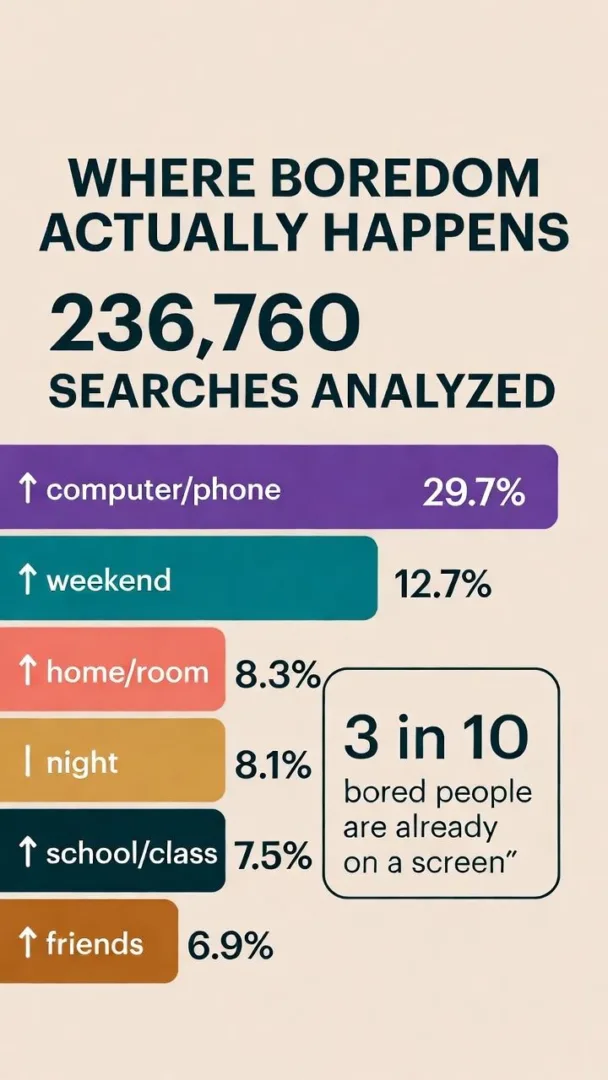
Here is why that keeps happening. Over the past six months we tracked 236,760 real searches from people trying to answer this exact question, and the pattern in them is not what the lists assume. The single biggest group of bored people — nearly three in ten — were already sitting at a screen when they searched. They were not short of stimulation. They were drowning in it.
Which means a list of “watch a new series, scroll Pinterest, download a game” isn’t a cure for those people. It’s a second helping of the thing that made them numb. Boredom has more than one cause, and the fixes for one cause actively make the others worse.

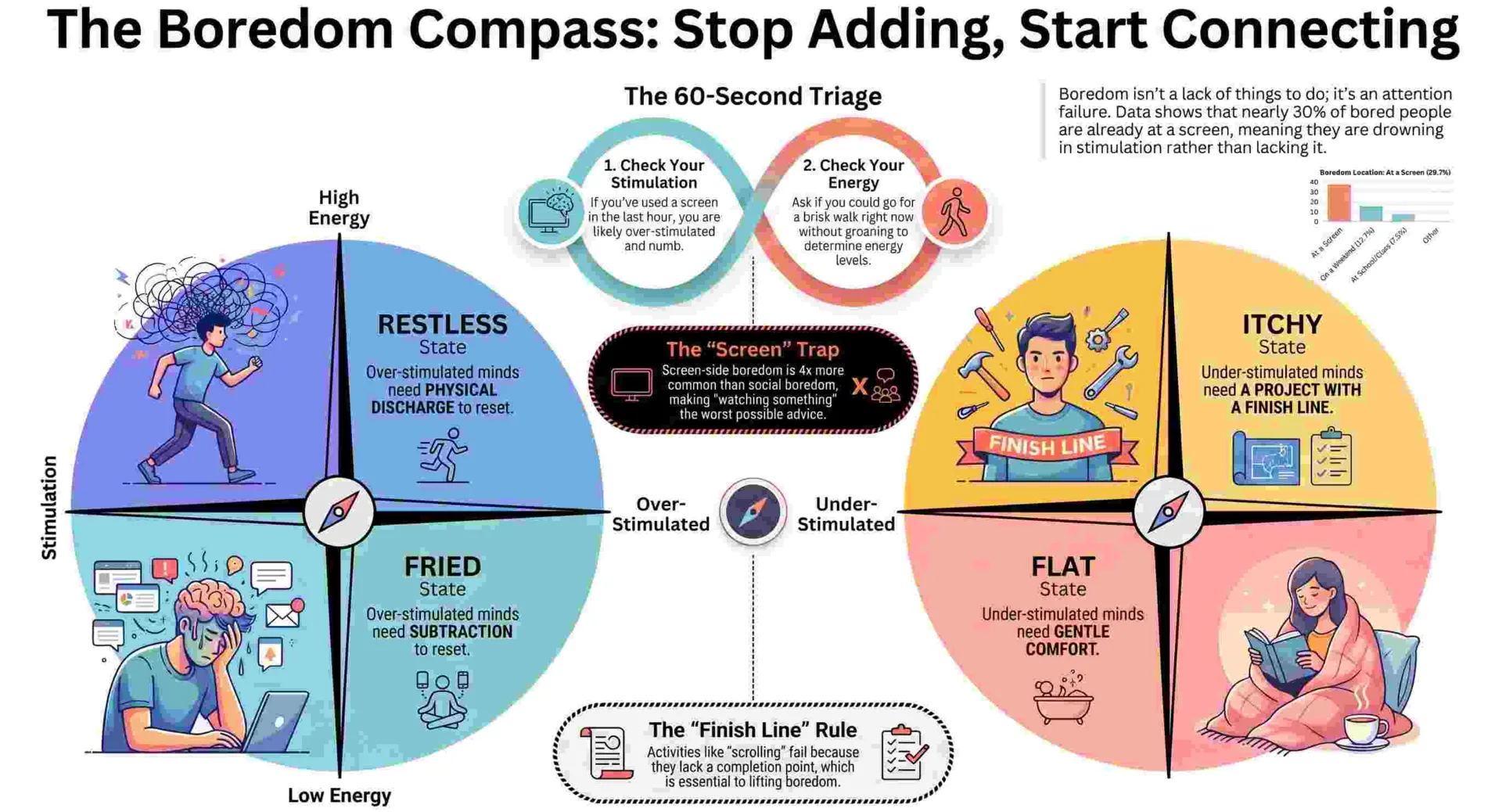
So this guide does something no list can do: it works out which kind of bored you are first, using two questions and about sixty seconds. Then it sends you to the exact fix — and, if you want more depth, to the one guide in our library written for your precise situation. We call it the Boredom Compass.
The Boredom Compass: why “what to do when bored” has four different answers
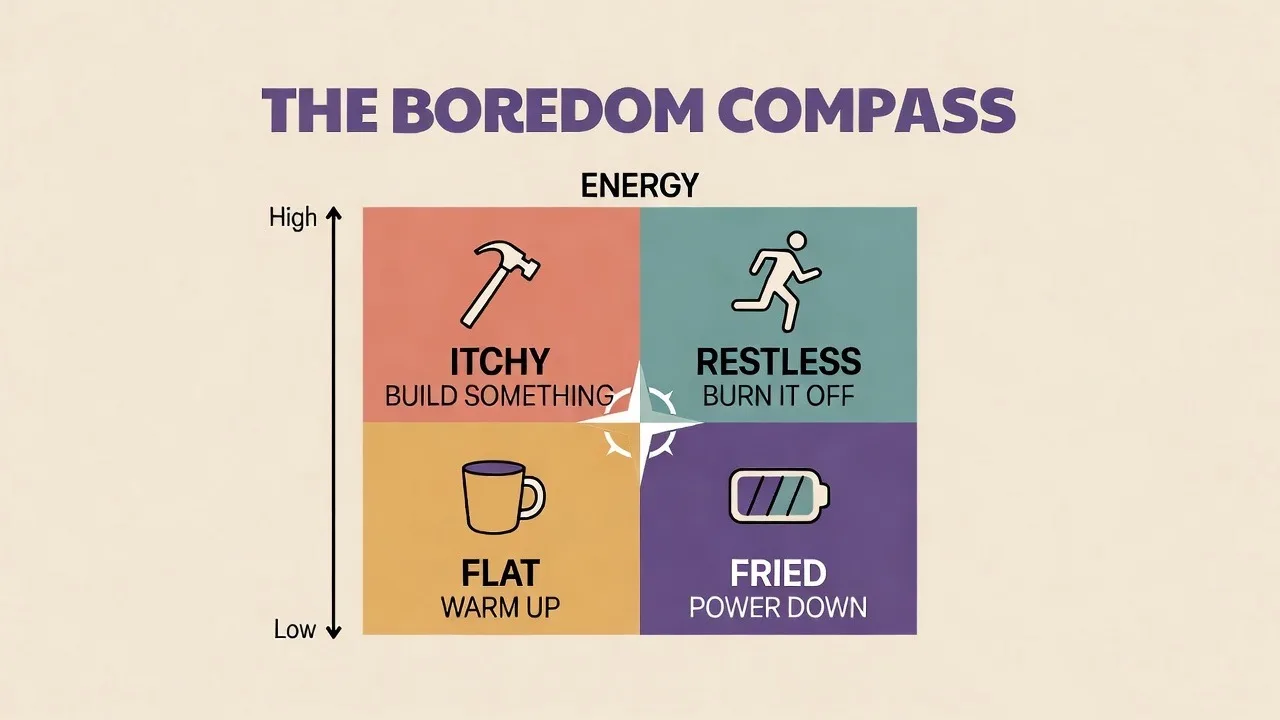
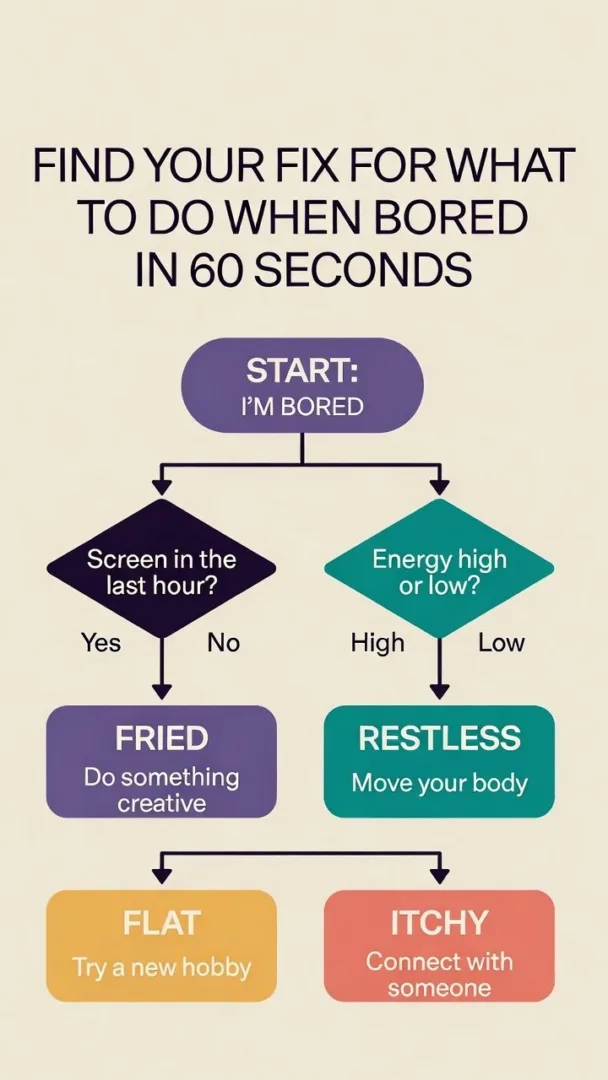
The Boredom Compass sorts boredom using two questions: is your brain over-stimulated or under-stimulated, and is your energy high or low? The four combinations are Fried, Restless, Flat, and Itchy — and each one needs a different fix. Matching the fix to the type is what makes boredom lift.
Every generic list treats boredom as one condition with one cure: add an activity. But boredom is not an absence of activities. You are surrounded by activities. Boredom is a failure to connect with any of them — and that failure has different causes on different days.
Ask yourself these two questions honestly. They take about ten seconds each.
1. Have I been on a screen in the last hour? — If yes, your brain is most likely over-stimulated — fed a lot of input, none of it satisfying. If you have been in a lecture, a waiting room, a long drive, or a quiet house, you are under-stimulated: not enough input to hold you.
2. Could I go for a brisk walk right now without groaning? — If yes, your energy is high. If the honest answer is “absolutely not, I want to lie down,” your energy is low. Do not answer how you wish you felt. Answer how you actually feel.
Cross the two answers and you land in one of four squares.
| Type | You feel | Because | What actually works |
|---|---|---|---|
| FRIED | Numb, twitchy, nothing appeals | Over-stimulated + low energy | Reduce input. Analog, slow, quiet. |
| RESTLESS | Agitated, can’t settle, pacing | Over-stimulated + high energy | Physical output. Move the body first. |
| FLAT | Heavy, grey, mildly sad | Under-stimulated + low energy | Gentle novelty. Warmth, comfort, one small new thing. |
| ITCHY | Impatient, capable, wasting time | Under-stimulated + high energy | A project with a finish line. |
Natty’s take: I spent years assuming my 9pm boredom and my Sunday-afternoon boredom were the same thing, and treating both with my phone. They are opposites. The 9pm one is Fried and needs less; the Sunday one is Itchy and needs a project. Once I stopped giving the same medicine to both, the evenings stopped disappearing.
What 236,760 boredom searches reveal about why you’re bored
Across 236,760 searches we tracked over six months, 29.7% of bored people were at a computer, laptop, or phone — more than four times the number who mentioned friends. Screen-side boredom is now the most common kind, which is why “watch something” is the most commonly wrong advice.
We run a library of boredom guides, so we see what people actually type when they are stuck. We sorted the thousand most common phrases by the situation they described. The result reorders everything the standard listicle assumes:
| Where the boredom happens | Share | What that tells us |
|---|---|---|
| At a computer, laptop or phone | 29.7% | The largest group by far — and already over-stimulated |
| On a weekend | 12.7% | Unstructured time, not lack of options |
| At home or in their room | 8.3% | Familiar space, nothing feels new |
| At night | 8.1% | Low energy, high screen exposure — mostly Fried |
| At school or in class | 7.5% | Under-stimulated and stuck in place |
| With or without friends | 6.9% | Social boredom is far rarer than assumed |
Thirteen of the thirty most common phrases mention a screen. Only two mention money. That gap matters, because it means the average bored person is not lacking options or funds — they are sitting inside an infinite options machine and feeling nothing. The problem is not supply. It is attention.
Type 1 — Fried: over-stimulated, low energy
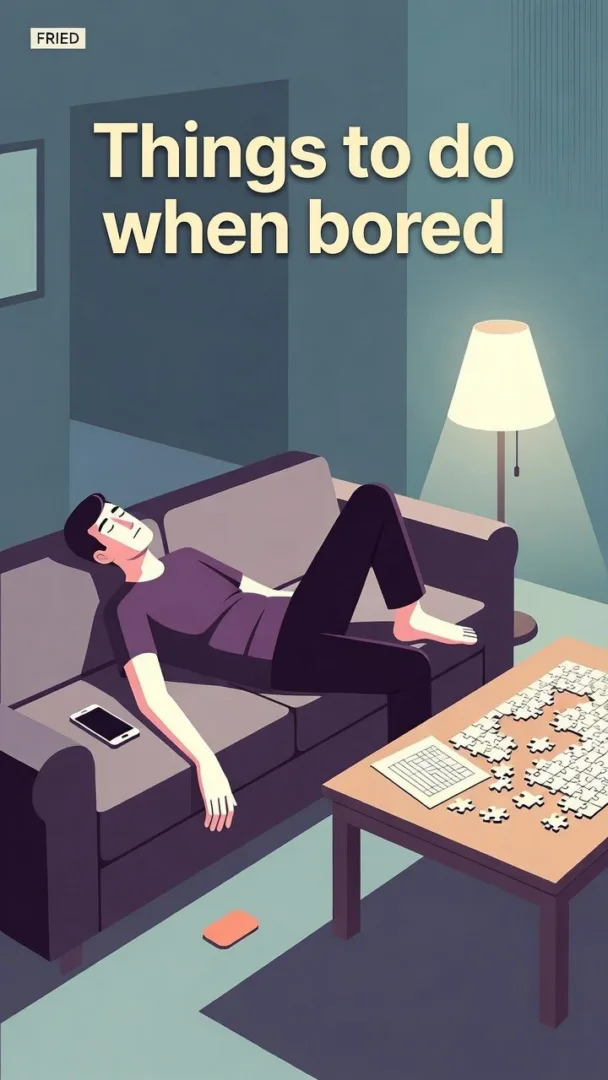
Fried is Boredom Compass boredom after too much input and too little rest: you are numb rather than restless, nothing appeals, and every app feels stale. The fix is subtraction, not addition. Reduce incoming stimulation for twenty minutes before you try to enjoy anything.
You know you are Fried when you have already checked the same three apps in a loop, you feel vaguely irritated, and the thought of starting anything is exhausting. This is the most common type in our data, and the one every list gets wrong — because their answer is another screen.
What actually works when you’re Fried
• Do something slow with your hands. Rearranging books by color, folding origami from old receipts, sorting a spice drawer, or practicing calligraphy asks almost nothing of your attention while giving it somewhere soft to land.
• Go analog on purpose. A paper crossword, a jigsaw puzzle, a physical magazine, or a Kindle in matte mode all remove the notification layer that keeps your attention fragmented.
• Change the light, not the content. Dim the room, open a window, step outside for four minutes. Fried boredom is often just a nervous system asking for a lower input volume.
• Do the boring maintenance task you’ve avoided. Ten minutes of tidying or meal prep gives you a completed loop, which is the exact thing infinite feeds never give you.
• Nap, properly. Twenty minutes, alarm set, phone in another room. Fried is the one type where doing nothing is a legitimate answer.
What backfires: opening Netflix, YouTube, TikTok, Reddit, or Twitch “just to see.” You are not under-entertained. Adding a fifth stream to a saturated system is why you have been bored for two hours instead of twenty minutes.
Go deeper: our guides on things to do instead of doomscrolling, the 30-day digital detox challenge, and how to build a dopamine menu are all built for this exact state.
Type 2 — Restless: over-stimulated, high energy
Restless is Boredom Compass boredom with fuel in the tank: you are agitated, can’t settle, and keep standing up for no reason. The fix is physical output before mental input. Move your body for ten minutes first — everything you try afterwards will hold your attention better.
Restless boredom is the one people mistake for laziness. You are not unmotivated. You have energy with nowhere to go, and a brain that has been over-fed information without any matching physical discharge. Sitting down with a new activity will not work until the energy is spent.
What actually works when you’re Restless
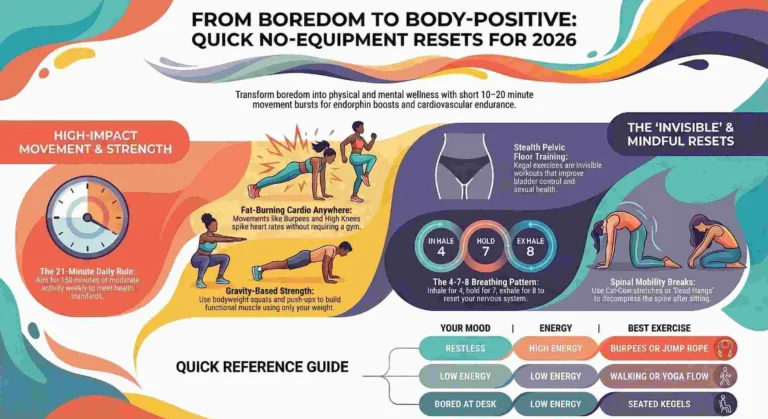
• Ten minutes of anything physical. A brisk walk, a bodyweight circuit, a seven-minute workout app, dancing badly to one loud song. The bar is deliberately low because the goal is discharge, not fitness.
• Clean something aggressively. Restless energy plus a messy room is a genuinely good trade. You get the discharge and a changed environment, which resets the staleness too.
• Learn a physical skill. Card shuffling, coin tricks, knots with a shoelace, juggling, swing dance or waltz steps from a video. Physical learning absorbs restless energy in a way passive watching never does.
• Go outside without a destination. Walk a route you have never taken. Novel physical space does double duty on both axes of the Compass at once.
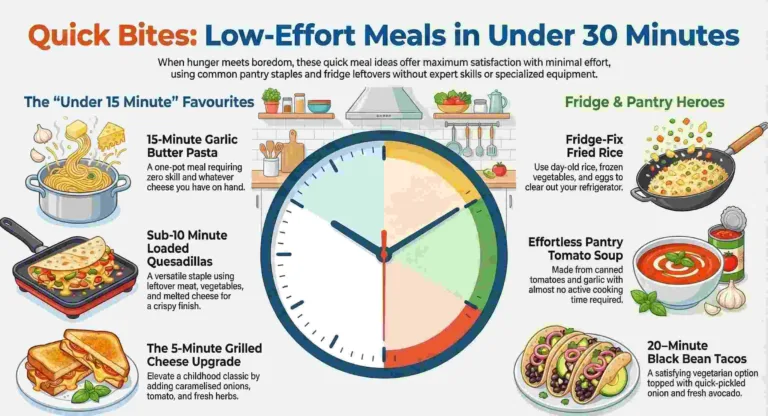
• Cook something that requires effort. Pizza dough you knead by hand, a batch of chocolate chip cookies, smoothie bags for the week. Standing, kneading, chopping — all output.
What backfires: sitting down to a film or a long series. You will fidget through it, absorb none of it, and finish more agitated than you started.
Go deeper: our guides on exercises to do when bored, things to do when bored at night, and things to do when bored on weekends fit this state best.
Type 3 — Flat: under-stimulated, low energy
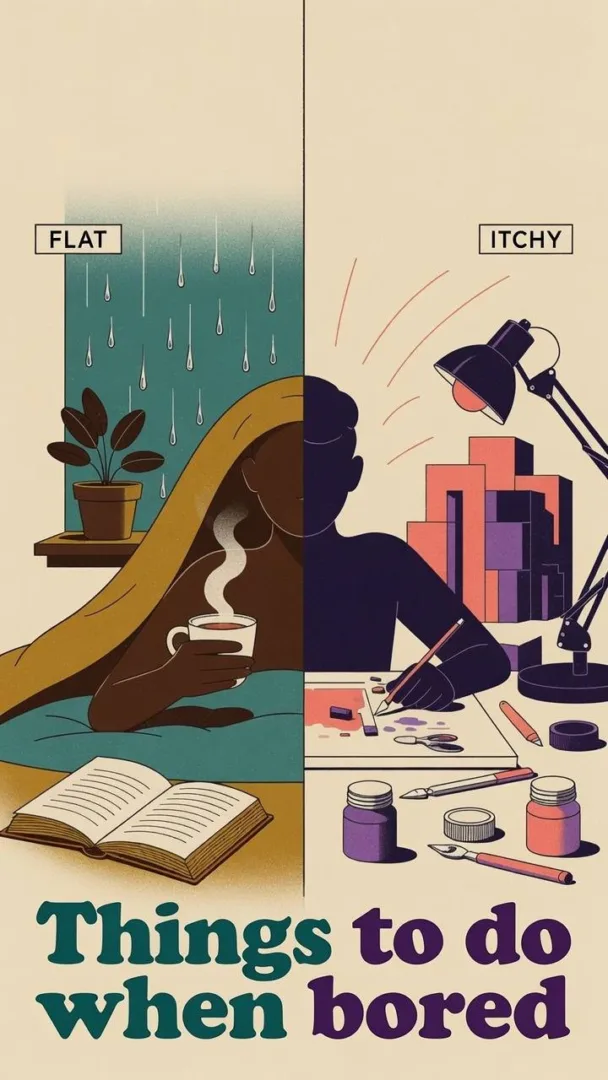
Flat is Boredom Compass boredom on an empty tank: grey, heavy, and slightly sad, with nothing coming in and nothing to give. The fix is gentle novelty — one small, warm, low-effort new thing. Do not attempt a project. Flat boredom collapses under ambition.
Flat is the quiet one. It shows up on rainy afternoons, in the days after something ends, in winter, and when you are recovering from being unwell. The mistake here is over-prescribing: telling a Flat person to start a side hustle guarantees they do nothing at all and feel worse for it.
What actually works when you’re Flat
• One small new input, comfortably delivered. A new album start to finish, one episode of a podcast you have never tried, a single chapter of a book from a genre you never read.
• Warmth first, activity second. Tea, a blanket, a hot shower, clean sheets. Flat boredom responds to physical comfort more than it responds to ideas.
• Tiny creative acts with no standard. Doodling on old receipts, sketching with charcoal, mixing random paint colors, drawing bad portraits of your pet, writing haikus about dust. The point is not the output.
• Comfort re-watching, chosen deliberately. There is a real difference between scrolling for ninety minutes and deciding to watch a Harry Potter film or Miss Americana. One is passive drift, the other is a choice — and choosing is the medicine.
• Rearrange one surface. A single shelf, a windowsill, one corner of a desk. Small environmental novelty for almost no energy.
What backfires: an ambitious to-do list, a 101-in-1001 challenge, or any advice that begins “why not learn a language.” You will fail at it today and add guilt to flatness.
One honest note: if flat, grey boredom has lasted for weeks rather than an afternoon, and food, sleep, or interest in things you normally love have changed with it, that is worth raising with a doctor. Persistent boredom and low mood overlap, and a professional is far better placed to help than any list of activities.
Go deeper: our guides on books to read when bored, things to do when bored on a rainy day, and things to do when feeling tired and bored are written for the Flat state.
Type 4 — Itchy: under-stimulated, high energy
Itchy is Boredom Compass boredom with capability going to waste: you have energy, you have time, and none of it is being used. The fix is a project with a visible finish line — something you can complete or measurably advance in one sitting.
Itchy is the most productive kind of boredom and the easiest to squander. It is the Sunday afternoon, the long holiday week, the empty evening when you are genuinely capable of something. Handed a screen, it evaporates. Handed a finish line, it turns into the thing you are proud of six months later.
What actually works when you’re Itchy
• Pick something with a defined end. Not “learn guitar.” Instead: learn the four chords of one song tonight. Not “get fit.” Instead: finish one workout. Completion is the whole mechanism.
• Build the thing you keep meaning to build. A mood board, a capsule wardrobe plan, a 101-in-1001 list, a scrapbook, a properly organized Google Drive, a playlist that actually flows.
• Learn a real skill in a structured way. Hand lettering, a Skillshare class, a Duolingo streak, Renaissance art history, chess openings. Structure is what turns itchy energy into competence.
• Start the side project. Write the first blog post, list three things for sale, sketch the business idea properly. Itchy boredom is the raw material most side hustles are made of.
• Make something with your hands and finish it. A DIY repair, a shelf, a paper airplane fleet, friendship bracelets, a repainted picture frame from Target. Finish it today — unfinished projects feed future boredom.
What backfires: “Researching” the project instead of starting it. Forty minutes of comparing tutorials on YouTube is how Itchy quietly becomes Fried.
Go deeper: our guides on things to do when bored on the computer, things to cook when bored, and home decor ideas to explore when bored suit an Itchy afternoon.
The 60-second boredom triage (if you only read one section)
Answer two questions. Screen in the last hour? Yes means over-stimulated, no means under-stimulated. Could you walk briskly right now? Yes means high energy, no means low. Over-stimulated plus low is Fried, plus high is Restless. Under-stimulated plus low is Flat, plus high is Itchy.
| Screen in last hour? | Energy right now | Your type and your first move |
|---|---|---|
| Yes | Low | FRIED — put the screen down, do something slow with your hands for 20 minutes |
| Yes | High | RESTLESS — move your body for 10 minutes before you choose anything else |
| No | Low | FLAT — get warm and comfortable, then add one small new input |
| No | High | ITCHY — start a project you can visibly finish today |
If you are genuinely between two squares, choose the lower-energy one. It is far easier to escalate from a gentle fix into a bigger one than to abandon an ambitious plan and feel worse.
Why do we get bored? The attention answer
Psychologists now define boredom as an attention problem rather than an activity shortage — the uncomfortable state of wanting to engage with something and being unable to. That is why adding more options rarely helps: the bottleneck is your ability to attend, not your supply of things to do.
This is the part the listicles skip, and it is the part that makes everything above make sense. In a landmark 2012 paper in Perspectives on Psychological Science, psychologist John Eastwood and colleagues at York University argued that boredom is best understood through attention: it is the aversive experience of wanting, but being unable, to engage with something satisfying.
Read that definition again, because it reframes your evening. You are not bored because there is nothing to do — you have Netflix, Amazon, YouTube, Spotify, a Kindle, a library card, and a whole city outside. You are bored because your attention will not attach to any of it. And attention behaves very differently when it is saturated than when it is starved, which is exactly the axis the Compass splits on.
Related research supports the split. Work by cognitive neuroscientist James Danckert at the University of Waterloo has found that people highly prone to boredom perform worse on tasks demanding sustained attention, and that boredom and low mood, while strongly related, are distinct states. The American Psychological Association has a readable overview of this body of work in its feature on the science of boredom if you want the full picture.
There is an upside worth knowing. Boredom has been repeatedly linked with a rise in creative, divergent thinking — the mind wanders, and wandering is where unusual ideas come from. Which means the goal is not to eliminate boredom on sight. It is to stop drowning it in stimulation long enough for it to turn into something.
Find your exact situation: the full boredom library
Once you know your Boredom Compass type, the fastest next step is a guide written for your precise situation. Below, every situation-specific guide we publish is grouped by where you are, when it is, who you are, who you’re with, how you feel, and what you have to hand.
The Compass tells you what kind of activity will work. This section tells you where to find the ideas. Pick the line that matches your afternoon.
Where you are
• At home · In your room · At work · Working from home
• At school · In class · In a waiting room · In a car · On a plane
When it is
• At night · On weekends · During a holiday
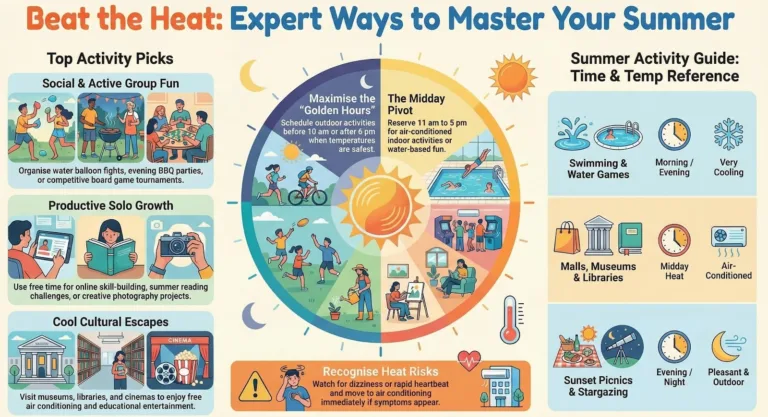
• In summer · In fall · In winter · In spring
• On a rainy day · On a snow day
Who you are
• Adults · Teens · Kids · College students
• Stay-at-home parents · After retirement
Who you’re with
• Alone · By yourself and productive · Bored and lonely
• With friends · At a friend’s house · At a sleepover
How you feel
• Anxious · Low and bored · Tired · Sick
• With ADHD · Narcoleptic and bored · After a breakup
What you’ve got to hand
• A computer · Just your phone · No money · A kitchen
• A book habit to build · Energy to burn · A room to change · A self-care evening
• Something to design · A rabbit hole to fall down · Just fun, nothing deeper
If your problem is really the screen
• Things to do instead of doomscrolling · The 30-day digital detox challenge · How to build a dopamine menu
What not to do when you’re bored
The five habits that reliably extend boredom are: opening another app, researching instead of starting, choosing an activity that doesn’t match your Boredom Compass type, waiting to feel motivated first, and picking something with no visible finish line.
1. Don’t open another app — The average bored person in our data is already on a device. A fifth feed is not a new experience — it is the same experience at a lower resolution.
2. Don’t research the activity instead of doing it — Comparing tutorials, reading reviews, and building the perfect playlist first are all boredom wearing a productivity costume. Start badly instead.
3. Don’t fight your type — Trying to start a project while Fried, or trying to sit still while Restless, fails every time and then you conclude you are lazy. You were not lazy. You picked the wrong square.
4. Don’t wait to feel motivated — Motivation follows action here, not the other way around. Two minutes of the activity generates more willingness than an hour of deciding.
5. Don’t pick something with no ending — “Browse,” “scroll,” “watch something” have no finish line, so they never deliver the small completion that actually lifts boredom. Choose things that end.
Natty’s take: With four kids in the house I get asked “what can I do” roughly nine times a day, and I stopped answering with ideas years ago. Now I ask the two Compass questions back. Nine times out of ten they answer their own question halfway through the second one — because naming the feeling is most of the fix.
Frequently asked questions
What should I do when I’m bored right now?
Run the 60-second triage. If you’ve been on a screen in the last hour and feel low, you’re Fried — do something slow with your hands, away from the device. If you’ve been on a screen and feel restless, move your body for ten minutes first. If you haven’t been on a screen, add gentle novelty when your energy is low, or start a finishable project when it’s high.
What are good things to do when bored at home?
It depends which type of bored you are at home. Fried at home means analog and slow — puzzles, tidying, cooking. Itchy at home means a project you can finish today — rearranging a room, a DIY repair, a mood board. Our guide on things to do when bored at home breaks it down room by room.
What can I do when I’m bored and have no money?
Almost every fix on the Boredom Compass is free. Walking, tidying, cooking with what’s in the cupboard, library books, drawing, learning card tricks, and rearranging a room cost nothing. Boredom is very rarely a budget problem — in our search data, only two of the thirty most common phrases mention money at all.
Why am I bored even though I have loads to do?
Because boredom is an attention problem, not a supply problem. Psychologists define it as wanting to engage with something and being unable to. When you’re over-stimulated, your attention won’t attach to anything — including a long to-do list. Reduce input first, then the same options start to feel possible again.
What are productive things to do when bored?
Productive fixes work best when you’re Itchy — under-stimulated with energy to spare. Learn one song, finish one workout, write one post, organize one drive, plan a capsule wardrobe, start a side project. The rule is that it must have a finish line you can reach in a single sitting.
What should I do when bored at night?
Night boredom is usually Fried: low energy after hours of screen exposure. Reach for low-light, low-input activities — reading, stretching, a paper puzzle, a shower, prepping tomorrow. Avoid starting a new series, which reliably turns twenty minutes of boredom into two hours.
Is being bored actually bad for you?
Not inherently. Boredom is linked with increases in creative and divergent thinking — the mind wanders, and wandering produces unusual ideas. The problem is chronic boredom, or drowning boredom in stimulation so it never gets the chance to become anything. Short bouts are useful; permanent numbness is worth addressing.
What’s the difference between being bored and being depressed?
They’re strongly related but research treats them as distinct states. Boredom is situational and lifts when engagement returns. If low, flat feelings persist for weeks, and sleep, appetite, or interest in things you normally enjoy have changed too, that’s worth discussing with a doctor rather than solving with an activity list.
What can I do when bored with friends?
Social boredom is rarer than people assume — only 6.9% of the searches we analyzed involved friends. When it happens, it’s usually Restless: a group with energy and no plan. Move first, decide second. Our guides on things to do when bored with friends and at a friend’s house have the specifics.
Start here
Run the two questions. Name your square. Then pick one thing from that square and do it badly for two minutes — that is genuinely the whole method. Boredom is not a character flaw or a shortage of ideas. It is your attention telling you it has had either too much or too little, and now you know which.
If you want to go deeper, start with our guide on fun things to do when bored, or browse the whole Things To Do library. If you’d rather build something lasting out of it, our Hobbies hub turns a bored afternoon into something you keep.
About the author. Natty O Lewis is a wellness coach, mother of four, and the founder of BoredomWizard.com, where she has spent the last year writing and testing more than fifty guides to beating boredom. She writes in plain, practical English — usually while at least one child asks her what there is to do.